Google is improving its green credentials by offering all of its employees a free bike to ride to work.The whole article is in The Guardian.
The bikes, manufactured by Raleigh Europe, will be offered to around 2,000 permanent employees of the search engine giant in Europe, the Middle East and Africa. All of the bikes - plus free helmets - will be branded with the Google name.
Holger Meyer, Germany's first Google employee, came up with the idea and staff will be able to choose from a range of models including a "cool cruiser" - a folding bike for those that only make part of their trip to work under pedal power - and men's and women's hybrids.
Sunday, March 25, 2007
Google Bikes
Wow, this is a nice benefit. Getting feelthy steenking rich is a good one too. I wonder why they aren't doing it in California? Poor climate?


Friday, March 23, 2007
Burma-Shave
Minneapolis is doing a Share the Road day or something like that next month. During my first meeting as a member of the Saint Paul Bicycle Advisory Board in early March it was suggested that Saint Paul should do something in coordination with Minneapolis for this day. One idea that was floated was to do a series of Burma Shave-like ads for the sides of the roads that day.
If you're not familiar with Burma Shave signs, they were an advertising campaign by a shaving cream maker involved bits of doggerel on signs along the highways and always ending in Burma Shave. Each line of the little poem would be on a separate sign spaced a few seconds apart with the last one reading Burma-Shave. These started off in 1925 and the last new ones were posted in 1963 which means that they overlap my life though I don't actually recall seeing any.
Here are a couple of examples:
Dealing with the product:
His cheek was rough
His chick vamoosed
Now she won't
Come home to roost
Burma-Shave
A whiskery kiss
For the one you adore
May not make her mad
But her face will be sore
Burma-Shave
And with driving safely, which many did. It's hard now to remember how narrow the roads were and how bad the tires, brakes and even windshield wipers were in those cars, which of course had no seatbelts or airbags:
A guy
who drives
his car wide open
Isn't thinking
He's just hopin'
Burma-Shave
As you can tell, these aren't as rigidly defined a style as haiku or limericks.
Anyway, the challenge is to write some of these that will end with Share the Road rather than Burma Shave. Here are some of my attempts:
On my bike
I may look dorky
but because I ride
I'm not porky!
Share the Road
Diabetes, strokes,
cardiac disease
riding your bicycle
can help avoid these
Share the Road
Driving to
Your Spinning Class?
Ride your bike
and save the gas! (alternatively, you lazy ass!)
Share the Road
Your auto weighs four thousand pounds
My bicycle weighs thirty
If you hit me when you drive
Your grille will get all dirty
Share the Road
On my bike
I work and toil
to Support the Troops:
I burn no oil!
Share the Road
Some would be for cyclists:
If you ride
your bike at night
Get a Clue
Turn on a light!
Share the Road
One of the other BAB members has written some as well. Sadly, I don't have them with me, but one I liked went something like:
The cell phone is
A wonderful invention
Perhaps you could hang up
And call me an ambulance
Share The Road
which I like because it doesn't even attempt to rhyme.
There's more time for ideas! Leave them in the Comments below so all can see! And Share the Road!
If you're not familiar with Burma Shave signs, they were an advertising campaign by a shaving cream maker involved bits of doggerel on signs along the highways and always ending in Burma Shave. Each line of the little poem would be on a separate sign spaced a few seconds apart with the last one reading Burma-Shave. These started off in 1925 and the last new ones were posted in 1963 which means that they overlap my life though I don't actually recall seeing any.
Here are a couple of examples:
Dealing with the product:
His cheek was rough
His chick vamoosed
Now she won't
Come home to roost
Burma-Shave
A whiskery kiss
For the one you adore
May not make her mad
But her face will be sore
Burma-Shave
And with driving safely, which many did. It's hard now to remember how narrow the roads were and how bad the tires, brakes and even windshield wipers were in those cars, which of course had no seatbelts or airbags:
A guy
who drives
his car wide open
Isn't thinking
He's just hopin'
Burma-Shave
As you can tell, these aren't as rigidly defined a style as haiku or limericks.
Anyway, the challenge is to write some of these that will end with Share the Road rather than Burma Shave. Here are some of my attempts:
On my bike
I may look dorky
but because I ride
I'm not porky!
Share the Road
Diabetes, strokes,
cardiac disease
riding your bicycle
can help avoid these
Share the Road
Driving to
Your Spinning Class?
Ride your bike
and save the gas! (alternatively, you lazy ass!)
Share the Road
Your auto weighs four thousand pounds
My bicycle weighs thirty
If you hit me when you drive
Your grille will get all dirty
Share the Road
On my bike
I work and toil
to Support the Troops:
I burn no oil!
Share the Road
Some would be for cyclists:
If you ride
your bike at night
Get a Clue
Turn on a light!
Share the Road
One of the other BAB members has written some as well. Sadly, I don't have them with me, but one I liked went something like:
The cell phone is
A wonderful invention
Perhaps you could hang up
And call me an ambulance
Share The Road
which I like because it doesn't even attempt to rhyme.
There's more time for ideas! Leave them in the Comments below so all can see! And Share the Road!
Monday, March 12, 2007
Some Bike Porn
The North American Handmade Bicycle Show was in San Jose the weekend before last, and Cycling News has posted a heap o' photos. You can see them here. There were a lot of utility bicycles this year, and there's a Gallery of Handmade Townies posted. The photographer does a good job but doesn't recognize some items, like the Stokemonkey or Tubus Cosmo. I did note that Vanilla Bicycles, which I've regarded as what I'd order if I won the lottery, now have a four-year wait. Holey smokes! Ahearne Cycles was there with one of their very nifty cargo racks with a slot to carry your U-lock though I think of them more as the cool flask cage maker. ANT from Boston was there; the Boston Roadster I think looks like a great utility bike. They also had a Rohloff-hubbed frame which would be deeply appealing though very expensive.
I don't know, though, my suddenly very modest-seeming Atlantis is expensive enough that I typically won't ride it somewhere where I have to park it outside for a couple of hours (like to a movie); I don't know what these bikes are running, but I'd be really nervous about a $5K or $8K or $10K bike to pop down to Rainbow for some milk. Still, they look fabulous and it's fun to see something other than just another (yawn) racing bike.
In other news, I stripped down my Schwinn today, starting preparations to get the frame painted. It needed some work when I got it, but new wheels (internal hub gears, dynamo hub), pedals, seat and handlebars looked after much of it. One thing I never looked at was the bottom bracket. After I got the crank arms off, I tried turning the bb axle and it is so tight and rough I can't turn it with my fingers! Yikes! I've never felt a bottom bracket so wretched. Think of all the newfound speed I'll have when I get it all put back together properly!
Finally, in the Tale of the Knickers, the lady around the corner couldn't handle buttonholes but there is a tailor in the strip mall nearby and he's going to do my conversion of a pair of summer weight black wool dress trousers to knickers for about $40. My legs will be 3 inches longer than the Bicycle Fixation knickers. I even got to choose the color of satin for my gusset (I went with blue, to match the frame color I'm likely to get). I also admired the achingly beautiful fabric samples for custom suits, which start at $1,300. I didn't tell him my trousers were $20 from Sierra Trading Post. Can't afford a custom bike, I can at least get handmade knickers. Anyway, these things'll be done next Tuesday. I'll let you know how it goes.
I don't know, though, my suddenly very modest-seeming Atlantis is expensive enough that I typically won't ride it somewhere where I have to park it outside for a couple of hours (like to a movie); I don't know what these bikes are running, but I'd be really nervous about a $5K or $8K or $10K bike to pop down to Rainbow for some milk. Still, they look fabulous and it's fun to see something other than just another (yawn) racing bike.
In other news, I stripped down my Schwinn today, starting preparations to get the frame painted. It needed some work when I got it, but new wheels (internal hub gears, dynamo hub), pedals, seat and handlebars looked after much of it. One thing I never looked at was the bottom bracket. After I got the crank arms off, I tried turning the bb axle and it is so tight and rough I can't turn it with my fingers! Yikes! I've never felt a bottom bracket so wretched. Think of all the newfound speed I'll have when I get it all put back together properly!
Finally, in the Tale of the Knickers, the lady around the corner couldn't handle buttonholes but there is a tailor in the strip mall nearby and he's going to do my conversion of a pair of summer weight black wool dress trousers to knickers for about $40. My legs will be 3 inches longer than the Bicycle Fixation knickers. I even got to choose the color of satin for my gusset (I went with blue, to match the frame color I'm likely to get). I also admired the achingly beautiful fabric samples for custom suits, which start at $1,300. I didn't tell him my trousers were $20 from Sierra Trading Post. Can't afford a custom bike, I can at least get handmade knickers. Anyway, these things'll be done next Tuesday. I'll let you know how it goes.
Sunday, March 11, 2007
Zwei Drei Geschwindigkeiten
According to Babelfish, that means Two Three Speeds.
If you're not into old bikes at all, this entry is going to be even duller than usual. If you have a passing interest, these bikes might be of interest. These bikes are a slightly different tack than the usual English three-speed bicycles. These are German three-speeds. They're called Rabeneicks, I'm guessing they're from 1958 or so (based on Sturmey Archer hub vintages), and they're down at One on One Bicycle Studio in Minneapolis (yes, that's Ein auf Einem).
The back story? I guess the original owner was in the U.S. Army in Germany in the 1950s, bought these there, and brought them home. It is thought that they weren't ridden much once back in the U.S. I am not an expert on this stuff, Rabeneicks seem to be ill-documented on the web (at least in English), but they look to be largely original. I thought they were cool when I first saw them in the infamous One on One basement, and asked if I could come in one Saturday morning, pull them out, and take photos. I did this yesterday. These are the photos and notes.
There are two of these bikes, a mens' and a ladies'. They are for sale for $600 for the pair, or $333 each, though it would be a pity to break them up after being together half a century.
Here are my photos:
(Note: as with almost all my photos, if you click on the picture you'll get a much larger version to better see the fine details)

This is the Rabeneick Men's bike...

...and this is the Ladies'.

One of the things that immediately drew me to these bikes was the "hood ornament", a metal eagle on the front fender. It looks so Germanic!

Everything's very solid, including the bell, with the Rabeneick name prominently showing.

The ladies' bike says Rabeneick Rad. Rad? Wow, man, that's Rad!

The men's bike has Weinmann 1020 brakes, the ladies' has one of those on back and an Altenburger sidepull on front. This is the brake lever for it. Both bikes had these Bakelite handgrips.

German they may be, but they're both Sturmey-Archer three-speeds.

The ladies' bike has this seat tube decal. A feature I really like is the little tool box affixed to the frame, visible in the background.

This is the toolbox.

This shows the dogbone wrenches (literally, "Hundeknochenschlüssel", what a great language, I should have taken German instead of French in high school) in the ladies' toolbox.

I don't know what this means. Neither does Babelfish.

Here's the Weinmann brake lever.

The ladies' bike has a 1958 Sturmey Archer SW hub. This was the replacement for the common-as-dirt AW hub but could be a finicky unit (the joke is that SW stands for Sometimes Works) and the AW came back into production, so that the one on my bike is a 1967 AW.

It's funny with steel stuff how slender things can be. This is the front hub. I like the wingnuts.

This shows the actual Altenburger front sidepull on the ladies' bike.

The bikes both have wheel locks. Nowadays, European bikes (and Breezer Uptowns) have these kind of "handcuff" locks--this one just sticks a bar in the spokes. It's called a Trelock Automat.

The Ladies' bike has Continental Type Corsa tires. Love these whitewalls. I think the ridges on the sidewall are to improve traction for the sidewall dynamos. Clever chaps these Germans! Also, the ladies' bike had all these holes drilled in the rear fender. It looks to me like it was to lace in a skirt guard. The men's bike doesn't have these drillings. Finally, notice the textured rim, little dots cut into the braking surface.

The saddle is an "L. Lepper, Beilefeld" unit.

I love fender lights. I just ordered one for my Schwinn, though it's batteries and LEDs while this one's a bulb and dynamo. Even so, it seems to have side windows for better visibility to traffic.

This is the downtube decal on the men's bike. This bike isn't Rad I guess. (Rad actually means "wheel" in German).
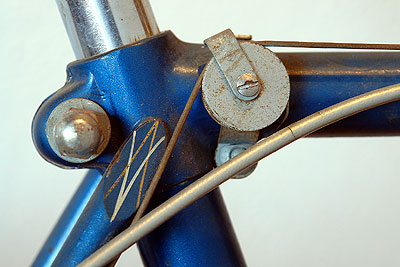
The cable routing for the men's bike takes the shift cable over a pulley. No cheesy English plastic shift pulleys here, boys, it's a metal pulley.

This is the whole drivetrain. At this date a swastika crankset would be out of the question, but they could have had more fun than this. Again, the steel components are very slender compared to modern aluminum or carbon components.

Even then they had reflectors in pedals. I don't know well these work, but they are pretty neat.

The men's bike has an alloy-shelled Sturmey Archer AM hub. The AM is the medium-range (the common-as-dirt AW is the Wide range). This is a 1956 unit.

The 6 volt 3 watt dynamo. That's the same as current specs.

This is the headbadge on the men's bike.

The ladies' stem is very plain, but I loved the sort of "ship's prow" casting (forging?) for the men's stem.

Another L. Lepper. You might want a cover.

They're solid, handsome bikes. They're also 50 years old.
To photograph these I set them up at the front of One on One and just used the mixture of open skylight and incandescent. I had to move a couple of new Bianchi racing bikes to make space. Boy, was that illuminating! Having just hauled these battlecruisers out of the basement I picked up a tiny (probably 19") Bianchi carbon racing bike and it weighed about 4 pounds. I exaggerate, but it was extremely light, especially compared to the all-steel Rabeneicks.
Thanks to One on One for letting me do this. I bought a coffee and then lunch from them and they were very agreeable to letting me do this. I may do it again on other interesting bikes in their collection. Also, in case you are wondering, I have no business arrangement with them--if this entry hastens the sale of these bikes I don't get paid. I just did this because they looked like unusual bikes and it was kind of fun to do on a unique pair of cycles.
Finally, if you're deeply interested in photography, these were all shot on my Sony DSC-R1 10.2 megapixel camera using a tripod. They're at ISO 160 and exposures often ran more than a second. One some photos I filled in the shadows a bit by holding a reflector just out of view.
If you're not into old bikes at all, this entry is going to be even duller than usual. If you have a passing interest, these bikes might be of interest. These bikes are a slightly different tack than the usual English three-speed bicycles. These are German three-speeds. They're called Rabeneicks, I'm guessing they're from 1958 or so (based on Sturmey Archer hub vintages), and they're down at One on One Bicycle Studio in Minneapolis (yes, that's Ein auf Einem).
The back story? I guess the original owner was in the U.S. Army in Germany in the 1950s, bought these there, and brought them home. It is thought that they weren't ridden much once back in the U.S. I am not an expert on this stuff, Rabeneicks seem to be ill-documented on the web (at least in English), but they look to be largely original. I thought they were cool when I first saw them in the infamous One on One basement, and asked if I could come in one Saturday morning, pull them out, and take photos. I did this yesterday. These are the photos and notes.
There are two of these bikes, a mens' and a ladies'. They are for sale for $600 for the pair, or $333 each, though it would be a pity to break them up after being together half a century.
Here are my photos:
(Note: as with almost all my photos, if you click on the picture you'll get a much larger version to better see the fine details)

This is the Rabeneick Men's bike...
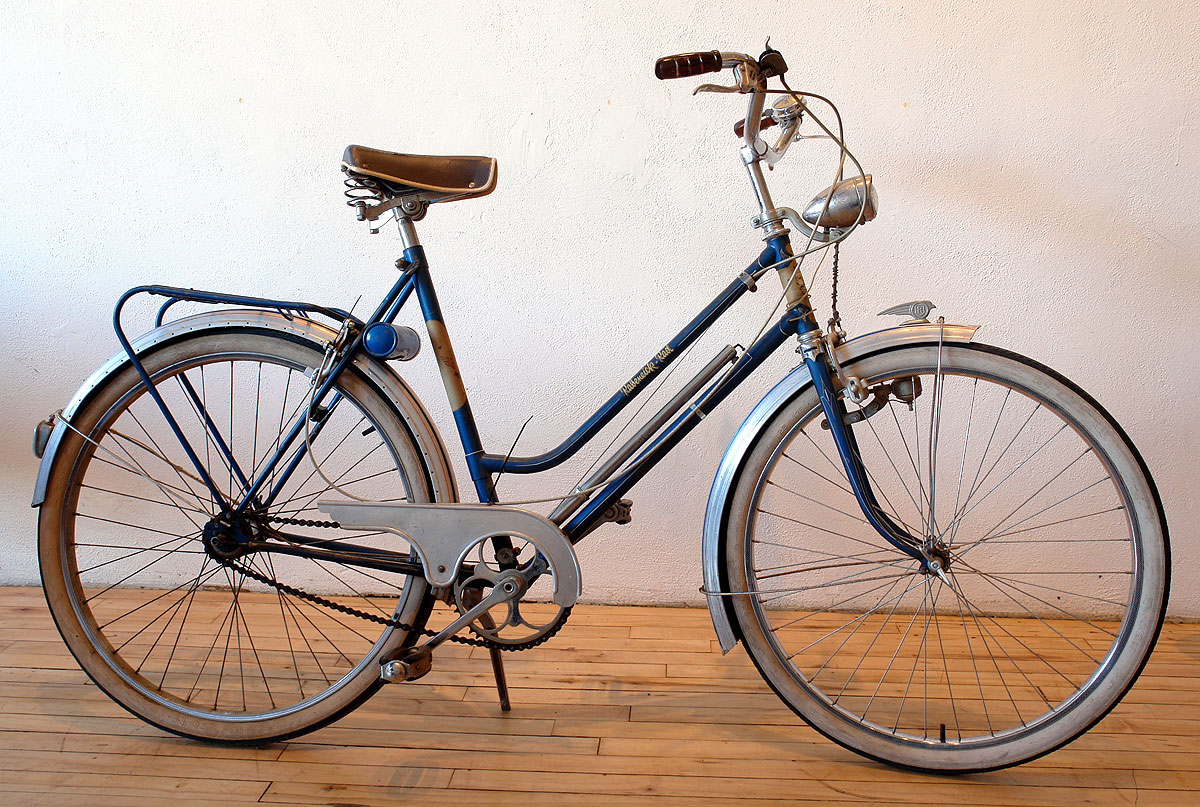
...and this is the Ladies'.
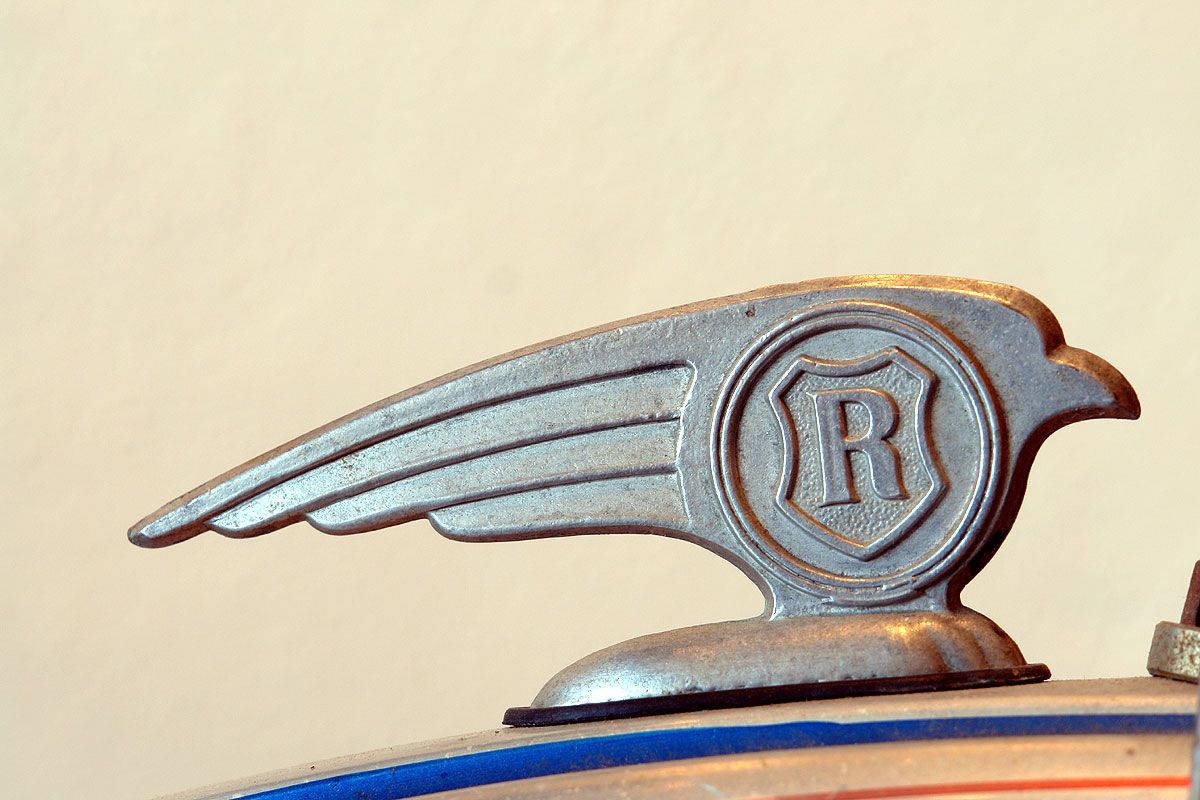
One of the things that immediately drew me to these bikes was the "hood ornament", a metal eagle on the front fender. It looks so Germanic!
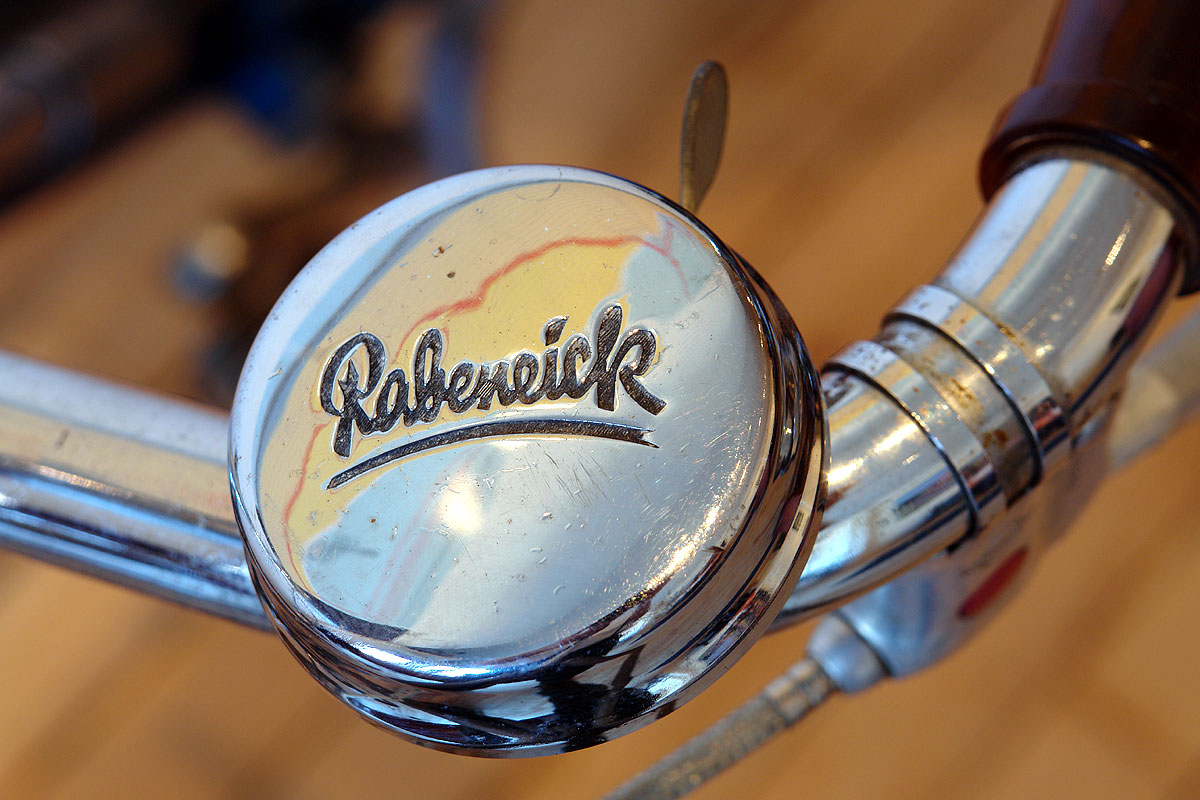
Everything's very solid, including the bell, with the Rabeneick name prominently showing.
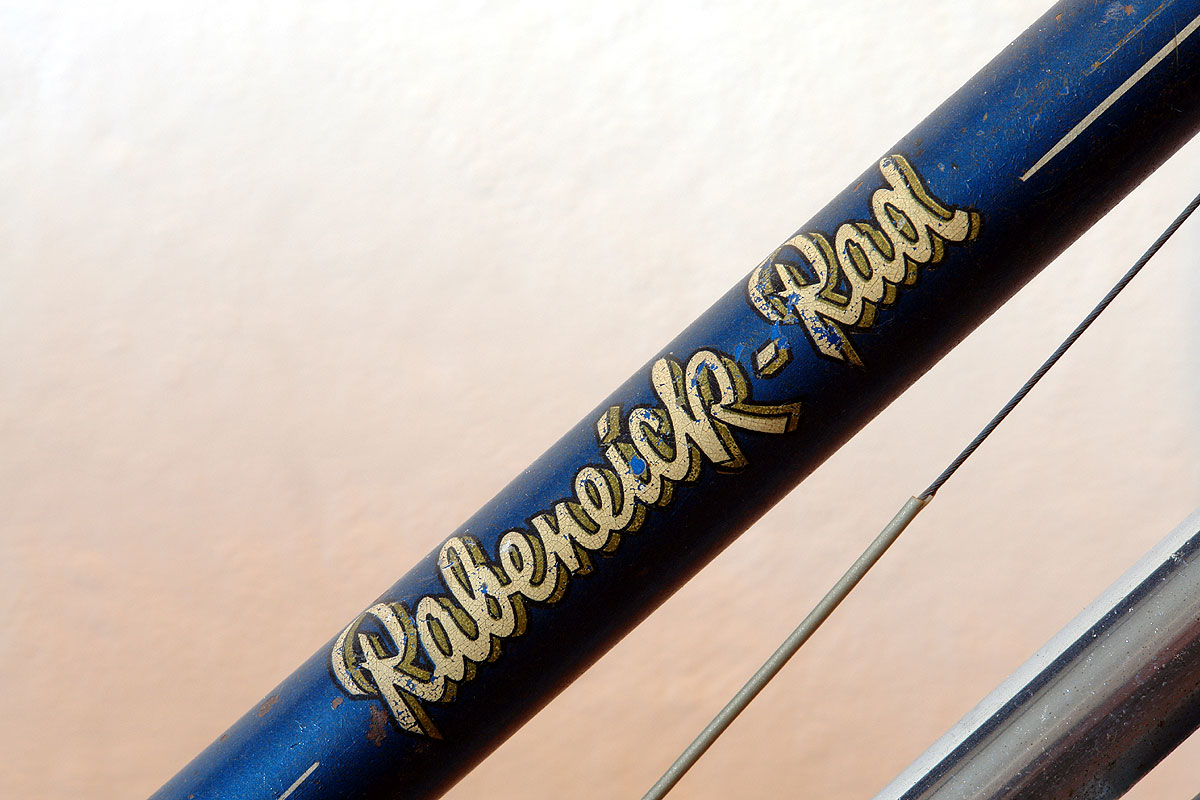
The ladies' bike says Rabeneick Rad. Rad? Wow, man, that's Rad!

The men's bike has Weinmann 1020 brakes, the ladies' has one of those on back and an Altenburger sidepull on front. This is the brake lever for it. Both bikes had these Bakelite handgrips.
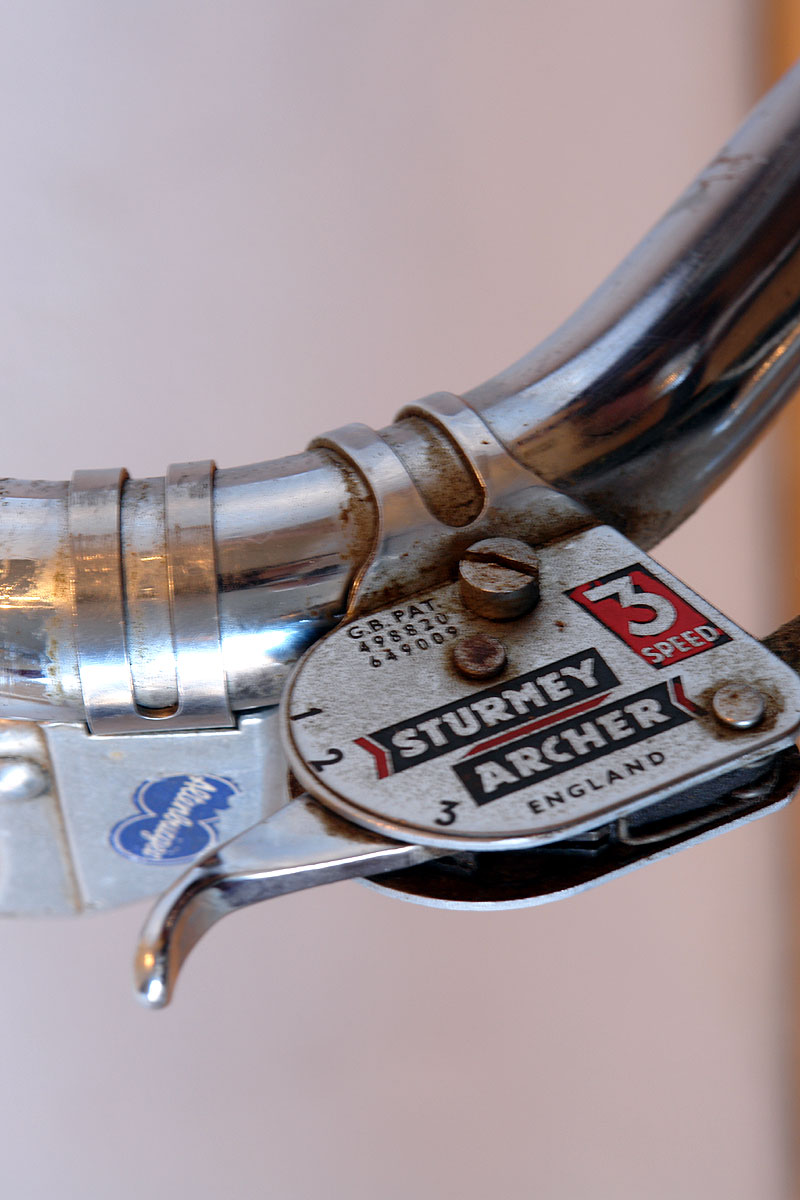
German they may be, but they're both Sturmey-Archer three-speeds.

The ladies' bike has this seat tube decal. A feature I really like is the little tool box affixed to the frame, visible in the background.

This is the toolbox.
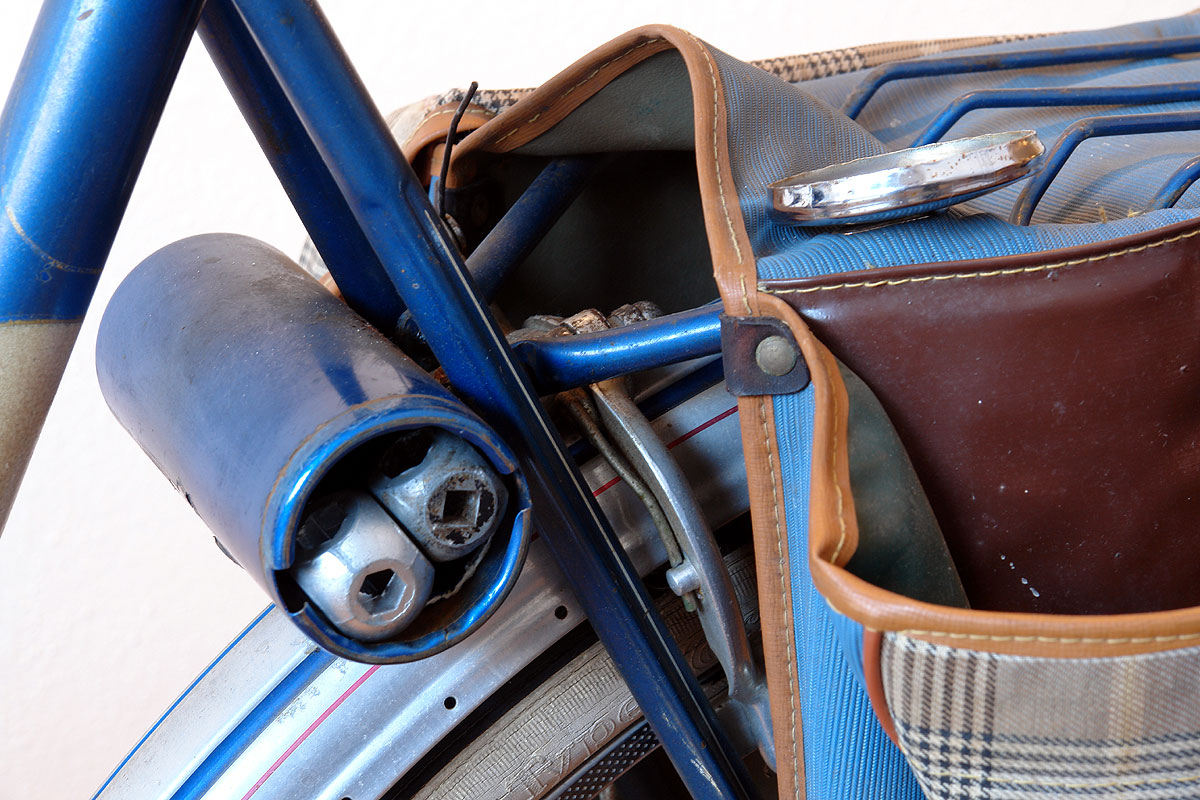
This shows the dogbone wrenches (literally, "Hundeknochenschlüssel", what a great language, I should have taken German instead of French in high school) in the ladies' toolbox.
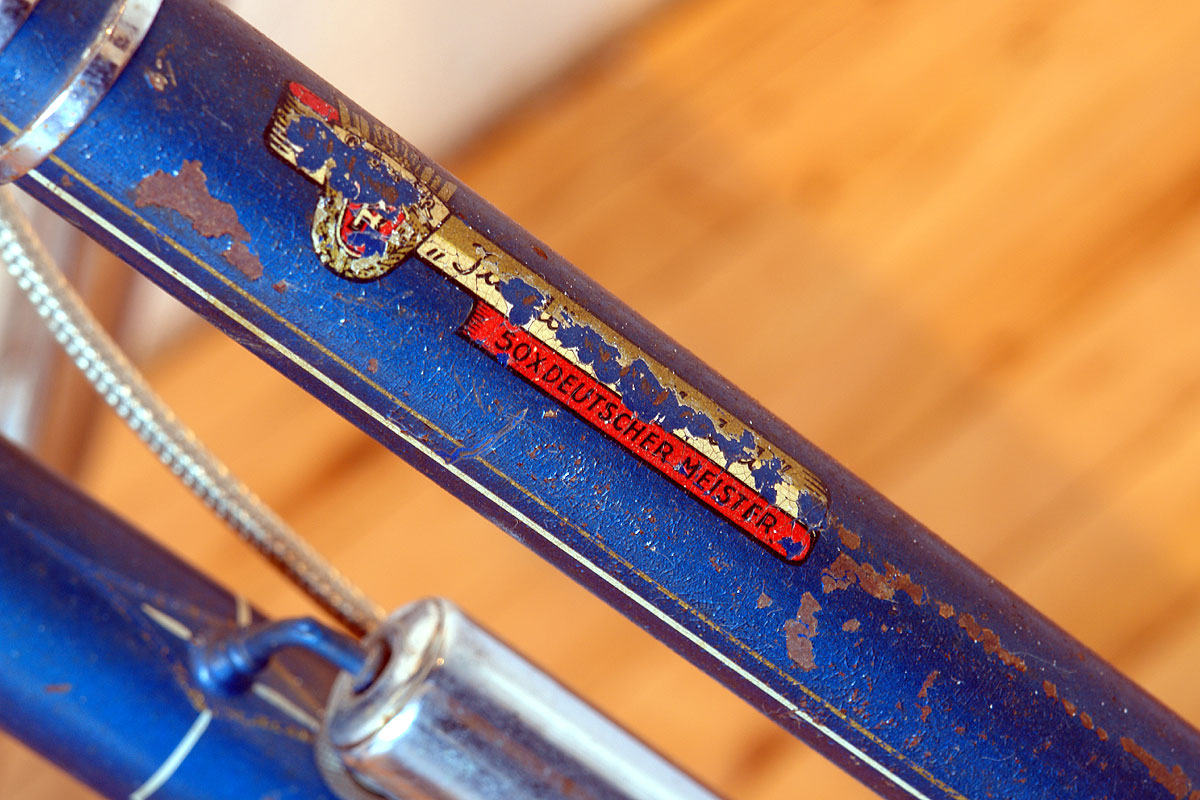
I don't know what this means. Neither does Babelfish.
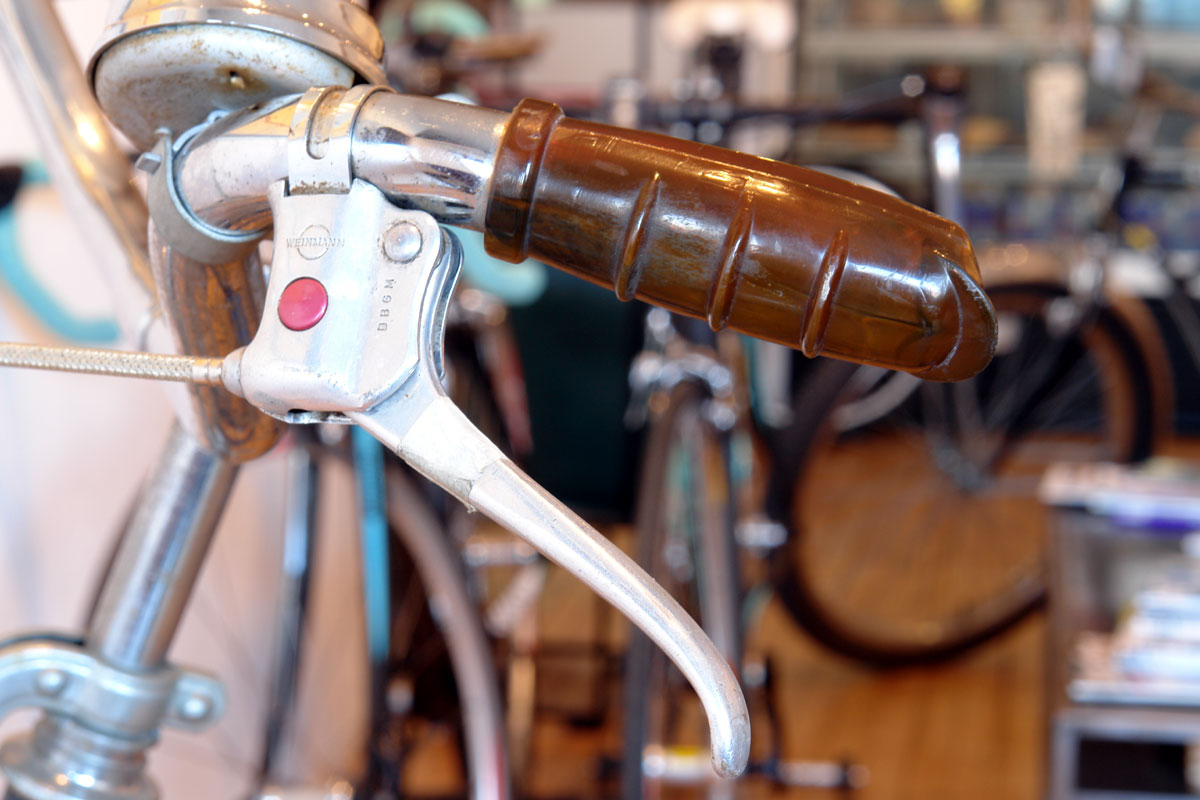
Here's the Weinmann brake lever.
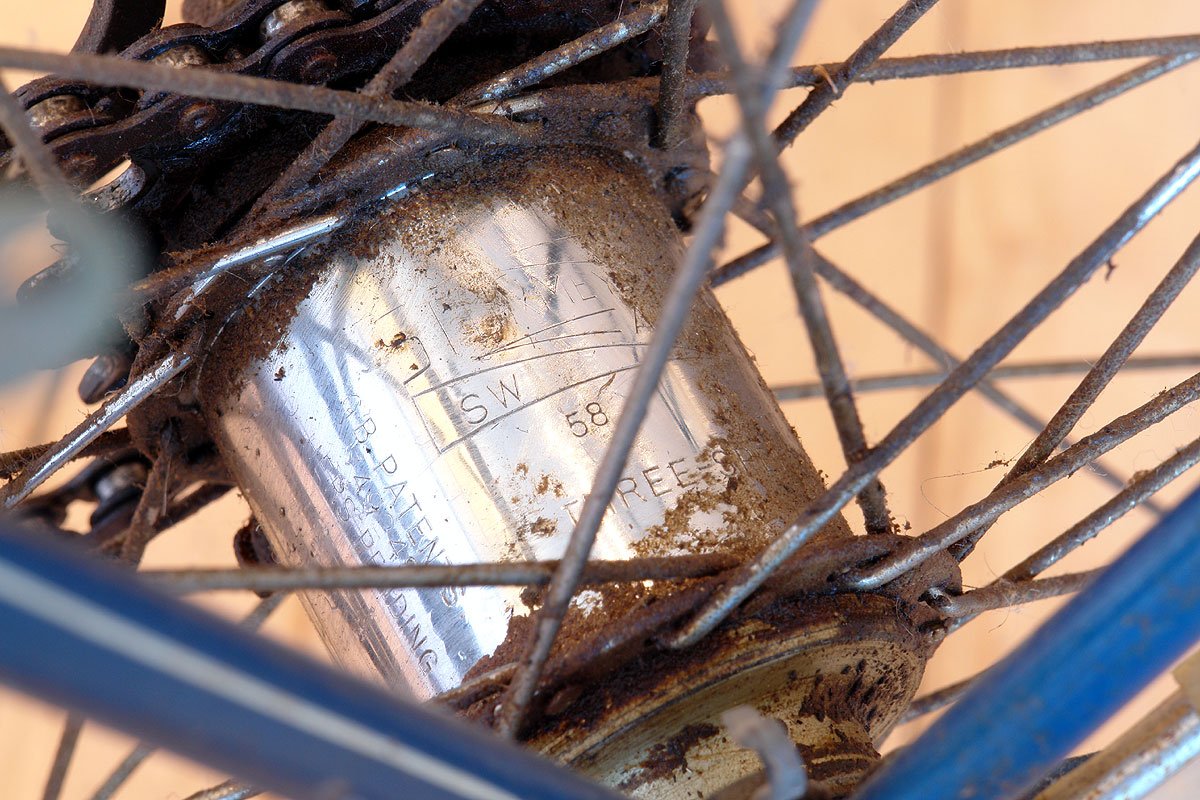
The ladies' bike has a 1958 Sturmey Archer SW hub. This was the replacement for the common-as-dirt AW hub but could be a finicky unit (the joke is that SW stands for Sometimes Works) and the AW came back into production, so that the one on my bike is a 1967 AW.
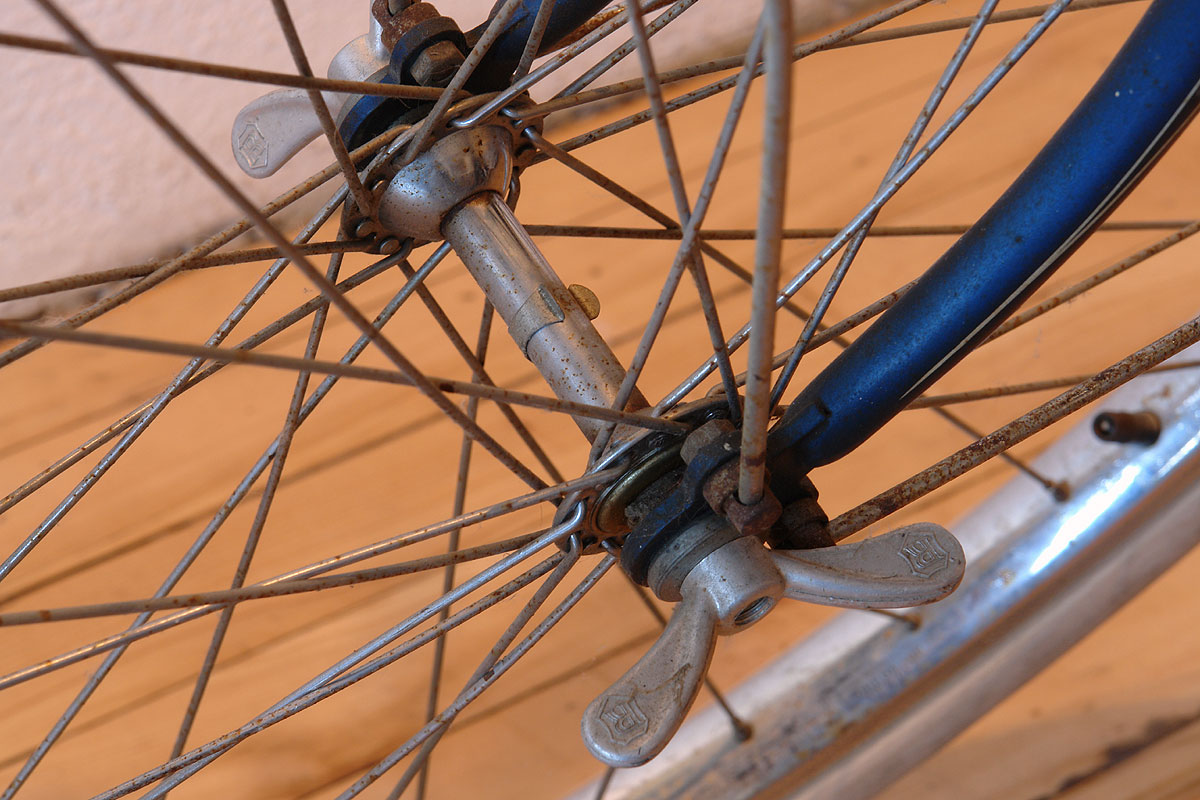
It's funny with steel stuff how slender things can be. This is the front hub. I like the wingnuts.
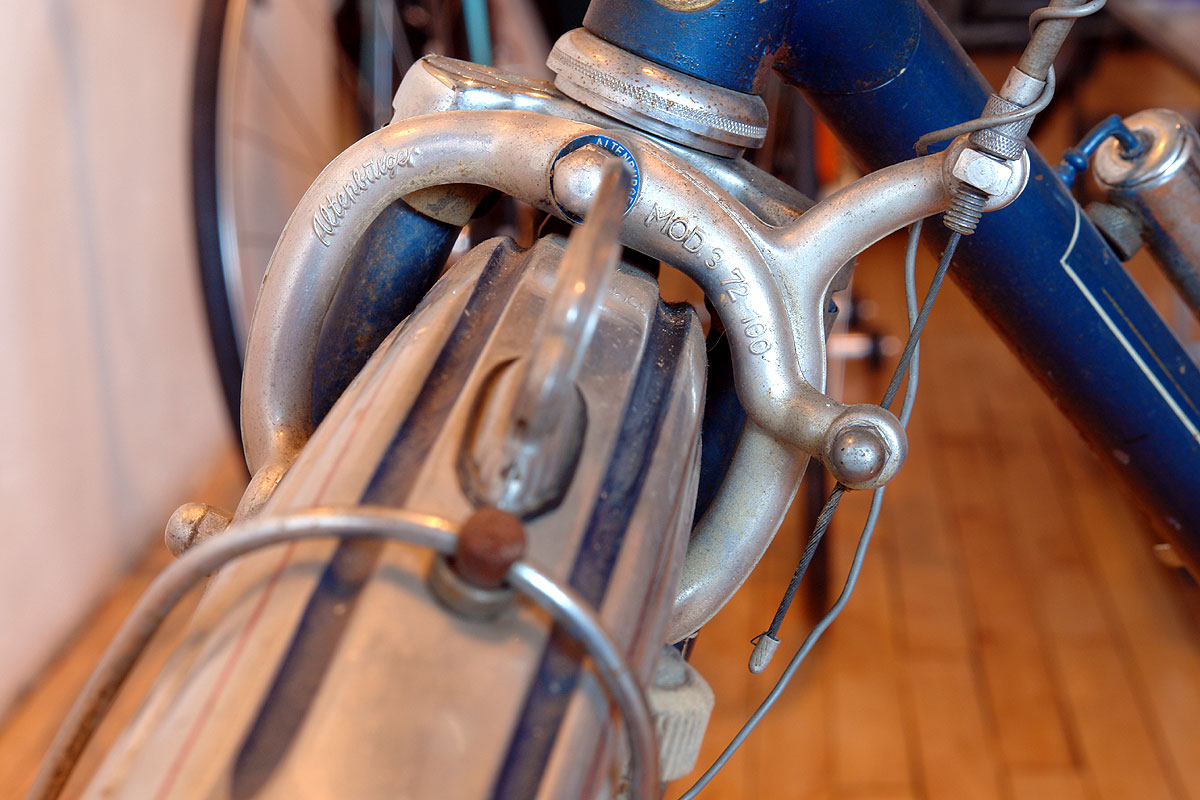
This shows the actual Altenburger front sidepull on the ladies' bike.

The bikes both have wheel locks. Nowadays, European bikes (and Breezer Uptowns) have these kind of "handcuff" locks--this one just sticks a bar in the spokes. It's called a Trelock Automat.

The Ladies' bike has Continental Type Corsa tires. Love these whitewalls. I think the ridges on the sidewall are to improve traction for the sidewall dynamos. Clever chaps these Germans! Also, the ladies' bike had all these holes drilled in the rear fender. It looks to me like it was to lace in a skirt guard. The men's bike doesn't have these drillings. Finally, notice the textured rim, little dots cut into the braking surface.
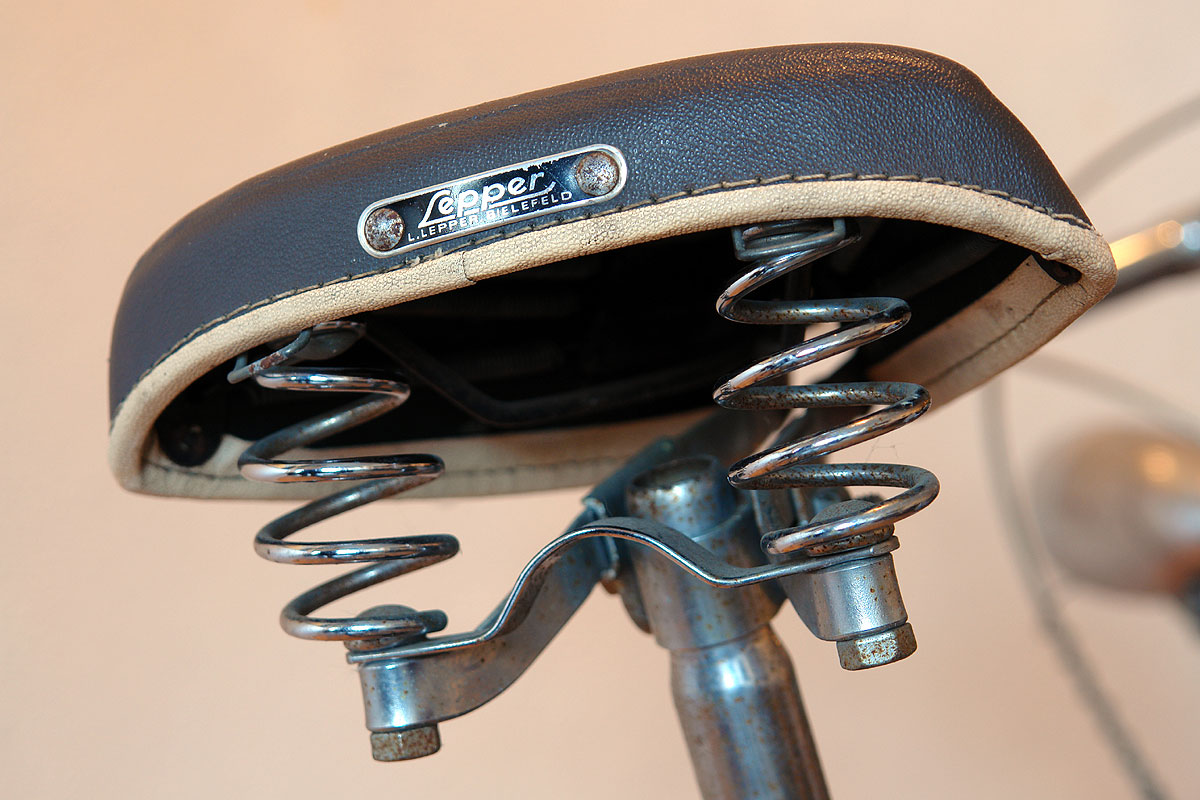
The saddle is an "L. Lepper, Beilefeld" unit.
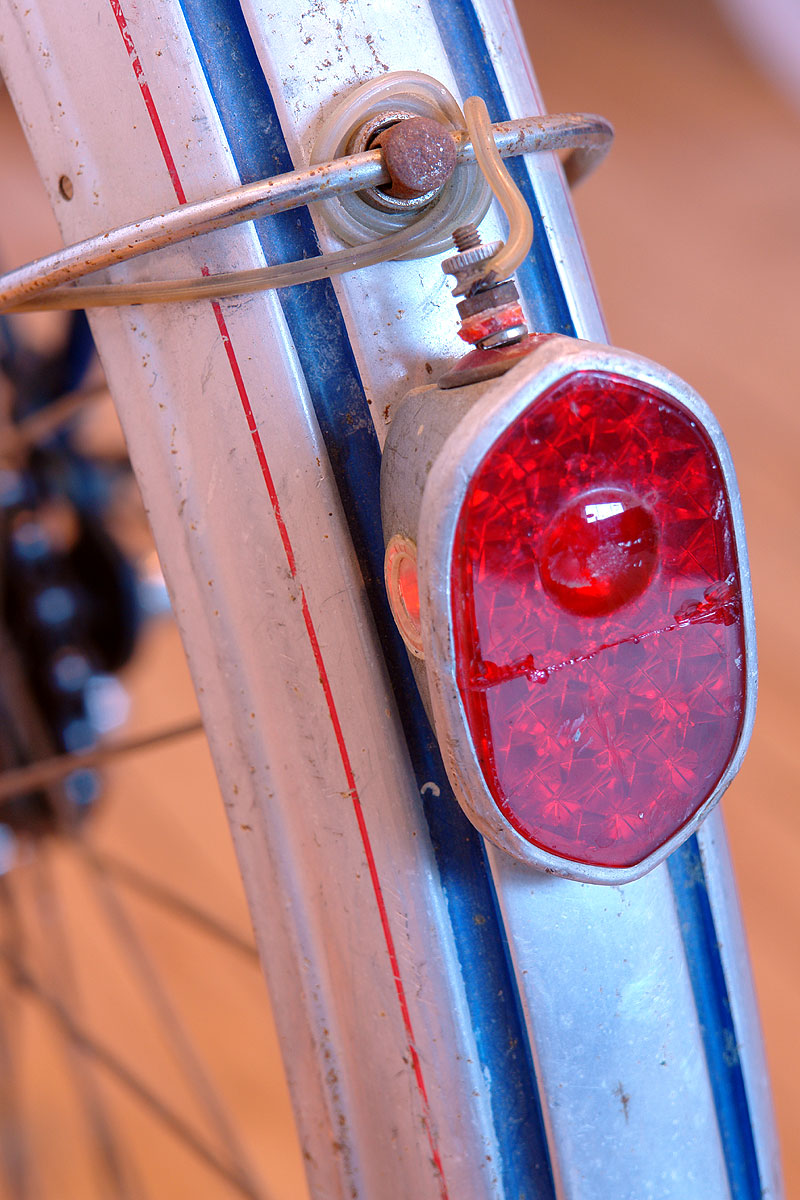
I love fender lights. I just ordered one for my Schwinn, though it's batteries and LEDs while this one's a bulb and dynamo. Even so, it seems to have side windows for better visibility to traffic.
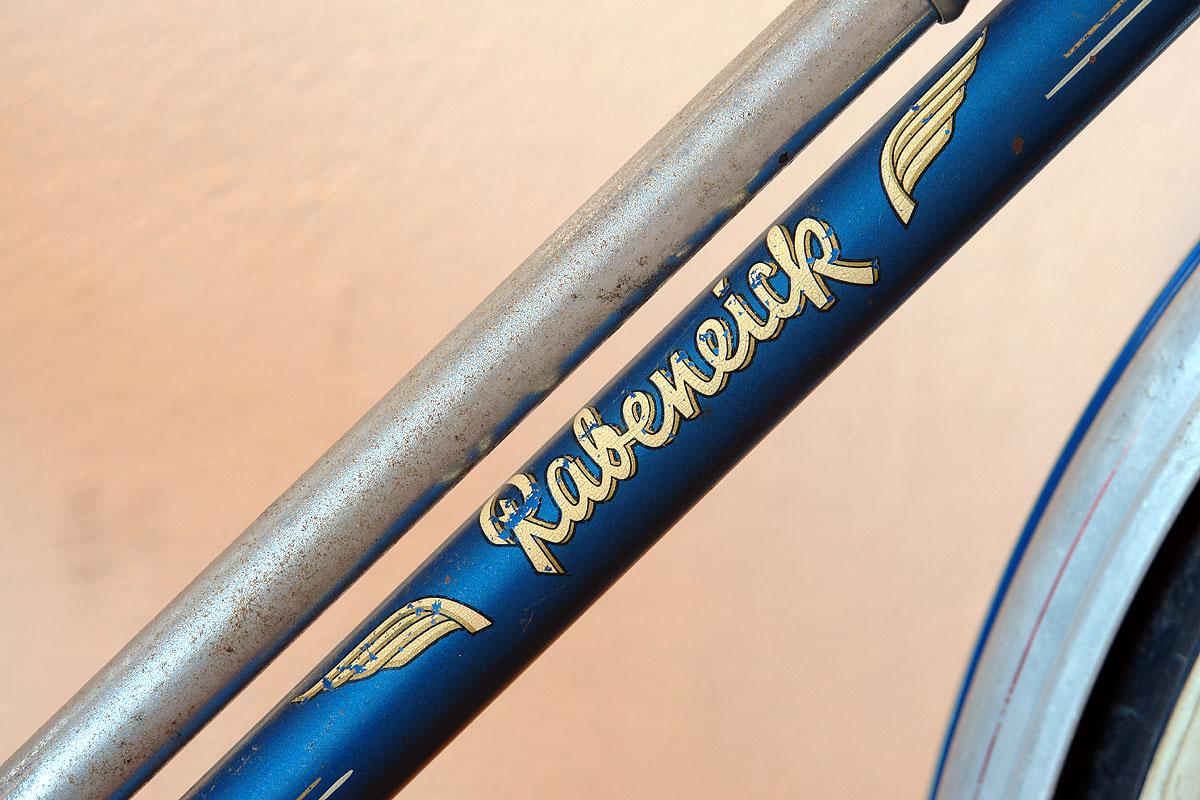
This is the downtube decal on the men's bike. This bike isn't Rad I guess. (Rad actually means "wheel" in German).
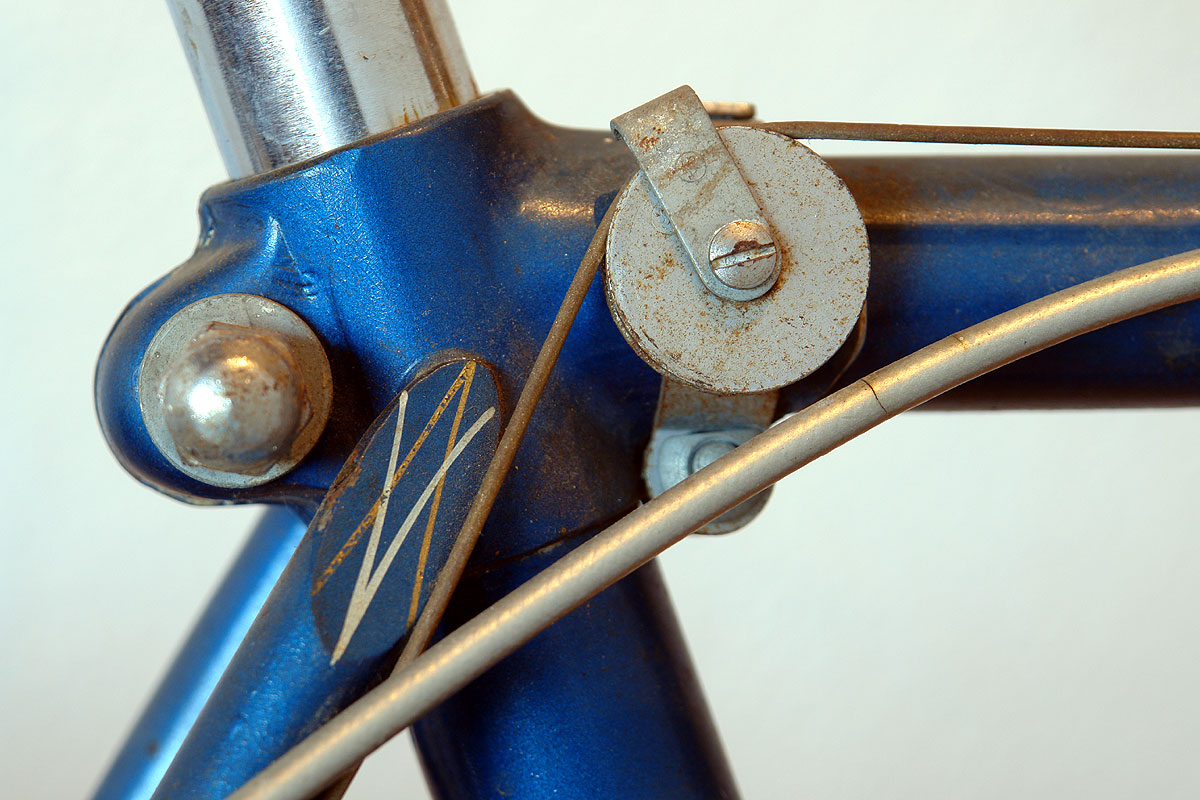
The cable routing for the men's bike takes the shift cable over a pulley. No cheesy English plastic shift pulleys here, boys, it's a metal pulley.
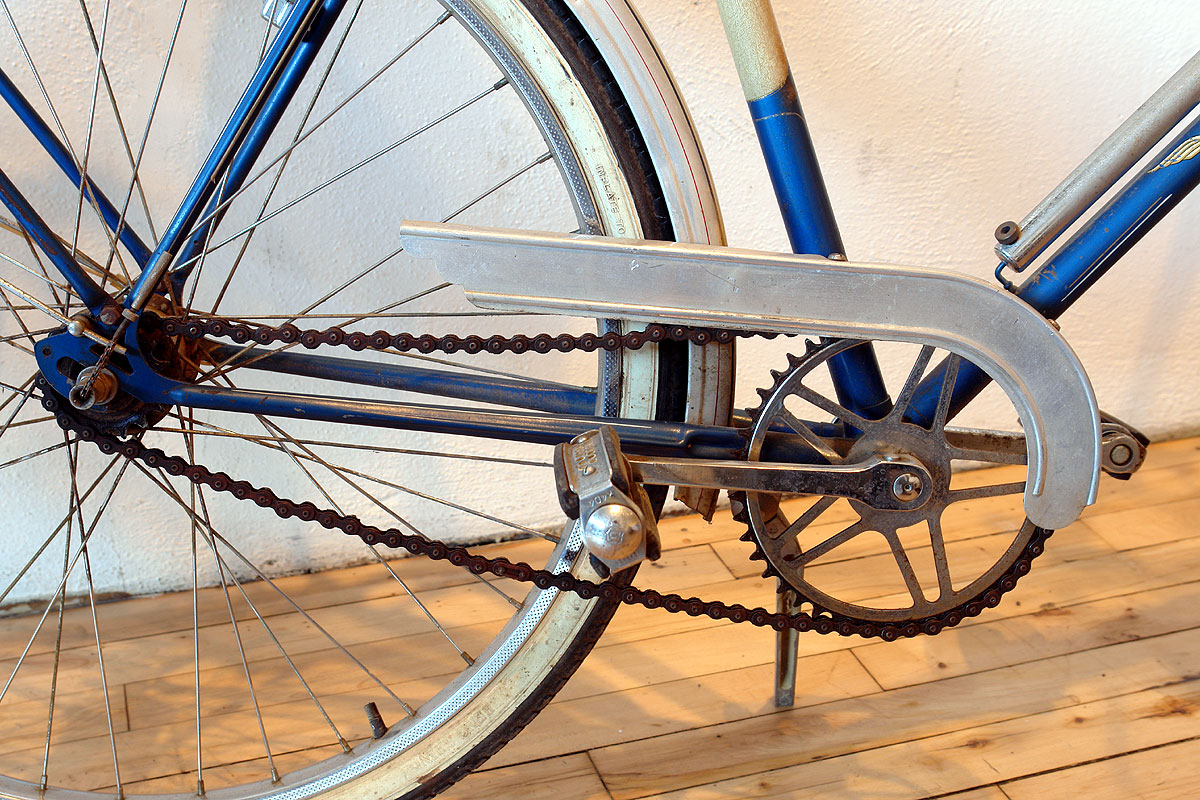
This is the whole drivetrain. At this date a swastika crankset would be out of the question, but they could have had more fun than this. Again, the steel components are very slender compared to modern aluminum or carbon components.
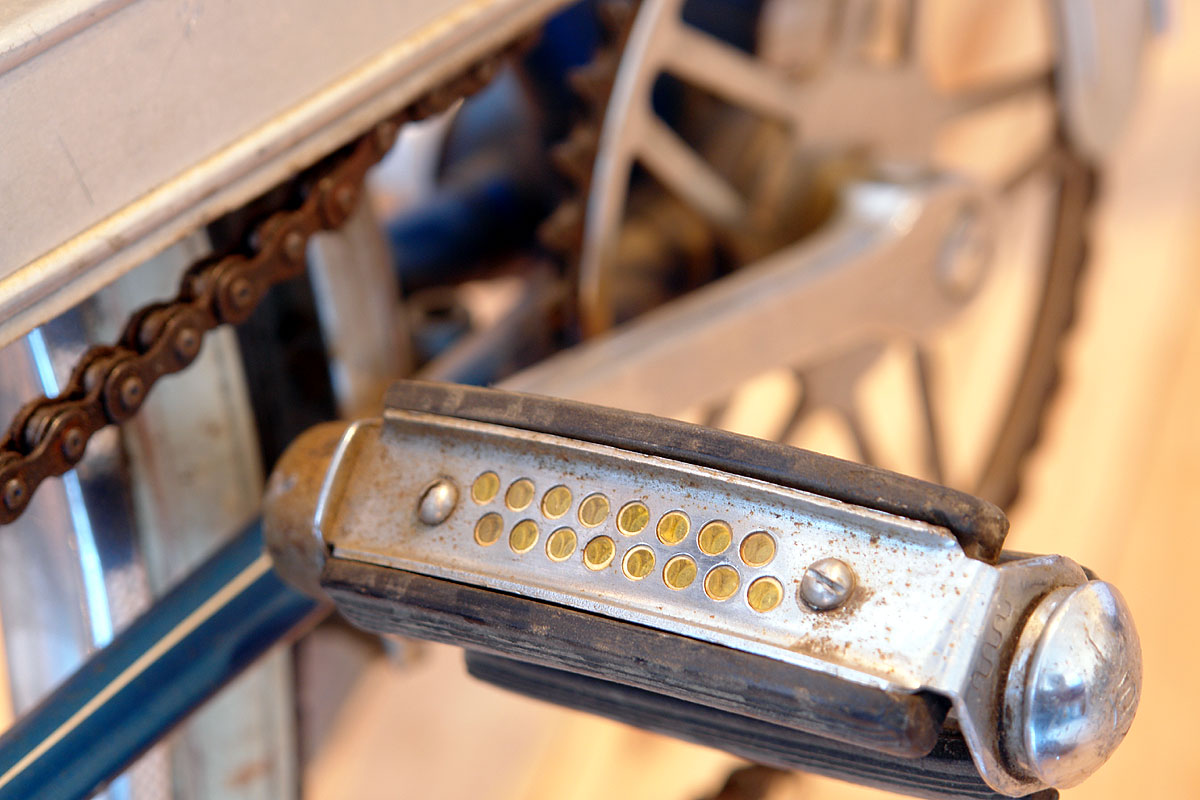
Even then they had reflectors in pedals. I don't know well these work, but they are pretty neat.
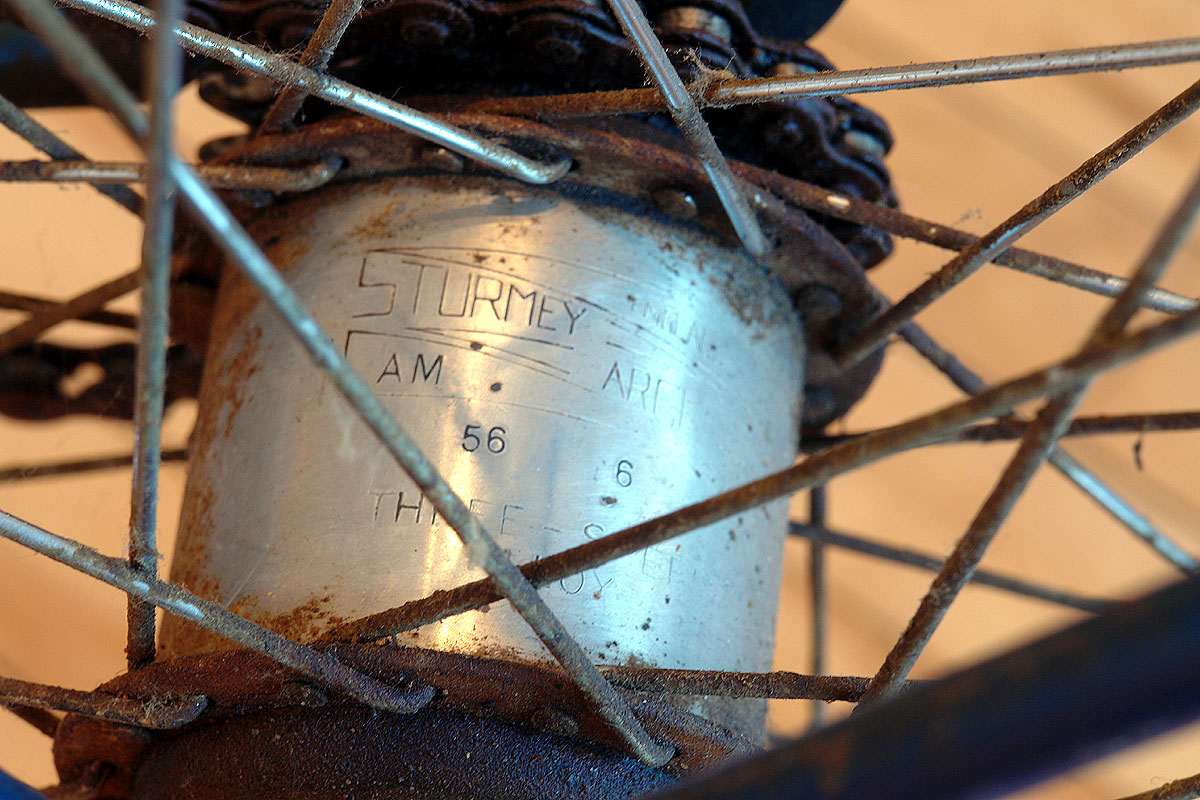
The men's bike has an alloy-shelled Sturmey Archer AM hub. The AM is the medium-range (the common-as-dirt AW is the Wide range). This is a 1956 unit.

The 6 volt 3 watt dynamo. That's the same as current specs.
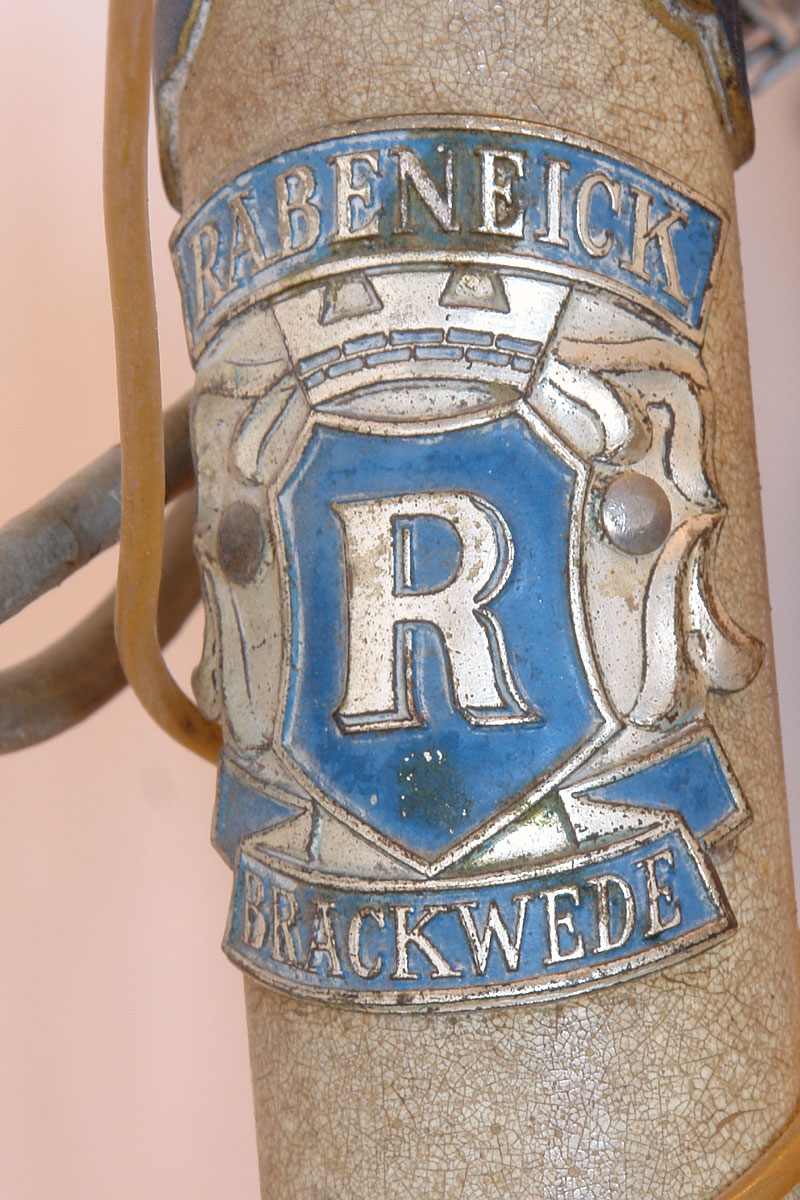
This is the headbadge on the men's bike.
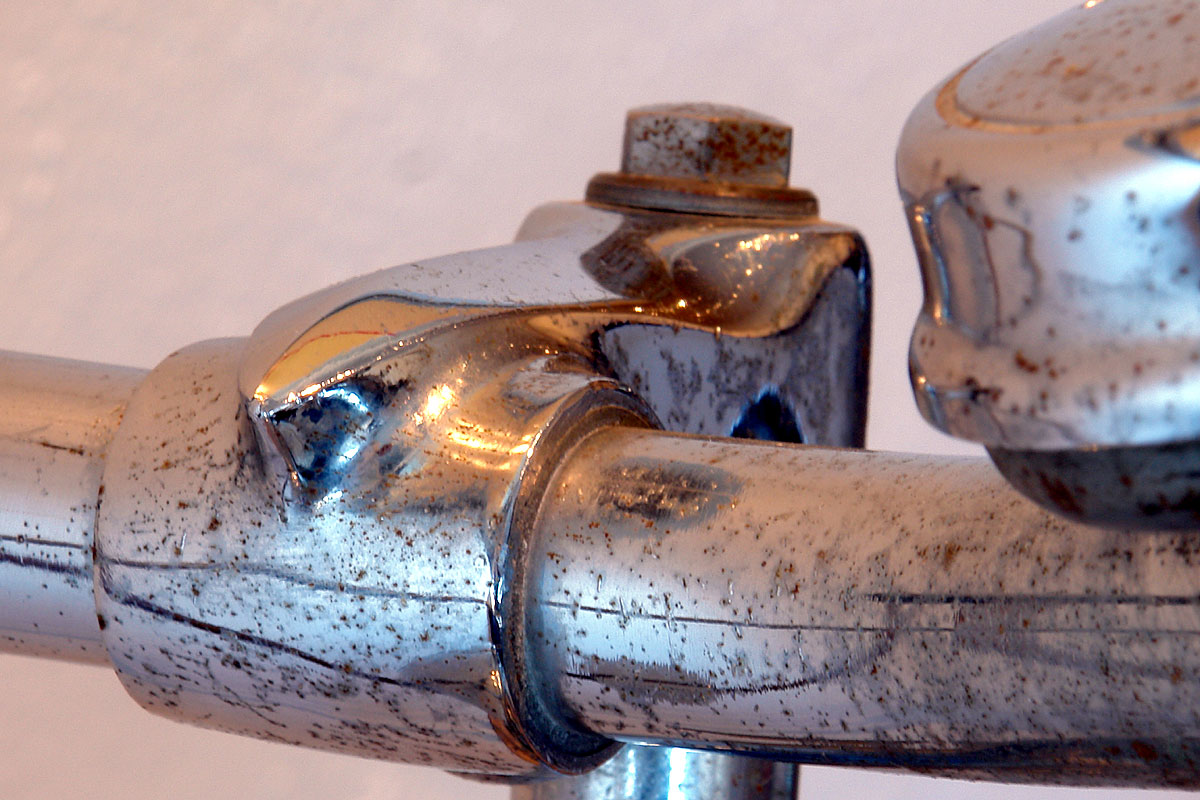
The ladies' stem is very plain, but I loved the sort of "ship's prow" casting (forging?) for the men's stem.
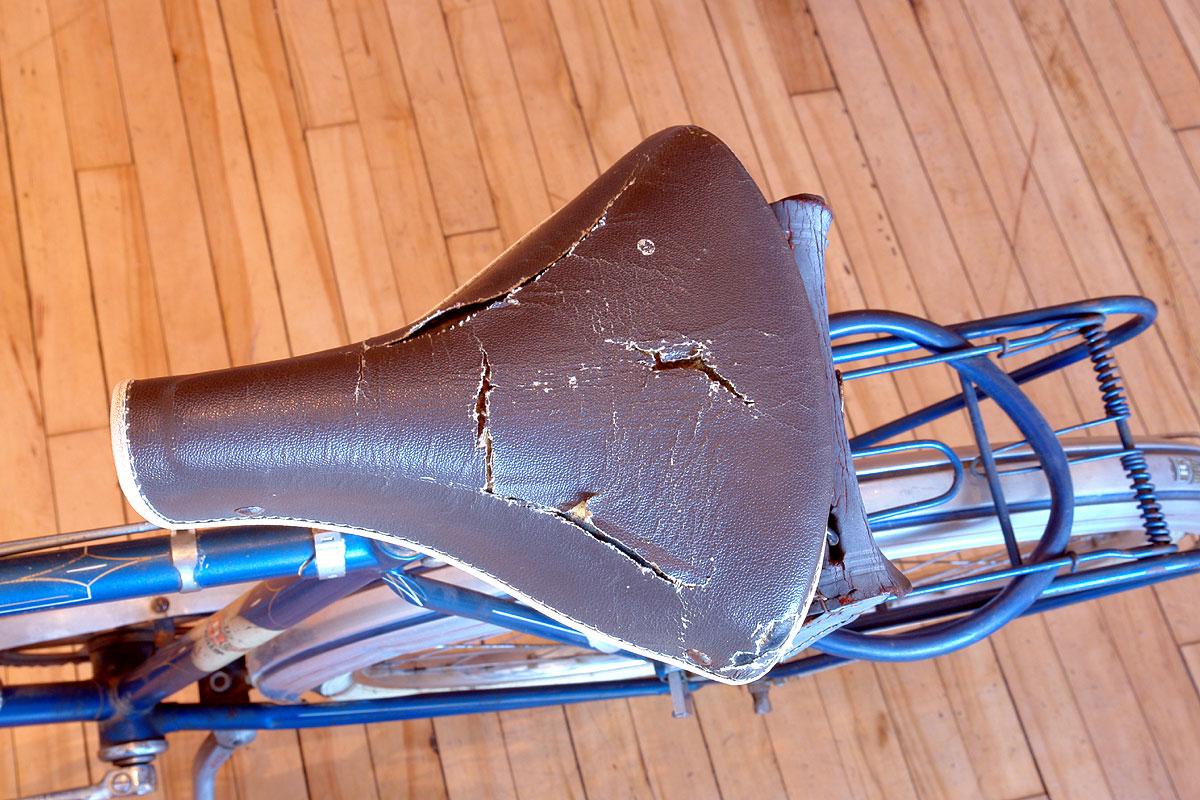
Another L. Lepper. You might want a cover.
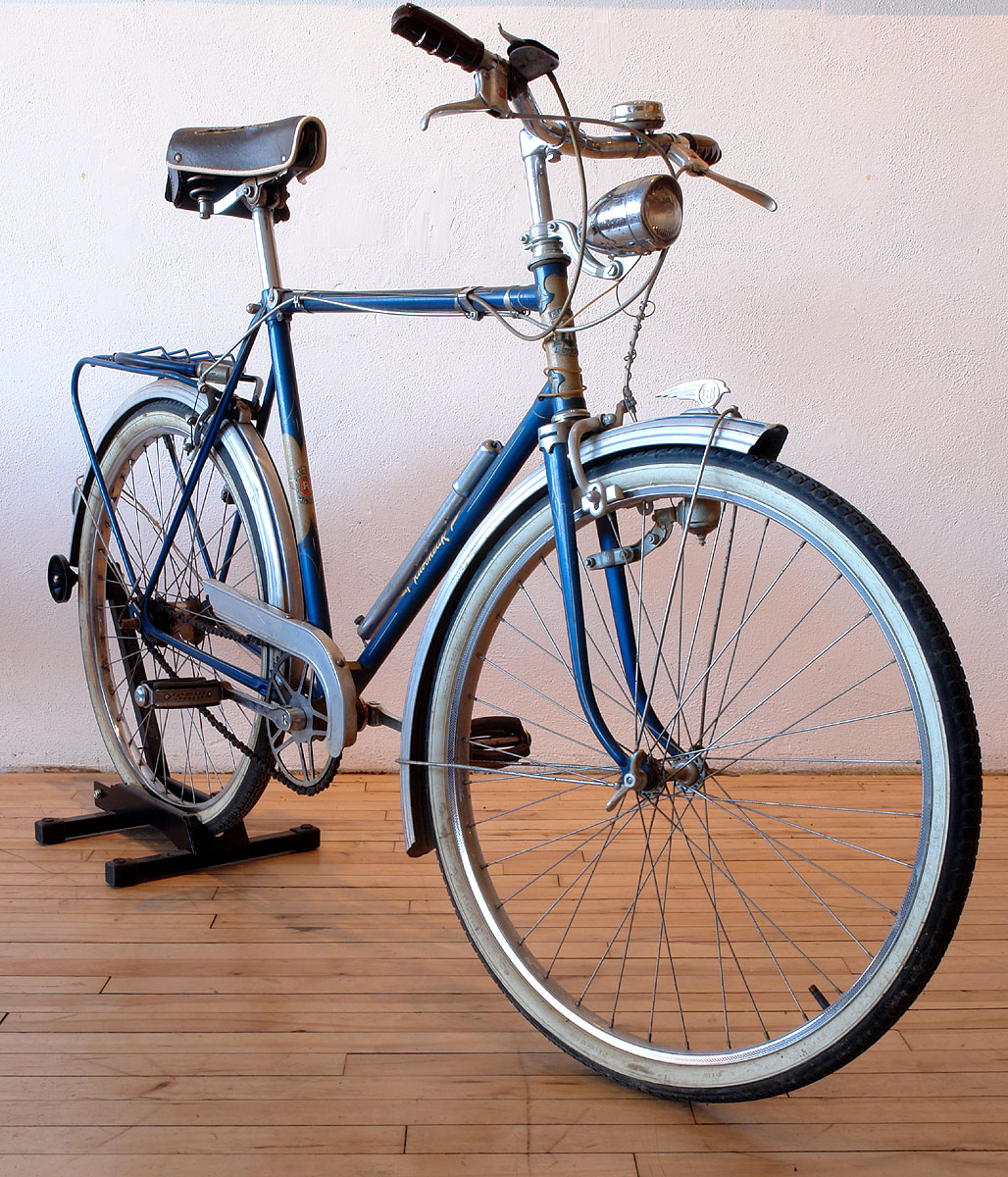
They're solid, handsome bikes. They're also 50 years old.
To photograph these I set them up at the front of One on One and just used the mixture of open skylight and incandescent. I had to move a couple of new Bianchi racing bikes to make space. Boy, was that illuminating! Having just hauled these battlecruisers out of the basement I picked up a tiny (probably 19") Bianchi carbon racing bike and it weighed about 4 pounds. I exaggerate, but it was extremely light, especially compared to the all-steel Rabeneicks.
Thanks to One on One for letting me do this. I bought a coffee and then lunch from them and they were very agreeable to letting me do this. I may do it again on other interesting bikes in their collection. Also, in case you are wondering, I have no business arrangement with them--if this entry hastens the sale of these bikes I don't get paid. I just did this because they looked like unusual bikes and it was kind of fun to do on a unique pair of cycles.
Finally, if you're deeply interested in photography, these were all shot on my Sony DSC-R1 10.2 megapixel camera using a tripod. They're at ISO 160 and exposures often ran more than a second. One some photos I filled in the shadows a bit by holding a reflector just out of view.
Thursday, March 08, 2007
You know you're too tall when...
...your knickers are too short.
One of the longstanding themes of me and bikes is the difficulties trying to get stuff big enough. I stand 6' 5" tall with a 36" inseam and wear a size 14 shoe (49 European). The fashion in bikes is for everything to be small, so that most bike shops leave me utterly uninterested in their newest offerings, which often max out at 60 or 62cm frame sizes.
In the last couple of years I've managed to address this. My main bike is a Rivendell Atlantis in the 68cm size (27"). I've got 175mm crank arms on it and the 56cm wide handlebars. It's really the first bike that ever fit me properly and has been a joy to ride--there's only so much that lots of stem and seatpost can do on a fundamentally too-small frame. (If you click on my Profile photo you'll see me dwarfing a 21.5" Marin mountain bike frame with lots of seatpost, a tall stem and riser and handlebars that come up a bit more--but the bike still feels cramped, and is now relegated to winter duties). My around-town bike is a early 1980s 68cm Schwinn World Sport bastardized into an 8-speed Nexus hub bike. It has regular 170mm cranks but the wide Nitto Albatross bars, real longhorns. Both these bikes, when around other people's rides, look like they have about a foot of headtube and the Schwinn, with thin 1980s frame tubes, looks particulary willowy.
Clothing remains an issue. In everyday stuff I wear a 17 1/2 X 37 shirt, 46 XL suits/jackets, very large hats and XL gloves. Cycling shorts are no problem, of course, nor are short-sleeved jerseys. Other items, though, get harder. It's tough to find size 49 cycling shoes, and 48s and a grimace don't make it (I tried). When I came across the Adidas El Moro IIIs in 49, I bought two pairs. One learns to buy when stuff is available. Long sleeved jerseys can be a problem; I tend to buy XL or XXL just to get the sleeve length, ending up with a really baggy fit since I have a very flat chest, due in part to a big chest operation I had when I was about 16 which at least gives me an artful scar and two belly buttons (OK, one's a drainage tube scar). The buy-large strategy doesn't always work; I recently got a Nike Tete du Course merino wool jersey in XXL length. It was $200 originally, I got it on deep discount sight-unseen, and the sleeves are short. It's made in Italy and their impression of an XXL doesn't seem to match up with North America's. It's not uncommon for garments made with really expensive luscious fabrics to be a bit stingy in the fit, which is pretty cheeky when you are asking $200 for a jersey.
Anyway, I decided to try some knickers. I was going to buy some last year but the places with my sizes were out and I never got around to it. This year, the guys at Bicyle Fixation are doing some knickers. They're wool, they're dressy, they're actually made in the United States of America! They even have a bit of flashy satin lining! I ordered up a pair.
They arrived yesterday. I was so happy, and nobody else was home, so into the living room and off with my trousers! I tried on the knickers and...they're too short. Not by a lot, 2 or 3 inches (OK, that's a lot in a garment), but with my upper leg horizontal, as on a pedal stroke, the knickers' cuff binds diagonally over my knee. I was really bummed out about this. There was a little note in there from the Bicycle Fixation people, how the wife was unimpressed by the selection of cycling garments for her husband, how they put together these wool gabardine knickers, how the flashy satin was actually from their wedding...I loved the vibe on these things. I wish they worked for me. They just don't fit.
(As an aside, there is a review of these knickers at Fixed Gear Gallery).
So, I'll be contacting them and returning them. In the meantime, I just got a pair of unhemmed wool dress trousers from Sierra Trading Post for $20 and they're lovely. There's a lady around the block from us who does alterations...I'm thinking I'll call her up and see if she can sew the trousers into knickers for me. I'm going to call her tonight and take over the Bicycle Fixation knickers so she can see what's involved. On the whole, I'd rather keep them, but they do need to fit. If you're normal-sized (my buddy Paul, who picked up the Tete du Course jersey for me in Cedar Rapids, said "that's what you get for being a freak" when I whined about the short long-sleeves on the garment), I'd think about a pair.
PS Later on today, after having posted this entry, I got a call from George's Shoe Store, where I'd left a pair of Rockport Dressports 14 Narrow shoes to be resoled. The sole that I'd selected? They don't make them that big. Sheesh, story of my life. I approved a different sole, and they'll be ready next week.
One of the longstanding themes of me and bikes is the difficulties trying to get stuff big enough. I stand 6' 5" tall with a 36" inseam and wear a size 14 shoe (49 European). The fashion in bikes is for everything to be small, so that most bike shops leave me utterly uninterested in their newest offerings, which often max out at 60 or 62cm frame sizes.
In the last couple of years I've managed to address this. My main bike is a Rivendell Atlantis in the 68cm size (27"). I've got 175mm crank arms on it and the 56cm wide handlebars. It's really the first bike that ever fit me properly and has been a joy to ride--there's only so much that lots of stem and seatpost can do on a fundamentally too-small frame. (If you click on my Profile photo you'll see me dwarfing a 21.5" Marin mountain bike frame with lots of seatpost, a tall stem and riser and handlebars that come up a bit more--but the bike still feels cramped, and is now relegated to winter duties). My around-town bike is a early 1980s 68cm Schwinn World Sport bastardized into an 8-speed Nexus hub bike. It has regular 170mm cranks but the wide Nitto Albatross bars, real longhorns. Both these bikes, when around other people's rides, look like they have about a foot of headtube and the Schwinn, with thin 1980s frame tubes, looks particulary willowy.
Clothing remains an issue. In everyday stuff I wear a 17 1/2 X 37 shirt, 46 XL suits/jackets, very large hats and XL gloves. Cycling shorts are no problem, of course, nor are short-sleeved jerseys. Other items, though, get harder. It's tough to find size 49 cycling shoes, and 48s and a grimace don't make it (I tried). When I came across the Adidas El Moro IIIs in 49, I bought two pairs. One learns to buy when stuff is available. Long sleeved jerseys can be a problem; I tend to buy XL or XXL just to get the sleeve length, ending up with a really baggy fit since I have a very flat chest, due in part to a big chest operation I had when I was about 16 which at least gives me an artful scar and two belly buttons (OK, one's a drainage tube scar). The buy-large strategy doesn't always work; I recently got a Nike Tete du Course merino wool jersey in XXL length. It was $200 originally, I got it on deep discount sight-unseen, and the sleeves are short. It's made in Italy and their impression of an XXL doesn't seem to match up with North America's. It's not uncommon for garments made with really expensive luscious fabrics to be a bit stingy in the fit, which is pretty cheeky when you are asking $200 for a jersey.
Anyway, I decided to try some knickers. I was going to buy some last year but the places with my sizes were out and I never got around to it. This year, the guys at Bicyle Fixation are doing some knickers. They're wool, they're dressy, they're actually made in the United States of America! They even have a bit of flashy satin lining! I ordered up a pair.
They arrived yesterday. I was so happy, and nobody else was home, so into the living room and off with my trousers! I tried on the knickers and...they're too short. Not by a lot, 2 or 3 inches (OK, that's a lot in a garment), but with my upper leg horizontal, as on a pedal stroke, the knickers' cuff binds diagonally over my knee. I was really bummed out about this. There was a little note in there from the Bicycle Fixation people, how the wife was unimpressed by the selection of cycling garments for her husband, how they put together these wool gabardine knickers, how the flashy satin was actually from their wedding...I loved the vibe on these things. I wish they worked for me. They just don't fit.
(As an aside, there is a review of these knickers at Fixed Gear Gallery).
So, I'll be contacting them and returning them. In the meantime, I just got a pair of unhemmed wool dress trousers from Sierra Trading Post for $20 and they're lovely. There's a lady around the block from us who does alterations...I'm thinking I'll call her up and see if she can sew the trousers into knickers for me. I'm going to call her tonight and take over the Bicycle Fixation knickers so she can see what's involved. On the whole, I'd rather keep them, but they do need to fit. If you're normal-sized (my buddy Paul, who picked up the Tete du Course jersey for me in Cedar Rapids, said "that's what you get for being a freak" when I whined about the short long-sleeves on the garment), I'd think about a pair.
PS Later on today, after having posted this entry, I got a call from George's Shoe Store, where I'd left a pair of Rockport Dressports 14 Narrow shoes to be resoled. The sole that I'd selected? They don't make them that big. Sheesh, story of my life. I approved a different sole, and they'll be ready next week.
Thursday, March 01, 2007
Wow, that's a slap in the face
The Wall Street Journal has a front-page article this morning about a health club in Hong Kong that has hooked up some of its elliptical exercise machines to run its lights. The machines had little generators in them already to light up their own displays, but most of the power was wasted as heat. Rewired, they run several fluourescent lights. The article goes on to talk about other efforts along these lines; generating power from backpacks, dance floors, even heel strikes of Army boots, something the military's been looking at. Of course, says the article, this has a long history. Old phones had a crank that generated electricity when you wanted to make a call, you can get windup radios and flashlights and...
Yep, lots of SON hubs on those Huffys! The emphasis was mine, not the Journal's.
It will be interesting to see if dynamo hubs get more popular as the light output of LEDs rises but remains well within the output of the hubs (about 3 watts). A 3 watt bulb is OK, the 3W LEDs are getting really bright.
The online Wall Street Journal requires a subscription so I'm not linking to it.
Separately, Wells Fargo seems to have got a reprieve. Longtime readers may recall that I was not allowed to make a deposit last July in the drive-through lanes of the local Wells Fargo bank branch. A desultory correspondence with Wells Fargo yielded conflicting answers as to whether this should be allowed and the suggestion that I just go inside. I relished the idea of dragging my filthy dripping bike into the Arden Hills branch, which at that time had no bike racks, but in November some racks appeared. Now, the small church that employs my wife as a superb Music Director started offering direct deposit, and she signed up. Both Februrary paychecks have appeared all by themselves in the account. I was chastised by some commenters for not having done this earlier, and I have for years in my own employment, but it was only just offered by the church. Wells Fargo has averted my wrath a bit longer.
Finally, despite this being a worthless winter for me riding (I've been gone a lot, either on business trips or working on my father's house in Des Moines), I was named to the Saint Paul Bicycle Advisory Board on January 24th. Unfortunately, they didn't tell me until February 6th, the morning of what should have been my first meeting, and I was in Des Moines scraping wallpaper off walls at the time. It is a pity I wasn't informed on time because I would have gone to the Iowa Bicycle Summit on Thursday/Friday February 1/2. I drove to Des Moines that Thursday evening anyway, I would have just gone a day earlier and gone to the Summit.
Fortunately, my longtime cycling and house-repairing buddy Paul went. He was about to spend a bit more than a week scraping wallpaper, ripping up carpet, painting, repairing, throwing out stuff, etc. with me. He sent me these links:
The Iowa Bicycle Coalition.
Iowa Department of Transportation Bike Site. Iowa does a bike-specific state highway map which is clever. They of course get huge numbers of riders for the annual RAGBRAI ride and my sister emailed yesterday and said it's ending up in Bellevue again this year, where she lives.
Iowa Bicycle Summit homepage which has links to the Powerpoint presentations. The one called "Bicycle Facility Design" took all day Thursday. Paul also liked the one called "Road Diet". These have lots to do with traffic engineering--lane widths, three lanes versus four, etc. Over the weekend, scraping wallpaper and talking about the Summit, we were both consumed with a desire to take tape measures out to streets and measure some lane widths. As with most Powerpoints, these would be better with the accompanying narrative, but they're still something to chew on.
There was a separate link about Bicycle Boulevards.
Like I said, if I'd known that my Ascent to Power had commenced, I would have taken another day off and gone to this summit, but I wasn't informed until too late. I got the materials from the Saint Paul Bicycle Advisory Board and my first meeting is March 6th, so I'll add my voice to that group and probably be better-informed about what's going on. In the meantime, I am the Ward 5 representative, and so one of my first goals is to ride every street and visit every tavern in Ward 5. Don't know where Ward 5 is? Yeah, neither did I. It abuts Larpenteur on the north (the north city limit), then basically runs from Hamline east and north of Front to Dale, then north of the BNSF railroad tracks east to Edgerton.
Anyway, March is here, and although it's snowing like a bastard at the moment, the weather will turn much more promising in the next few weeks. I have a couple of more weekends to do down at Dad's, but with luck we'll sell the house this spring and be done with that time sink.
Some people have been capturing their own sweat for years, including children on bicycles whose pedaling generates electricity to operate their headlights.
Yep, lots of SON hubs on those Huffys! The emphasis was mine, not the Journal's.
It will be interesting to see if dynamo hubs get more popular as the light output of LEDs rises but remains well within the output of the hubs (about 3 watts). A 3 watt bulb is OK, the 3W LEDs are getting really bright.
The online Wall Street Journal requires a subscription so I'm not linking to it.
Separately, Wells Fargo seems to have got a reprieve. Longtime readers may recall that I was not allowed to make a deposit last July in the drive-through lanes of the local Wells Fargo bank branch. A desultory correspondence with Wells Fargo yielded conflicting answers as to whether this should be allowed and the suggestion that I just go inside. I relished the idea of dragging my filthy dripping bike into the Arden Hills branch, which at that time had no bike racks, but in November some racks appeared. Now, the small church that employs my wife as a superb Music Director started offering direct deposit, and she signed up. Both Februrary paychecks have appeared all by themselves in the account. I was chastised by some commenters for not having done this earlier, and I have for years in my own employment, but it was only just offered by the church. Wells Fargo has averted my wrath a bit longer.
Finally, despite this being a worthless winter for me riding (I've been gone a lot, either on business trips or working on my father's house in Des Moines), I was named to the Saint Paul Bicycle Advisory Board on January 24th. Unfortunately, they didn't tell me until February 6th, the morning of what should have been my first meeting, and I was in Des Moines scraping wallpaper off walls at the time. It is a pity I wasn't informed on time because I would have gone to the Iowa Bicycle Summit on Thursday/Friday February 1/2. I drove to Des Moines that Thursday evening anyway, I would have just gone a day earlier and gone to the Summit.
Fortunately, my longtime cycling and house-repairing buddy Paul went. He was about to spend a bit more than a week scraping wallpaper, ripping up carpet, painting, repairing, throwing out stuff, etc. with me. He sent me these links:
The Iowa Bicycle Coalition.
Iowa Department of Transportation Bike Site. Iowa does a bike-specific state highway map which is clever. They of course get huge numbers of riders for the annual RAGBRAI ride and my sister emailed yesterday and said it's ending up in Bellevue again this year, where she lives.
Iowa Bicycle Summit homepage which has links to the Powerpoint presentations. The one called "Bicycle Facility Design" took all day Thursday. Paul also liked the one called "Road Diet". These have lots to do with traffic engineering--lane widths, three lanes versus four, etc. Over the weekend, scraping wallpaper and talking about the Summit, we were both consumed with a desire to take tape measures out to streets and measure some lane widths. As with most Powerpoints, these would be better with the accompanying narrative, but they're still something to chew on.
There was a separate link about Bicycle Boulevards.
Like I said, if I'd known that my Ascent to Power had commenced, I would have taken another day off and gone to this summit, but I wasn't informed until too late. I got the materials from the Saint Paul Bicycle Advisory Board and my first meeting is March 6th, so I'll add my voice to that group and probably be better-informed about what's going on. In the meantime, I am the Ward 5 representative, and so one of my first goals is to ride every street and visit every tavern in Ward 5. Don't know where Ward 5 is? Yeah, neither did I. It abuts Larpenteur on the north (the north city limit), then basically runs from Hamline east and north of Front to Dale, then north of the BNSF railroad tracks east to Edgerton.
Anyway, March is here, and although it's snowing like a bastard at the moment, the weather will turn much more promising in the next few weeks. I have a couple of more weekends to do down at Dad's, but with luck we'll sell the house this spring and be done with that time sink.
Subscribe to:
Posts (Atom)