Wednesday, April 26, 2006

Flip Flop Flip Flop Whattya do when your numbers drop?

(Sung to the old Alka-Selzer plop plop fizz fizz tune)

Here's our steadfast great leader George W. Bush in 2000 when the Clinton-Gore administration released oil from the Strategic Petroleum Reserve:

George W. Bush, trying to slow Al Gore’s momentum and overcome discourag-ing polls, accused his rival on Saturday of engaging in “a disturbing pattern of embellishments and sudden reversals.

He then referred to the Strategic Petroleum Reserve:
"The strategic reserve should not be used as an attempt to drive down oil prices right before an election," Bush said. "It should not be used for short-term political gain at the cost of long-term national security. It was created for cases of war or a sudden disruption of America's energy supply," Bush said. "That's why it's called the Strategic Petroleum Reserve, not the Strategic Political Reserve."

Remember all the digs at Kerry about being a flip-flopper? Here's our Great Leader yesterday:
Tuesday, Bush, facing an outcry from his own party leaders, called high gas prices "a hidden tax on the working people" and said he would stop purchases and deposits to the reserve in order to increase supplies for consumer use. "By deferring deposits until the fall, we’ll leave a little more oil on the market," Bush said. "Every little bit helps."

What happened to that steadfast, clear-eyed leadership? Of course, it's not that we haven't had an energy plan:

"Laurence Lindsey – President Bush’s senior economic advisor at the time — argued in 2002 that the Iraq war would increase oil supplies and lower prices. From the Washington Times, 9/19/02:

As for the impact of a war with Iraq, “It depends how the war goes.” But he quickly adds that that “Under every plausible scenario, the negative effect will be quite small relative to the economic benefits that would come from a successful prosecution of the war.”

“The key issue is oil, and a regime change in Iraq would facilitate an increase in world oil,” which would drive down oil prices, giving the U.S. economy an added boost.

Yeah, that worked well.

The New Republic has an article by John Judis just out today that finally notices. The article starts off:
It's not fashionable to say this, but the Iraq war was about oil. Not entirely, but certainly more than it was about weapons of mass destruction or a link to Al Qaeda. The 1991 war with Iraq was also about oil, and if the United States goes to war in the future with Iran or with China, it will likely be about oil.

Not fashionable to say it? Jesus. Isn't it, wasn't it, blindingly obvious? Good to know our intellectual elite are catching on! Speaking of finally catching on, the article has some interesting quotes from Condaleeza Rice, who has just popped into Baghdad for a surprise visit.

Secretary of State Condoleezza Rice summed up the challenge from China, Iran, and Venezuela in testimony in April before the Senate Foreign Relations Committee. "We do have to do something about the energy problem," she said. "I can tell you that nothing has really taken me aback more, as secretary of state, than the way that the politics of energy is--I will use the word 'warping'--diplomacy around the world. It has given extraordinary power to some states that are using that power in not very good ways for the international system, states that would otherwise have very little power. It is sending some states that are growing very rapidly in an all-out search for energy states like China, states like India that is really sending them into parts of the world where they've not been seen before, and challenging, I think, for our diplomacy."

What to do? The Democrats seem to be using this opportunity to bash Bush, which is all good fun and richly deserved, too, but in reality Bush can't do much about this and neither can they. The sooner that we all grasp this, the better, because until it becomes clear to everyone that one day we will long for the day when gas was just $3.00 a gallon we are likely to think of this as just one more temporary price hiccup, to be endured for a short time until gas prices return to "normal". It may be that demand for gasoline is mostly inelastic at $2 and $3 a gallon, but at some point, that elasticity starts to give and at $4 or $5 or $6 people start changing their behavior in more ways that just driving away from gas stations without paying more often. I've paid $6 a gallon before (in the UK, not the US) and it blows. It'd sure have me thinking hard about what I drove, when, where and how often.

Whatever pain folks are enduring at the pumps, it could be worse. Midas, the muffler and brake people, ran a contest to find the longest commute. The North Country Times has an article about Dave Givens, who drives 186 miles each way to his engineering job at Cisco Systems in San Jose. He does it in a 2005 Honda Accord he bought new in June and which now has 74,500 miles on it. It takes him about 12 gallons of gasoline a day to make this round-trip. I guess he's not a candidate for bike commuting!

Er, I'm getting ready to publish and Slate comes out with an article entitled I Smell Gas: A subject that makes Congressmen stupid that makes many of the same points and even uses some of the same quotes. It's really good, it explores more of the political dimension of this, how free-market Republicans suddenly want to investigate price-gouging and how environmentalist Democrats suddenly decry the high price of gas. If you're a Democrat, high gas prices are good, they'll cut consumption and therefore pollution and they'll send the price signals that finally institute some change; if you're Republican, they are good too, a part of the workings of a free market where prices work towards the supply and demand balances. Nobody dares speak the hideous truth, though, posturing and maintaining access to power and its privileges is a higher priority than levelling with us. They think we can't handle the truth.

We deserve better.

Tuesday, April 25, 2006

The Butcher's Bill

The butcher's bill is in for last year: 43,200 highway fatalities in 2005, up from 42,636 in 2004. That's a rate of 1.46 deaths for every 100 million vehicle miles travelled, up from 2004's 1.44. About 55% of the passenger vehicle occupants who died were not wearing seat belts compared to an overall seatbelt usage of 82%. Of course, not everyone gets killed; there were 2.68 million injuries in 2005, down a bit from the 2.79 million in 2004. It gets expensive; the National Highway Traffic Safety Administration estimates that these highway crashes cost the nation $230 billion, or $820 a person.

These are from a preliminary NHTSA report; the final report later this summer will contain additional information. It is notable that our two-wheeled compatriots on motorcycles died in larger numbers, too, 4,315 last year, up from 4,008 in 2004 and the eighth straight year's increase. It looks like bicyclists are holding about steady, at 720 dead in 2005 compared to 725 in 2004. However, we got injured more, 45,000 injuries versus about 40,000 in 2004.

I'd love to see how many people have died in highway crashes since I started driving, in 1974. There is an excellent data set at FARS (Fatality Analysis Reporting System) which I supplemented with some InfoPlease stats going back to 1983. From 1983 to 005, there have been 987,764 people killed in highway crashes. The figures from 1974 through 1982 would take that up another 400,000 dead, I expect (there were more than 50,000 killed in 1975 alone), for a total in the 1.4 million dead range since I first took to the roads in a car.

At some level we accept these brutal and random deaths as part of the cost of convenient transportation, but it's still worth contemplating the full extent of the slaughter, about 5 people an hour (if the deaths were evenly distributed throughout the day, which they're not) day in, day out, all year long. As a useful comparison, the roughly 2,900 dead on 9/11/2001 shocked us as a nation and has led to huge consequences in foreign policy, domestic freedoms and our nation's direction. Part of the shock of that morning was the random nature of the deaths, window washers, waiters, secretaries, titans of Wall Street, all caught up and suddenly killed in the midst of their daily routine. Given the 118 people a day, on average, killed on our nation's roads, about as many people have died since April 1 with much the same sudden randomness but with little attention unless the victims are famous, particularly cute or if they died in a particulary harsh way.

The NHTSA press release came out, appeared briefly on the news tickers and was pushed down by later stories, discontinuing oil into the Strategic Petroleum Reserve, Brett Favre's staying with the Packers, rumours of a new White House Press Secretary and all the other daily white noise. Forty three thousand dead hardly merits any attention.

Be careful out there.

Tuesday, April 18, 2006

Three Articles

Haven't had much time to blog and am down in Iowa on Dad duties again this weekend, but there were three articles I thought were interesing today.

First, in Newsweek, there is a My Turn article on neighborhoods and sidewalks at Sidewalks Can Make a Town a Neighborhood in which the author notes how we've evolved to be dependent on cars and how un-neighborly that is. Quoting: "For kids today, geography is understood from the back seat of a car, rather than through the scents and textures of heart-beating, muscle-flexing, self-motivated expeditions that connect one place to another, one person to another. The destination has displaced the journey."

Also in Newsweek, Jane Bryant Quinn notices our addiction to oil in The Price of Our Addiction. She rumbles through some of the Peak Oil arguments, points out that our military is becoming an Oil Protection Force and concludes "We're running a faith-based energy policy—still addicted to oil. If something goes wrong, it will go wrong big." It hasn't gone wrong yet, but I bought gas tonight and it was $2.85 a gallon for the cheap stuff. We're bound to hear more about this.

Finally, in Slate the Shopping article is entitled Avoiding The Bicycle Thief which rates, of all things, locks. It's an interesting read, and it you just want to cut to the chase, get the Kryptonite New York Fahgettaboudit U-lock for $90. Nothing's perfect, of course, but this is the best of the ones he tested.

I have been out riding a bit, the Atlantis on high-pressure tires a revelation after the Marin with it's knobbies and studs, my main mount for the winter. It felt good to click into the SPDs again, quick shifting, fast cruising. I'm looking forward to getting out some more.

Thursday, March 30, 2006

Lost Month

March draws to a close and I have hardly ridden my bikes. Events have intervened. The summary version is that my father, who lives alone in Des Moines, hurt his back in early March which, when added to the unsteadiness he already has from his Parkinson's disease, left him largely unable to look after himself. A sister of mine from Kentucky happened to be there for a week but was concerned about leaving him alone and asked me to come down and see him, so I did the weekend starting Friday 3/10. It became apparent by Sunday morning that I couldn't just leave him alone and I called an old friend (and cyclist!) of mine who's a psychiatrist (and therefore also an MD) and he came over. He said this isn't getting resolved until his back's looked after, let's take him to the ER and get it evaluated. Dad was in hospital until Thursday and had to go to assisted living, at least until his back improves, and chose a place in Bellevue, Iowa, near Dubuque and another sister, where he hopes to move into a senior apartment. I took him home Thursday morning, threw a party for him in his house of 39 years, and on Friday took him to Bellevue, returning to Saint Paul late Saturday.

In the meantime, the same afternoon I was hosting an Open House and having all his friends over to say Hi before he left, my mother in law, who also lives alone in Des Moines, was found in her house, having collapsed and lay for 30 hours before being found. She was rushed to hospital and I managed a couple of quick visits while neighbors tended to Dad before I left to take him to Bellevue. So, Sunday, after playing the morning services, Karla headed to Des Moines and left me a single parent for the week, a large amount of work even when you don't come down with a nasty cold, which I did.

There are side stories to all this. I'd previously whined about having to drop $1,600 to fix my Ford Ranger's differential. Well, while in Des Moines tending to my Dad, the truck acted up again, shaking badly. I won't go into all the gory details, but I ended up leaving it to get fixed under Ford's parts warranty and taking Dad's Mercury Sable to Bellevue and Saint Paul. So, last weekend, with my truck and wife in Des Moines, I found someone to take the kids and took Greyhound to Des Moines Friday to get the truck Saturday. I got it, no charge, and spent several hours at Dad's packing up things. I wouldn't say Dad's an extraordinary man, but he's certainly an interesting one, and old photo albums in particular are cool, photos from his service in the Royal Navy in World War II aboard the HMS Vengeance (aircraft carrier) and in Ceylon (now Sri Lanka) and photos from a month-long trip around Spain in 1953 with three others in a 1927 Humber (car) with sleeping bags lashed to the running boards. Anyway, Sunday the truck acted up again, shaking badly in back. With the original repair the guys had said I needed new tires, so I dropped $400 and got that done, but it still shook, so I left it at the dealer again and came home with Karla.

The dealer managed to replicate the shaking, which was intermittent, and it's a bad carrier bearing, something in the middle of the two-piece driveshaft, $250 to repair, so I authorized it and expect tomorrow to head out on Greyhound to Des Moines again to collect my truck, visit my mother in law and bring back all the stuff I packed up last weekend.

There are other wrinkles in this; you know that snow you guys got on Monday 3/13 and Thursday 3/16? I was in Des Moines for those and missed them and poor Karla, when she tried to start the snowblower, found it spewing gasoline on the floor and had to hire in a snowplow guy who, with our serpentine driveway, managed to rip up some grass, for which he didn't charge any extra. Then Karla goes to Des Moines and gets caught in their snow and her Mom's shower won't turn off and she has to run dripping around the basement to find the main water shutoff and then hire in a plumber to fix that. While I was at Dad's and he was in hospital, and electrical fault knocked out half his house's electricity, then when I came home to Saint Paul, one morning when I flushed the toilet, filthy water rose in the bathtub. Not content to spend all this money fixing my damn truck, I also laid out over $300 to put two new tires on Dad's car, get it aligned and have the headlights reaimed.

Not that I'm whining. There is a certain refreshing clarity to decision making and priorities when all this kind of stuff happens and it has forced some major decisions that had to be made anyway. It's annoying to have to layer in plumbing, electrical, snowblower and car problems all on top of the health issues of the surviving parents (I forgot to mention that my sister's mother in law suffered from ill-health the week I was in Des Moines and had to be rushed to hospital Tuesday evening and then got a pacemaker installed Wednesday, which didn't directly affect me of course but did make for the trifecta among the surviving parents) and of course the routine of the kids' lives continues apace while at church, Karla's job, Holy Week and Easter loom, but you cope with a certain ruthless intensity with the problems as they arise.

With all this, I've hardly ridden. Coming into March I was still in long-undies and studded tires mode; now, as soon as I am able, Sunday, probably, I'll switch out the knobby studded Nokians on my Marin for the usual burly smooth tires. I also haven't had the Atlantis out in months, preferring not to ride it in the salty slop of a Minnesota winter, but shortly I'll be back on that bike with cleated shoes and high-pressure tires. Whatever low level of fitness I managed to maintain with my meagre miles in January and February has probably been squandered in the last month of fast food on the run, single parenthood, driving and sickness. Still, spring is upon us, it was actually raining this morning which corrodes away the remaining snow very quickly and makes a start on cleaning the streets, and the regular cycling season is about to commence. It is likely I'll end up in Des Moines and Bellevue pretty frequently the next few months, that my weekends in particular won't be fully my own until later in the summer, but I'll grab what cycling opportunities I can.

In the near term, I have some wheels to build. I have a Shimano dynamo front hub and a 1967 Sturmey-Archer 3 speed rear and a Shimano Nexus 8-speed rear that all need to turn into wheels. The 3-speed I intend to use on the Lake Pepin Three Speed Tour in May. One minor benefit of the running around is that on the way back from Bellevue on 3/18 I managed to pick up a $20 Lands End 46 Tall blazer at one of the Bargain Nooks, perfect wear for the 3ST, and then stopped at Wabasha to check out the Hotel & RV Park where I have a reservation. I've been unable to find an actual English 3-speed in anything approaching a large-enough bike so am instead going to 3-speed the 68cm Schwinn World Sport I bought on a whim last summer and ride that although I am likely to get a lot of crap from the actual English-bike riders. Once the 3ST is over, I'll pop in the Nexus 8-speed hub instead.

Anyway, for all those multitudes clamouring for more blog entries from me (hi Bob!), this is why I've been so quiet most of March. Choir rehearsal was last night but I didn't go, the residual effects of my cold making my throat very tender, so didn't get in that ride, which has been a common one for me through the winter. I haven't commuted to work yet this season, but that ought to start soon. I have some thrilling news about a rear basket for my bike which I'm sure will enchant all (you can take votes to decide whether my basket or my kickstand is dorkier) but it'll have to wait a few days. Once this next weekend is over, life ought to become more normal once again. We'll see.

Wednesday, March 08, 2006

More Handmade Bikes

The Cycling News has posted its photos from Day 3 of the North American Handmade Bicycle Show which was held in San Jose last weekend. The text of the article discusses how steel is making something of a resurgence fueled in part by the tubing manufacturers' innovations. Reynolds has their air-hardened 853 tube set and the new 953 tube set which is a stainless steel alloy, light and strong, rustproof and not even requiring painting. True Temper has a new light, strong S3 steel tube set available and Columbus has theirs, called Spirit. There are other materials in evidence, of course, including my favorite of the day, a titanium single-speed road bike with (if I read this right) titanium S and S Machine torque couplings, apparently designed for the heretofore underserved wealthy weight-conscious world-travelling bike messenger market. There are carbon/titanium and carbon/steel frame mixes, more cool lugs, nifty brazing jobs and innovative disc brake mounts. No more titanium streamlined bike baskets, sadly. In a lot of ways, these bikes are like the Ferraris and Lamborghinis of the bike world, flashy and sexy (although no matter how flashy your bicycle, it's unlikely to attract bimbos like a Ferrari, if that's your goal) but I don't know if I'd ride one to work and leave it in the bike rack all day. Still, it's fun to see what's happening on the outer edges of materials, techniques and craftsmanship.

Monday, March 06, 2006

Eat Your Veggies. Lots of 'em!

I took another crack at Sunrise Cyclery this weekend. Karla and I were down at church crawling around the organ room, which oddly enough is up in our tower. This church's pipe organ is a tempermental thing and has taken to randomly ceasing to function. Karla, an accomplished classical pianist, just switches over to the piano, but it's still annoying, and we were poking around trying unsuccessfully to figure out why the thing just stops. Anyway, when we got done, we drove by Sunrise Cyclery and...they were closed! Down at the Bike Expo! Oh well.

I had no interest in the Bike Expo, but there was a show on in San Jose this past weekend called the North American Handmade Bicycle Show and it looked really fun. Many custom frame builders were there showing off their wares and they're showing not just boring old nicely done frames but ones done with fetishistic details, exoticully cut lugs, fabulously detailed paint jobs and some wacky ideas. I like the stainless steel bike (Reynolds is now doing a stainless steel tube set) and the Bruce Gordon streamlined titanium basket, which is silly on many levels (e.g., the streamlining is pointless since the mesh doesn't offer much air resistance to start with and it serves the additional function of wildly limiting the basket's utility, but here I am debating the utilitarian merits of a titanium bicycle basket involving 500 separate welds but apparently unable to hold a gallon of milk, so it's at least attention-getting!). None of these guys look like those bloated bearded bellowing buffoons who do the American Chopper motorcycle shows, but I think otherwise this is the bicycle equivalent, where skilled craftsmen (are there any female framebuilders? perhaps, but none spring to mind) show off their skill. You can read the reports from Day One and Day Two. Click on the photos, you'll get a bigger version, then just keep going "Next" and work your way through the show. Then you can go out to the garage and look at that shabby piece of crap you ride and feel cheap and ashamed.

In somewhat less-exciting news, it appears that the nutrient quality of our mass-produced fruits and vegetables has declined since the mid 20th century. There's less calcium, riboflavins, protein, Vitamin C, phosphorus and iron than there used to be. Here's the abstract for a report called "Trends in the Nutrient and Antioxidant Content of Common Foods" by Donald R. Davis of the Universityof Texas at Austin & Bio-Communicaions Research Institute of Wichita, Kansas.

For over 25 years agronomists have known that yield-enhancing methods such as fertilization and irrigation may decrease the concentration of some nutrients in food crops. They call the phenomenon “the dilution effect.” Emerging evidence shows that genetic enhancements of yield also can dilute nutrient concentrations. High-yield crops grow bigger or faster, but are not necessarily able to make or uptake sufficient nutrients to maintain their nutritional value. Recent studies of vegetables, fruits and wheat find median declines since the mid-20th century of about 5% to 35% in concentrations of some vitamins, minerals and protein. Possible reversal of dilution effects, while maintaining yield levels, is an important research goal that would have great benefits to both consumers and farmers.

Other changes in agriculture during the last half-century include widespread use of pesticides, plant growth regulators, and highly soluble sources of plant nutrients, along with decreased use of humus-containing fertilizers. Recent studies have tested the effects on antioxidant levels of reversing these changes. They show that several organic growing methods can increase the broad antioxidant content of produce, as measured by ORAC scores and other measures. These practices include avoiding synthetic pesticides and using compost, cover crops and slow-release nitrogen sources. On average, antioxidant levels increased by about 30% in carefully designed comparative trials. Thus, organically grown produce offers significantly enhanced health-promoting qualities, contributing to the achievement of important national public health goals.
Here's the UT Press Release. Note that they didn't opine on a number of trace elements and nutrients because they weren't tested for in 1950. Anyway, you'd better eat up to 40% more fruits and veggies to make up for the nutritional deficiencies of our modern wonder-foods! Me, I think I may plant a vegetable garden this spring.

Thursday, March 02, 2006

Late February

Sunday I tried something different, taking the bike to church on the car and then leaving after the early service. This worked out very nicely, with me changing into warm clothing and heading out. I overdressed; it had been 16 out when we'd left for church and I dressed for it, but in the interim it had warmed up, so that when I got home by 2:30 it was 34 outside. I eventually stopped and took off my sweater and admired the view.
Minnehaha Falls frozen  February 2006
The Minnehaha Falls, shortly before the Minnehaha Creek enters the Mississippi in Minneapolis, are an attractive feature nicely set in a lovely park. I hadn't been by this winter, having taken more direct routes home, but I was trying something different this time. The ice of the falls looked very dramatic, and there were some visitors down on the frozen creek surface taking photos. You can see one of the guys in the photo, giving you a sense of the scale.

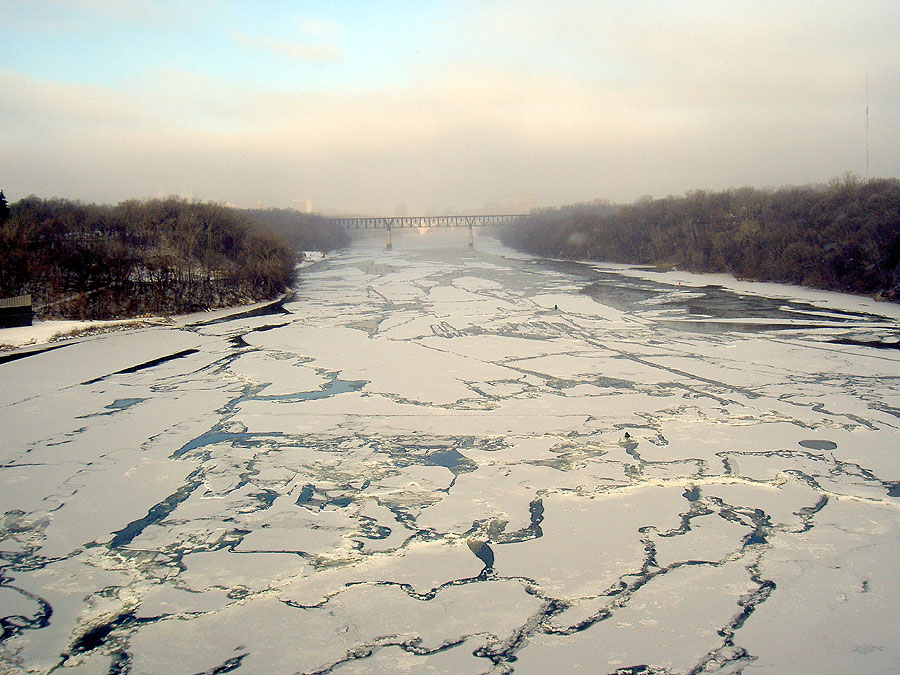
Having removed my commando sweater, I rode on, crossing the river on the Ford Street bridge. The Mississippi is largely open; one week it looked well-frozen over, the next it was clear. I think the ice must float off downstream. Within a month the river will be open for navigation again, but for the moment there are still areas with lots of ice.
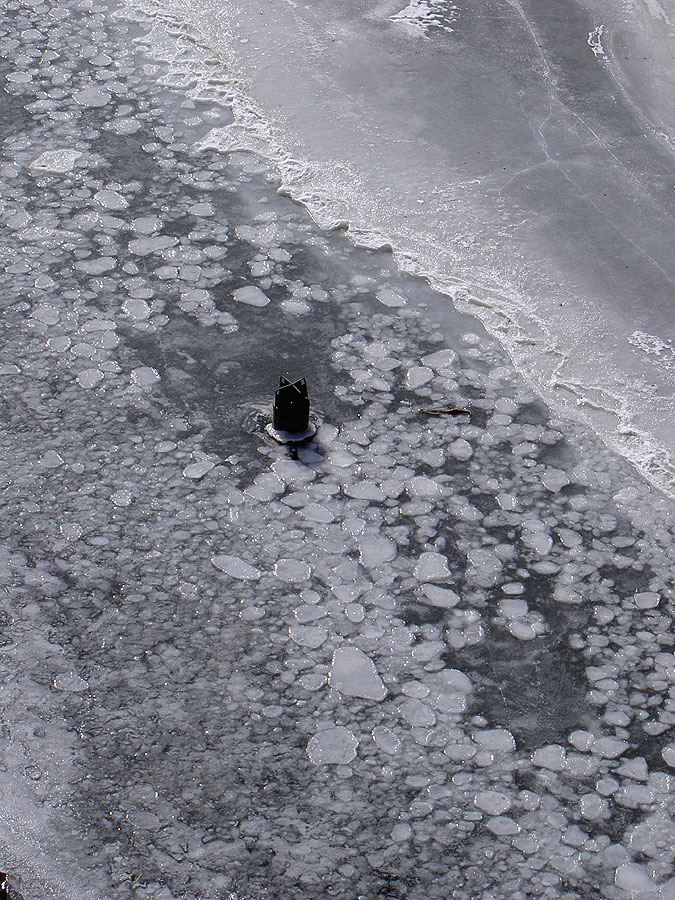
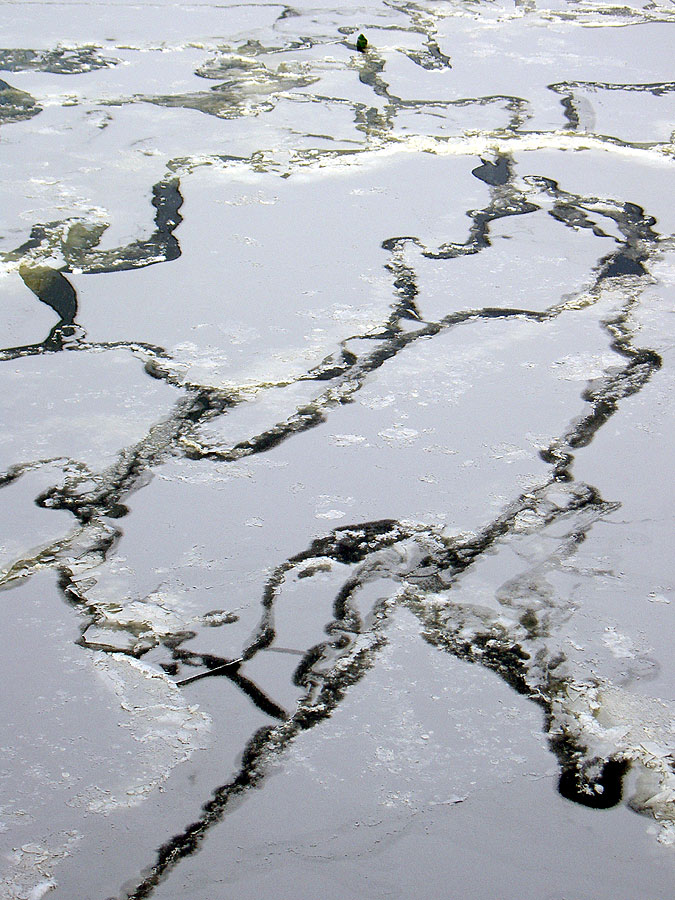
Ice on the Mississippi with Buoy February 2006
Here you can see a navigation buoy in the ice on the river just above Lock and Dam Number 1.
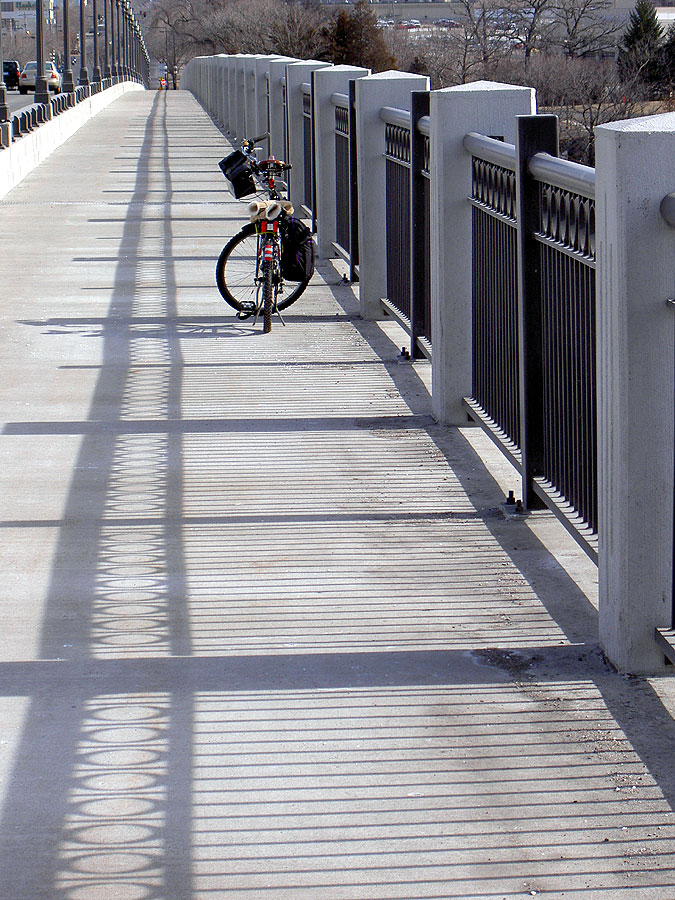
Marin Bicycle on Ford Bridge  February 2006
Here's the Marin parked on the Bridge. There's nothing remarkable here, I just liked the pattern of the shadows.

I rode on across and worked my way up to Raymond Street. There was a Swap Meet going on but, in my typical fashion, I had only a vague idea of where it was. I got on Raymond and rode by a parking lot full of cars with bike racks. Aha! This must be it! I parked the bike, paid my five bucks, and went in.

Almost immediately I ran into Jim and Kevin from Hiawatha Cyclery who recognized me from a couple of brief encounters last summer. I admired their stuff, took one of the excellent Atlantis brochures, and took a look at a 68cm Eisentraut frame Kevin had bought. A friend of mine in Saint Louis rides an Eisentraut he got in about 1978 I think.

The meet was probably great for the total equipment freaks. Here's what I wrote a friend of mine:

There was a Mavic crankset which looked very sleek but where the large chainring was a part of the crank forging, so it could never be changed. This seems an odd design decision although on the other hand I hardly ever ride the big chainrings and have never ever worn one out. There was a Bridgestone XO-1 there, not a pretty bike, but I thought maybe they should have a kneeling cushion and some prayer candles and incense in front of it so we could all worship ("Our Grant, who art in Walnut Creek, Moustache be thy bars"). The Hiawatha Cycle guys were there and had a really nice Atlantis brochure, one of which I took. It's so nice I want to buy another one! There was a photo on back of the 47cm (I think, the smallest one anyway) and the 68cm frames side by side, aligned at the bottom bracket. They had a normal-sized built-out Atlantis there (and a Ramboooeelay) and the measured the downtube diameter which was 1.25". I used a tape on mine, not calipers, too lazy to go inside, but am pretty sure it is 1.625". Jim (Oil is for Sissies, one of the Hiawatha guys) said they thought about carrying Pashleys but figured it might be too expensive and take a lot of explanation to sell them. He thought they'd be $1,300 but this seems high to me, they go for 460 pounds in the UK, maybe $825, and I figured it would run a couple of hundred to ship here, but maybe you'd get VAT back, so just assumed a Roadster Sovereign would cost me $1,000 delivered, maybe a bit more if I bought a spare tube and tire or two. There were a bunch of bikes and components that I'm pretty sure are extremely lustworthy to small subsets of the cycling community but of which I know nothing. There was a framebuilder (Chris Kvale, who is well thought of) selling framebuildng jigs. He has a little store I ride past on the way to/from church on my normal route and is closing the store; maybe he's stopping making frames too. And there were many way cool people, old Steel Framers like ourselves (not cool), tattooed singlespeeders, in-the-know racers, etc. Also some cute babes. I impressed this lot by, as I left, riding off the curb and having my pannier fall off.

I didn't buy anything. I did get something off eBay in the mail today, a 46-tooth Biopace chainring I want to try on my Schwinn World Sport with a Nexus 8-speed hub. I'm gathering the parts to do this, the Biopace is just the next item. It is kind of hilarious, it looks like a manufacturing mistake or maybe the detritus of some hideous accident.

I did ride home and my pannier fell off twice more. This is truly annoying. It is a pretty nice pannier, a very useful model no longer made, but it has the traditional U hooks (think an upside-down U) and an elastic bit that hooks on the rack bottoms. When you go fast, or over curbs in front of cute 21-year-olds, it bounces off. It ought not to be that hard to make hooks that lock on the rack, that hang on no matter what, and I may try and chase down an Ortlieb or Carradice set of clamps and graft onto this pannier to stop this.

Riding home was pretty fast. I thought maybe this was the awesome power of my magnificent legs but eventually noticed that the flags were snapping pretty well and I had a good tailwind. Still, it felt nice.

In other news, further details have come out about President George Bush's bicycle crash last summer at the G8 summit in Scotland. Apparently he came riding quickly by a group of policemen and tried to wave as he rode by and crashed, sliding for 5 metres and hitting a policeman hard enough that he was off work for 14 weeks. You can read about it in the New Zealand Herald. Sadly, the remarkably restrained Al Jazeera article seems to have gone. Oh well. As you may recall, the seriousness of this accident was minimized at the time. President Bush is going to end up clumsier than President Ford; he chokes into unconsciousness on a pretzel, falls off a Segway, crashs his bike in Texas and again in Scotland. With his lawyer-shootin' Vice President, it's like Laurel and Hardy leading us.

The San Francisco Chronicle has a report about actual charges being filed against a bus driver who attempted (er, allegedly attempted) to run a cyclist off the road, then ran over his $5,000 bicycle. The charges are for assault with a deadly weapon, vandalism and reckless driving. Man, wouldn't it be gratifying it that happened a little more often!

Speaking of bikes'n'crime, the Washington Post is reporting that a punk bank sticker on a bike cause a big bomb scare in Ohio:

ATHENS, Ohio -- A sticker on a bicycle that said "this bike is a pipe bomb" caused a scare Thursday at Ohio University that shut down four buildings before authorities learned the message was the name of a punk rock band, a university spokesman said.

The sticker on the bike chained outside the university-owned Oasis restaurant near the center of campus attracted the attention of a police officer about 5:30 a.m., spokesman Jack Jeffery said.

Police blocked streets around the restaurant and the Columbus police bomb squad came from about 65 miles away.

The bomb experts hit the bike with a high-pressure spray of water, then pried it apart with a hydraulic device normally used to rescue accident victims trapped in cars, acting Athens Fire Chief Ken Gilbraith said. Once they had it open, they saw there was no bomb.

The article goes on a bit; the area was declared safe, the bike owner was questioned and released, the punk band's label has no phone number. No mention if he gets paid for the bike.

Can you imagine coming out to get your bike and there is a pack of cops ripping it apart with a hydraulic device? Maybe he'd better stick with I Wish My Girlfriend Was As Dirty As My Bike stickers.

Saturday, February 25, 2006

Dubya and Dubai

It's been entertaining to see the hysteria surrounding the deal to sell the firm that manages six U.S. ports to a United Arab Emirates firm. There has been a bipartisan eruption of dismay and disbelief at this, and the President, who wasn't involved in the decision (there's a shock) has admonished the opponents of the deal for being racist.

There is a certain satisfaction in all this. This Administration has hearkened back to the terrorist attacks of 9/11 to justify all sorts of abrogations of our rights and liberties domestically and treaties internationally. Bad behavior, whether it's reclassifying documents, holding U.S. nationals without habeas corpus or torturing prisoners, is justified due to the fight against terrorism. There are some shameful commercials running now in Minnesota which again tie the Iraq war to the 9/11 attacks. Now, let us be clear about this; Iraq had nothing to do with 9/11 and none, not one, of the 9/11 hijackers was Iraqi. Neither did Iraq have weapons of mass destruction and many in our intelligence community knew it and were ignored or suppressed. Now we find ourselves with over 2,000 dead Americans, thousands more wounded and maimed and a bill approaching half a trillion dollars.

Compare that to the United Arab Emirates, where Dubai is located. Two of the 9/11 hijackers were Emiratis (both on United flight 175), money to fund the operation came through banks located in the Emirates and the country has been a common route for weapons proliferation activities, including facilitating the transshipment of nuclear weapons materials to Iran from A. Q. Khan, the head of the Pakistani nuclear weapons program and probably the world's worst proliferator.

Now, given the utter lack of involvement in 9/11 of Iraq and the war there we've pursued regardless, doesn't the involvement of actual Emirati personnel and financial institutions in the 9/11 attacks and the participation in weapons of mass destruction proliferation activities give this Administration even a moments' pause? I watch television and these patriots on the commercials tell me that the war in Iraq is justified and reminds us of the 9/11 attacks with photos even though, to reiterate, Iraq had nothing to do with 9/11. (The commercials also tout the great strides in Iraqi democracy, about which I don't give two hoots, but are silent regarding weapons of mass destruction or the utter lack of planning for the postwar occupation). Then I see the President wonder why there is any concern when a nation who had citizens participate actively in the 9/11 attacks takes over running several major ports.

Should we be all worked up? You know, probably it's no big deal, running the ports involves scheduling trucks and maintaining cranes, more than likely a company from Dubai is as good as anyone. The security at these ports is lax already, it's not likely to be any worse now, if you can call that reassuring. Also, the people who actually do the work of running the company tend to be Westerners, American, British, Australian, etc., not actual Emiratis. Realistically, it's probably not a security threat, but our President has used hysteria at every turn to justify the Iraqi war and the excesses of the war on terror so should not be surprised when that same hysteria is turned against him on what can only be described as a tone-deaf political decision.

In at least a snippet of good news, our President during his State of the Union speech talked about our addiction to oil and all the alternative energy programs we're working on at the same time the actual National Renewal Energy Laboratory announced that it had to fire 32 people working on ethanol and wind energy projects due to a $28 million funding cutback. As part of a tour to tout his energy programs Mr. Bush visited the lab. The hypocrisy of touting these energy sources as the key to future on one hand and simultaneously firing the actual researchers on the other was apparently too much for even Mr. Bush to bear and the Department of Energy rustled up $5 million to restore the positions cut, although the actual employees hadn't all been called back the day Mr. Bush visited. The lab's funding is still down $23 million from last year. They're going to cut back on employee travel, conferences and subcontractors.

Bikewise, it seems a quiet time of year. The initial novelty for new winter riders has passed and we're into the dreary, ugly part of the season. The evenings seem pretty bright, the worst of the cold snaps is behind us, the snow's ugly, the streets dusty with sand and salt so that passing cars can leave a salty taste in your mouth. There is a Bike Swap at the Saint Paul Academy School Gym on Sunday which I might go to. I had planned to do a circuit of all the stores carrying used bikes to see if there were any good 3-speeds available for the Lake Pepin Three Speed Tour (for a friend of mine, I despair of finding one my size) but my buddy bought a Rudge off eBay so even that isn't needed now.

Thursday, February 16, 2006

Shoot First, Answer Questions Later

Vice President Richard "Dick" Cheney's shooting of 78-year-old hunting companion Harry Whittington last Saturday has brought on an onslaught of jokes and comments. There are a couple of angles which I don't think have got a lot of coverage.

Locally, has anyone tied this to our former Governor Jesse Ventura's comments about "you haven't hunted until you've hunted man"? Minnesotans may recall that Jesse was being interviewed at a time when his choice for the Department of Natural Resources commissioner was under question. Jesse dismissed deer hunting as being for wimps, and said that until you've hunted man, a prey that can shoot back, you haven't really hunted, alluding to his time in the military. By his reckoning, I guess Vice President Cheney has now really hunted, though he kind of cold-cocked Mr. Whittington. Pity he hit him in the face, it sort of ruins the trophy.

It's also illuminating to recall that during the 2004 election, John Kerry was mocked by the Bushies when he went hunting. As I recall, Mr. Kerry never shot anybody accidentally (he did shoot people while in the employ of the United States Government, much like Mr. Cheney just did, but that was in Vietnam, and he didn't just wing them). The sniggering mockery looks pretty lame now, as Mr. Cheney's gun handling skills appear deficient.

Mr. Kerry was also mocked during the 2004 campaign for having an $8,000 bicycle. Mr. Cheney's shotgun is a custom-made Italian Perazzi that runs $7,500 or more. Both men are plenty wealthy, they can spend their money where they want, but why is it worth mocking to have an expensive bike but not to have an expensive shotgun? Appropriately enough, the Perazzi home page has a graphic of a man with a sight aimed at him. Now, if you were John Kerry, wouldn't it be deeply tempting to say Mr. Cheney, if you like shooting so much, why didn't you come and join us in Vietnam rather than getting multiple deferments? The Army would have shown you how to handle a firearm properly too, so as to minimize these friendly fire casualties. (I particulary like Mr. Cheney's baby deferment: one day the government said married men without children would no longer be exempt from the draft. Nine months and two days later, the Cheneys had their first child. That's performing on demand!)

Finally, it's interesting to note that the Law and Order Vice President didn't have the required Quail Stamp for his hunting license. He's since sent in a check for $7 to get this. No word on whether or not he had the Lawyer Stamp, or what the bag limit is on 78-year-olds.

Tuesday, February 14, 2006

Some UK Cycling Notes

Some various notes from the last few days.

I rode to church again. It was our priest's last Sunday, so for the third week in a row we did an 11:00 Festival service rather than the usual 9:00 Stodgy/11:00 Lame service schedule. Since the choir sings the Stodgy service (which is becoming somewhat less stodgy as time goes on) and has to warm up, we need to be there before 8:30 most Sundays, and at up to an hour and a half to ride in requiring a 7AM departure, it's unlikely I'll be riding in on Sunday mornings for a while. It was another cold morning, 16F when I left, but clear and dry and a routine ride. After church, I partook of my new favorited Sunday afternoon riding tradition, not finding a bike store whose location I more or less know. Last Sunday I rode obliviously by the new Hiawatha Cyclery; this Sunday it was the turn of Sunrise Cyclery. I remembered this as being at 31st and 3rd Avenue, rode there, and trolled up and down a couple of blocks without success. Turns out that it's at 31st and 2nd Avenue, I was a block away, but by then I'd given up, got on the Midtown Greenway and ridden home. I was going to look to see what Sunrise had in the way of used 3-speeds; I bought a 1967 Sturmey-Archer AW 3-speed hub from the Sibley Bike Depot on Saturday (another ride, but this time I at least knew where Sibley was!) to build a wheel, but a friend of mine is looking for a 3-speed for the Lake Pepin Three Speed Tour in May. Oh well, I'll have to try Sunrise some other time.

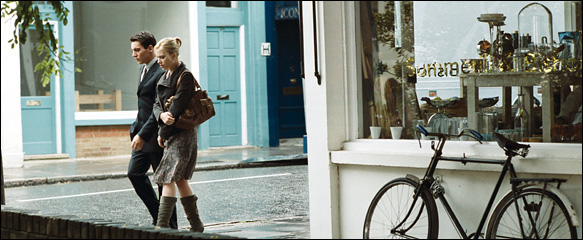
Speaking of English 3-speeds, there was an article in the New York Times last week about how accurately Woody Allen's new movie Match Point portrays London's geography. This is the photograph from the article:

Match Point photo from NY Times
I like how the main prop in the photo is a bicycle, what looks to be an English 3-speed. I hope it's locked, because from what I can tell, bicycle theft is a big problem in the UK, especially in London. One wonders what the prop would be in New York. A hot dog stand? A yellow cab? Cops beating some Critical Mass riders?

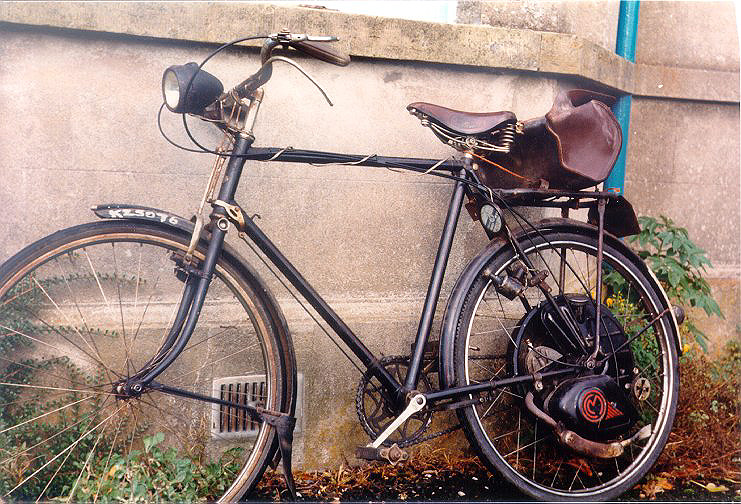
Speaking of English bikes, I rode a week ago Sunday to a friend's house in Bloomington to watch the Super Bowl. I parked my bike in their garage, and then, when leaving, saw what looked like an English 3-speed in the garage. The wife in this couple is from Northern Ireland, so I inquired at choir practice on Wednesday. Turns out this is a Cyclemaster, a 25.7cc two-stroke gasoline powered bike her father, a priest, bought in 1950 and used for several years to make the rounds in his parish before he could afford a car. The bike cost 25 pounds, the Cyclemaster accessory was 25 pounds more, at a time when he made 400 pounds a year. They've kept it all these years and now the husband has got it running again.

Cyclemaster in Ireland  1963
This is a photograph of the Cyclemaster in 1963, still in Ireland. This couple has a scan of the owners manual and I slapped it together in a PDF file and have posted it to the web. Once the weather warms up, we're going to get this thing out and play with it and take some photos. It looks like good fun. It would be fun, and truly British, to take on the Lake Pepin Three Speed Tour but that might be unsporting.

More English cycling news. The Tour de France is starting in Britain in 2007, the Prologue in London and the first stage from London to Canterbury:

2007 Tour de France  Stage 1  London to Canterbury

Well, my family's English, I have a heap o' cousins over there, so I looked up a couple of addresses in the Yahoo! UK Maps and compared them with the roads in my Ordnance Survey Motoring Atlas of Great Britain. It looks like one cousin lives about 1.5 miles off the route early in the stage when the race goes from London towards Greenwich and another lives one mile off the route as it passes through the Kent town of Tonbridge. Sadly, none of my cousins had the foresight to move to Canterbury. Although I doubt that I will do anything about it, it is tempting to imagine hiring a motorcycle (from Scootabout in London, where a friend and I rented Honda 500s for a couple of happy weeks in 1985), catching the race going by in London, then zooming off to Tonbridge to see it pass there as well. Well, we've got more than a year to consider it.

These cousins are the children of my Uncle John, who died in December. As related in an earlier entry, I was unable to attend the funeral. However, we were sent a copy of the Reflections on Uncle John's life. From a cycling point of view, these bits are interesting:
"As a teenager he was a keen cyclist, making expeditions alone equipped with a small tent or sometimes accompanies by his friend Trotter Trout....He still cycled and traveled during the vacations and in 1939 whilst his family were camping in Folkstone he and a friend were on bikes well in to France. Heading east near Reims they encountered refugees fleeing in the opposite direction and decided the wisest course was to turn around and pedal hard for the Channel ports...[he was] commissioned into the 109th Field Artillery of the Royal Artillery and spent time training at various locations including Northumberland and Cumbria. He rode a large motorcycle for a short time until he hit a milk van head on but was saved by flying over the roof and landing on the road, only cutting his leg with a small scar that he would show us when we were small."
I stayed home Monday, wife's on jury duty, daugher's sick, and left only to pick up my truck. It was making some hideous noises from the back. It's a 1996 Ford Ranger, made right here in Saint Paul, a little less than 67,000 miles on it, and it needs a differential rebuild. What do you do? I OK'd it, and it was $1,700. Funny how you just swallow and pay up to fix a motor vehicle, even a cheapish one that is running into problems way too early, when spending that kind of money on a bike is something I agonized over for years. And I like bikes. I rode my bike up to the dealership to pick up the truck, then tossed the Marin in the back and drove home. On the way up, when cars passed by, the dust they kicked up tasted salty. We're in for a cold week these next few days, but it won't be long and winter will be over.

Saturday, February 11, 2006

A Cold and Frosty Morning

I've been riding some more. Once you get used to this cold weather thing, once you're over the fear that you're going to freeze to death, it's kind of fun. My rides remain mostly to church. Sunday the Bishop was visiting so the main service wasn't until 11:00 so there was plenty of time to ride (typically the choir needs to be there at 8:30 or so, and it's unlikely that I'll be out the door at 7AM on a Sunday to make this). I set out in 8F temperatures amid frozen icy particles drifting about and cloud-thinned sunshine. It was pretty, and kind of fun to take the same route I've been using Wednesday nights but in daylight.

State Fair Grounds in February
The State Fair Grounds on a February Sunday morning. There was just a light dusting of snow on the ground.

Mississippi River north from Lake Street Bridge
Looking upriver from the Lake/Marshall Bridge. The river is finally icing up, having remained open water through our warm January.

Ice on the Mississippi  February 2006
Not that I'd want to walk on this ice.

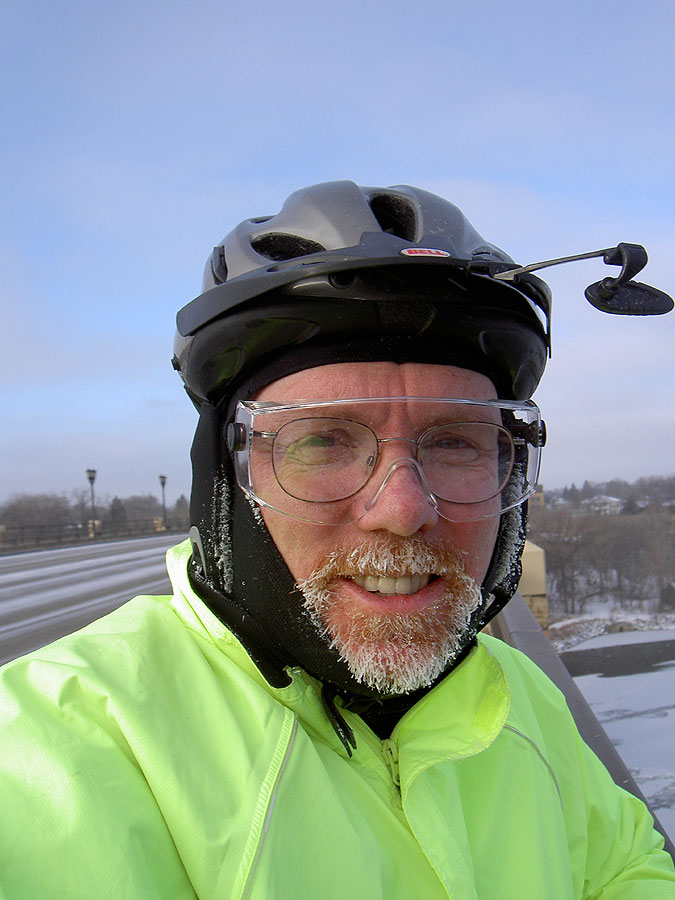
Frosty Matt on Lake Street Bridge
I'm looking nice and frosty. I like the frost on the ear covers, my breath flowing back in the slipstream and freezing. I had to pick a lot of ice out of my beard when I got to church--I'm only halfway there at this point.

There are enough cyclists in these Cities that even at 9:00AM on a frosty Sunday morning I wasn't the first bike down these streets. Down Pelham, across the Lake/Marshall Bridge and then down 46th Avenue I followed in the path of someone else. They had carried on down 46th as I turned onto 42nd Street.

Once church was over, we were invited to watch the Super Bowl at some friends' in Bloomington. By now it was 1:30 and I figured there wasn't much point in riding home, just to turn around and drive down. Karla and the kids headed home in the car while I set off on the bike.

I thought I'd take a crack at Hiawatha Cylcery, which I recalled being on 54th Street somewhere, down towards the eastern end. I rode down the Minnehaha Creek Trail for the first time since early November, alongside the icy creek and past the dog-walkers who seem to be the main users now. I met one other cyclist coming the other way. It was in the low 20s by now, but sunny, and felt warmer. I rode right the way down 54th Street and didn't see Hiawatha Cyclery though I must have ridden right past it. Oh well. I crossed over to Minnehaha Park and rode the upper path to Fort Snelling. The main obstacle here is the airport--I wanted to be south of it. My choice was to circle all the way around the western end or take the Fort Snelling State Park loop to the Post Road. I did this.

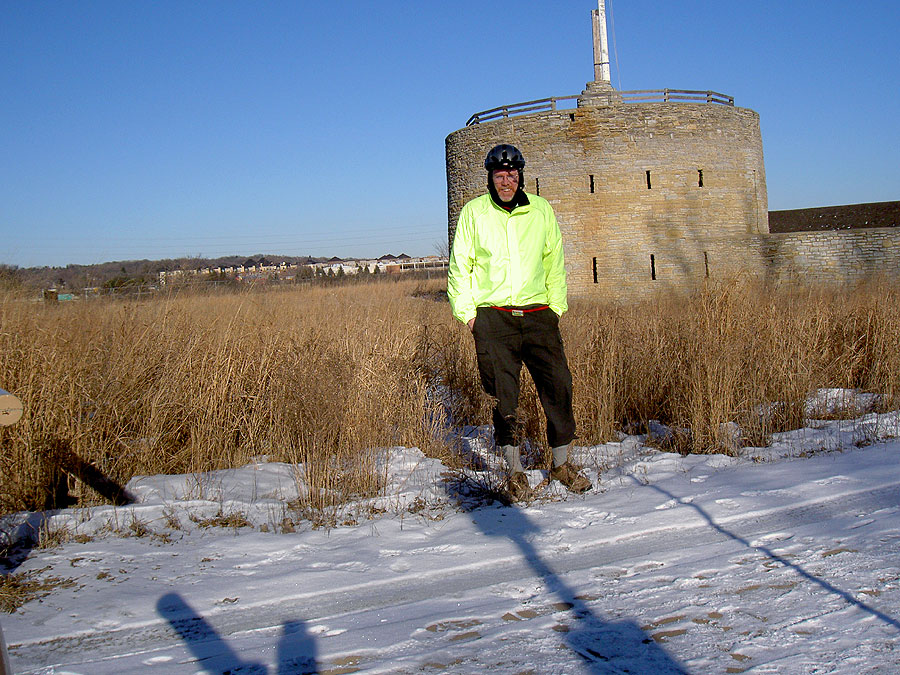
Me at Fort Snelling  February 2006
Me up by the Fort. Fort Snelling was established in 1829 and one wonders how these folks kept warm through these frigid winters. They wouldn't be all that impressed that I ride a bike in this weather.

Local cyclists might be familiar with the very steep hill right next to the fort that takes you from the blufftop to the river valley. This ends abruptly at a T intersection right at the bottom of the hill which merits caution even in summer. This path hadn't been cleared and was still snow-covered and in some parts pretty icy. I gingerly rode down, dragging the back brake in particular all the way down, then set off into the park. The roads were cleared and I made my way around and then up the park entrance road to the Post Road. Here, consulting my excellent Twin Cities Bike Map, I plotted my course down past the Humphrey Terminal to Old Shakopee Road and eventually to 106th Street under the Interstate and to our friends' house where I staggered in baying for beer and football.

The novelty of this was that all the trip south of the airport was new territory for me, places I hadn't previously ridden, yet I was content to plug along finding my way through even though it was 20F outside. It was like it was a day in May. I ended up doing 32 miles from the time I set off from home, this on a bike I don't think I've ever ridden more than 35 miles in a day, and now hobbled with snow tires and chain grime. I would hardly call myself a dedicated winter cyclist, for these conditions (cold, dry and sunny with mostly dry and sandy roads) are pretty easy, but this whole winter riding thing does take some getting used to and I think I'm getting there. It is worth noting that I didn't ride home, instead slapping the bike rack on the back of the Toyota and hauling the bike back when the game was done.

I rode again Wednesday to choir practice and then, uncharacteristically, rode home. I was helped in part by my new headlight, a Light and Motion Solo Logic SL. I couldn't be happier with this light, a 13W halogen headlight that casts a bright and wide beam (you can actually focus it), is non-fussy on the bike (just a battery and the light head, no auxillary switch wires or other nonsense) and has a plug-and-forget charger. The light casts a beam virtually as bright as a car headlight, just narrower (I was noting that I could still just make out my light patch on the street as cars overtook me with their lights on). With this lighting my way and the three blinkies on back (albeit on steady, not blinking), I feel like a pretty visible road user.

Mount for two blinkies on Marin
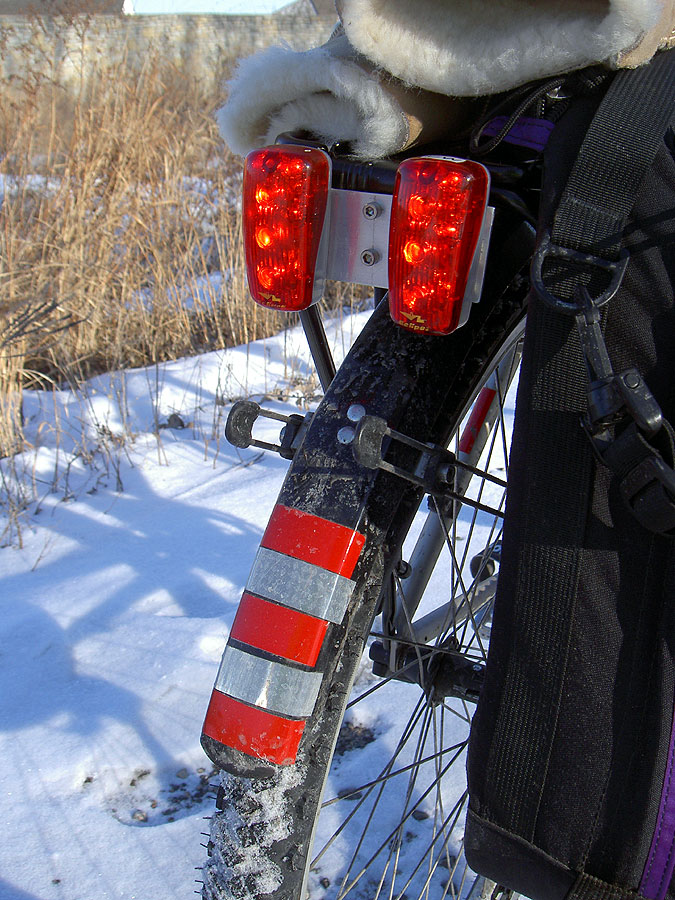
This is my mount for two taillights on the rack. I figure that these will look like one bright light at a distance and resolve into two smaller lights as people draw closer. I also have some reflective tape here.

I also got a good demonstration of the studded tires in action. I took a slightly different route to church including riding down 32nd Street. This dumps you into Powderhorn Park and the map says to go around the northern end of this. This was the wrong direction by a block or two, so I instead rode through the park. This drops down to a frozen pond with people skating on it, then up a short, sharp hill to the street. This sidewalk wasn't cleared but had been trodden down and then frozen and I rode up. Going up, in a low gear, I was pushing hard enough that the rear wheel would spin a fraction of a rotation and then grip as the studs reasserted themselves. Without another bike there to try it, I can't be certain, but I think a non-studded tire would simply have spun on the icy sidewalk and I would have been unable to ride up the hill. I rode triumphantly off at the top and headed on south.

I am pretty slow. I keep finding myself seeing 14 and 15 mph on the computer but then averaging 10.2 mph or something over the whole trip. Maybe it's because I'm not looking at it when I grind my way up some slippery sidewalk at 4.5 mph or whatever. Also, I can't read the computer most of the time unless I go under a streetlight.

On the way home, I noticed as I went by Como Lake that my cheeks got really cold. This was nearly at the end of an hour and twenty minute ride. It was perfectly clear out, harbinger of a cold night to come, but it was still 17F when I got home a few minutes later. I think that some colder air had settled in the small valley Como Lake lies in and that as I came down the hill to the lake I descended into this cooler air, then climbed back out up towards home. It was the only point in the ride where my face felt very cold. Funny how you notice things like that on a bike.

So I'm building some experience. I haven't ridden in bitter winds yet, I haven't ridden in driving snow or icy treacherous streets where out-of-control motorists could be a real threat, I haven't ridden in miserable 35 degree rain or biting -10F temperatures. You know what? Probably I won't, either, driving and the bus remain options for me and there are times when comfort, safety and convenience will have me do those rather than ride. Sure this makes me soft, but even for a softie like me there is much to enjoy in winter cycling once you get over the psychological barriers of "Ride a bike? In the cold? Are you nuts?".

So since I'm sure everyone is just dying to know, here's what I've been wearing:

A pair of silk sock liners, then a nice thick pair of SmartWool socks, and a pair of Timberland walking shoes. These are pretty bulky and when I finally put my XL PowerGrips this last week they fit much better and I haven't kicked off my pannier since.

For my legs, I'm wearing a pair of black SmartWool long underwear. I bought these pretty recently and they are great. I had a pair of polyproylene long undies I got a Target for $13 but they were kind of short and I wasn't all that pleased with them. These SmartWools are wondeful, long and warm and delightfully soft, I'd wear them all the time if it wouldn't make me sweat to death. On top of those, I wear a pair of wool dress pants. They don't look so dressy anymore, they have pilled badly, and the styling's a bit odd, with cargo pockets, but they are comfortable. So far, not having ridden in the wet or bitter winds, this combination of long underwear and trousers has been plenty warm. Oh, I generally also wear a pair of cycling underwear, like Andiamnos, under all this. I noticed early on that one's, ahem, parts can get kind of chilly whilst riding, and this helps in that area.

For the upper body, it's a SmartWool t shirt, an Ibex or WoolyWarm long sleeved wool jersey and then a Cabela's lambswool commando sweater, all topped with an REI cycling jacket, just a windshell, nothing insulated. This all keeps me pretty warm, warm enough that I've left the armpit zippers open for all this riding.

For my hands, it's a pair of Acorn merino Shearling mittens. They are toasty warm, windproof, breathable and extremely easy to get on and off even while riding.

For my head, it's a balaclava shockingly not made of wool! I top it with a Bell Metro helmet in which I have installed the Cold Weather Kit (plugs all the vents, has ear flaps over the ears). I own a face mask I haven't worn yet, instead putting a bit of lotion on my cheeks and nose before setting out. When it's been below about 20F, I've worn a pair of goofy safety glasses to cut the wind on my eyes.

On these rides to and from church, which extend to well over an hour, I've also been listening to the radio. I have a little Walkman and put an earphone in just the right ear, leaving my left ear open to hear traffic. Sometimes it's music, sometimes it's NPR, sometimes it's sports talk radio. Wednesday night I listened to the Timberwolves game, very unusual for me as I don't give a rat's ass about basketball, because Henry's singing the National Anthem at the game Friday (along with the rest of the Minnesota Boychoir) and I'm going and so thought I'd get a taste of what I'm in for. What I'm in for, it sounds like, is a team that leads by 15 early, has the opposing star player have an off night, and still loses by 6 at the end. Oh boy!

Monday, February 06, 2006

Groundhog Speech

The President gave his State of the Union speech the other night. I didn't watch it because I can hardly bear to hear the man talk. I see a breathtaking amount of hypocrisy in this administration and don't like the culture of corruption, cronyism and incompetence it has engendered. Still, reading the post-game reports, one bit sounded familiar:

Keeping America competitive requires affordable energy. And here we have a serious problem. America is addicted to oil, which is often imported from unstable parts of the world.

The best way to break this addiction is through technology. Since 2001, we have spent nearly $10 billion to develop cleaner, cheaper and more reliable alternative energy sources. And we are on the threshold of incredible advances. So tonight, I announce the Advanced Energy Initiative, a 22 percent increase in clean-energy research at the Department of Energy to push for breakthroughs in two vital areas. To change how we power our homes and offices, we will invest more in zero-emission coal-fired plants, revolutionary solar and wind technologies and clean, safe nuclear energy.

We must also change how we power our automobiles. We will increase our research in better batteries for hybrid and electric cars and in pollution-free cars that run on hydrogen. We will also fund additional research in cutting-edge methods of producing ethanol, not just from corn but from wood chips and stalks or switch grass. Our goal is to make this new kind of ethanol practical and competitive within six years.

Breakthroughs on this and other new technologies will help us reach another great goal, to replace more than 75 percent of our oil imports from the Middle East by 2025. By applying the talent and technology of America, this country can dramatically improve our environment, move beyond a petroleum-based economy and make our dependence on Middle Eastern oil a thing of the past.

We've been hearing about this before. In 2003, President Bush...

"...announced a $1.2 billion hydrogen fuel initiative to reverse America's growing dependence on foreign oil by developing the technology for commercially viable hydrogen-powered fuel cells to power cars, trucks, homes and businesses with no pollution or greenhouse gases. Combined with the FreedomCAR (Cooperative Automotive Research) initiative, President Bush is proposing a total of $1.7 billion over the next five years to develop hydrogen-powered fuel cells, hydrogen infrastructure and advanced automotive technologies."

Hmmm, we're three years in, how's that going? I think Honda has a couple of hydrogen cars (a couple of vehicles, not a couple of models) it's leasing to families, was that part of the initiative? It's always great to announce these programs with long time frames so that the real costs arise after the current administration is gone, and this administration is by no means the first to engage in this bit of long-term grandiosity.

In 1998, Bill Clinton was on the case in his State of the Union speech:

"We have it in our power to act right here, right now. I propose $6 billion in tax cuts and research and development to encourage innovation, renewable energy, fuel-efficient cars, energy- efficient homes. Every time we have acted to heal our environment, pessimists have told us it would hurt the economy. Well, today our economy is the strongest in a generation. And our environment is the cleanest in a generation. We have always found a way to clean the environment and grow the economy at the same time."

In 1980, Jimmy Carter gave a terrific speech. It's hard now to remember what a good man he was, how uncynical compared to recent presidents. It's worth reading the whole thing, but unlike the empty rhetoric we get now with no action to back it up, Carter was clear:

"The single biggest factor in the inflation rate last year, the increase in the inflation rate last year, was from one cause: the skyrocketing prices of OPEC oil. We must take whatever actions are necessary to reduce our dependence on foreign oil--and at the same time reduce inflation.

As individuals and as families, few of us can produce energy by ourselves. But all of us can conserve energy--every one of us, every day of our lives. Tonight I call on you--in fact, all the people of America--to help our Nation. Conserve energy. Eliminate waste. Make 1980 indeed a year of energy conservation....

Our material resources, great as they are, are limited. Our problems are too complex for simple slogans or for quick solutions. We cannot solve them without effort and sacrifice. Walter Lippmann once reminded us, "You took the good things for granted. Now you must earn them again. For every right that you cherish, you have a duty which you must fulfill. For every good which you wish to preserve, you will have to sacrifice your comfort and your ease. There is nothing for nothing any longer."

The Oil Crises predated Carter. Here's Gerald Ford in 1975:

During the 1960's, this country had a surplus capacity of crude oil which we were able to make available to our trading partners whenever there was a disruption of supply. This surplus capacity enabled us to influence both supplies and prices of crude oil throughout the world. Our excess capacity neutralized any effort at establishing an effective cartel, and thus the rest of the world was assured of adequate supplies of oil at reasonable prices.

By 1970, our surplus capacity had vanished, and as a consequence, the latent power of the oil cartel could emerge in full force. Europe and Japan, both heavily dependent on imported oil, now struggle to keep their economies in balance. Even the United States, our country, which is far more self-sufficient than most other industrial countries, has been put under serious pressure.

I am proposing a program which will begin to restore our country's surplus capacity in total energy. In this way, we will be able to assure ourselves reliable and adequate energy and help foster a new world energy stability for other major consuming nations.

But this Nation and, in fact, the world must face the prospect of energy difficulties between now and 1985. This program will impose burdens on all of us with the aim of reducing our consumption of energy and increasing our production. Great attention has been paid to the considerations of fairness, and I can assure you that the burdens will not fall more harshly on those less able to bear them.

I am recommending a plan to make us invulnerable to cutoffs of foreign oil. It will require sacrifices, but it--and this is most important--it will work.

I have set the following national energy goals to assure that our future is as secure and as productive as our past:

First, we must reduce oil imports by 1 million barrels per day by the end of this year and by 2 million barrels per day by the end of 1977.

Second, we must end vulnerability to economic disruption by foreign suppliers by 1985.

Third, we must develop our energy technology and resources so that the United States has the ability to supply a significant share of the energy needs of the free world by the end of this century.

To attain these objectives, we need immediate action to cut imports. Unfortunately, in the short term there are only a limited number of actions which can increase domestic supply. I will press for all of them.

I urge quick action on the necessary legislation to allow commercial production at the Elk Hills, California, Naval Petroleum Reserve. In order that we make greater use of domestic coal resources, I am submitting amendments to the Energy Supply and Environmental Coordination Act which will greatly increase the number of powerplants that can be promptly converted to coal.

Obviously, voluntary conservation continues to be essential, but tougher programs are needed--and needed now. Therefore, I am using Presidential powers to raise the fee on all imported crude oil and petroleum products. The crude oil fee level will be increased $1 per barrel on February 1, by $2 per barrel on March 1, and by $3 per barrel on April 1. I will take actions to reduce undue hardships on any geographical region. The foregoing are interim administrative actions. They will be rescinded when broader but necessary legislation is enacted.

To that end, I am requesting the Congress to act within 90 days on a more comprehensive energy tax program. It includes: excise taxes and import fees totaling $2 per barrel on product imports and on all crude oil; deregulation of new natural gas and enactment of a natural gas excise tax.

I plan to take Presidential initiative to decontrol the price of domestic crude oil on April 1. I urge the Congress to enact a windfall profits tax by that date to ensure that oil producers do not profit unduly.

The sooner Congress acts, the more effective the oil conservation program will be and the quicker the Federal revenues can be returned to our people.

I am prepared to use Presidential authority to limit imports, as necessary, to guarantee success.

I want you to know that before deciding on my energy conservation program, I considered rationing and higher gasoline taxes as alternatives. In my judgment, neither would achieve the desired results and both would produce unacceptable inequities.

A massive program must be initiated to increase energy supply, to cut demand, and provide new standby emergency programs to achieve the independence we want by 1985. The largest part of increased oil production must come from new frontier areas on the Outer Continental Shelf and from the Naval Petroleum Reserve No. 4 in Alaska. It is the intent of this Administration to move ahead with exploration, leasing, and production on those frontier areas of the Outer Continental Shelf where the environmental risks are acceptable.

President Ford was also wringing his hands about a budget deficit that might hit $45 Billion and a national debt that would top half a trillion dollars. Funnily enough, only Democratic President Bill Clinton's administrations have run budget surpluses since then. Fiscal conservative Ronald Reagan ran big deficits; so did George Bush I, though he tried to rein them in with some tax increases and got savaged for it; George Bush II has spent money like a drunken sailor, seen huge budget deficit increases yet finds tax cutting to be the correct policy prescription for nearly all our ills. We will one day rue these developments. Now we have an $8 trillion national debt and it rises about $2 billion a day. The half trillion dollar national debt isn't as much as is proposed for defence spending in the budget just submitted (ok, I'm being unfair here and using nominal dollars, not constant).

Richard Nixon, soon to resign under threat of impeachment for, among other things, domestic wiretaps and coverups, addressed the issue in early 1974:

Looking at the year 1974 which lies before us, there are 10 key areas in which landmark accomplishments are possible this year in America. If we make these our national agenda, this is what we will achieve in 1974:

We will break the back of the energy crisis; we will lay the foundation for our future capacity to meet America's energy needs from America's own resources....

We will establish a new system that makes high-quality health care available to every American in a dignified manner and at a price he can afford....

In all of the 186 State of the Union messages delivered from this place, in our history this is the first in which the one priority, the first priority, is energy. Let me begin by reporting a new development which I know will be welcome news to every American. As you know, we have committed ourselves to an active role in helping to achieve a just and durable peace in the Middle East, on the basis of full implementation of Security Council Resolutions 242 and 338. The first step in the process is the disengagement of Egyptian and Israeli forces which is now taking place.

Because of this hopeful development, I can announce tonight that I have been assured, through my personal contacts with friendly leaders in the Middle Eastern area, that an urgent meeting will be called in the immediate future to discuss the lifting of the oil embargo.

This is an encouraging sign. However, it should be clearly understood by our friends in the Middle East that the United States will not be coerced on this issue.

Regardless of the outcome of this meeting, the cooperation of the American people in our energy conservation program has already gone a long way towards achieving a goal to which I am deeply dedicated. Let us do everything we can to avoid gasoline rationing in the United States of America.

Last week, I sent to the Congress a comprehensive special message setting forth our energy situation, recommending the legislative measures which are necessary to a program for meeting our needs. If the embargo is lifted, this will ease the crisis, but it will not mean an end to the energy shortage in America. Voluntary conservation will continue to be necessary. And let me take this occasion to pay tribute once again to the splendid spirit of cooperation the American people have shown which has made possible our success in meeting this emergency up to this time.

The new legislation I have requested will also remain necessary. Therefore, I urge again that the energy measures that I have proposed be made the first priority of this session of the Congress. These measures will require the oil companies and other energy producers to provide the public with the necessary information on their supplies. They will prevent the injustice of windfall profits for a few as a result of the sacrifices of the millions of Americans. And they will give us the organization, the incentives, the authorities needed to deal with the short-term emergency and to move toward meeting our long-term needs.

Just as 1970 was the year in which we began a full-scale effort to protect the environment, 1974 must be the year in which we organize a full-scale effort to provide for our energy needs, not only in this decade but through the 21st century.

As we move toward the celebration 2 years from now of the 200th anniversary of this Nation's independence, let us press vigorously on toward the goal I announced last November for Project Independence. Let this be our national goal: At the end of this decade, in the year 1980, the United States will not be dependent on any other country for the energy we need to provide our jobs, to heat our homes, and to keep our transportation moving.

To indicate the size of the Government commitment, to spur energy research and development, we plan to spend $10 billion in Federal funds over the next 5 years. That is an enormous amount. But during the same 5 years, private enterprise will be investing as much as $200 billion-- and in 10 years, $500 billion--to develop the new resources, the new technology, the new capacity America will require for its energy needs in the 1980's. That is just a measure of the magnitude of the project we are undertaking.

But America performs best when called to its biggest tasks. It can truly be said that only in America could a task so tremendous be achieved so quickly, and achieved not by regimentation, but through the effort and ingenuity of a free people, working in a free system....

I think all of us recognize that the energy crisis has given new urgency to the need to improve public transportation, not only in our cities but in rural areas as well. The program I have proposed this year will give communities not only more money but also more freedom to balance their own transportation needs. It will mark the strongest Federal commitment ever to the improvement of mass transit as an essential element of the improvement of life in our towns and cities....

Unrelated to energy but of remarkably current interest:

One measure of a truly free society is the vigor with which it protects the liberties of its individual citizens. As technology has advanced in America, it has increasingly encroached on one of those liberties--what I term the right of personal privacy. Modern information systems, data banks, credit records, mailing list abuses, electronic snooping, the collection of personal data for one purpose that may be used for another--all these have left millions of Americans deeply concerned by the privacy they cherish.

And the time has come, therefore, for a major initiative to define the nature and extent of the basic rights of privacy and to erect new safeguards to ensure that those rights are respected."

Nixon would resign that summer in the fallout of the Watergate scandal. We were driving down the 401 in southern Ontario at the time he resigned and my parents let me, a new driver, try driving 1t 65 there since the U.S. speed limit had been dropped to 55 to conserve oil. Something was being asked of us.

There are a number of things that stink about getting older (although, as my mother once said, it's better than the alternative!) but one satisfying thing is seeing the fuss and buzz of daily news resolve itself into longer story cycles. The Peak Oil predicitions made in the 1950s said U.S. oil production would go into decline around 1970; sure enough, it did, President Ford alludes to it above. The resulting increase in dependence on foreign oil combined with Arab anger at the Yom Kippur war got us an OPEC embargo, higher gasoline prices and, in some places, lines at gas stations (though I never saw any personally). This was around the time I began driving.

The reaction to that lasted a decade, as we dumped the huge, heavy inefficient (and often pretty crappy) cars for smaller vehicles that polluted much less and got better mileage. My own experience saw me go from a 1972 Plymouth Valiant, a compact in the parlance of the day, which had a 318 cubic inch (5.2 litre) V-8 and just managed 20 mpg on the highway, to a 1986 Saab 900 with a 2-litre inline 4-cylinder that would manage the upper 20s. 1986 also happens to be the year the U.S. passenger fleet reached its peak in fuel efficiency. That year oil prices collapsed to around $10 a barrel, cars started to creep up in size and the expectation for horsepower went up as well. The 110 horsepower of my Saab 900 would be laugable now; our Totota Avalon has 225 and the new ones have 280. In the last decade the number of vehicles exempt from even our unambitious fleet fuel efficiency requirments has increased, particulary pickup trucks (and yes, I have one, a 1996 Ford Ranger, 25 mpg on the highway, around 20-21 in mixed driving) and sports utility vehicles. Attempts to raise the requirements or to impose the same safety and efficiency requirements on these vehicles in get shouted down amid cries about the safety of America's children (lighter vehicles=less safety, goes the logic) even though it has been shown that SUVs have higher death rates than sedans.

So, OK, gas is $2.09 a gallon, sounds like a crisis, any call to sacrifice? Any "For every right that you cherish, you have a duty which you must fulfill?" Any "Ask not what your country can do for you?" Any "I have nothing to give but blood, sweat, toil and tears?" How about raising gasoline taxes, perhaps 10 cents a gallon a year for the next five years? How about eliminating tax breaks that encourage the purchase by individuals of trucks over 6,000 pounds? How about encouraging some conservation?

Nope. The extremely patriotic Vice President Dick Cheney (patriotic now that he doesn't need to worry about his draft deferrments) went on the very patriotic Rush Limbaugh's show (for you Family Values types, that's the drug addict guy who recently divorced his third wife, which seems not to faze the Bible bashers despite the good book's clear injunctions against divorce) to say the Administration would continue to push to open the Arctic National Wildlife Refuge to drilling. How about some sacrifice? Samuel Bodman, the Energy Secretary, said that "many Americans believe they're already sacrificing by paying the prices they're paying for gasoline and heating oil and natural gas." Hmmm, it's $2.09 a gallon over at the corner gas staion, cheaper than it was in 1981 in real terms. That's some sacrifice! Our leaders, supposedly engaged in a war againt terrorism, have asked nothing beyond that we keep flying and go shopping. And don't worry about those wiretap things.

So in the meantime, our oil imports continue to creep upwards. The lofty goal of eliminating our dependence on Mideast oil is pushed out to 2025; even though it's under 20% of our oil consumption, we continue to send tens of billions of dollars a year to the Middle East, including to Saudi Arabia, our strong ally and, oh yeah, home of 15 of the 19 September 11, 2001 hijackers. Our purchases help keep the price high for everyone, ensuring plenty of funding of our adversaries, of those who work to kill our troops. Al Qaeda and the Iraqi insurgents don't get their money from bake sales, they get it from oil.

Will the situation be any different in 2025 than it was in 1974? That's a 50 year span, and 30 of them have passed and the situation has deteriorated. Will we still have brave talk, rousing calls to action and a continuing addiction to hydrocarbons produced by unsavoury regimes, a continued drain on our economy and a continued funding source to those who hate us? Probably. Our leadership is unwilling to take any hard steps. Jimmy Carter asked for sacrifice and was voted out for an Alzheimers sufferer. George Bush I tried to be responsible and pay for our spending and was summarily despatched from office. Bill Clinton ran surpluses, attacked Al Qaeda bases in Afghanistan and contained Saddam and he was savaged by the party who has found it preferable to spend money like water, expand entitlements, involve us in a needless war and alienate our allies.

For all the brave talk Monday of biofuels and switchgrass, the Energy Department is about to lay off 40 scientists who work on biofuels due to budget cuts proposed by this President and passed by this Congress. For all the talk of increased competitiveness in technology and research, this Congress just passed cuts in student loan programs that help university students.

I'll keep riding my bicycle to substitute for some trips in our cars, I'll keep working to make the house more energy-efficient, but I fully expect to hear a State of the Union speech twenty years hence saying that our dependency on imported petroleum is reaching a crisis point and something needs to be done about it, just like I heard last Monday and just like I heard thirty years ago. By then it will hardly be my problem any longer, and I can pass it on to my children and to theirs. The time for brave action is, ummm, then. In the meantime, keep the gas flowing.

Sunday, January 29, 2006

Late January

I rode to choir rehearsal again, last Wednesday. I haven't been noting each time I do this and this was my third time this year. Geared up as I was for what is typically the coldest week of the year here, it was 30 degrees out and the challenge was to stay cool enough. Having bought 160-stud Nokian Mount and Ground studded tires in December, January is uncharacteristically warm and the streets were so snow-free that I could have ridden the smooth-tired Atlantis with no problem. And the tide has turned; as I set out there was still some glow in the sky in the west as we pick up a couple of minutes of sunlight a day. A week ago Wednesday we had 9 hrs 13 minutes of daylight; last Wednesday it was 9 hrs 27 mins; in a couple of days it'll be 9 hrs 43 mins. A half hour more daylight in two weeks. It feels good.

You still need lights, though. I see other cyclists out riding with proper lights and I see, sometimes, others riding showing no lights whatsoever. I think these latter people are foolish and may not realize quite how invisible they are to motorists. I've been showing 3 taillights (one on my helmet, one under my seat, one on my pannier) and two headlights (a Blackburn Quadrant, one which doesn't fall off, and an old Nice Light! which actually works pretty well considering it's just 4AAs.) I also have reflector tape on my rear fender.

I tried shearling mittens for the first time. My cycling buddy Paul in Cedar Rapids, Iowa, who rides lots more than I do, said he's found that shearling works best of all. He said that he tried lobster mittens but they'd get soaked with sweat and get all clammy but shearling absorbed the sweat, stayed warm and dried out gracefully. I picked up a pair of Acorn Merino Shearling Mittens from Sierra Trading Post for $25 and used a free shipping coupon code (now expired) to keep the cost down. Although they're L/XL, they're a bit small for me (isn't everything?) but were very warm. Of course, 30F is hardly an acid test.

Paul, a retired engineer, has also been performing experiments. I have one of the legendary Jong-Won JSB-500 stainless steel vacuum insulated water bottles. It works great, keeping icy stuff really cold in the summer and coffee or whatever piping hot in the winter. The guy at Bicycle Coffee Systems loved these things. I'd given Paul one. In the autumn of 2004 he had came up and spent three weeks scraping and painting my house, I fed him pizza and beer and in my everlasting thanks gave him a stainless water bottle that cost me $10 on clearance from Things Remembered a couple of years before.

Paul writes:

Cole:

I don't know why I'm spending time writing to you about this; I guess it's just your lucky day.

I was reading your blog and you mentioned your "excellent Jong Won JSB500 stainless steel thermal water bottle". When I rode to KC to pick up the truck, I took the JSB500 you gave me (thanks) along. The day I left it was cool and misting so I filled it with coffee. It kept the coffee warm for a few hours. I stopped mid morning and had some warm coffee. The next few days I would fill it with ice and Gatorade so that in the afternoon after my Camelbak was empty I would have something cold to drink. JSB500 worked well but for some reason I could not get the coffee taste to wash out of the bottle. And the cap on the JSB500 sucks; it leaks and seems to be the main heat loss point.

Well anyway I bought two other stainless steel thermal water bottles from Campmor.com. They are: This one and this one.

These seem to be the same bottle with the second one just having an additional cap with a pull spout. Both bottles also have a nice push-open push-closed stopper and the cutest little drinking cup cap you've ever seen. Both hold 16 oz. They are a loose fit in a water bottle cage so you have to bend the cage in slightly to keep the bottle from rattling.

I tested the three bottles by pouring near-boiling water in each and periodically checking the water temp. The Campmor bottles performed about the same and held heat better than the JSB500. After a couple of hours, the difference was more than 20F. Again, the problem seemed to be with the JSB500's cap.

The first bottle from Campmor is only $10. The second one is $16 with the extra $6 getting you a pull to sip top. I sent back the 16 buck bottle because I can't see trying to sip hot coffee on a bicycle anyway.

So for 10 bucks the Campmor bottle seems like a pretty good bottle. They also sell a 24 oz version for $16, but it's dia is a bit too big for a water bottle cage. I suppose you could bend up an old cage and make it work.

Well that is all for today.

Later,

PBS

Paul being an engineer and all, I sent him a link to Despair, Inc.: Inspiration

I haven't bought the Campmor bottle yet because I don't want to pay shipping on a $10 item and am not sure I need anything else from them, plus I have two of the JSB-500s. I like these units but they have two weaknesses. First, the flip-up top has a little rubber nipple in the top of it to seal off the drinking spout. On two of my three tops (I bought a spare), this has fallen out, which allows road grit etc to fall into my beverage and my beverage to splash out onto my bike. Second, when you drink from it, there's a little rubber valve arrangement that allows air in to displace the liquid you're sucking out (it's steel, so you can't squeeze it, unless maybe you're on better 'roids than I am). This thing makes an amazingly annoying noise if, for instance, you ride to choir practice and get a latte on the way to enjoy whilst rehearsing, then start sucking on it while your wife the director tries to give the choir instructions. It turns out to be much more politic to pour your caffeinated beverage into a cup to drink from with just the usual slurping and lip-smacking.

I haven't really tried drinking coffee while riding, at least not more than once. The flip-up top seems break-prone in this kind of action and the excellent thermal performance of the JSB-500 ensured that when I tried it I scalded the shit out of my tongue.

In other intensely interesting news, I have been riding Power Grips straps on the Marin rather than my SPD pedals. This allows me to wear some big hiking shoes that easily fit two pairs of socks and keep my toes warm. I pinched the pedals and straps off my son's bike and the straps are a bit short, forcing my foot back a bit and ensuring that last Wednesday I managed to kick my pannier off the rack and into the street. I'll probably buy some new pedals and the XL straps for myself, give Henry back his pedals and fit mine for the shoes I wear for winter riding. In the meantime, I wish I could find a good system to better attach the pannier to the rack, something more positive like Ortlieb's or Carradice's clamps.

My bike lives in a detached garage and never thaws out. I also discovered last week that when I ride through lots of sloppy messy streets then park the bike in the warm church during choir rehearsal, it drops all the slop on the carpet. Fortunately, the bike did this in the side entrance elevator lobby rather than on the main new carpet, but last night and in future weeks I'm going to park it in the kitchen by the floor drain.

I was out this past Saturday and stopped in a couple of bike shops. Interesting items include a built-up 700C Nexus 8 speed wheel with a coaster brake at The Bicycle Chain, a bike shop quite close to me. I have a 68cm Schwinn World Sport I'd like to roadster-ize and have been thinking about the Nexus 8-speed internal hub as a possibility. I feel kind of bad for the store; somebody ordered this up, had them build the wheel then decided they didn't want it. Demand for Nexus wheels probably isn't huge, and here I am intrigued with the Nexus hub idea, but the one I'm interested in is the red-band SG-8R25 (1,550g) not the SG-8C20 (1,990g) with the coaster brake.

Over at the Hub Bike Coop they had a little display of Shimano dynamo hubs including both the $85 DH-3N70 and the new $99 DH-3D71 (but not the DH-3N71), which supposedly has 40% less rolling resistance than the DH-3N70 when the lights are off. This would be a great front hub for the World Sport Roadster though again I managed to resist temptation. The 3D71 they have is the Disk brake-compatible model, the 3N71 they don't have is the non-disk brake compatible. I think you could use the 3D71 on a non-disk brake bike, but you'd end up with a weirdly dished front wheel. I did buy a Topeak rear rack that was discounted because the bolts to attach it to the dropouts were missing. Sheesh, $8 off because $0.50 of bolts are missing? I'll take it!

I stopped in at the Express Bike Shop at Snelling and Marshall in Saint Paul. These guys sell used bikes and I have an interest in a big honkin' three-speed so I can ride in the Lake Pepin Three Speed Tour. I despair of finding one, however, but wonder if a Sturmey-Archer 3-speed hub on the Schwinn World Sport would count? Did they have any S-A hubs? They did, a 1972 one for $6 but the rod and chain shifting mechanism seems to be missing. I looked around; they have a big-framed Maserati built out as a fixed-gear for $195 and, in a world where my 68cm Atlantis and Schwinn frames are as giants among men, they had a custom-built 69cm racing bike! Holy smokes! It was a Watson (?) custom frame and was fitted with running gear, though I didn't pay attention to that, as they also wanted $800 for this unit.

Meanwhile, as I dream of Nexus 8-speeds and 3-watt dynamos and sweat my way around on the Marin kicking my panniers off with my big feet the lengthening days and unseasonably warm weather bring forth thoughts of balmy days ahead. Probably we'll have some more cold weather, we're likely to get socked with some real snowfall before we're done, but things are on the upswing and the priceless sunny balmy days of spring and summer are coming.

Sunday, January 01, 2006

Sloppy Mess

I haven't ridden much the last couple of weeks; the work involved in doing the Lessons and Carols at church followed by out-of-town visitors to be collected, fed, and taken around, stole away my time. I do love Christmas and New Year's, but it's always a very busy time and the timing of Christmas this year made it busier than usual.

I began to feel a bit bloated and inactive, even though my weight hadn't moved by more than a couple of pounds. Then on the 29th my Uncle John died, my Dad's brother in England. By Saturday the funeral was scheduled for next Thursday and I considered going. Although this sounds a bit morbid, I had carefully hoarded 50,000 Northwest WorldPerks miles for just this eventuality and figured I might try to fly Tuesday to Tuesday. But, I'd have to have some year-end things ready at work before I went. So I rode to work, my last commute of the year.

By Saturday morning the wet 7" snowfall we'd had Thursday was mostly cleared from the roads and it was still pretty warm, right around 30 degrees. I got dressed and rode to work in the slop. I'm happy to say I wasn't the first to ride Lexington, that there were one and for a while two prior sets of bicycle tracks by 10:00AM, though I didn't see the cyclists. Work is 4.8 miles if I ride straight there, more like 5.0 miles if I stop at Caribou to get a fancy-ass coffee in my stainless steel thermal water bottle, like I did Saturday morning.

I'm still pretty new to the Nokian Mount and Ground 160s (see Peter White Cycles for a description of these studded tires) and so set gingerly off. Experienced winter bikers will not be surprised to find that what I ran into wasn't so much treacherous ice patches, not at these moderate temperatures, but rather a slimy salty sloppy mess in the bike lane. I plugged along with no traction issues, riding in the main traffic lane when there was nobody coming, slogging along in the slop when there was. After a mere 5 miles of this, I had nasty buildups of gunk under my downtube, on my derailleur and all over my waterbottle. Fortunately, this particular water bottle is meant to keep your beverage hot (or cold) and not so much to drink out of whilst riding, so I could take it inside and pour the contents out of the grime-covered bottle into my coffee mug.

A couple of hours wrapped up my end-of-month work, and I rode home, stopping in Arthur's Jewelers, looking like a robber with my balaclava on, to get a watch battery replaced, where a very fetching young lady did a great job of feigning interest in winter cycling, then home through the intersection where a pedestrian was killed the night before. They hadn't heard about it at Arthur's; I suppose another dead person is unremarkable when it's something so routine.

My bike gets parked in an unheated garage, so doesn't mess up the house, but my water bottle melted off into a messy puddle on top of the dishwasher. Looking at this mess, I thought that I need to get myself some really good chain lube! I think I also need to extend my fenders, fine for occasional rides in rain with fairly mildly treaded-tires but inadequate protection for riding in slop with aggressive debris-throwing knobbies.

With the work details nailed down, I called Northwest to see about travel. Normally, 50,000 miles is enough for a standard overseas travel reward; normally, January to the U.K. is a low-demand route, low enough that Northwest discontinued their direct Minneapolis to London flight for the winter. However, this isn't quite normal, I'd have to travel Monday or Tuesday to be there in time and these are intensely busy days, the end of holiday travel. Buying a ticket was expensive; even Icelandair through Reykjavik was running $2,200. There were a couple of weird routings down into the $1,700 range, Continental through Orlando or Houston, but that's a still a lot of money. By contrast, a flight three weeks from now is about $500. That's the difficulty of wanting to book on short notice in a blackout-date period. There is no such thing as a bereavement award and the minimum number of miles to book on short notice for flights this week was 100,000. I'm not entirely surprised they remained inflexible in considering 50,000 miles for me to fly; it looks like the actual Northwest routing through Detroit has nothing but Business and First class seats left, and perhaps they have no flexibility in dealing with partner awards through other cities.

And so Uncle John will be buried Thursday and I won't be there. We'd actually talked Christmas Day, when he'd called here to chat and also to talk to his brother, my Dad. John was nearly 86, a British Army veteran of North Africa, Italy and Greece, with seven children, my cousins, and 25 grandchildren. In the funny ways that a family can be buffeted by global affairs, he was all set to move to Persia in the 1950s to work for British Petroleum there when the CIA engineered a coup and installed the Shah of Iran (who would subsequently be overthrown in 1979 and replaced by the mullahs who currently run the country and who are pursuing nuclear technology but for its peaceful uses only, and not to wipe Israel off the map). He did work for BP, but spent his career in London rather than the Middle East. He married a doctor, my Auntie Gwen, and they have lived south of London ever since. It was their 50th anniversary in September 2001 that found us in Britain when the 9/11 terrorist attacks occurred, our last time over. Gwen is still there, and my cousins, John was struggling with cancer, he would have been 86 in a couple of weeks, but it's still a surprise and shock when he actually died. May his soul rest in peace.