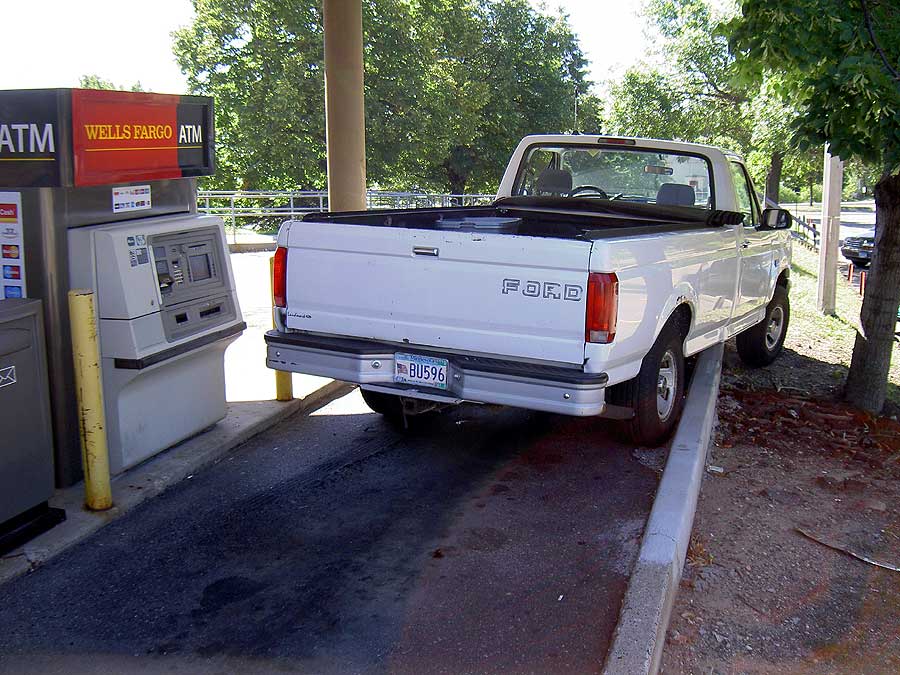
It's getting pretty bad when you can't even pull away from the ATM without getting inextricably stuck. I came across this in South Saint Paul Saturday morning. The ATM still worked. The driver who executed this maneuver was not in evidence.
Sunday, August 07, 2005
We're sharing the road with 'em, folks
It's getting pretty bad when you can't even pull away from the ATM without getting inextricably stuck. I came across this in South Saint Paul Saturday morning. The ATM still worked. The driver who executed this maneuver was not in evidence.
Friday, August 05, 2005
Number 9 Number 9 Number 9
Apologies to Beatles fans.
I decided to go for a ride Wednesday night. Three things intrigued me; a crossing of Highway 280 from the west end of Roselawn to Broadway mentioned in a comment by another blogger (Nathan); a bike shop I hadn't been to called Behind Bars; and a bridge over the Mississippi I'd never even noticed known as Bridge Number 9.
So I set off, westbound down Roselawn right to the end. You can go from the end of Roselawn across into the left turn lane of Highway 280 and take a left onto Broadway. It looks like this (and, if you like Google Maps, like this):

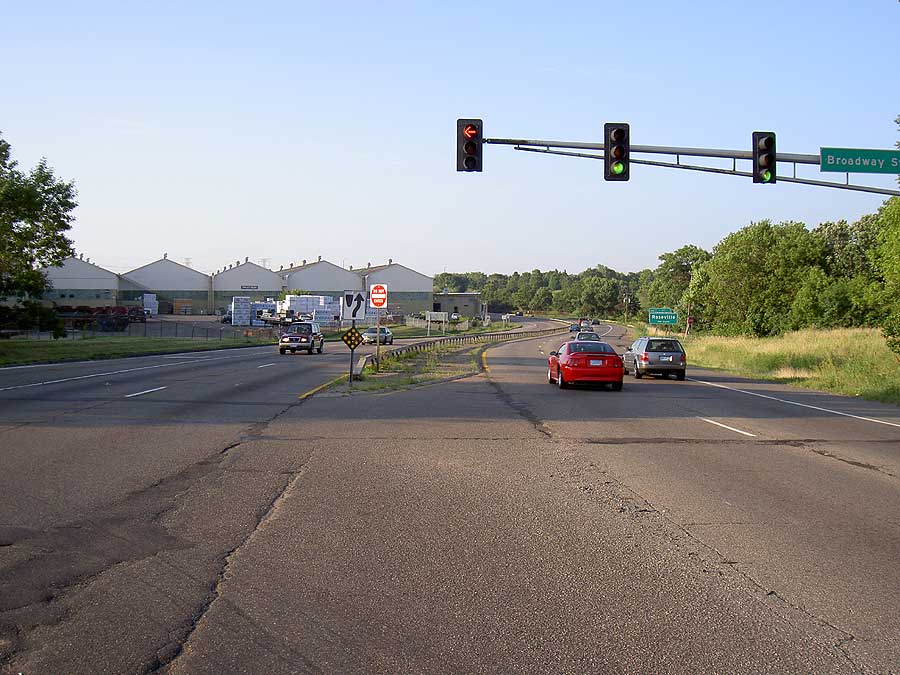
Highway 280 is a 55-mph limited access highway, not Interstate quality, but nearly as inhospitable. I waited for a big gap in northbound traffic and nipped across into the left turn lane to get onto Broadway. I got a red arrow in the lane so, not wishing to be thought a scofflaw, I waited. Luckily, My Friend The Car arrived behind me to trigger the light for me. I also noticed that there is a pedestrian crosswalk button on the east side even though there's no painted crosswalk or sidewalk along the highway. Here was my view.

I rode off westbound on Broadway. It's not marked as a suggested bike route on the Twin Cities Bike Map and I can see why; it blows. It's four-lanes, but no shoulder, the pavement's in bad shape, there's shitloads of glass and hordes of UPS trucks trying to make it in by 7:00PM (I rode by the UPS hub at about 7:05). Once past UPS, things got a bit less frantic and I coasted on down the long hill, across Stinson and over I-35. You get squeezed down to one lane under some railroad tracks and traffic picks back up going up towards Central. I crossed Central and knew I was getting in the area of the Behind Bars bike shop. I took a wrong turn by some of Minneapolis's classic industry:

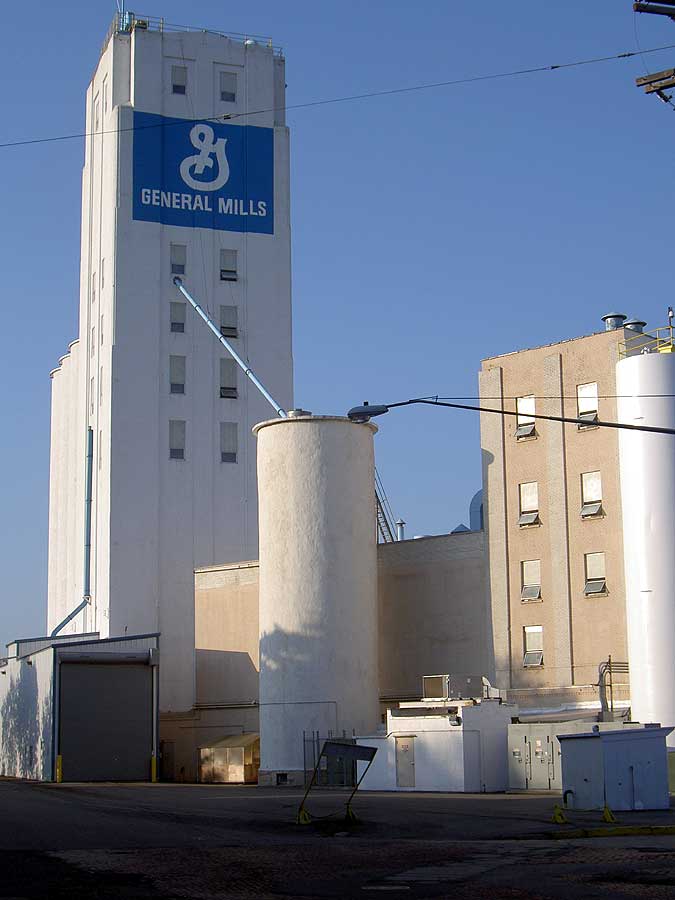
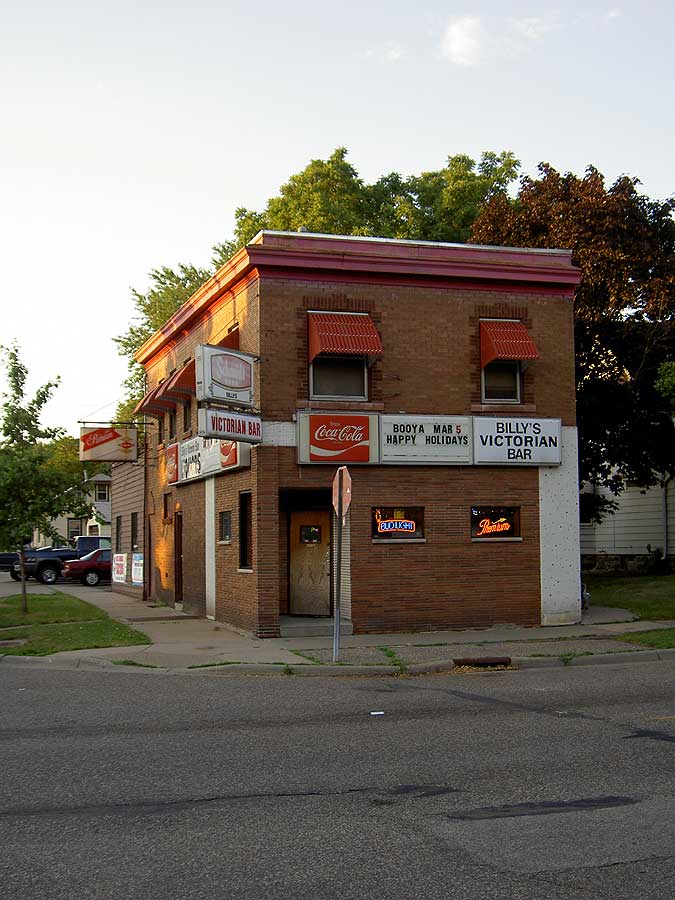
I wonder how many developers have driven by thinking, hmmm, that would make for some nice condos? For the moment, it's still in operation. Lots of charm, too, the streets are brick. Maybe one day when it's raining I'll come back and try some high speed turns on this to get a flavor of the European spring classics. In the meantime, I clattered back and forth up this street. There are some classic northeast Minneapolis eating establishments around, like this one on Broadway.

I've never actually eaten here, so this isn't an endorsement.
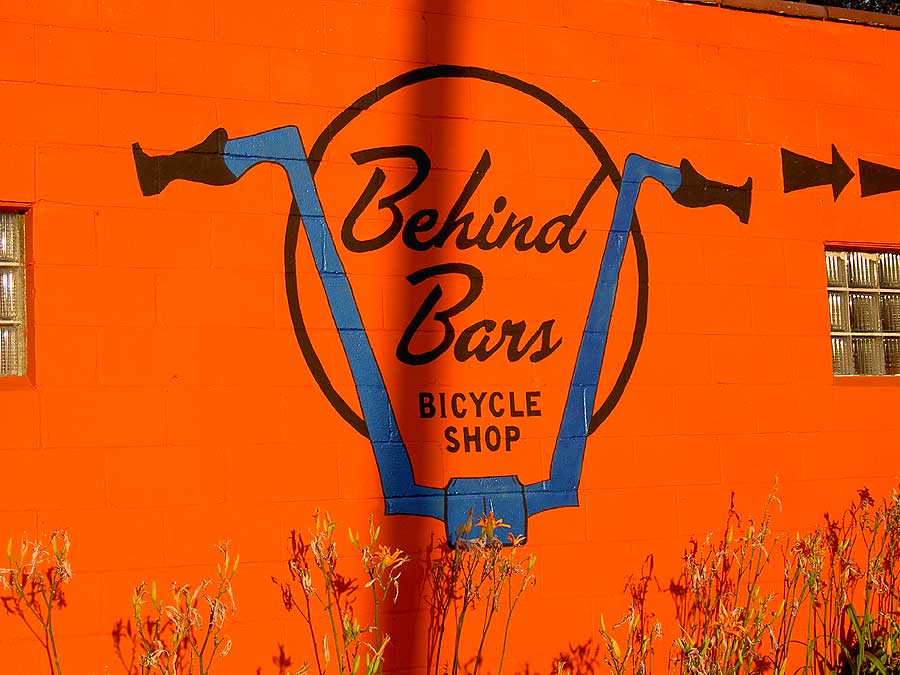
I rode on down to 208 13th Avenue NE and found Behind Bars. It was open! I went in and talked to Chuck, the guy who runs the place. He asked how I'd heard of them; I told him I'd read about him on a blog. He was interested in which one. I had to think and then look on his computer, but it was Bicyclo II. He took a look at it and said, oh yeah, Michael, I know him. We chatted for a while, interrupted by a couple of customers. I offered to take his picture outside the store, no such thing as bad publicity you know, just make sure you spell the name right, but he didn't want to do that. I instead took a photo of the store's name painted on an adjacent wall.

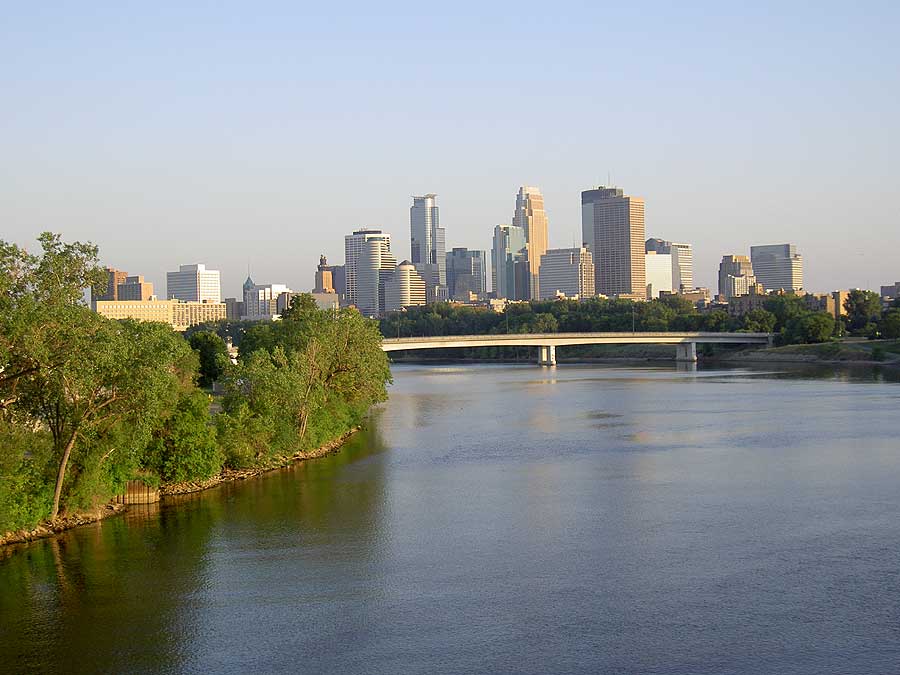
I rode on down past the old Grain Belt brewery and set off across the Broadway bridge over the Mississippi. I rode on the south sidewalk so I could see the view downriver, where you can see downtown Minneapolis and the Plymouth Avenue bridge. The bridge Henry and I took going to Baker Park a month ago is another couple of miles upstream from here.

I wasn't interested in following Broadway any further west at the moment and instead set off down the West River Road. At Plymouth a bike trail arises on the east side of the road. I was at the red light eyeing this across the intersection; the WALK light was still on for cross-traffic; there was no cross-traffic; I looked around; I ran the light (shhh!). God, I'm embarassed. Still, it saved me a couple of minutes and the light didn't seem to be responding to me.
I rode down to downtown, past the Mill City Museum and the Guthrie Theatre Erection and under the I-35 bridge. About here the path diverges and loops up to the end of the Number 9 bridge. I rode over to it. There's a historical marker.
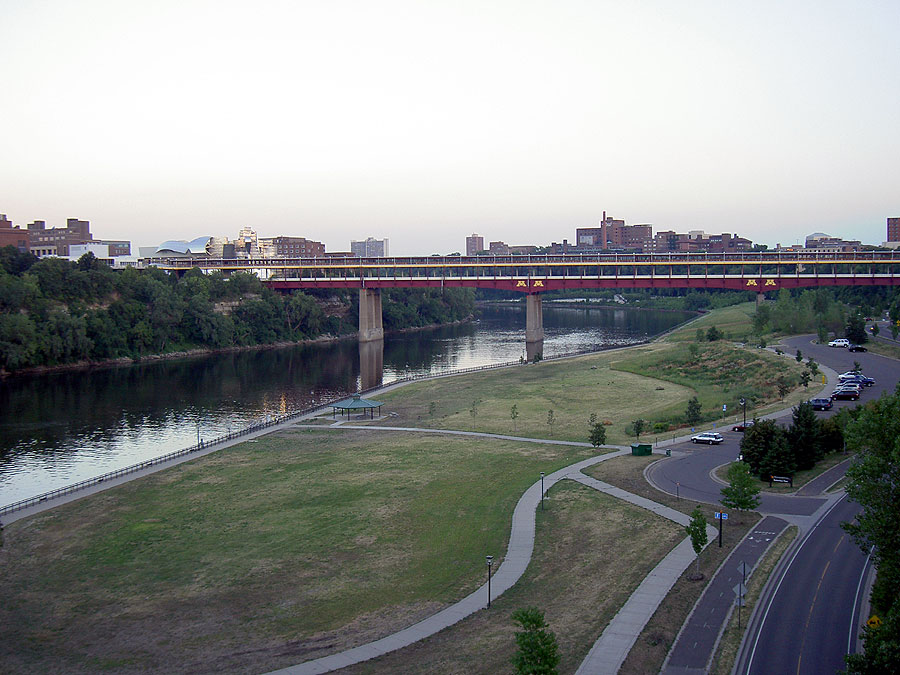
The bridge was built by the railroads back in the 1920s when some pretty mainline tracks still ran right through campus. I guess it was used until 1986, then sat abandoned for several years, only to reopen as a sidewalk and bike bridge in 2000. This is odd; we had lived here for several years by then and I have no recollection of this happening. I didn't even realize this bridge was here, partly because it sits at a lower level than the Interstate and Cedar Avenue/10th Street bridges nearby (here's the Google Map of this one).
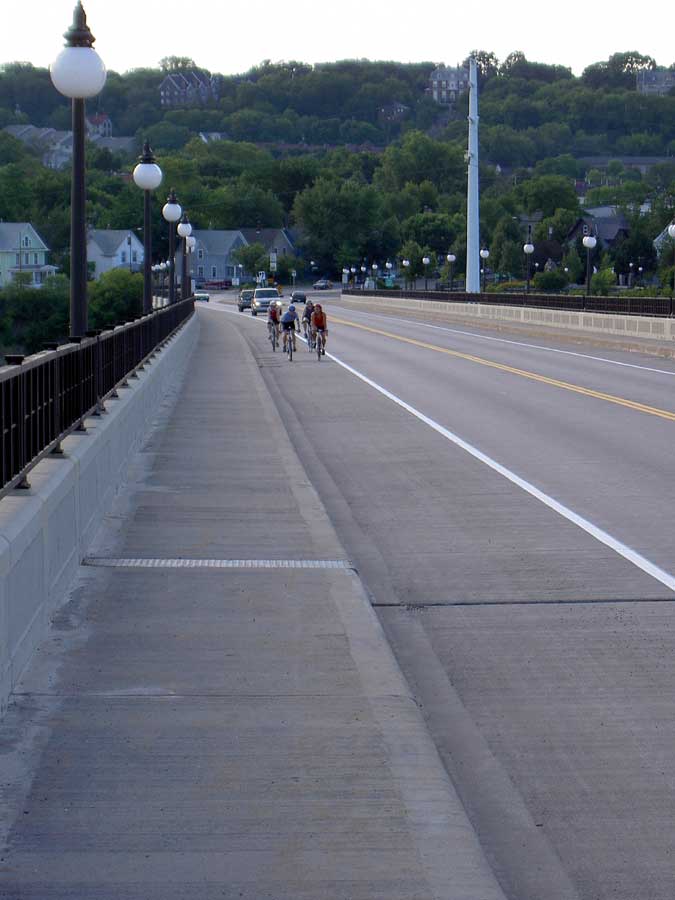
I rode out onto the bridge. Downstream was a good view of the Washington Avenue bridge.

That bridge has terrific integration into the University's traffic patterns; the Number 9 bridge is a bit of an orphan at the moment, although I gather that there is a plan to connect it to the Intercampus Transitway, even after the Transitway may get disrupted by a hoped-for new U of M football stadium. Don't get me started.
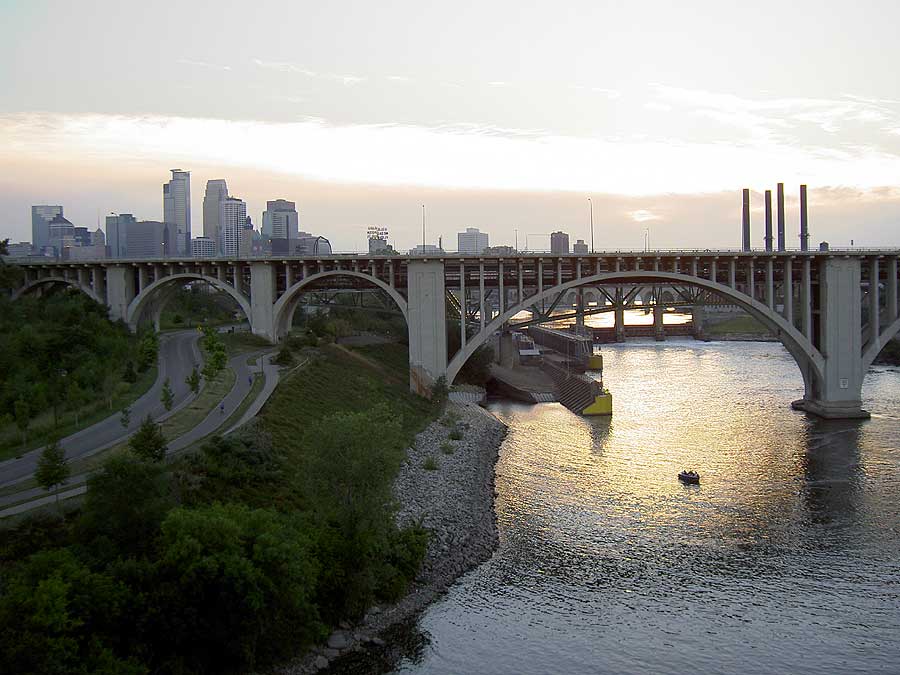
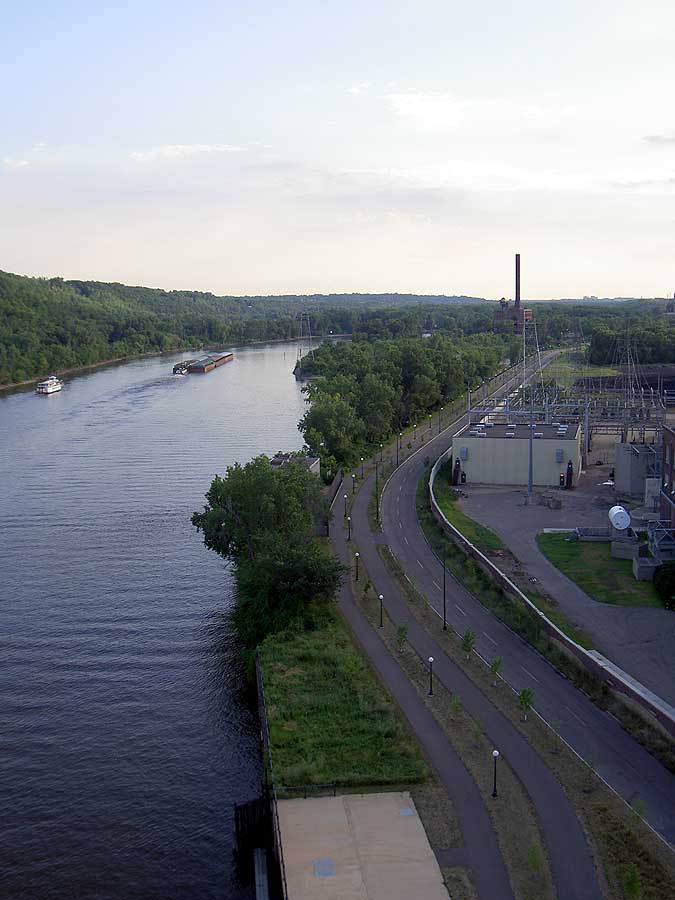
North from the bridge you can see downtown in the distance. The West River bike paths are visible in the lower left.

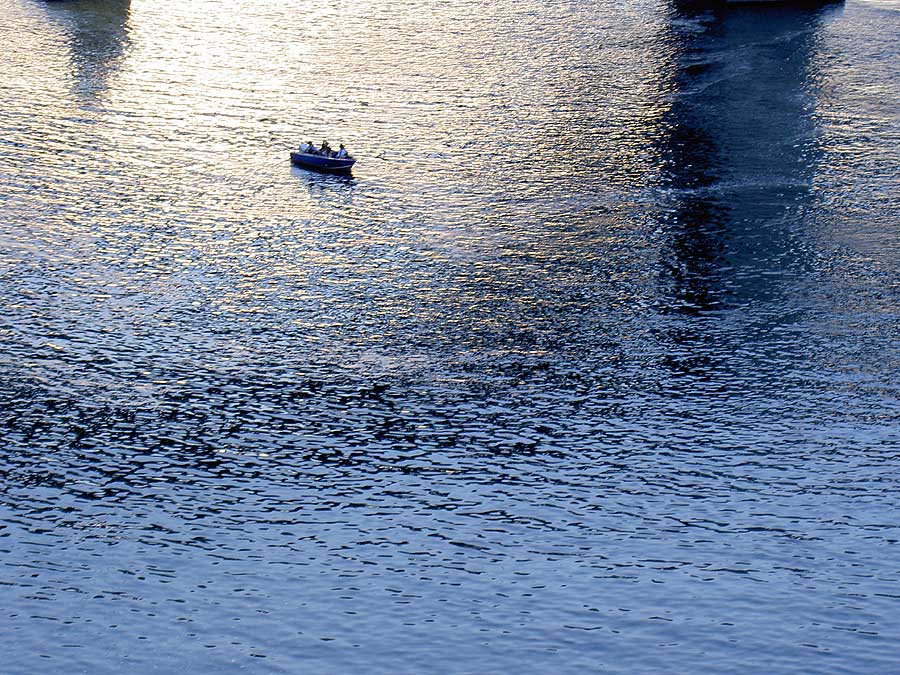
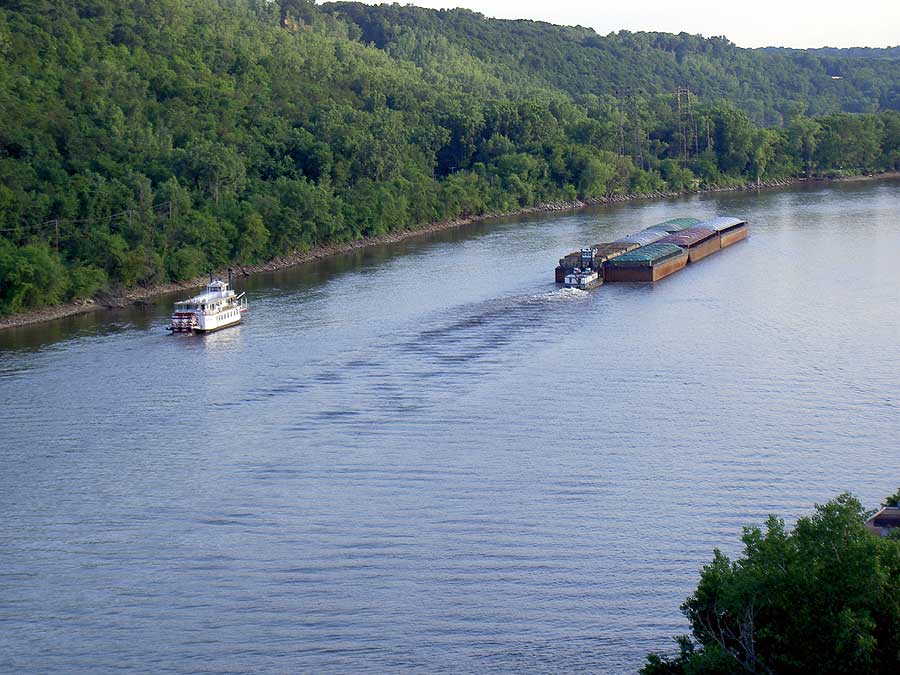
There was a boat on the Mississippi below the Saint Anthony locks. This is north from the Number 9 bridge.

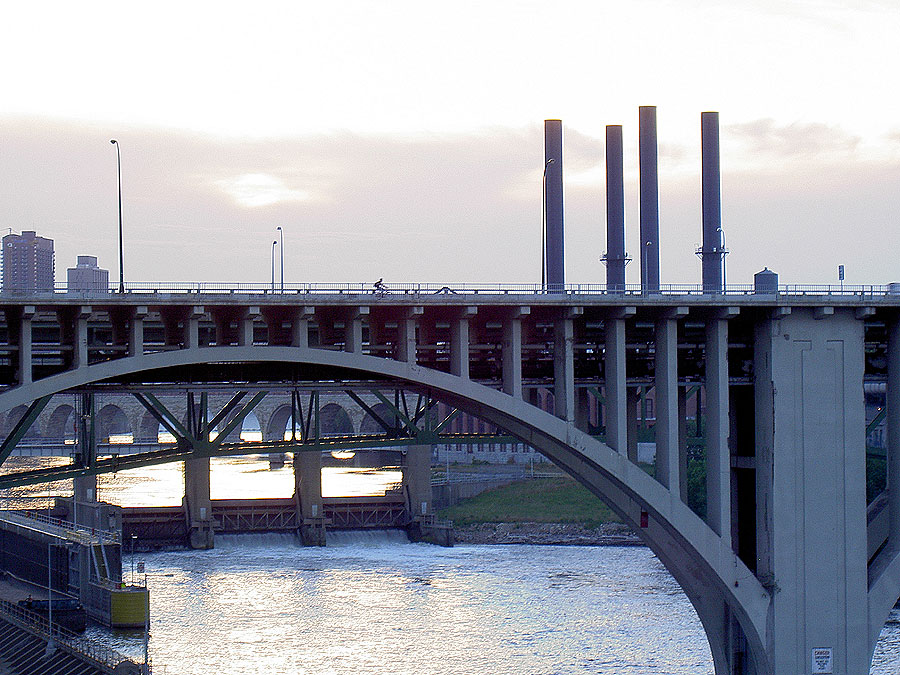
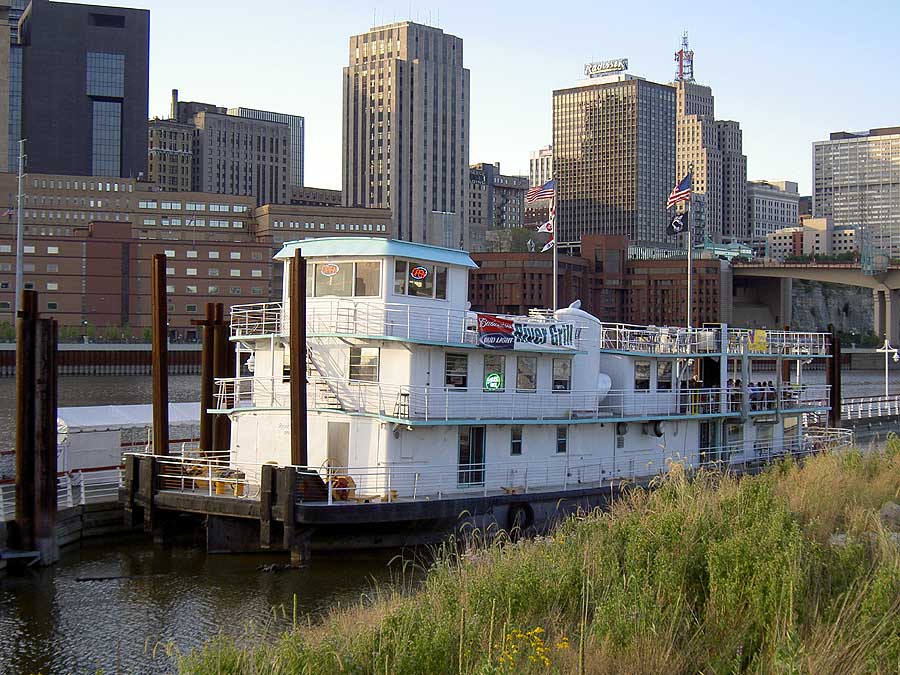
This is a more cluttered view north. You can see the Lower Saint Anthony lock and dam, the SE 10th/Cedar Avenue Bridge (the nice white one with a cyclist on it), the Interstate 35 bridge (the girders in the background), the Stone Arch Bridge and the upper Saint Anthony dam. Just last weekend I was at the Twin Cities Model Railroad Museum in Bandana Square and was looking at old photos of the Twin Cities on the walls. There was one of this very area, when the flat green space along the river was cluttered with small houses in a neighborhood called Bohemian Flats and there was a dense net of railways and a lot more industry along the west bank. It's a cool museum and worth a visit. Anyway, here's the bridges.

I rode on across. You take a hard right and go up a short hill to the East Bank of the University of Minnesota campus. I rode slowly across campus, full of the happy buzz of a summer evening on a quiet campus, sharing the sidewalk with a couple of parents escorting young students on Orientation. I can remember my first orientation visit to Iowa State thirty years ago, and how it all seemed pretty big and grown up. I went up to the Intercampus Transitway, my new favorite bike highway, and rode home, stopping at a convenience store for a Gatorade on this sweaty evening. Also at the convenience store were a couple of Bike Patrol security guys, also getting drinks, who then rode off down the Transitway on their mountain bikes. I guess it is patrolled. I went on home, lights showing (wouldn't want to be a scofflaw) and ended up with 18.7 miles at 12.4 mph. That's faster than my usual Bicycle Based Photography outings, but that desolate stretch of Broadway must have sped things up.
I probably won't use Broadway much. If I'm going downtown, Como Avenue or the Transitway are much better alternatives. If I'm going north, I'll take a couple of hundred yards of Larpenteur and then onto Industrial Boulevard instead. Still, you never know until you try it.
I decided to go for a ride Wednesday night. Three things intrigued me; a crossing of Highway 280 from the west end of Roselawn to Broadway mentioned in a comment by another blogger (Nathan); a bike shop I hadn't been to called Behind Bars; and a bridge over the Mississippi I'd never even noticed known as Bridge Number 9.
So I set off, westbound down Roselawn right to the end. You can go from the end of Roselawn across into the left turn lane of Highway 280 and take a left onto Broadway. It looks like this (and, if you like Google Maps, like this):
Highway 280 is a 55-mph limited access highway, not Interstate quality, but nearly as inhospitable. I waited for a big gap in northbound traffic and nipped across into the left turn lane to get onto Broadway. I got a red arrow in the lane so, not wishing to be thought a scofflaw, I waited. Luckily, My Friend The Car arrived behind me to trigger the light for me. I also noticed that there is a pedestrian crosswalk button on the east side even though there's no painted crosswalk or sidewalk along the highway. Here was my view.
I rode off westbound on Broadway. It's not marked as a suggested bike route on the Twin Cities Bike Map and I can see why; it blows. It's four-lanes, but no shoulder, the pavement's in bad shape, there's shitloads of glass and hordes of UPS trucks trying to make it in by 7:00PM (I rode by the UPS hub at about 7:05). Once past UPS, things got a bit less frantic and I coasted on down the long hill, across Stinson and over I-35. You get squeezed down to one lane under some railroad tracks and traffic picks back up going up towards Central. I crossed Central and knew I was getting in the area of the Behind Bars bike shop. I took a wrong turn by some of Minneapolis's classic industry:
I wonder how many developers have driven by thinking, hmmm, that would make for some nice condos? For the moment, it's still in operation. Lots of charm, too, the streets are brick. Maybe one day when it's raining I'll come back and try some high speed turns on this to get a flavor of the European spring classics. In the meantime, I clattered back and forth up this street. There are some classic northeast Minneapolis eating establishments around, like this one on Broadway.
I've never actually eaten here, so this isn't an endorsement.
I rode on down to 208 13th Avenue NE and found Behind Bars. It was open! I went in and talked to Chuck, the guy who runs the place. He asked how I'd heard of them; I told him I'd read about him on a blog. He was interested in which one. I had to think and then look on his computer, but it was Bicyclo II. He took a look at it and said, oh yeah, Michael, I know him. We chatted for a while, interrupted by a couple of customers. I offered to take his picture outside the store, no such thing as bad publicity you know, just make sure you spell the name right, but he didn't want to do that. I instead took a photo of the store's name painted on an adjacent wall.
I rode on down past the old Grain Belt brewery and set off across the Broadway bridge over the Mississippi. I rode on the south sidewalk so I could see the view downriver, where you can see downtown Minneapolis and the Plymouth Avenue bridge. The bridge Henry and I took going to Baker Park a month ago is another couple of miles upstream from here.
I wasn't interested in following Broadway any further west at the moment and instead set off down the West River Road. At Plymouth a bike trail arises on the east side of the road. I was at the red light eyeing this across the intersection; the WALK light was still on for cross-traffic; there was no cross-traffic; I looked around; I ran the light (shhh!). God, I'm embarassed. Still, it saved me a couple of minutes and the light didn't seem to be responding to me.
I rode down to downtown, past the Mill City Museum and the Guthrie Theatre Erection and under the I-35 bridge. About here the path diverges and loops up to the end of the Number 9 bridge. I rode over to it. There's a historical marker.
The bridge was built by the railroads back in the 1920s when some pretty mainline tracks still ran right through campus. I guess it was used until 1986, then sat abandoned for several years, only to reopen as a sidewalk and bike bridge in 2000. This is odd; we had lived here for several years by then and I have no recollection of this happening. I didn't even realize this bridge was here, partly because it sits at a lower level than the Interstate and Cedar Avenue/10th Street bridges nearby (here's the Google Map of this one).
I rode out onto the bridge. Downstream was a good view of the Washington Avenue bridge.
That bridge has terrific integration into the University's traffic patterns; the Number 9 bridge is a bit of an orphan at the moment, although I gather that there is a plan to connect it to the Intercampus Transitway, even after the Transitway may get disrupted by a hoped-for new U of M football stadium. Don't get me started.
North from the bridge you can see downtown in the distance. The West River bike paths are visible in the lower left.
There was a boat on the Mississippi below the Saint Anthony locks. This is north from the Number 9 bridge.
This is a more cluttered view north. You can see the Lower Saint Anthony lock and dam, the SE 10th/Cedar Avenue Bridge (the nice white one with a cyclist on it), the Interstate 35 bridge (the girders in the background), the Stone Arch Bridge and the upper Saint Anthony dam. Just last weekend I was at the Twin Cities Model Railroad Museum in Bandana Square and was looking at old photos of the Twin Cities on the walls. There was one of this very area, when the flat green space along the river was cluttered with small houses in a neighborhood called Bohemian Flats and there was a dense net of railways and a lot more industry along the west bank. It's a cool museum and worth a visit. Anyway, here's the bridges.
I rode on across. You take a hard right and go up a short hill to the East Bank of the University of Minnesota campus. I rode slowly across campus, full of the happy buzz of a summer evening on a quiet campus, sharing the sidewalk with a couple of parents escorting young students on Orientation. I can remember my first orientation visit to Iowa State thirty years ago, and how it all seemed pretty big and grown up. I went up to the Intercampus Transitway, my new favorite bike highway, and rode home, stopping at a convenience store for a Gatorade on this sweaty evening. Also at the convenience store were a couple of Bike Patrol security guys, also getting drinks, who then rode off down the Transitway on their mountain bikes. I guess it is patrolled. I went on home, lights showing (wouldn't want to be a scofflaw) and ended up with 18.7 miles at 12.4 mph. That's faster than my usual Bicycle Based Photography outings, but that desolate stretch of Broadway must have sped things up.
I probably won't use Broadway much. If I'm going downtown, Como Avenue or the Transitway are much better alternatives. If I'm going north, I'll take a couple of hundred yards of Larpenteur and then onto Industrial Boulevard instead. Still, you never know until you try it.
Thursday, August 04, 2005
Grizzled Veterans
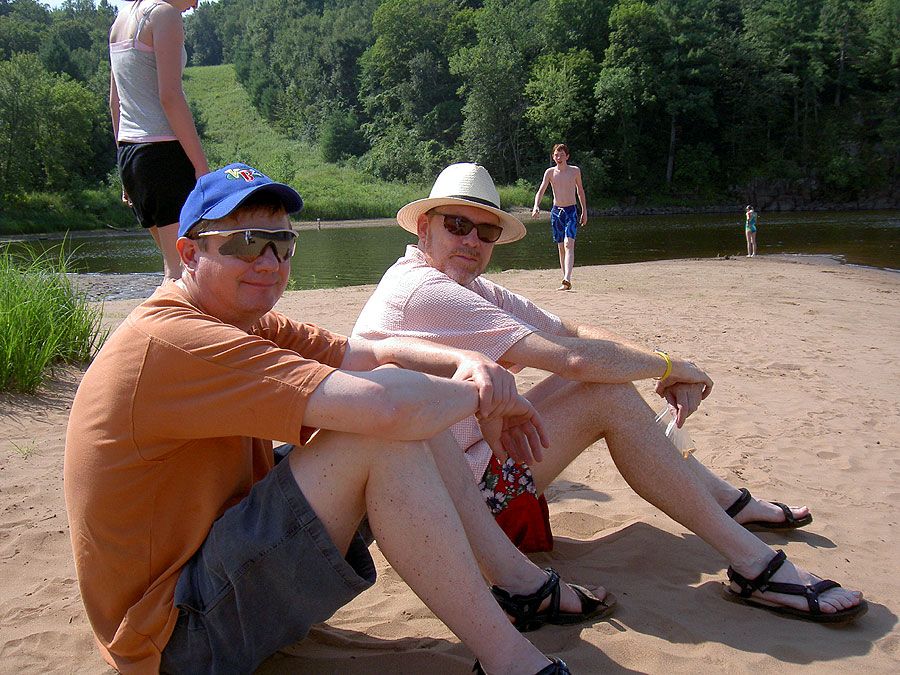
Grizzled Veterans of the 1970s Bike Boom, anyway. My friends Mark and Teresa were up for the weekend. Of all my cycling buddies, Mark was the earliest. That's him on the left, me on the right. He got in early, in high school in the early 1970s, when his paper-route money made him comparatively a rich man. He had one of the three Raleigh Professionals, all Reynolds 531 and Campy, in the state of Iowa when European bike supplies dried up due to President Nixon's wage and price controls; one of the others was owned by John Karras, one of the founders of the Register's Annual Great Bike Ride Across Iowa (RAGBRAI); fittingly, Mark was one of about 120 people to ride the entire first RAGBRAI; for all the current fuss about fixed-gear bikes, he had a fixed-gear brakeless track bike before we were out of high school and once rode it to Booneville, our regular 28-mile loop; he and my other main biking buddy Paul rode a tandem from Des Moines to Boston in 1980; Mark rode the BAM (Bike Across Missouri, 24 hours from Saint Louis to Kansas City) in the early 1990s; in recent years, he was a riding partner with Bob Breedlove, a high-achieving distance cyclist killed in June when he was hit by a truck in Colorado while competing in the Ride Across America (RAAM). Mark was on his way to work support for Breedlove farther east when the accident occurred. And when I say Mark was a riding partner, Breedlove had a custom carbon tandem built sized for Breedlove in front and Mark in back; this weighed in right at 30 pounds, about the same as my Atlantis with fenders, rack, kickstand, etc., and Mark related how they'd go riding with racers 10-15 years younger than they were, keep with them up the hills then, as he put it, put a hurtin' on them on the flats. The idea was to ride Paris-Brest-Paris on this bike, but they missed the last one.
Mark was always a strong rider. He was a competitive swimmer in high school and, while I think it's fair to say he was just an ok swimmer, the several-thousand yards a day they trained would deliver him in early spring in terrific physical shape, unlike me.
So two old biking buddies get together and what do they do? Go canoeing! In the photo above, we are sitting on a sandbar in the Saint Croix river late last Sunday morning while some of our offspring frolic in the background. We did the Taylors Falls to Osceola stretch and it turned out to be a lot of work; while the current was with us, the wind was strong from the south and we had to paddle hard against it. At one point we had stopped paddling and stowed paddles so I could take some photos, and our canoe (me and my daughter Geneva) blew upstream and lodged against some submerged rocks. The only cycling was Mark's quick loop around our driveway on my Atlantis, which he could just barely straddle.
Had we been real men, we would have done what these people are doing: Tow Their Canoe with a Bike (Thanks to cleverchimp for noticing this item). But we drove up, seven of us in their minivan, and caught the schoolbus back upstream when we were done.
It's funny how we all evolved differently. Four of us (me, these two, and another guy named Bob) used to regularly ride to Booneville through the late 1970s as a training ride, though what we were training for remains unclear as I for one never raced. Mark became almost a pure distance cyclist; once I was at their house on a Saturday at lunchtime and he rolled in off a 150-mile training ride, but I doubt he ever rides to work. Paul has become very much a Practical Cyclist, with the first of the Xtracycles among us and the willingness to ride big distances for visits, as when he rode from Cedar Rapids up to Saint Paul to work the bike races in June. I have become just a local cyclist, my riding nearly all in the cities, often with my children, rarely doing more than 30 miles in a day. The Atlantis's comfort is going to start stretching this out somewhat, but my mileage remains just a fraction of what these guys typically ride. There are many ways to enjoy cycling, that's one of the great things about it, and we've all taken different paths.
Friday, July 29, 2005
Middle Ground
There have been a couple of columnists in the Pioneer-Press, Saint Paul's newspaper, ripping cyclists for one thing or another. The guys who wrote these are just columnists so their pieces are long on blustery opinion and short on objective facts of the type an actual reporter might get together. However, they did get me to thinking.
A common thread in both was cyclist's failure to stop at Stop signs. Now, leaving aside for the moment the point that most motorists don't stop at Stop signs either, I was looking around on the web to see what information there was about bicycles and Stop signs. Interestingly, a physics professor at Berkeley has done some work on Physics and Bicycles and points out that there is a good reason cyclists don't like to stop; conservation of energy. (you can read the version for civilians and columnists here and see all the math here). The main point of this is that 1) it takes much less energy to keep a bicycle (or car, for that matter) moving than it does to get it moving in the first place and 2) in a roadway with a Stop sign every hundred meters or so, bringing a bike to a full stop and then restarting it means that a cyclist has to expend roughly 500W (Watts) of power to maintain a 12.5 mph pace versus roughly 100W to maintain a 12.5 mph pace without stopping at all. What makes this interesting is that 100-150W is within the sustainable power range of most people whereas 500W is highly-conditioned bike-racer type output. No wonder we don't like to stop.
If you are like me, or like the majority of automobiles, you neither come to a full, complete stop at each stop sign nor do you breeze blithely on through with insouciant unconcern. Instead, you slow down, look both ways, and, if it's clear, carry on. What may be maddening to motorists is that bikes don't slow down as much as cars. I think this is because cyclists generally have much better situational awareness on a bike than motorists do in a car (I speak as someone who both rides and drives). My Atlantis is unusually tall, but even on my Marin my eye level is slightly higher than that of a driver of a Suburban or Ford F-150 and way above that of drivers of minivans or sedans. I like this visibility, and it is one reason I'd be terrified of a recumbent in the city--you couldn't see anything and nobody could see you.
In addition to the better visibility, cyclists can hear better on bikes than can people in enclosed cars with engine noise, fans, the radio, etc. As a result, I’m speculating that the speed to which bikes slow down before proceeding at stop signs is faster than the speed to which cars slow down. The result is annoyance, the same annoyance I've felt when driving 72 in a 55-mph zone and someone overtakes me doing 76; "Hey! That's unsafe, you scofflaw bastard!", ignoring my own transgression. Rather than seethe privately about it, the Pioneer-Press columnists wrote about it in their paper.
So, motorists get annoyed at cyclists for slowing down to only 8 mph at Stop signs when they, responsible law-abiding citizens that they are, slow all the way down to 3 mph. Well, guess what, neither one is a full stop, both are breaking the law, so I could do with a little less righteous indignation from the motorist crowd on this point. As for those cyclists who do go sailing blithely on through Stop signs and red lights, they’ll soon be thinned from the herd and I will feel the same lack of sympathy for them that I do when adult snowmobilers fall through the ice on lakes and die. Stupidity has a way of catching up with people.
While I was looking up this stuff I thought also about the columnist comments about how bikes are hogging the roads. I looked out at our parking lot at work, the east side of which is currently being resurfaced. We must have ten acres of parking. The parking footprint is way bigger than the building footprint. In fact, as I look around, the company maintains a bigger space for my car than it does for me. Hey! There is a bike rack on one side on one of the little decorative gravel islands, then this enormous semi-circle with parking for hundreds of cars being maintained at great cost. I wondered, how much room does a car take up in the road compared to a bike? The Pioneer-Press columns were certainly fact-free zones and no help. Let’s look up some numbers.
Well, my Atlantis, from the front of the front tire to the back of the rear fender, is 72 inches long. The handlebar, with my hands on the brake levers, is about 22 inches wide. Thus, a rectangle to contain the bike would have to be 1,584 square inches, or 11 square feet. Remember, this is a long-wheelbase touring frame in the biggest size available (68cm) and unusually wide handlebars (48cm). Our main car, a 2004 Toyota Avalon, is 191.9 inches long and 71.7 inches wide, requiring an area of 95.6 square feet. (These auto figures, by the way, all come from the Automobile Invoice Service New Car Cost Guide, which is the sort of thing we have lying around at work). Move up to a Chevrolet Suburban, at 219.3 inches long and 78.9 inches wide, and you're looking at 120.2 square feet. But the Avalon will carry five people and the Suburban seven, you say. Sure they will, but most of them don't most of the time. In my daily commute to work, nearly all the vehicles I see are driver-only, as I am when I drive.
Given this, it can be a bit grating when someone driving a vehicle with a 95-square-foot footprint is complaining about someone riding a vehicle with a 11-square-foot footprint "hogging the road". (I used Visio to do a precise diagram of three vehicles' Comparative Footprints so you can decide for yourself who hogs the road.)
The power output was interesting as well. The study I cited says that regular non-athletic cyclists (like me) should be able to maintain 100 watts of output without undue effort. I don't know what my maximum output would be, but I'm going to say maybe 200 watts. How much power does a car use to move? Well, the Avalon has a 210-hp engine (the new 2005s are 280), which is 156,660 watts of power; the Suburban has a 295-hp engine, or 220,000 watts of power. They need all that power to move all that weight, 3,400 lbs curb weight for the Avalon and 5,470 for the Suburban versus 30 pounds for my Atlantis. Think about that next time you see someone stop in the fire lane at Blockbuster in their 3,000-6,000-lb, 100,000-235,000 watt vehicle to drop off a 4-ounce DVD. That's when riding a 30-lb machine at a decent cruising speed (12.5 mph) over short to intermediate distances with typical small payloads occupying less road and parking space, all for less power output than just the headlights on a car, makes sense.
As an aside, a vehicle that is often savaged for its excesses is the Hummer H2. This is a vehicle favored by military wannabes although of course it's just a boxy body, one reminiscent of the actual military Humvee (or Honda Element, for that matter), on a Chevy Tahoe frame. One of these days I am going to dress nicely and drive the Avalon to the local Cadillac/Hummer dealership and test drive one of these puppies. In the meantime, it's interesting to note that the H2 is actually 2 inches shorter (in length, not height) than our Avalon, although it is nearly 10 inches wider without the mirrors. In overall footprint, the H2 is actually a hair smaller than the popular Honda Odyssey minivan. The weird thing is the weight; the Odyssey comes in at 4,500 pounds, the H2 at 6,400 pounds empty. Jesus, what’s this thing made of, spent uranium? No wonder it needs 316 horsepower (236,000 watts) to get moving.
Anyway, I found it interesting to look up some actual facts regarding autos and bikes. Too much of the discussion, whether in these Pioneer-Press opinion columns or on many bike blogs, is pointless name-calling, people yelling past each other with hardly any exchange of actual data. Various parties may enjoy dismissing motorists as clueless criminal foul-smelling oil sluts and cyclists as Spandex-clad scofflaw Lance wannabe bike faggots, but I ride and I drive, I don't think I'm clueless, I'm neither a Lance nor a military wannabe and I think there is some middle ground in the transportation mix that makes more sense than where we are now, that costs less, uses less energy, pollutes less yet meets our transportation needs. I'm working to find that middle ground for myself. I'd encourage you to do the same.
A common thread in both was cyclist's failure to stop at Stop signs. Now, leaving aside for the moment the point that most motorists don't stop at Stop signs either, I was looking around on the web to see what information there was about bicycles and Stop signs. Interestingly, a physics professor at Berkeley has done some work on Physics and Bicycles and points out that there is a good reason cyclists don't like to stop; conservation of energy. (you can read the version for civilians and columnists here and see all the math here). The main point of this is that 1) it takes much less energy to keep a bicycle (or car, for that matter) moving than it does to get it moving in the first place and 2) in a roadway with a Stop sign every hundred meters or so, bringing a bike to a full stop and then restarting it means that a cyclist has to expend roughly 500W (Watts) of power to maintain a 12.5 mph pace versus roughly 100W to maintain a 12.5 mph pace without stopping at all. What makes this interesting is that 100-150W is within the sustainable power range of most people whereas 500W is highly-conditioned bike-racer type output. No wonder we don't like to stop.
If you are like me, or like the majority of automobiles, you neither come to a full, complete stop at each stop sign nor do you breeze blithely on through with insouciant unconcern. Instead, you slow down, look both ways, and, if it's clear, carry on. What may be maddening to motorists is that bikes don't slow down as much as cars. I think this is because cyclists generally have much better situational awareness on a bike than motorists do in a car (I speak as someone who both rides and drives). My Atlantis is unusually tall, but even on my Marin my eye level is slightly higher than that of a driver of a Suburban or Ford F-150 and way above that of drivers of minivans or sedans. I like this visibility, and it is one reason I'd be terrified of a recumbent in the city--you couldn't see anything and nobody could see you.
In addition to the better visibility, cyclists can hear better on bikes than can people in enclosed cars with engine noise, fans, the radio, etc. As a result, I’m speculating that the speed to which bikes slow down before proceeding at stop signs is faster than the speed to which cars slow down. The result is annoyance, the same annoyance I've felt when driving 72 in a 55-mph zone and someone overtakes me doing 76; "Hey! That's unsafe, you scofflaw bastard!", ignoring my own transgression. Rather than seethe privately about it, the Pioneer-Press columnists wrote about it in their paper.
So, motorists get annoyed at cyclists for slowing down to only 8 mph at Stop signs when they, responsible law-abiding citizens that they are, slow all the way down to 3 mph. Well, guess what, neither one is a full stop, both are breaking the law, so I could do with a little less righteous indignation from the motorist crowd on this point. As for those cyclists who do go sailing blithely on through Stop signs and red lights, they’ll soon be thinned from the herd and I will feel the same lack of sympathy for them that I do when adult snowmobilers fall through the ice on lakes and die. Stupidity has a way of catching up with people.
While I was looking up this stuff I thought also about the columnist comments about how bikes are hogging the roads. I looked out at our parking lot at work, the east side of which is currently being resurfaced. We must have ten acres of parking. The parking footprint is way bigger than the building footprint. In fact, as I look around, the company maintains a bigger space for my car than it does for me. Hey! There is a bike rack on one side on one of the little decorative gravel islands, then this enormous semi-circle with parking for hundreds of cars being maintained at great cost. I wondered, how much room does a car take up in the road compared to a bike? The Pioneer-Press columns were certainly fact-free zones and no help. Let’s look up some numbers.
Well, my Atlantis, from the front of the front tire to the back of the rear fender, is 72 inches long. The handlebar, with my hands on the brake levers, is about 22 inches wide. Thus, a rectangle to contain the bike would have to be 1,584 square inches, or 11 square feet. Remember, this is a long-wheelbase touring frame in the biggest size available (68cm) and unusually wide handlebars (48cm). Our main car, a 2004 Toyota Avalon, is 191.9 inches long and 71.7 inches wide, requiring an area of 95.6 square feet. (These auto figures, by the way, all come from the Automobile Invoice Service New Car Cost Guide, which is the sort of thing we have lying around at work). Move up to a Chevrolet Suburban, at 219.3 inches long and 78.9 inches wide, and you're looking at 120.2 square feet. But the Avalon will carry five people and the Suburban seven, you say. Sure they will, but most of them don't most of the time. In my daily commute to work, nearly all the vehicles I see are driver-only, as I am when I drive.
Given this, it can be a bit grating when someone driving a vehicle with a 95-square-foot footprint is complaining about someone riding a vehicle with a 11-square-foot footprint "hogging the road". (I used Visio to do a precise diagram of three vehicles' Comparative Footprints so you can decide for yourself who hogs the road.)
The power output was interesting as well. The study I cited says that regular non-athletic cyclists (like me) should be able to maintain 100 watts of output without undue effort. I don't know what my maximum output would be, but I'm going to say maybe 200 watts. How much power does a car use to move? Well, the Avalon has a 210-hp engine (the new 2005s are 280), which is 156,660 watts of power; the Suburban has a 295-hp engine, or 220,000 watts of power. They need all that power to move all that weight, 3,400 lbs curb weight for the Avalon and 5,470 for the Suburban versus 30 pounds for my Atlantis. Think about that next time you see someone stop in the fire lane at Blockbuster in their 3,000-6,000-lb, 100,000-235,000 watt vehicle to drop off a 4-ounce DVD. That's when riding a 30-lb machine at a decent cruising speed (12.5 mph) over short to intermediate distances with typical small payloads occupying less road and parking space, all for less power output than just the headlights on a car, makes sense.
As an aside, a vehicle that is often savaged for its excesses is the Hummer H2. This is a vehicle favored by military wannabes although of course it's just a boxy body, one reminiscent of the actual military Humvee (or Honda Element, for that matter), on a Chevy Tahoe frame. One of these days I am going to dress nicely and drive the Avalon to the local Cadillac/Hummer dealership and test drive one of these puppies. In the meantime, it's interesting to note that the H2 is actually 2 inches shorter (in length, not height) than our Avalon, although it is nearly 10 inches wider without the mirrors. In overall footprint, the H2 is actually a hair smaller than the popular Honda Odyssey minivan. The weird thing is the weight; the Odyssey comes in at 4,500 pounds, the H2 at 6,400 pounds empty. Jesus, what’s this thing made of, spent uranium? No wonder it needs 316 horsepower (236,000 watts) to get moving.
Anyway, I found it interesting to look up some actual facts regarding autos and bikes. Too much of the discussion, whether in these Pioneer-Press opinion columns or on many bike blogs, is pointless name-calling, people yelling past each other with hardly any exchange of actual data. Various parties may enjoy dismissing motorists as clueless criminal foul-smelling oil sluts and cyclists as Spandex-clad scofflaw Lance wannabe bike faggots, but I ride and I drive, I don't think I'm clueless, I'm neither a Lance nor a military wannabe and I think there is some middle ground in the transportation mix that makes more sense than where we are now, that costs less, uses less energy, pollutes less yet meets our transportation needs. I'm working to find that middle ground for myself. I'd encourage you to do the same.
Thursday, July 28, 2005
Matt Writes An E Mail
Our company got a new regional Vice President last week, a guy who has worked here locally for many years and is really good. Today we had an all-employee meeting where he spoke, we reviewed the results through June and talked about upcoming plans for various things. One quick presentation was on the building, which is currently getting new foundation waterproofing and will soon have the east parking lot resurfaced. Further down the list was planning bathroom renovations.
Time for Matt to toss in his two cents worth. I wrote to the HR Manager and Facilities guy.
There. At least they know that somebody is using these things, that at a minimum they shouldn't eliminate the showers, and maybe they should enhance them. One has to work on all fronts and this won't affect anyone outside the building, but it's probably good to let the powers that be know what you're up to.
Now, if I could just figure out a graceful way to do indoor bike parking...
Time for Matt to toss in his two cents worth. I wrote to the HR Manager and Facilities guy.
Hi guys
I have a suggestion to consider when doing the bathroom renovations.
I have been riding my bike to work some days (not today, as I have golf tonight, but many other non-Thursdays). In the humid weather, I take a shower in the first floor Men's room shower and change into work clothes from my biking clothes. This bathroom gets really really steamy because there is no exhaust vent. While this works well to let my wool slacks' wrinkles hang out, it would be much nicer if there was a ventilation system that would draw out the moisture and vent it elsewhere as there is in nearly all home bathrooms.
The shower otherwise works very nicely in part because barely anyone uses it as far as I can tell. If higher gas prices arrive, more people might consider cycling in and need the showers. Also, my hair care and makeup needs are extremely minimal, but more attractive and fashionable people might want a place to plug in a blow dryer and apply various colored-pastes to their faces.
Anyway, I'd appreciate it if you'd give this some consideration when looking at the renovations. There are many benefits to cycling in (good exercise, lower oil consumption, less pollution, less traffic congestion, etc) and a better shower facility might tip some more people into trying it.
Thanks
Matt
PS This is the first office I've worked in with a shower available and I thank you for that--it would be impractical to ride in and dress nicely when it's really steamy out without it.
There. At least they know that somebody is using these things, that at a minimum they shouldn't eliminate the showers, and maybe they should enhance them. One has to work on all fronts and this won't affect anyone outside the building, but it's probably good to let the powers that be know what you're up to.
Now, if I could just figure out a graceful way to do indoor bike parking...
EPA Report on Auto Mileage
This is from this morning's New York Times. Where there are ellipsis (...) I've skipped bits.
The full article can be read here but it requires registration, which is free.
I have the sense that we're fiddling while oil burns. Our response to our oil dependence on many unsavoury parts of the globe has been to cut taxes, encourage people to shop more and do nothing, absolutely nothing, about encouraging conservation of energy. It was photos of President Bush holding hands with and kissing the Saudi Crown Prince this past spring that finally revolted me enough to get back into commuting by bicycle more and substituting the bike for the car when practical. I was ashamed to see our President sucking up to those who hate us. Which country provided 15 of the 19 9/11 hijackers? (hint: it wasn't Iraq) Who does he think funds the insurgents trying to kill our troops in Iraq? How does he think Al Qaeda gets its funding? Bake sales? And now, as this bloated, worthless piece of legislation is about to get voted on, the EPA stalls delivery of a report that might be mildly embarassing to the Administration and Congress. They should be embarassed.
E.P.A. Holds Back Report on Car Fuel Efficiency
DETROIT, July 27 - With Congress poised for a final vote on the energy bill, the Environmental Protection Agency made an 11th-hour decision Tuesday to delay the planned release of an annual report on fuel economy.
But a copy of the report, embargoed for publication Wednesday, was sent to The New York Times by a member of the E.P.A. communications staff just minutes before the decision was made to delay it until next week. The contents of the report show that loopholes in American fuel economy regulations have allowed automakers to produce cars and trucks that are significantly less fuel-efficient, on average, than they were in the late 1980's.
Releasing the report this week would have been inopportune for the Bush administration, its critics said, because it would have come on the eve of a final vote in Congress on energy legislation six years in the making. The bill, as it stands, largely ignores auto mileage regulations.
The executive summary of the copy of the report obtained by The Times acknowledges that "fuel economy is directly related to energy security," because consumer cars and trucks account for about 40 percent of the nation's oil consumption. But trends highlighted in the report show that carmakers are not making progress in improving fuel economy, and environmentalists say the energy bill will do little to prod them...
Eryn Witcher, a spokeswoman for the E.P.A., said the timing of the release of the report had nothing to do with the energy bill deliberations...
While the proposed bill, as it stands, does offer limited tax credits for hybrid electric cars and advanced diesels, environmental groups object to extending mileage credits for vehicles that can be filled up with an ethanol blend instead of gasoline; many consumers who purchase such vehicles are not even aware of the feature.
The E.P.A. report illustrates what has happened as the industry has poured resources into S.U.V.'s, minivans and family-oriented pickup trucks, vehicle types with less stringent fuel economy requirements than cars. The average new vehicle weight has risen to about 4,000 pounds today, from about 3,200 in the early 1980's. At the same time, the horsepower of an average engine has roughly doubled over two decades, trimming four seconds from the time it takes for the average vehicle to accelerate from zero to 60.
The full article can be read here but it requires registration, which is free.
I have the sense that we're fiddling while oil burns. Our response to our oil dependence on many unsavoury parts of the globe has been to cut taxes, encourage people to shop more and do nothing, absolutely nothing, about encouraging conservation of energy. It was photos of President Bush holding hands with and kissing the Saudi Crown Prince this past spring that finally revolted me enough to get back into commuting by bicycle more and substituting the bike for the car when practical. I was ashamed to see our President sucking up to those who hate us. Which country provided 15 of the 19 9/11 hijackers? (hint: it wasn't Iraq) Who does he think funds the insurgents trying to kill our troops in Iraq? How does he think Al Qaeda gets its funding? Bake sales? And now, as this bloated, worthless piece of legislation is about to get voted on, the EPA stalls delivery of a report that might be mildly embarassing to the Administration and Congress. They should be embarassed.
Wednesday, July 27, 2005
We Put the Hell in Helicomatic
I got Henry a bike from The Spoken Wheel in Iowa Falls last April, a circa-1984 Trek 620 touring bike (you can read the sales brochure here). It's generally very nice and I'm hoping that the long wheelbase, lovely double-butted and lugged Reynolds 531 touring frame will prove as comfortable and satisfying to Henry as my Atlantis is to me. However, the bike comes with a Maillard Helicomatic rear hub which has the reputation of being troublesome. It's living up to its reputation.
Henry rode up to the Library yesterday. When it came time to ride home, the freewheel on the Helicomatic, an early form of cassette hub, stopped working. Or maybe it worked too well; it freewheeled in both directions! Kind of the opposite of a fixie! Poor Henry couldn't apply any power and, as I had ridden to work on my bike and Karla was off at a music seminar, he had to walk the bike home, coasting down any hills or slopes. He'd get on to ride and it would catch for a half-turn, then disengage and he would spin the crank and the freewheel would just go around. He found this annoying.
I think this may have happened a couple of times on the way to Baker Park earlier in the month, he'd complain about his gearing acting funny then of course it wouldn't happen again while I watched. What he had then described as the pedals skipping I had assumed was the rear derailleur shifting so I tightened the tension on the bar-end shifter, thinking maybe it was too loose and allowing the spring tension on the derailleur to move and shift down a cog. I think my interpretation of his complaint was incorrect and the tension on that shifter hadn't felt particularly loose.
I got home and hung the bike up in the garage from the ceiling ropes I use for working on bikes, and of course, under no load, the hub/cluster worked perfectly. We took it down and Henry rode it around the driveway and there it goes, the cogs spinning uselessly around when he pedalled, not engaging or applying any power, then catching for a second, then spinning uselessly again.
He's getting a wheel upgrade in August as it is, all-new 700Cs on an eight-speed Shimano Deore LX cassette hub, left over from my Marin's orignal back wheel and its corroded nipples, all I need is for this to work for about three weeks. I looked at the Helicomatic but it needs a special tool to disassemble. How much effort do I want to put into this wheel when even Francophile Sheldon Brown doesn't like them? But wait! I have that Schwinn World Sport in the 68cm size I bought for $125 last month and it has 27" wheels, like this Trek. I pulled the back wheel off the Schwinn and slapped it on the Trek and it worked perfectly! It even has a six-speed freewheel.
The tube valve stem on this wheel was at a severe angle so I thought I'd move the tube around and straighten it out. The last thing Henry needs to endure is a stupid flat on the way home, he'll think this bike is cursed. I got the tire off the rim and saw that the tube around the stem was layered in like a set of intestines around the valve. It was too big. Sheesh. We rode over to The Bicycle Chain to get a new tube of the correct size, a $4 item that cost me about $95 when I also bought a book and a new Bell Metro helmet for Henry, then came back, installed the tube, inflated the tire and reinstalled the wheel. A couple of minor adjustments to the derailleur stops and he was all set. That ought to hold him until mid-August.
Meanwhile, I have a Helicomatic wheel sitting around. The guy over at The Bicycle Chain said he had a tool to get it apart, maybe I'll go over and pop the cluster off just to see what this thing looks like inside.
Henry rode up to the Library yesterday. When it came time to ride home, the freewheel on the Helicomatic, an early form of cassette hub, stopped working. Or maybe it worked too well; it freewheeled in both directions! Kind of the opposite of a fixie! Poor Henry couldn't apply any power and, as I had ridden to work on my bike and Karla was off at a music seminar, he had to walk the bike home, coasting down any hills or slopes. He'd get on to ride and it would catch for a half-turn, then disengage and he would spin the crank and the freewheel would just go around. He found this annoying.
I think this may have happened a couple of times on the way to Baker Park earlier in the month, he'd complain about his gearing acting funny then of course it wouldn't happen again while I watched. What he had then described as the pedals skipping I had assumed was the rear derailleur shifting so I tightened the tension on the bar-end shifter, thinking maybe it was too loose and allowing the spring tension on the derailleur to move and shift down a cog. I think my interpretation of his complaint was incorrect and the tension on that shifter hadn't felt particularly loose.
I got home and hung the bike up in the garage from the ceiling ropes I use for working on bikes, and of course, under no load, the hub/cluster worked perfectly. We took it down and Henry rode it around the driveway and there it goes, the cogs spinning uselessly around when he pedalled, not engaging or applying any power, then catching for a second, then spinning uselessly again.
He's getting a wheel upgrade in August as it is, all-new 700Cs on an eight-speed Shimano Deore LX cassette hub, left over from my Marin's orignal back wheel and its corroded nipples, all I need is for this to work for about three weeks. I looked at the Helicomatic but it needs a special tool to disassemble. How much effort do I want to put into this wheel when even Francophile Sheldon Brown doesn't like them? But wait! I have that Schwinn World Sport in the 68cm size I bought for $125 last month and it has 27" wheels, like this Trek. I pulled the back wheel off the Schwinn and slapped it on the Trek and it worked perfectly! It even has a six-speed freewheel.
The tube valve stem on this wheel was at a severe angle so I thought I'd move the tube around and straighten it out. The last thing Henry needs to endure is a stupid flat on the way home, he'll think this bike is cursed. I got the tire off the rim and saw that the tube around the stem was layered in like a set of intestines around the valve. It was too big. Sheesh. We rode over to The Bicycle Chain to get a new tube of the correct size, a $4 item that cost me about $95 when I also bought a book and a new Bell Metro helmet for Henry, then came back, installed the tube, inflated the tire and reinstalled the wheel. A couple of minor adjustments to the derailleur stops and he was all set. That ought to hold him until mid-August.
Meanwhile, I have a Helicomatic wheel sitting around. The guy over at The Bicycle Chain said he had a tool to get it apart, maybe I'll go over and pop the cluster off just to see what this thing looks like inside.
Tuesday, July 26, 2005
Matt Writes a Letter
In today's Saint Paul Pioneer-Press, Bob Sansevere, one of the sports columnists, makes the following observations about cyclists under the headline "Lance wannabes hog roads".
Truthfully, I find it annoying when cyclists (and drivers) flaunt traffic laws as well, and am personally fairly scrupulous about riding in a law-abiding fashion. Even so, I wrote a letter to the editor. This will not get published as it runs 286 words and the limit is 200, but I figured I'd run it here for all six of my readers (Hi Liz!).
It is funny that he uses the word scofflaw when I'd just used it to describe myself and my investigation of the Intercampus Transitway and then the pedestrian side of the Washington Street bridge. I don't expect this letter to get published due to its excessive length, so figured I'd run it here.
Funnily enough, in terms of speeding, I got the weekly New York Times "Drive Times" email, all cars, and there's an article there by Joe Queenan titled "Honk if you Hate Me" in which he relates driving just the speed limit for many months and the abuse, scorn and hatred that engendered. You can read the article here but you may have to register (it's free).
That's what bothers me, I guess, this double-standard, that cyclists by God have to stop at every damn stop sign and let's see that foot go down mister and never ever ever run a red light while cars blithely sail through stop signs all the time, speed constantly, run red lights literally by the thousands and kill, on average, 116 people a day. Lance wannabes in spandex aren't the problem here.
Time for me to ride home. I think I get a tailwind tonight oh boy.
A few things: It is exciting that Lance Armstrong won his seventh straight Tour de France. It's especially exciting that he's retiring from cycling. Now maybe there will be fewer bicyclists crowding our streets and ignoring the rules of the road.
While it is massively impressive that Armstrong overcame cancer to win a record number of Tour de France titles, I hold him directly responsible for the surge in scofflaw bicyclists.
All those Tour de France victories ramped up interest in cycling, and I'm hoping now that he's retiring a lot of the law-breaking Lance wannabes will put their bikes up for sale on eBay.
There are plenty of law-abiding bicycle riders out there, and I have no gripe with them when they stop at stop signs and don't go pedaling through red lights.
The problem is, there are far too many SOBs (Spandex-Obsessed Bicyclists) who think they own whatever road they're on.
And it's not usually someone riding a Schwinn or Huffy. It's often the SOBs on their sleek Armstrongesque racing bikes.
Truthfully, I find it annoying when cyclists (and drivers) flaunt traffic laws as well, and am personally fairly scrupulous about riding in a law-abiding fashion. Even so, I wrote a letter to the editor. This will not get published as it runs 286 words and the limit is 200, but I figured I'd run it here for all six of my readers (Hi Liz!).
It was with considerable amusement that I read Bob Sansevere's comments on scofflaw bicyclists hogging the roads. I hadn't previously realized that our traffic congestion was caused by Lance Armstrong wannabes. And scofflaws, my goodness, how can we innocent motorists in our 3,000-lb. vehicles possibly deal with those outlaws on their 30-lb. bikes?
Consider:
Running stop signs? Have you ever watched cars at stop signs? If there's no opposing traffic, cars hardly ever stop. Just watch the wheels, see if they stop turning.
Running red lights? Not like those innocent lambs in automobiles, 4,400 of whom were caught running red lights in just 30 days and 12 intersections in Minneapolis's test of the Stop On Red traffic camera system in June. It's reassuring to know that fourteen police cars, an animal control vehicle and a fire department SUV were among the harvest.
Law-Abiding Motorists? Just for a day, just once, try driving the posted speed limit on all the roads you drive all day long. I predict that many people will enthusiastically communicate with you!
I don't condone blasting through red lights and stop signs on a bike or in a car, but hoping that all those road-hogging scofflaw cyclists will now go away so that traffic can once again run free as nature intended is just silly. You should worry more about those scofflaw motorists. Every year we kill more than 42,000 people in auto accidents in this country, 567 last year just in Minnesota. Do you hold NASCAR directly responsible for this? Or is that just the regrettable but necessary cost of convenient transportation? Sharing the road with a smattering of bicycles should be the least of your worries.
It is funny that he uses the word scofflaw when I'd just used it to describe myself and my investigation of the Intercampus Transitway and then the pedestrian side of the Washington Street bridge. I don't expect this letter to get published due to its excessive length, so figured I'd run it here.
Funnily enough, in terms of speeding, I got the weekly New York Times "Drive Times" email, all cars, and there's an article there by Joe Queenan titled "Honk if you Hate Me" in which he relates driving just the speed limit for many months and the abuse, scorn and hatred that engendered. You can read the article here but you may have to register (it's free).
That's what bothers me, I guess, this double-standard, that cyclists by God have to stop at every damn stop sign and let's see that foot go down mister and never ever ever run a red light while cars blithely sail through stop signs all the time, speed constantly, run red lights literally by the thousands and kill, on average, 116 people a day. Lance wannabes in spandex aren't the problem here.
Time for me to ride home. I think I get a tailwind tonight oh boy.
Monday, July 25, 2005
I'm Going to Get So Wet
At 3:57PM, at work, I wrote:
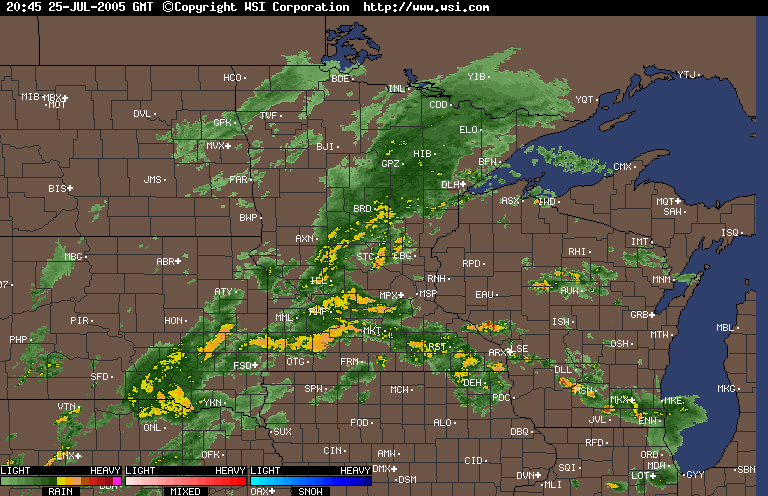
I am going to get so wet riding home! Take a look at the Minneapolis radar as of 4:00PM. We're more or less at MSP. (as always, you can see a bigger version by clicking on the image).

Update:
I wasn't worried. I had my Carradice rain poncho and the rain cover for my Bell Metro helmet. By 5:40, when it came time for me to go, it was raining hard but there was lightning locally. I stalled for about 10 minutes and then decided to go anyway. I put the raincover over my pannier, put on the poncho and helmet, and waded out into the parking lot.
It was raining like a bastard. I put my luggage on the Marin, took the plastic Target bag off my Brooks seat, saddled up, and rode off.
Geez, was it raining! It turns out we set a new record for rainfall for this date, and the worst of it, more than an inch, fell between 6:00PM and 7:00PM, right when I was riding. It was discouragingly dark out and I had only my red blinky light on back. I rode down Lexington and my glasses were quickly fogged over and spattered with rain. I coasted a bit, and discovered that the rushing water along the curb was deep enough that it would splash my foot on the bottom pedal.
I rode up towards County Cycles. The water was coming down the street so hard that a car's floormat went floating downhill on the stream. It's hard to describe how hard this rain was coming down; it's as hard as I've ever seen, a tropical downpour, and certainly as hard as I've ever ridden in. The water was pouring down the street and my front tire was kicking up big splashes which inundated each foot in turn as the crank went around.
Down towards County C I rode the brakes to clear the rims in case I needed to stop. I splashed my way across the intersection as the light went yellow, probably providing a startling and hilarious tableau to the awaiting motorists as I cruised through with my poncho, splashing up water like I was a motorboat, a view they could probably barely see through the belting rain and swishing windshield wipers.
It's hard to say if it rained harder as I went south, but the water was halfway across the lanes so passing cars splashed me. I could feel the resistance of 2-3 inches of water as I rode through it. By the Roseville High School the wind was suddenly cool and the fog on my glasses cleared, though I couldn't see very well because the helmet rain cover and poncho hood conspired to pour a constant stream of water into my left eye. I waddled over to the left turn lane at Larpenteur and headed east and home, my lame attempt at signalling hindered by my thumb being hooked into my rain poncho. I rode home and parked behind the house and sloshed in, leaving puddles all over the back porch, entryway and kitchen so that Geneva came out with paper towels and mopped up, complaining, though the floor's cleaner now.
How did the gear perform? The poncho soaked through, the Jandd front bag collected half a cup of water and got its contents wet, and the helmet rain cover worked great (and made a funny noise in the heaviest rain, so that I thought maybe there was hail). The helmet, as is true with most helmets, could use a longer visor. My rear pannier, with a rain cover, kept all its contents dry. One day I will write about this pannier although all it will do is annoy you because it's a great unit but isn't made any longer.
The poncho might work better in the yellow plastic version. I bought the waxed cotton version out of misplaced nostalgia, having bought some waxed cotton rain pants in the UK for a wet motorcycling trip twenty years ago, which worked great and which I still use for occasional bouts of downhill skiing, but plain old yellow plastic wouldn't soak through like this cotton did.
I need to get another Ortlieb bag mount so I can use the Ortlieb handlebar bag on the Marin. I think it would have been more waterproof on this day.
You know the funny thing about this? It was kind of fun. I was just laughing at some parts as I rode along, at the absurdity of it, of being unabashedly out in the rain when people in cars were running through the parking lots getting soaked to cower in their cars, at my sopping shoes, my silly poncho, at the weird joy of just getting wet and enjoying it. I've done it before, camping, where once it rained so hard that the label washed off my bottle of Wild Turkey so it looked, with its corked top, like a bottle of moonshine. It's been years, though, and there was a real lighthearted joy to the ride.
As I update this, at 11:15PM, it's gorgeous out, cool, with dropping dewpoints, gentle breezes and our windows open. Tomorrow sounds like it will be spectacular. I might even ride the Atlantis to work.
I am going to get so wet riding home! Take a look at the Minneapolis radar as of 4:00PM. We're more or less at MSP. (as always, you can see a bigger version by clicking on the image).
Update:
I wasn't worried. I had my Carradice rain poncho and the rain cover for my Bell Metro helmet. By 5:40, when it came time for me to go, it was raining hard but there was lightning locally. I stalled for about 10 minutes and then decided to go anyway. I put the raincover over my pannier, put on the poncho and helmet, and waded out into the parking lot.
It was raining like a bastard. I put my luggage on the Marin, took the plastic Target bag off my Brooks seat, saddled up, and rode off.
Geez, was it raining! It turns out we set a new record for rainfall for this date, and the worst of it, more than an inch, fell between 6:00PM and 7:00PM, right when I was riding. It was discouragingly dark out and I had only my red blinky light on back. I rode down Lexington and my glasses were quickly fogged over and spattered with rain. I coasted a bit, and discovered that the rushing water along the curb was deep enough that it would splash my foot on the bottom pedal.
I rode up towards County Cycles. The water was coming down the street so hard that a car's floormat went floating downhill on the stream. It's hard to describe how hard this rain was coming down; it's as hard as I've ever seen, a tropical downpour, and certainly as hard as I've ever ridden in. The water was pouring down the street and my front tire was kicking up big splashes which inundated each foot in turn as the crank went around.
Down towards County C I rode the brakes to clear the rims in case I needed to stop. I splashed my way across the intersection as the light went yellow, probably providing a startling and hilarious tableau to the awaiting motorists as I cruised through with my poncho, splashing up water like I was a motorboat, a view they could probably barely see through the belting rain and swishing windshield wipers.
It's hard to say if it rained harder as I went south, but the water was halfway across the lanes so passing cars splashed me. I could feel the resistance of 2-3 inches of water as I rode through it. By the Roseville High School the wind was suddenly cool and the fog on my glasses cleared, though I couldn't see very well because the helmet rain cover and poncho hood conspired to pour a constant stream of water into my left eye. I waddled over to the left turn lane at Larpenteur and headed east and home, my lame attempt at signalling hindered by my thumb being hooked into my rain poncho. I rode home and parked behind the house and sloshed in, leaving puddles all over the back porch, entryway and kitchen so that Geneva came out with paper towels and mopped up, complaining, though the floor's cleaner now.
How did the gear perform? The poncho soaked through, the Jandd front bag collected half a cup of water and got its contents wet, and the helmet rain cover worked great (and made a funny noise in the heaviest rain, so that I thought maybe there was hail). The helmet, as is true with most helmets, could use a longer visor. My rear pannier, with a rain cover, kept all its contents dry. One day I will write about this pannier although all it will do is annoy you because it's a great unit but isn't made any longer.
The poncho might work better in the yellow plastic version. I bought the waxed cotton version out of misplaced nostalgia, having bought some waxed cotton rain pants in the UK for a wet motorcycling trip twenty years ago, which worked great and which I still use for occasional bouts of downhill skiing, but plain old yellow plastic wouldn't soak through like this cotton did.
I need to get another Ortlieb bag mount so I can use the Ortlieb handlebar bag on the Marin. I think it would have been more waterproof on this day.
You know the funny thing about this? It was kind of fun. I was just laughing at some parts as I rode along, at the absurdity of it, of being unabashedly out in the rain when people in cars were running through the parking lots getting soaked to cower in their cars, at my sopping shoes, my silly poncho, at the weird joy of just getting wet and enjoying it. I've done it before, camping, where once it rained so hard that the label washed off my bottle of Wild Turkey so it looked, with its corked top, like a bottle of moonshine. It's been years, though, and there was a real lighthearted joy to the ride.
As I update this, at 11:15PM, it's gorgeous out, cool, with dropping dewpoints, gentle breezes and our windows open. Tomorrow sounds like it will be spectacular. I might even ride the Atlantis to work.
Scofflaw
I didn't ride to church Sunday due to some confusion over coffee hour (like, I forgot to remind the people I'd assigned and wasn't sure they'd do it) and wanting to get back by 1:00 for sure to see CBS's excellent weekly Tour de France show. After the sweltering stick-your-shirt-to-your-back heat of the church (especially for me, since I was up in the mostly disused balcony to take some photos on my Mamiya 6), we lay in the air-conditioned comfort of our bedroom and watched Lance's seventh win. He is an animal. CBS does a good job with this show, done in conjunction with Outdoor Life Network, and the Trek commercials with Phil Liggett and Bob Roll are weirdly cheesy, as bad as locally-produced late-night used car dealer ads.
Once that was over, I fell asleep while some golf broadcast from Milwaukee droned on. I woke up eventually, I made afternoon tea, and after that decided to go for a ride. It was cloudy to the west and the radar looked like it might portend rain, but I figured, hey, the Atlantis has fenders and some raingear, I'll just do a short ride.
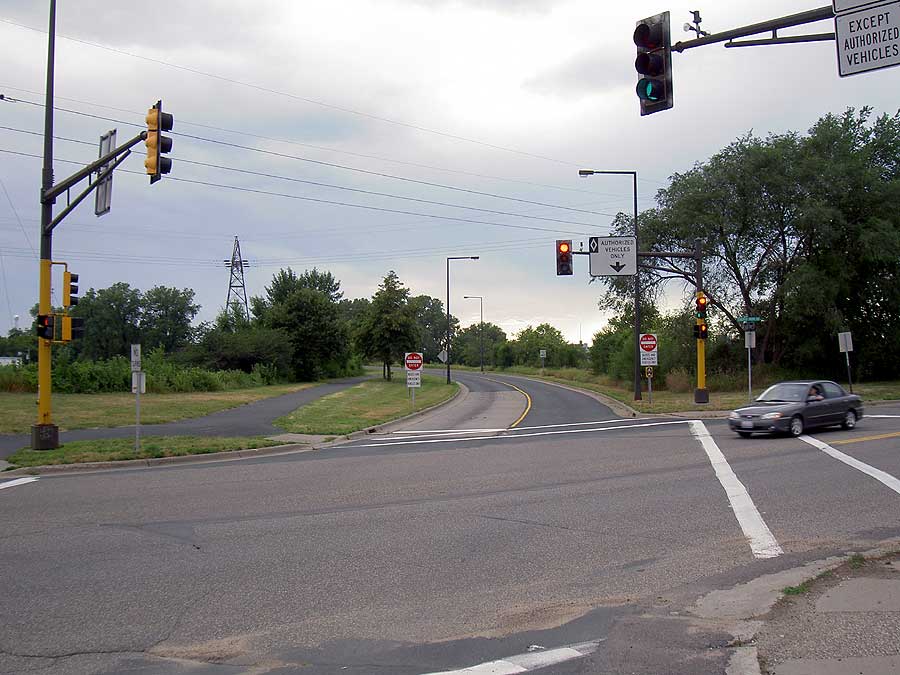
I headed off down Como past the State Fair Grounds with no real goal in mind, figuring it would start to rain and I'd go home. I was riding down Como when I came to the north end of the Intercampus Transitway. I'd noticed this on the excellent Twin Cities Bike Map and thought how exceedingly useful it looked, too bad it was for buses only. Still, how many buses could there be at 6:30 on a summer Sunday evening? Disregarding the Authorized Vehicles Only signs, and with a furtive look around, I headed off up the Transitway.
This is the Google map satellite view of the State Fairgrounds end of the Transitway. It is the bridge that curves over the railroad tracks: Google Map View of Transitway.
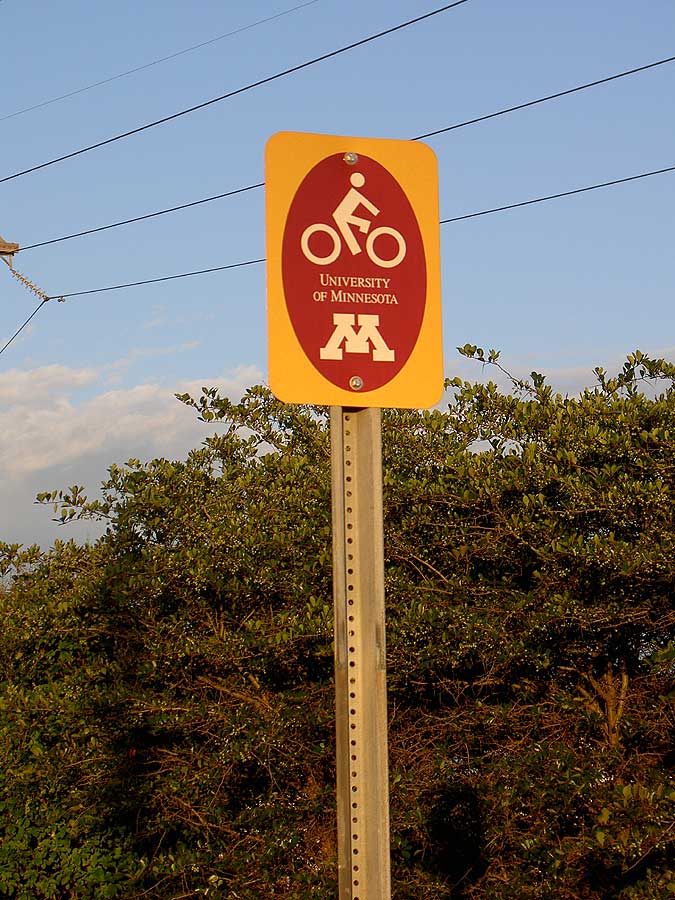
I'm smitten! What a great route! It goes up over this bridge, along some rail lines, then over Raymond and on under Highway 280. Not only that, a couple of other cyclists went by the other way looking not at all guilty. When I got to Energy Park Drive, I found out why; it's marked as a Bike Route with a University of Minnesota sign. South of Energy Park, there's a separate bike path.

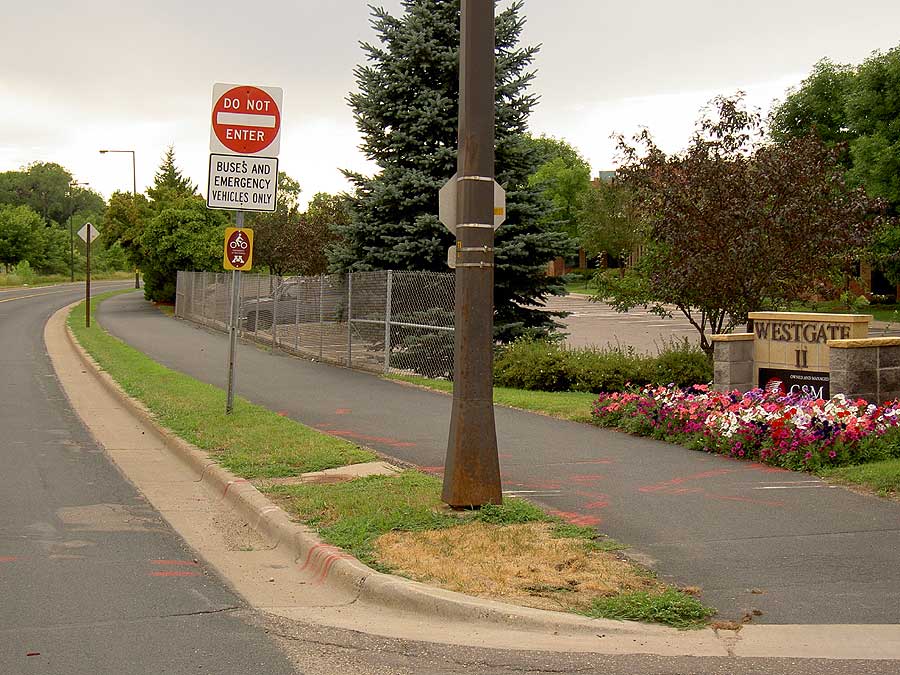
It's along here you go under Highway 280. At Westgate the path switches sides of the road.

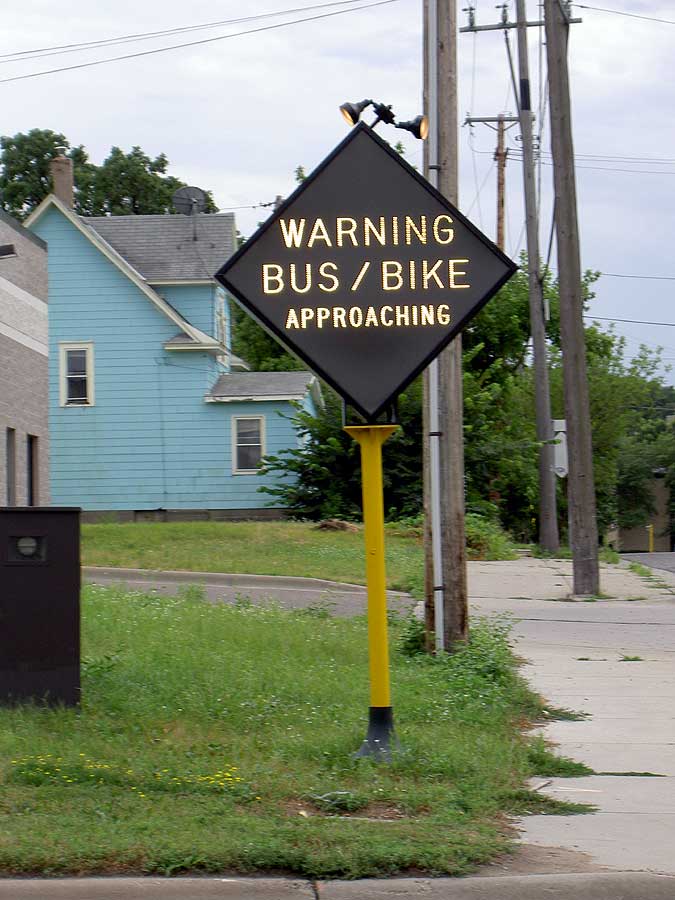
After a rash of truck/bus accidents in the mid-1990s, special signs were put in for the intersecting roads. These detect oncoming buses and bikes and light up to warn crossing drivers.

It's a pretty industrial part of town. There wasn't much traffic, but it was the evening of a sweaty night with the sky threatening rain.

At the west end, it parallels University Avenue and you could get off on any number of side streets. I rode down to the Williams and Mariucci Arena end and turned left. A couple of blocks down I turned onto Washington, which has a bridge across the river. Washington's pretty busy and it's Orientation time now so there are lots of confused buffalo wandering around turning right out of the left turn lanes, looking for landmarks, saying to the kids "Boy this sure has changed since I was here when I met your Mom at that kegger" while the cool 18-year-olds roll their eyes and turn up their iPods, etc.
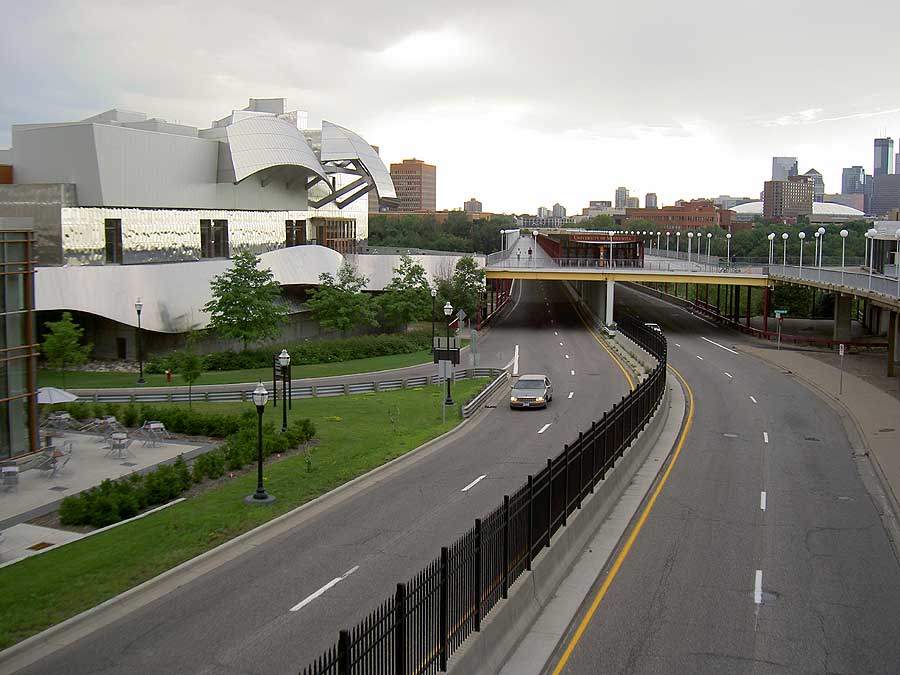
The Washington bridge is great. It has the road below and a path for pedestrians and bikes up above.

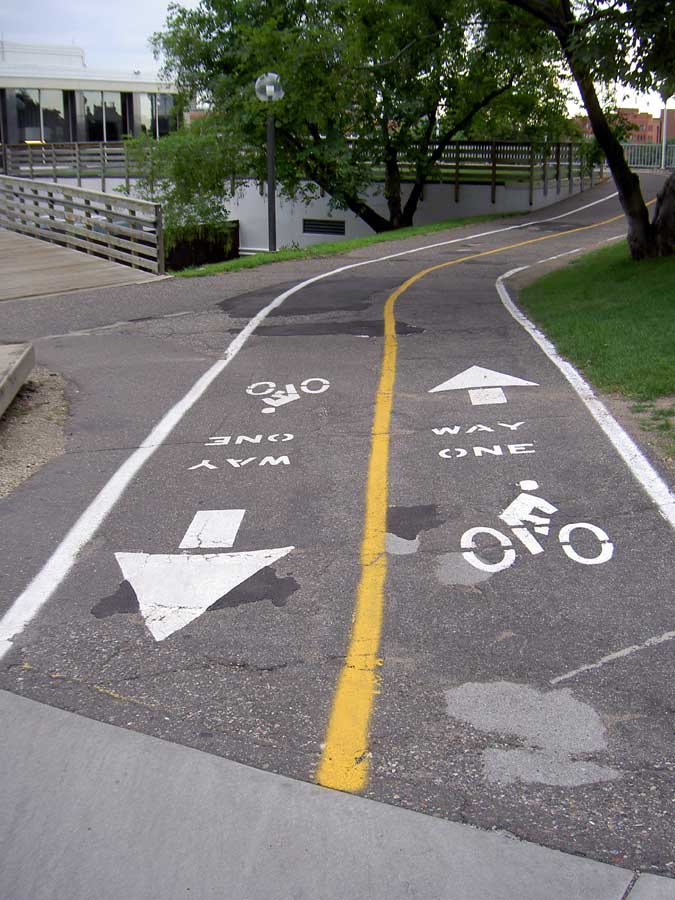
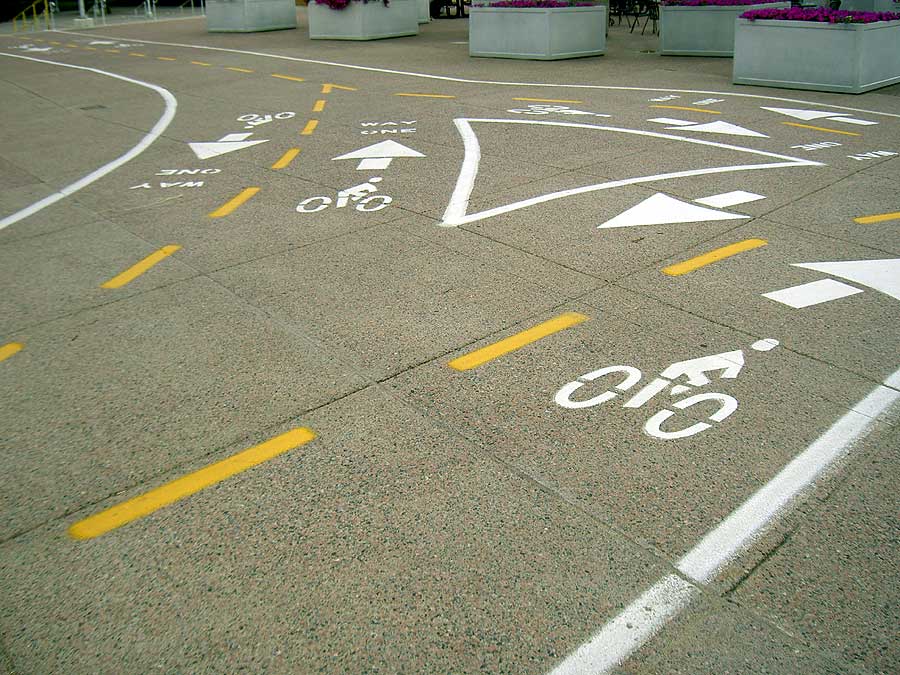
The bike lanes are clearly marked.

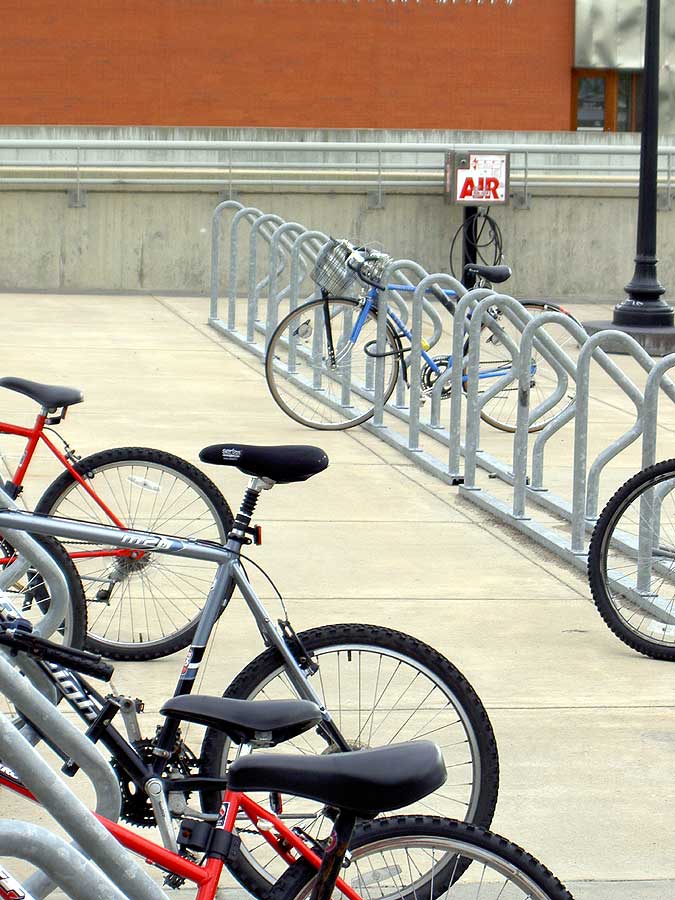
By the Weismann museum on the east bank there is bike parking and something I hadn't seen before.

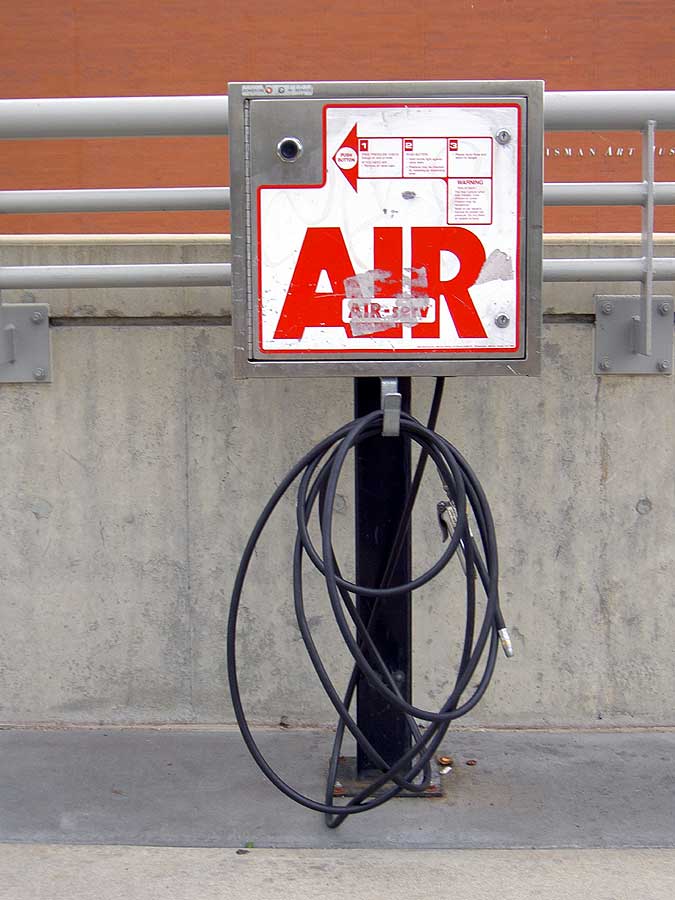
A free air pump for bicycles! Pity the fool who has Presta valves, though.

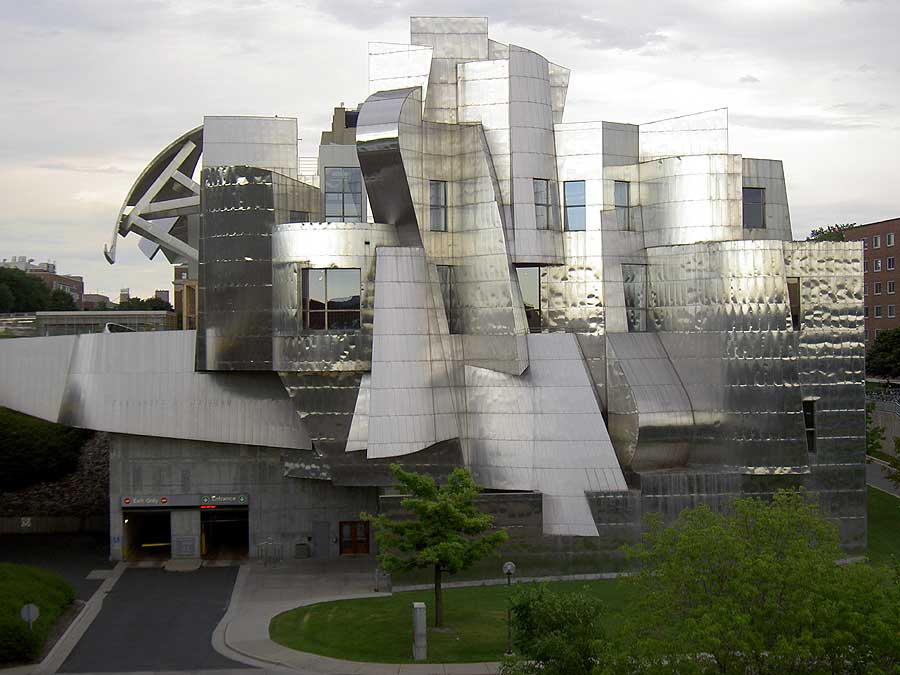
I rode onto the bridge, once again Thumbing My Nose At The Man by riding on the walking side so I could see the downstream view. I didn't seem to inconvenience the single pedestrian I met, a young lady blathering away on her cellphone. You can see the Weisman, covered in tinfoil or something.

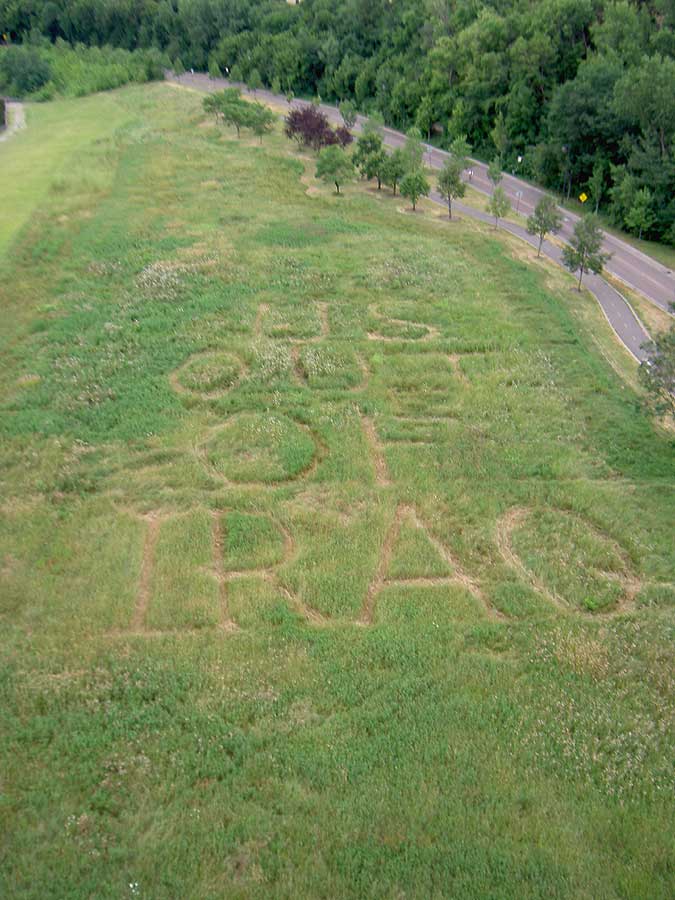
There seems to be some sentiment against the war in Iraq. Once, in Des Moines, back in the Viet Nam war, some protesters fertilized a Peace sign into a public lawn, at the Art Center, I think. That was clever as it persists for a looong time! Kind of like the war in Iraq.

It was quiet this Sunday evening, but there are clear cycling pathways laid out when you arrive at the West Bank. I'll bet this place is hopping on, say, a Tuesday morning in September, once everyone's back, class is in session, and people have their routes figured out.

I rode over to the Riverside LRT station, then up the path to downtown. The apartments right here are heavily North African. There's a tennis court hard by the Interstate and bike trail, but it's disused, lots of weeds and no net. I wonder if Somalis and Ethiopians don't play tennis. Mixed doubles might be hard with those burkhas. Riding by the Metrodome there was some outdoor concert going on. The band seemed to subscribe to the "If you have no talent, buy bigger amps" theory of performance.
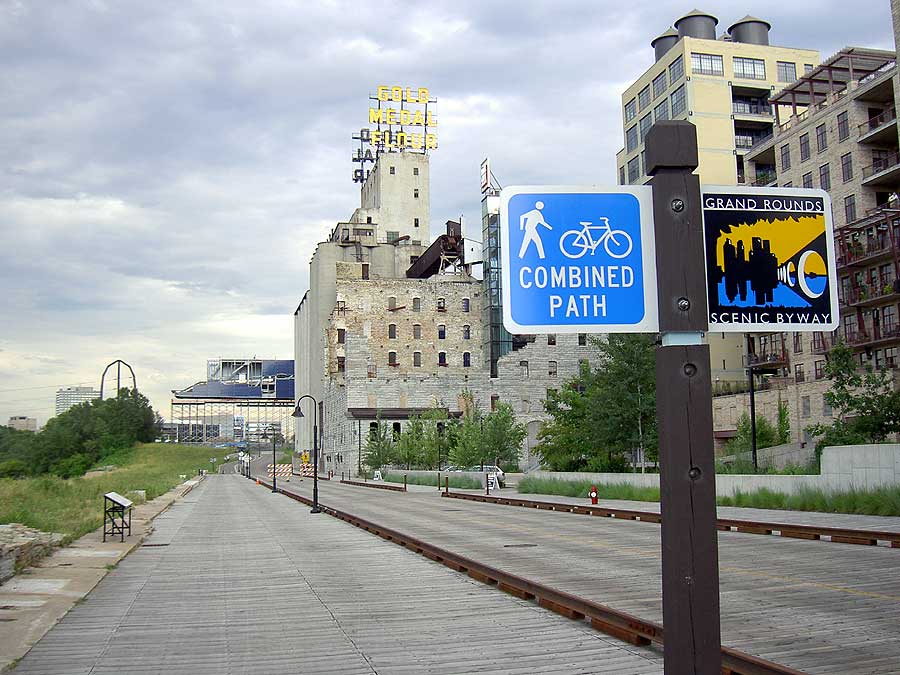
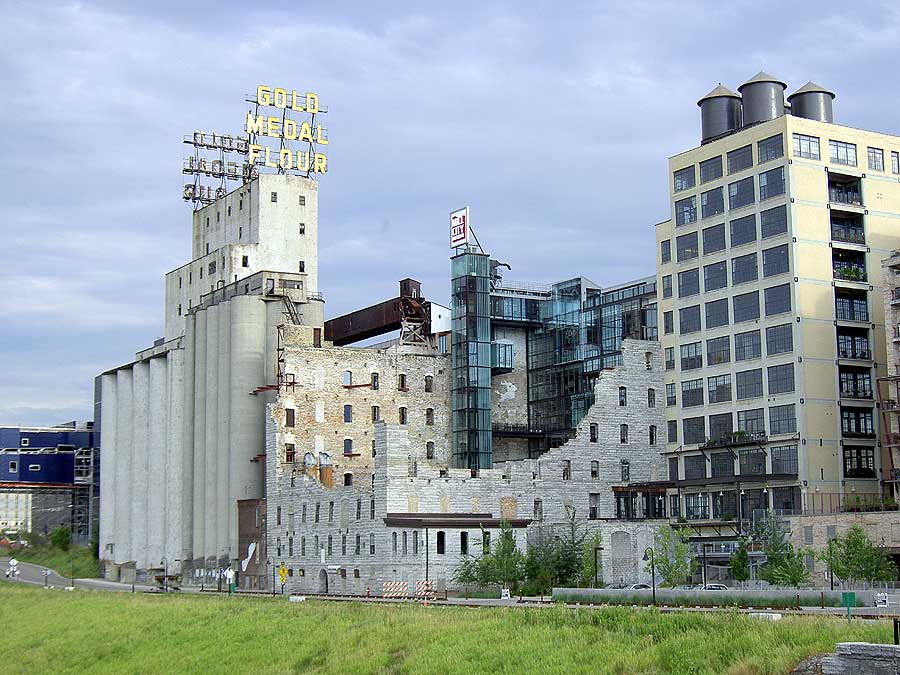
I took a photo of the path along by the Mill City Museum. It's part of Minneapolis's Grand Round Tour.

There's lots of old ruins here.

Out on the Stone Arch Bridge you get a good view of the Museum.

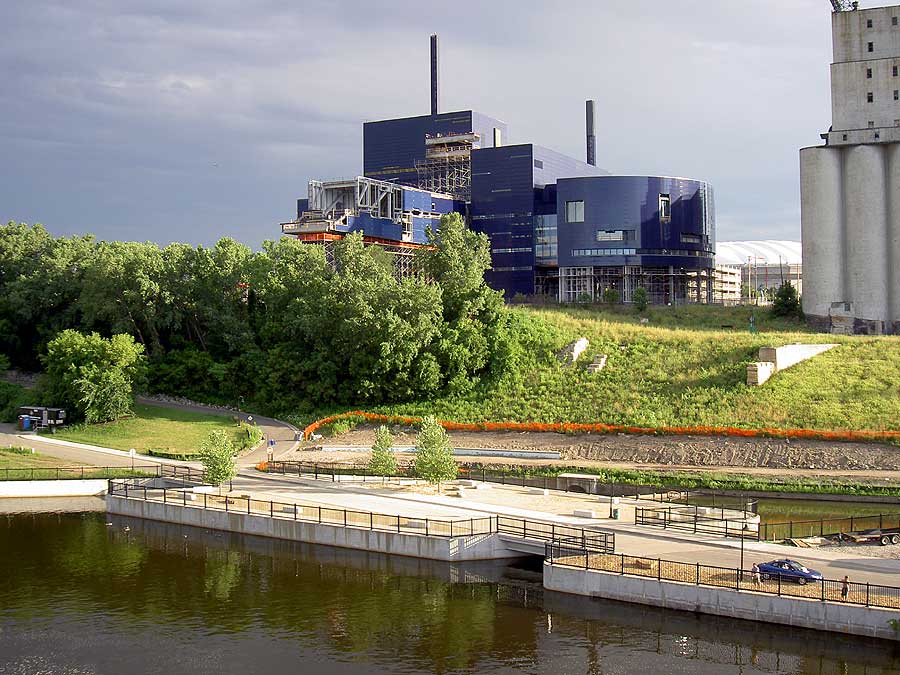
And of the Guthrie Theatre, currently under construction.

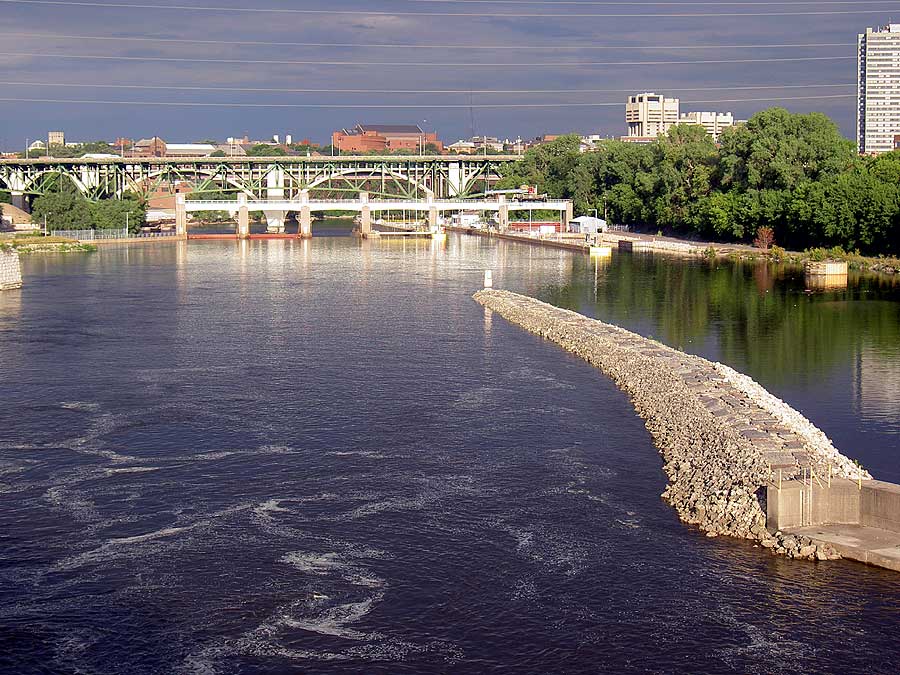
The edge of the clouds passed overhead and the sun came out. I took a picture downriver. That's the lower Saint Anthony lock and dam down there along with the Interstate 35W bridge and some other structures.

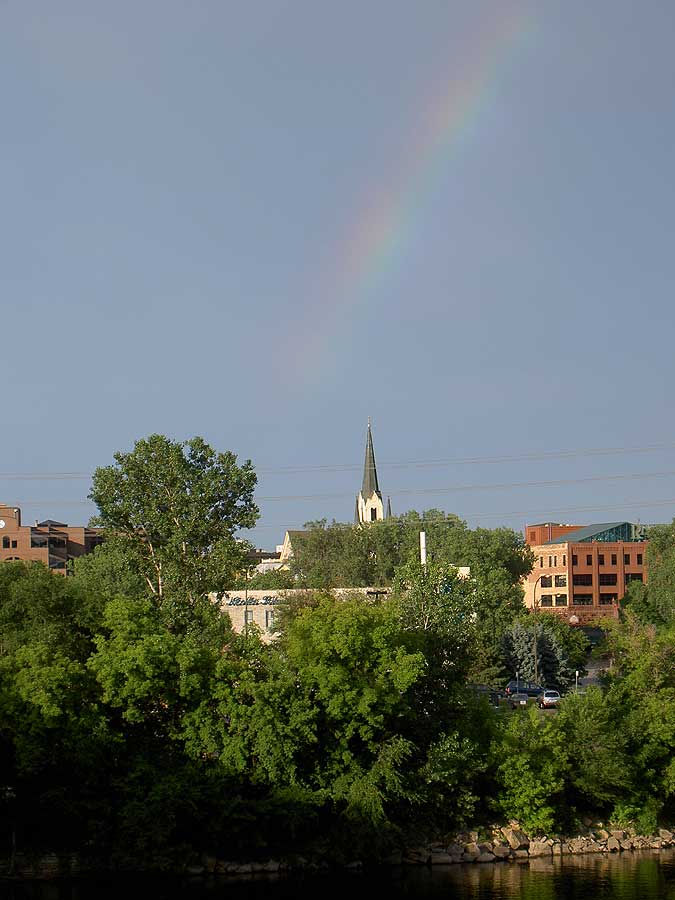
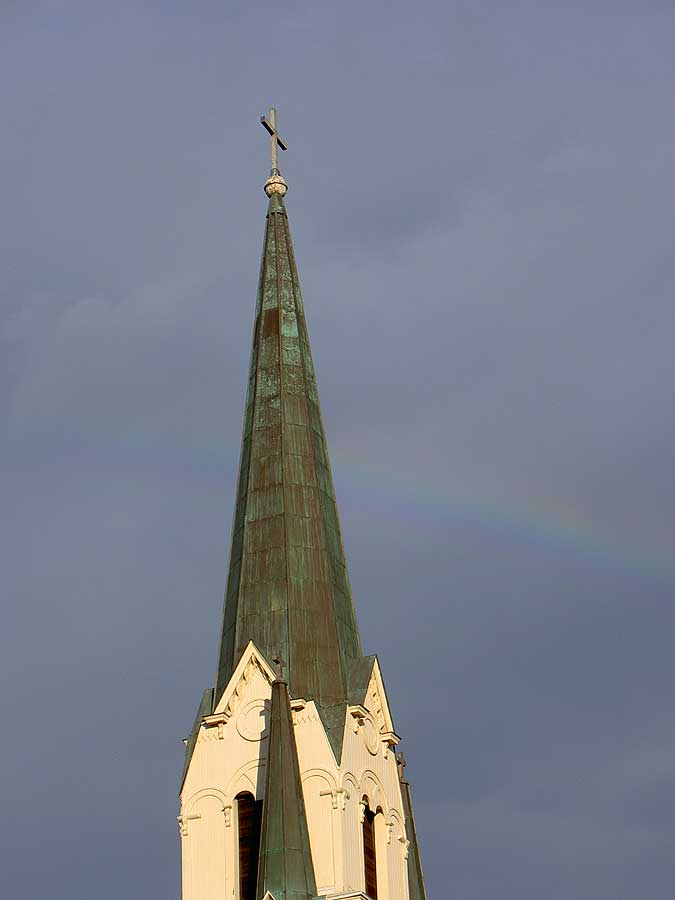
I rode up the bike path and up the spiral ramp onto the Hennepin Bridge. With the sun out and some trace of rain, a faint rainbow had come out. Here is it over Our Lady of Lourdes church.

Right by the church, you could see it by the steeple.

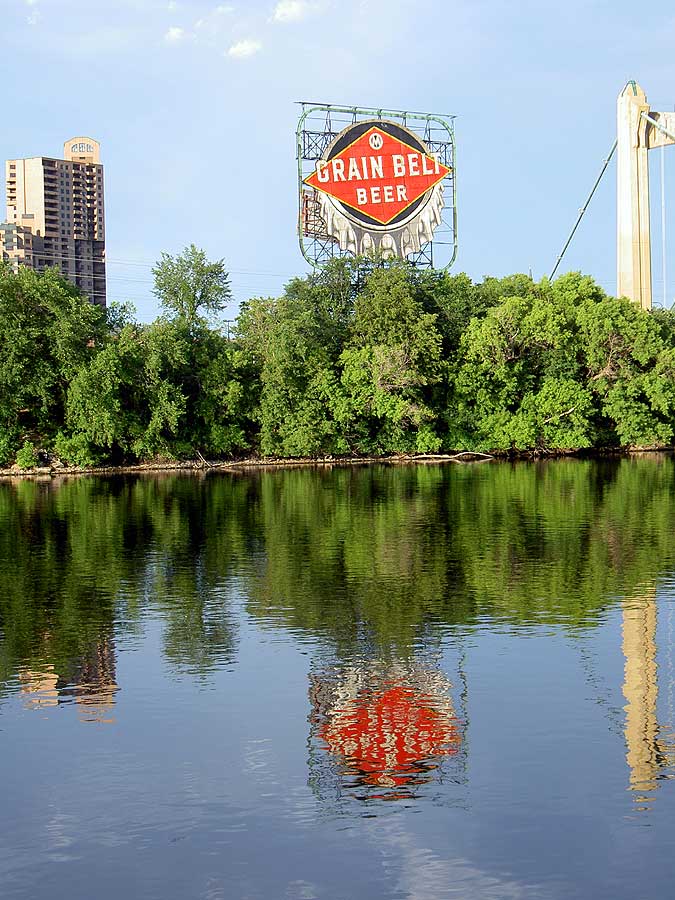
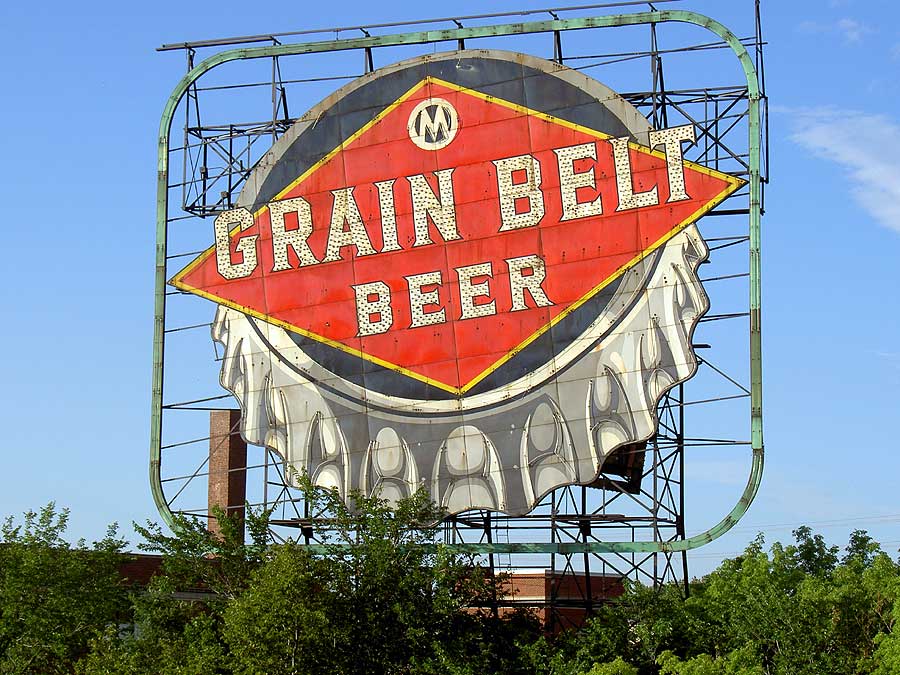
I rode back across the bridge, and took a couple of photos of the big Grain Belt sign on Nicollet Island. Oddly enough, this is right by De La Salle, a Catholic high school.


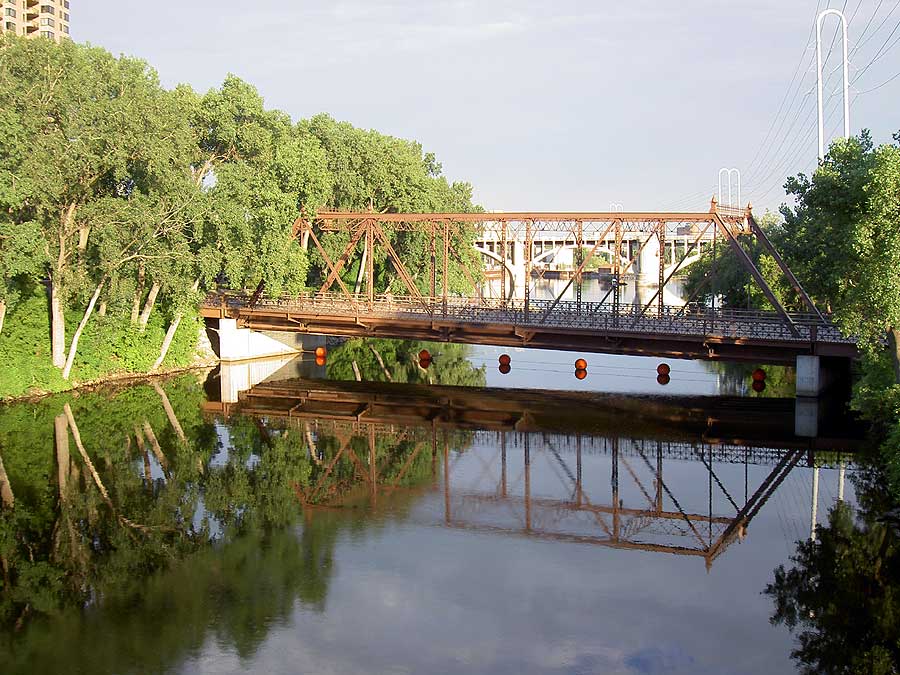
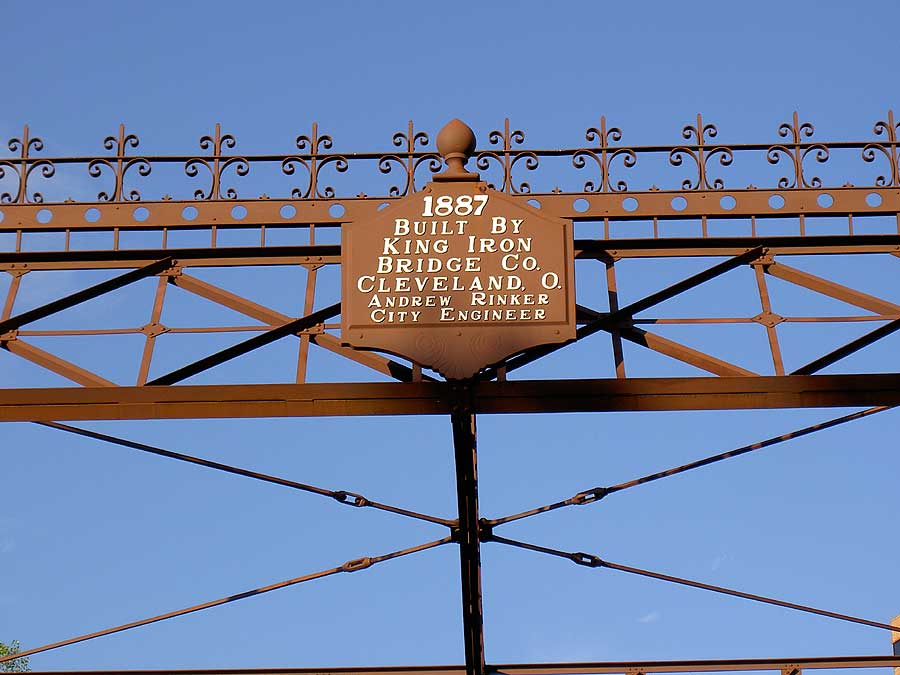
I rode back down through Old Saint Anthony. You can get to Nicollet Island a couple of ways, including this bridge.

It remains as a monument to the great Andrew Rinker, whose name shall go down in History!

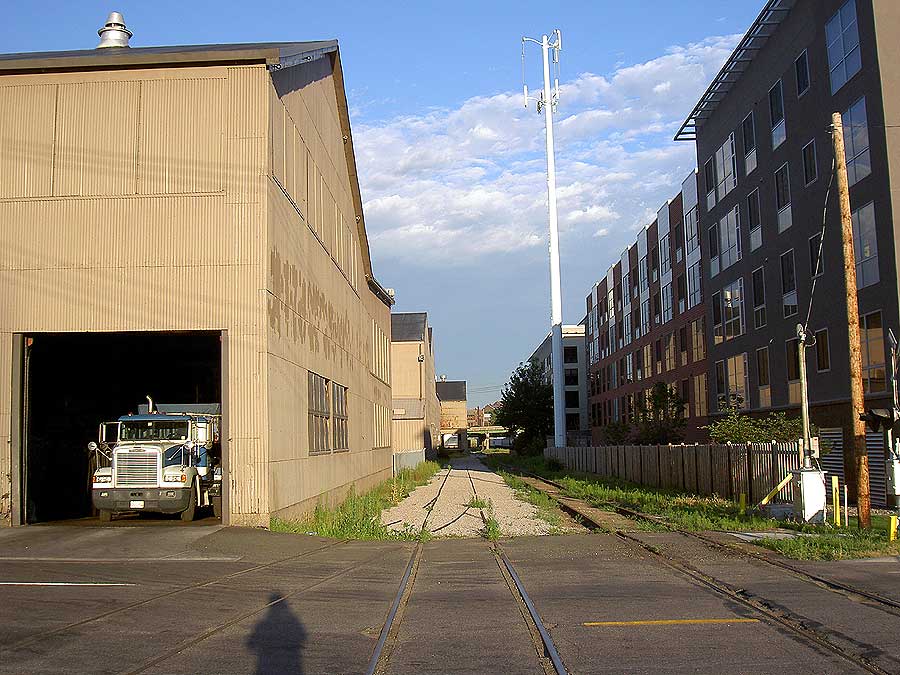
I clattered on down the cobblestones past the Pillsbury A Mill, soon to be condos. There is a funny mix of fashionable riverside residential living and actual productive industry down here. In this photo you have Metalmatic, a factory, on the left, and the Stone Arch condos on the right, with a rail spur in between. My guess is that the condos on this side are cheaper than the ones overlooking the river!

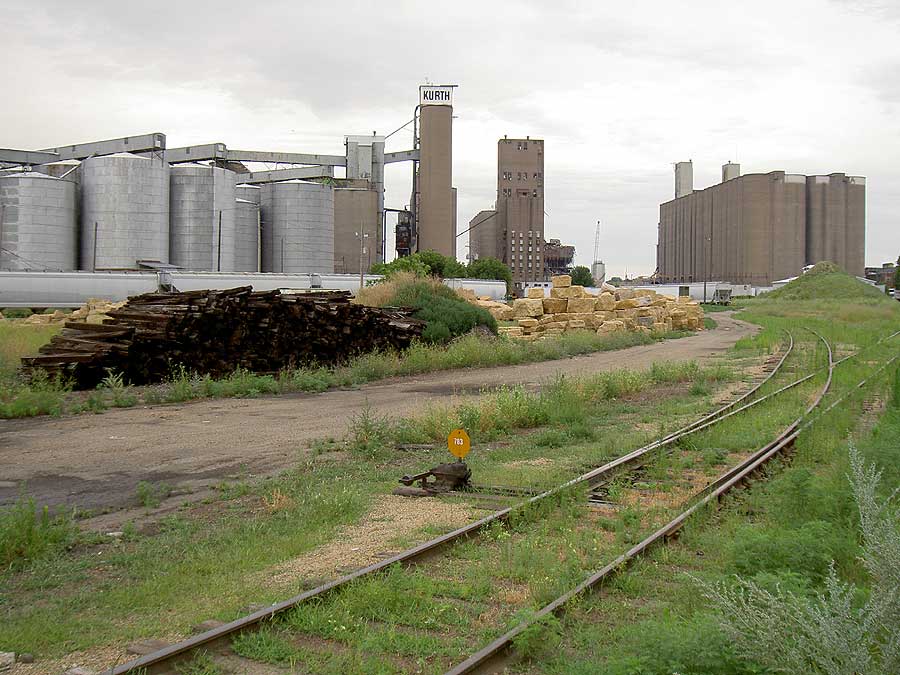
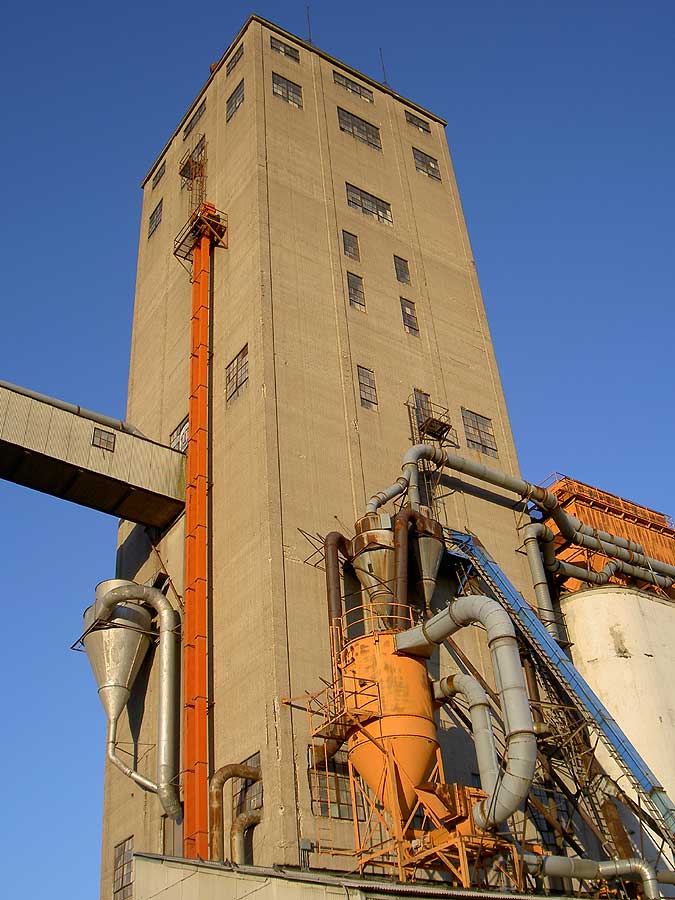
I rode up through Dinkytown and back out to the acres of parking lots around the beginning of the bike path. There are a number of old but still-active grain elevators out here. Here is some of the machinery in the late evening light.

I got back on the Transitway bike path and rode towards home. Again, it was pretty quiet, I met only a single cyclist and a single runner with a dog. At Energy Park an emergency vehicle was coming the other way on the Transitway, but there were no sirens or lights, they may have just been going to dinner. I was happy to see the Bike Path sign north from Energy Park Drive. Maybe I wasn't such a scofflaw after all.

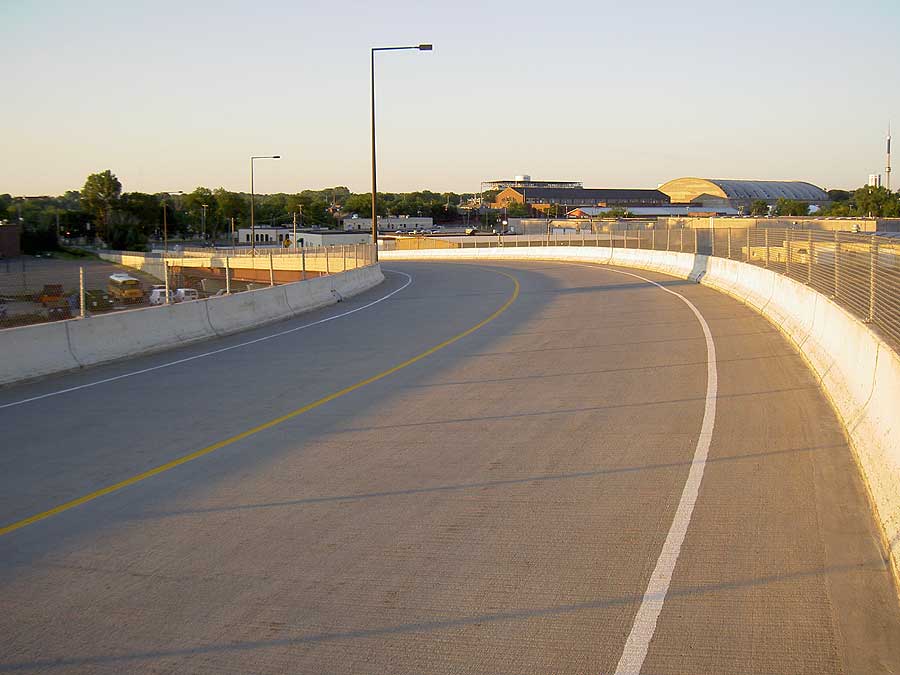
This is the view at the top of the bridge when it arcs north. The State Fairgrounds are in the distance.

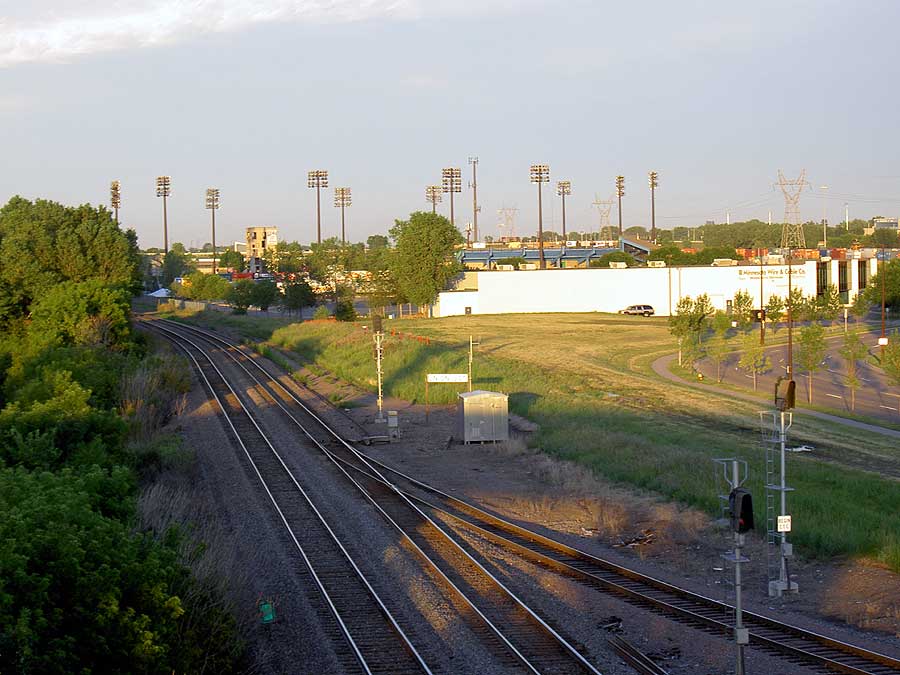
Looking more due east, you see the light poles of Midway Stadium, home of the Saint Paul Saints, as well as some of the railways this transitway deals so elegantly with.

Back at the north end, at Como, I turned for home. Another cyclist was just heading up the Transitway. Maybe this thing is common knowledge to others, but to me it was a revelation. It's not marked as a bike route on the Twin Cities Bike Map so it hadn't occurred to me to try it; I'm not so much a scofflaw that I'd ever tried it in a car, not that there's lots of cops out staking out the Transitway for unauthorized vehicles. At the moment, with Como Avenue severely torn up over by Manning's this makes a great alternative for riding to Minneapolis or the University.
And I rode on home, my blinky light flashing away on my seatpost. I hate to mention this, but it seems to me that the days are getting shorter, that my evening rambles are starting to hint at an overlap with light levels where it seems prudent to turn on a taillight.
In the end, I rode about 22 miles at roughly 11 miles per hour, which seems to be my average whenever I do bicycle-based photography. With the exception of a few widely-scattered raindrops as the sun came out, it never really did rain and I hauled around my poncho and helmet cover for no reason.
Once that was over, I fell asleep while some golf broadcast from Milwaukee droned on. I woke up eventually, I made afternoon tea, and after that decided to go for a ride. It was cloudy to the west and the radar looked like it might portend rain, but I figured, hey, the Atlantis has fenders and some raingear, I'll just do a short ride.
I headed off down Como past the State Fair Grounds with no real goal in mind, figuring it would start to rain and I'd go home. I was riding down Como when I came to the north end of the Intercampus Transitway. I'd noticed this on the excellent Twin Cities Bike Map and thought how exceedingly useful it looked, too bad it was for buses only. Still, how many buses could there be at 6:30 on a summer Sunday evening? Disregarding the Authorized Vehicles Only signs, and with a furtive look around, I headed off up the Transitway.
This is the Google map satellite view of the State Fairgrounds end of the Transitway. It is the bridge that curves over the railroad tracks: Google Map View of Transitway.
I'm smitten! What a great route! It goes up over this bridge, along some rail lines, then over Raymond and on under Highway 280. Not only that, a couple of other cyclists went by the other way looking not at all guilty. When I got to Energy Park Drive, I found out why; it's marked as a Bike Route with a University of Minnesota sign. South of Energy Park, there's a separate bike path.
It's along here you go under Highway 280. At Westgate the path switches sides of the road.
After a rash of truck/bus accidents in the mid-1990s, special signs were put in for the intersecting roads. These detect oncoming buses and bikes and light up to warn crossing drivers.
It's a pretty industrial part of town. There wasn't much traffic, but it was the evening of a sweaty night with the sky threatening rain.
At the west end, it parallels University Avenue and you could get off on any number of side streets. I rode down to the Williams and Mariucci Arena end and turned left. A couple of blocks down I turned onto Washington, which has a bridge across the river. Washington's pretty busy and it's Orientation time now so there are lots of confused buffalo wandering around turning right out of the left turn lanes, looking for landmarks, saying to the kids "Boy this sure has changed since I was here when I met your Mom at that kegger" while the cool 18-year-olds roll their eyes and turn up their iPods, etc.
The Washington bridge is great. It has the road below and a path for pedestrians and bikes up above.
The bike lanes are clearly marked.
By the Weismann museum on the east bank there is bike parking and something I hadn't seen before.
A free air pump for bicycles! Pity the fool who has Presta valves, though.
I rode onto the bridge, once again Thumbing My Nose At The Man by riding on the walking side so I could see the downstream view. I didn't seem to inconvenience the single pedestrian I met, a young lady blathering away on her cellphone. You can see the Weisman, covered in tinfoil or something.
There seems to be some sentiment against the war in Iraq. Once, in Des Moines, back in the Viet Nam war, some protesters fertilized a Peace sign into a public lawn, at the Art Center, I think. That was clever as it persists for a looong time! Kind of like the war in Iraq.
It was quiet this Sunday evening, but there are clear cycling pathways laid out when you arrive at the West Bank. I'll bet this place is hopping on, say, a Tuesday morning in September, once everyone's back, class is in session, and people have their routes figured out.
I rode over to the Riverside LRT station, then up the path to downtown. The apartments right here are heavily North African. There's a tennis court hard by the Interstate and bike trail, but it's disused, lots of weeds and no net. I wonder if Somalis and Ethiopians don't play tennis. Mixed doubles might be hard with those burkhas. Riding by the Metrodome there was some outdoor concert going on. The band seemed to subscribe to the "If you have no talent, buy bigger amps" theory of performance.
I took a photo of the path along by the Mill City Museum. It's part of Minneapolis's Grand Round Tour.
There's lots of old ruins here.
Out on the Stone Arch Bridge you get a good view of the Museum.
And of the Guthrie Theatre, currently under construction.
The edge of the clouds passed overhead and the sun came out. I took a picture downriver. That's the lower Saint Anthony lock and dam down there along with the Interstate 35W bridge and some other structures.
I rode up the bike path and up the spiral ramp onto the Hennepin Bridge. With the sun out and some trace of rain, a faint rainbow had come out. Here is it over Our Lady of Lourdes church.
Right by the church, you could see it by the steeple.
I rode back across the bridge, and took a couple of photos of the big Grain Belt sign on Nicollet Island. Oddly enough, this is right by De La Salle, a Catholic high school.
I rode back down through Old Saint Anthony. You can get to Nicollet Island a couple of ways, including this bridge.
It remains as a monument to the great Andrew Rinker, whose name shall go down in History!
I clattered on down the cobblestones past the Pillsbury A Mill, soon to be condos. There is a funny mix of fashionable riverside residential living and actual productive industry down here. In this photo you have Metalmatic, a factory, on the left, and the Stone Arch condos on the right, with a rail spur in between. My guess is that the condos on this side are cheaper than the ones overlooking the river!
I rode up through Dinkytown and back out to the acres of parking lots around the beginning of the bike path. There are a number of old but still-active grain elevators out here. Here is some of the machinery in the late evening light.
I got back on the Transitway bike path and rode towards home. Again, it was pretty quiet, I met only a single cyclist and a single runner with a dog. At Energy Park an emergency vehicle was coming the other way on the Transitway, but there were no sirens or lights, they may have just been going to dinner. I was happy to see the Bike Path sign north from Energy Park Drive. Maybe I wasn't such a scofflaw after all.
This is the view at the top of the bridge when it arcs north. The State Fairgrounds are in the distance.
Looking more due east, you see the light poles of Midway Stadium, home of the Saint Paul Saints, as well as some of the railways this transitway deals so elegantly with.
Back at the north end, at Como, I turned for home. Another cyclist was just heading up the Transitway. Maybe this thing is common knowledge to others, but to me it was a revelation. It's not marked as a bike route on the Twin Cities Bike Map so it hadn't occurred to me to try it; I'm not so much a scofflaw that I'd ever tried it in a car, not that there's lots of cops out staking out the Transitway for unauthorized vehicles. At the moment, with Como Avenue severely torn up over by Manning's this makes a great alternative for riding to Minneapolis or the University.
And I rode on home, my blinky light flashing away on my seatpost. I hate to mention this, but it seems to me that the days are getting shorter, that my evening rambles are starting to hint at an overlap with light levels where it seems prudent to turn on a taillight.
In the end, I rode about 22 miles at roughly 11 miles per hour, which seems to be my average whenever I do bicycle-based photography. With the exception of a few widely-scattered raindrops as the sun came out, it never really did rain and I hauled around my poncho and helmet cover for no reason.
Thursday, July 21, 2005
Uncomfortable Reminders
I started off in college as a Journalism major. I switched after a couple of years but retain some residual interest in journalism and subscribe to a Poynter Institute Morning Meeting email. This has story ideas for journalists. Cleaning up emails, I read this one about roadside memorials.
This is interesting as the debate is couched in terms of religious observance on public land, safety risk, etc. I wonder how much of it is squeamishness about the ubiquity of these sudden, untimely deaths. Minnesota is mentioned in there with the context of the death of Herb Brooks, the coach of the 1980 U.S. Olympic Miracle on Ice hockey team. He fell asleep at the wheel, ran off Interstate 35 and was thrown from his minivan. He wasn't wearing a seatbelt. There is now a statue of him in downtown St. Paul holding his arms up. It's supposed to signify the victory over the Russians leading towards the gold medal game (against the Swedes, though people forget that) but I think of it as the pose he must have had as he went through the windshield in part because of his free choice not to wear a seatbelt. Fame is no protector of the foolish, as Princess Diana also found out.
Rather than remove these memorials after a year or two, they ought to be permanent. Wouldn't fields of little white crosses with names and dates be a sobering reminder of the price we pay for our mobility? I've been driving for thirty years; during that time, something like 1,400,000 people have been killed on the nation's roadways with millions more injured. Maybe if we planted little crosses every time someone was killed and we left them in place and maintained them, their ubiquity and frequency would make people think a little harder about how they drive.
Of course, we'd have to hang up our cellphones long enough to notice.
Be careful out there.
A battle is emerging over roadside memorials that are springing up everywhere. Sometimes the memorials themselves create traffic hazards. Memorials are becoming so commonplace that this website documents thousands of such memorials from sea to sea. I have touched on this topic a couple of times in the past, once in August 2003 and again in June 2003.
There are questions about whether overly religious markers should be allowed on government property. Some states, like Wisconsin, decided to allow memorials to remain in some places for up a year. Alaska places the limit at two years.
USA Today reported that Roadside memorials were once most common in the Southwest , where they evolved from centuries-old Catholic traditions in Spain and Mexico. Now, they're everywhere -- from rural Wyoming, where school kids designed the state's official memorial sign, to New York City, where artists install white "ghost bikes" at the site of deadly bicycle crashes.
There's no national law on roadside memorials. States and municipalities apply a hodge-podge of policies. The issue is often emotional: Arguments about traffic hazards and right-of-way aren't welcome by families in mourning.
Some states, like North Carolina and Oregon, prohibit the shrines. Others, like Florida and Washington, allow only state-sanctioned markers. Only Alaska and West Virginia have statutes that encourage memorials. (In fact, West Virginia asks that those who place the memorials put some contact information on the memorials in case highway workers have to disturb the markers.)
Utah will ban memorials later this year and instead offer to plant wildflowers or erect a state-approved sign. Delaware began engraving bricks this year for a state-maintained memorial garden. And in May, Norton, Mass., imposed a 30-day limit on roadside shrines.
As the number and scope of the memorials grow, battles have become more common: A year after a series of heated public hearings in 2004, Nevada has yet to decide how to regulate roadside memorials. The issue came to a head after state highway officials, threatened with a lawsuit, removed an 8-foot, steel cross from U.S. Highway 50 near Carson City. "It became a huge emotional issue. And here we are, the big bad government, in between," says Scott Magruder, a spokesman for the Nevada Department of Transportation. ...
Minnesota cracked down last summer by clearing interstates and freeways of personal memorials. The action came after the fatal car crash of hockey great Herb Brooks, who coached the U.S. Olympics team in 1980 to victory over the Soviet Union.
Hundreds of mourners left flowers, balloons, hockey paraphernalia, even a huge plywood "M" for the University of Minnesota at the site of Brooks' 2003 accident on Interstate 35. "The bottom line is safety," says Kevin Gutkneckt, a spokesman for Minnesota's transportation department. "We don't want things built on the roadsides that could cause a crash." [Read Minnesota's official policy by clicking here.]
RoadsideAmerica.com also has a thoughtful piece from a few years ago that is worth a look.
Stateline.org did a big story about the conflicts emerging over roadside memorials in 2003. Be sure to check and see if specific state laws have changed since then.
A sociology professor from Virginia Tech, Clifton Bryant, says these roadside memorials can be important:
Roadside memorials also may be an attempt by the survivors to warn others of an unsafe stretch of road, Bryant suggests.
But, more importantly, roadside or other impromptu memorials mark the untimeliness of the deaths. When people are sick and hospitalized and their deaths are expected, there is no similar need to mark the spot of where they died. But when death is unexpected, it disturbs people's sense of time, of specificity. "There's something mystical, if not magic, about the site of the death," Bryant says. "There's a symbolic significance of the exact spot where they died. Instant monuments provide some symbolic stability, a lighthouse to the place people can go to pay homage."
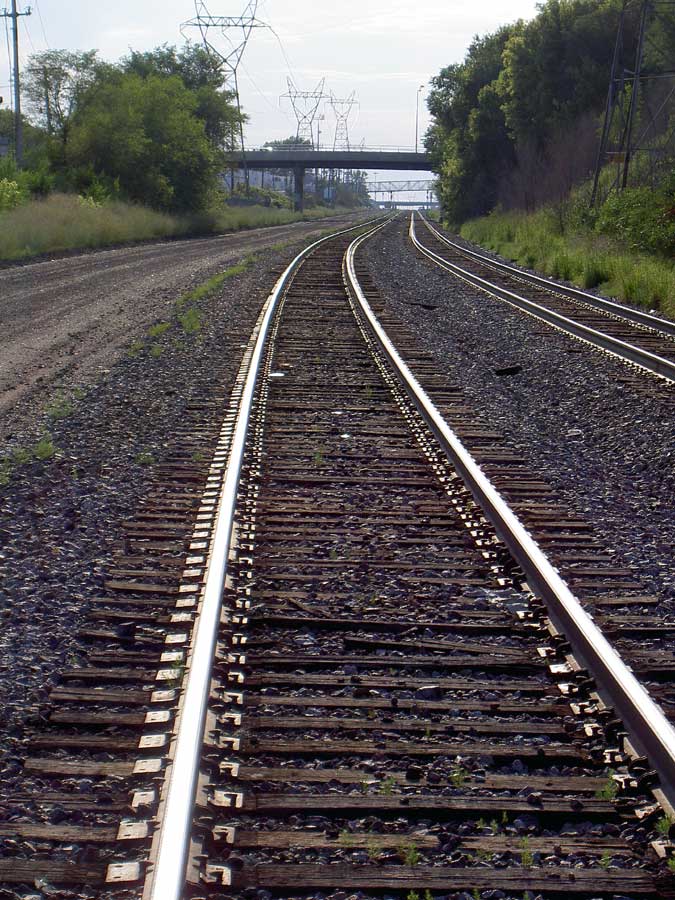
This is interesting as the debate is couched in terms of religious observance on public land, safety risk, etc. I wonder how much of it is squeamishness about the ubiquity of these sudden, untimely deaths. Minnesota is mentioned in there with the context of the death of Herb Brooks, the coach of the 1980 U.S. Olympic Miracle on Ice hockey team. He fell asleep at the wheel, ran off Interstate 35 and was thrown from his minivan. He wasn't wearing a seatbelt. There is now a statue of him in downtown St. Paul holding his arms up. It's supposed to signify the victory over the Russians leading towards the gold medal game (against the Swedes, though people forget that) but I think of it as the pose he must have had as he went through the windshield in part because of his free choice not to wear a seatbelt. Fame is no protector of the foolish, as Princess Diana also found out.
Rather than remove these memorials after a year or two, they ought to be permanent. Wouldn't fields of little white crosses with names and dates be a sobering reminder of the price we pay for our mobility? I've been driving for thirty years; during that time, something like 1,400,000 people have been killed on the nation's roadways with millions more injured. Maybe if we planted little crosses every time someone was killed and we left them in place and maintained them, their ubiquity and frequency would make people think a little harder about how they drive.
Of course, we'd have to hang up our cellphones long enough to notice.
Be careful out there.
Wednesday, July 20, 2005
Get Me a Red Spotted Jersey!
I had big plans to ride to church to help in painting the entryway tonight, but it got called off onaccounta the heat. Our church isn't air conditioned so we get a preview of Hades on these sweltery Sundays. Anyway, I had read some other blogs talking about riding up the Saint Paul High Bridge, Ohio Street and Ramsey Hill and decided to go out for a ride. I've ridden (and walked!) up Ramsey Hill before, but never the High Bridge and I've only gone down Ohio Street. It may be too hot to paint but it's not too hot to climb some hills!
I headed off down my usual Chatsworth route a little before 7PM. There were no trains in evidence and I went across the informal crossing.

Chatsworth ends at Saint Clair. This is handy as the approach to the High Bridge is down St. Clair. This goes down a nice long hill into the river valley where you can build up a good head of steam. You can see the bridge in the distance from the top of the hill.

There are some nice views in the last few hundred yards to the bottom of the bridge. This is the big power plant right on the river.

I got to the bottom (the north end) of the High Bridge and rode on up. It's a long, gentle slope with a pretty generous bike lane. I had no trouble with it but did stop halfway to take some photos. There was traffic in the river.

There's a good view of the bike trail right along the north bank of the Mississippi (the river runs east and west here for a few miles before turning back south).

While I was taking pictures, four women came riding up past me.

After I got to the top, I took a left and then rode down Ohio Street, a steep hill with lots of S-curves. I was roaring down like I was the Tour de France (actually, I never exceeded 31 mph) as what appeared to be a whole bike club labored up the hill. I felt sort of guilty. Going down is easy. I should ride up the hill too.
But first, let's look around!
There's a floating restaurant moored on the Mississippi again! Yay! We used to be quite fond of the No Wake Cafe but it's closed. We'll have to come down and try the River Grill. Maybe I can get Karla to ride here.

I rode under the Wabasha Street Bridge. Here's what it looks like.

Having stalled long enough, I rode over to the base of Ohio Street and headed up. I used my small chainring and ground my way up. I've never been fond of hill climbing. It's kind of a demoralizing hill in that all those curves mean you can't see the top and even when you get to the top of the main hill there's a couple of blocks of upslope to Smith, the High Street road.
Having made my way up, I stopped at the observation area at the south end of the High Bridge. There's a nice view of downtown Saint Paul a little to the east.

A mother and little girl arrived about the same time, from the other side (not having ridden up Ohio Street!) and I overheard Mom make a comment that she didn't know they had telescopes there, next time she'd bring a quarter. I rummaged around in my front bag and found a quarter and gave it to her, and the little girl, Nora, had a good look at downtown Saint Paul.

Here's a view of the bridge from the observation area.

I rode down across the bridge. There's a surprising amount of broken glass in the downhill bike lane. Maybe the sun angle was picking it up. At the bottom, feeling manly, having ridden the High Bridge and Ohio Street, I rode the Ramsey Hill up to Summit, and made it! No old ladies on trikes with cats in their front baskets rode by me saying "on your left!" Last time I tackled the hill was right after working all day at the Great River Energy Bike Festival Time Trials and I'd just had a half-pound bison burger and two major beers and ended up walking the Marin up. This time, I rode! I'll have to get myself a red spotted jersey!
At Summit and Victoria, the light was red, so I took a right and headed up Victoria to try something different. It parallels Chatsworth a few blocks east and gets across I-94 on its own bridge and crosses University on a traffic light. The neighborhoods are kind of transitional, some gentrification, some immigrants, some African-Americans. There are snippets of Old Minnesota, like Billy's Victorian Bar.

It's hard to imagine a less Victorian-looking bar, but it is on Victoria in Saint Paul. It looks pretty Old Minnesota because of the Grain Belt Premium and Old Style signs out. Also, it has a sign for a Booya which I think of as a Minnesota thing. This one either happened three months ago or is coming up in nine months. I'll have to stop in here sometime for a beer.
And I went home to delicious leftover tuna and spicy noodles and a couple of glasses of wine. I then felt ambitious enough to catch up on the blogging, hence all of tonight's entries.
I have to say, this Atlantis is really fun. It makes cycling much more fun than my Marin, which means I want to ride around more, which means I get stronger, which makes it more fun, etc. It's a virtuous cycle. My mileage (17.5 miles tonight) and pace (11.5 mph average, largely due to farting around taking pictures etc) are pathetic compared to serious cyclists', but I'm having a great time. It's hard to tell how others experience their bikes, what combination of joy and discomfort they get, but I wish more people could have the fun I'm having now on this bike. We'd all be out there.
I headed off down my usual Chatsworth route a little before 7PM. There were no trains in evidence and I went across the informal crossing.
Chatsworth ends at Saint Clair. This is handy as the approach to the High Bridge is down St. Clair. This goes down a nice long hill into the river valley where you can build up a good head of steam. You can see the bridge in the distance from the top of the hill.
There are some nice views in the last few hundred yards to the bottom of the bridge. This is the big power plant right on the river.
I got to the bottom (the north end) of the High Bridge and rode on up. It's a long, gentle slope with a pretty generous bike lane. I had no trouble with it but did stop halfway to take some photos. There was traffic in the river.
There's a good view of the bike trail right along the north bank of the Mississippi (the river runs east and west here for a few miles before turning back south).
While I was taking pictures, four women came riding up past me.
After I got to the top, I took a left and then rode down Ohio Street, a steep hill with lots of S-curves. I was roaring down like I was the Tour de France (actually, I never exceeded 31 mph) as what appeared to be a whole bike club labored up the hill. I felt sort of guilty. Going down is easy. I should ride up the hill too.
But first, let's look around!
There's a floating restaurant moored on the Mississippi again! Yay! We used to be quite fond of the No Wake Cafe but it's closed. We'll have to come down and try the River Grill. Maybe I can get Karla to ride here.
I rode under the Wabasha Street Bridge. Here's what it looks like.
Having stalled long enough, I rode over to the base of Ohio Street and headed up. I used my small chainring and ground my way up. I've never been fond of hill climbing. It's kind of a demoralizing hill in that all those curves mean you can't see the top and even when you get to the top of the main hill there's a couple of blocks of upslope to Smith, the High Street road.
Having made my way up, I stopped at the observation area at the south end of the High Bridge. There's a nice view of downtown Saint Paul a little to the east.
A mother and little girl arrived about the same time, from the other side (not having ridden up Ohio Street!) and I overheard Mom make a comment that she didn't know they had telescopes there, next time she'd bring a quarter. I rummaged around in my front bag and found a quarter and gave it to her, and the little girl, Nora, had a good look at downtown Saint Paul.
Here's a view of the bridge from the observation area.
I rode down across the bridge. There's a surprising amount of broken glass in the downhill bike lane. Maybe the sun angle was picking it up. At the bottom, feeling manly, having ridden the High Bridge and Ohio Street, I rode the Ramsey Hill up to Summit, and made it! No old ladies on trikes with cats in their front baskets rode by me saying "on your left!" Last time I tackled the hill was right after working all day at the Great River Energy Bike Festival Time Trials and I'd just had a half-pound bison burger and two major beers and ended up walking the Marin up. This time, I rode! I'll have to get myself a red spotted jersey!
At Summit and Victoria, the light was red, so I took a right and headed up Victoria to try something different. It parallels Chatsworth a few blocks east and gets across I-94 on its own bridge and crosses University on a traffic light. The neighborhoods are kind of transitional, some gentrification, some immigrants, some African-Americans. There are snippets of Old Minnesota, like Billy's Victorian Bar.
It's hard to imagine a less Victorian-looking bar, but it is on Victoria in Saint Paul. It looks pretty Old Minnesota because of the Grain Belt Premium and Old Style signs out. Also, it has a sign for a Booya which I think of as a Minnesota thing. This one either happened three months ago or is coming up in nine months. I'll have to stop in here sometime for a beer.
And I went home to delicious leftover tuna and spicy noodles and a couple of glasses of wine. I then felt ambitious enough to catch up on the blogging, hence all of tonight's entries.
I have to say, this Atlantis is really fun. It makes cycling much more fun than my Marin, which means I want to ride around more, which means I get stronger, which makes it more fun, etc. It's a virtuous cycle. My mileage (17.5 miles tonight) and pace (11.5 mph average, largely due to farting around taking pictures etc) are pathetic compared to serious cyclists', but I'm having a great time. It's hard to tell how others experience their bikes, what combination of joy and discomfort they get, but I wish more people could have the fun I'm having now on this bike. We'd all be out there.
Subscribe to:
Posts (Atom)