Monday, February 06, 2006

Groundhog Speech

The President gave his State of the Union speech the other night. I didn't watch it because I can hardly bear to hear the man talk. I see a breathtaking amount of hypocrisy in this administration and don't like the culture of corruption, cronyism and incompetence it has engendered. Still, reading the post-game reports, one bit sounded familiar:

Keeping America competitive requires affordable energy. And here we have a serious problem. America is addicted to oil, which is often imported from unstable parts of the world.

The best way to break this addiction is through technology. Since 2001, we have spent nearly $10 billion to develop cleaner, cheaper and more reliable alternative energy sources. And we are on the threshold of incredible advances. So tonight, I announce the Advanced Energy Initiative, a 22 percent increase in clean-energy research at the Department of Energy to push for breakthroughs in two vital areas. To change how we power our homes and offices, we will invest more in zero-emission coal-fired plants, revolutionary solar and wind technologies and clean, safe nuclear energy.

We must also change how we power our automobiles. We will increase our research in better batteries for hybrid and electric cars and in pollution-free cars that run on hydrogen. We will also fund additional research in cutting-edge methods of producing ethanol, not just from corn but from wood chips and stalks or switch grass. Our goal is to make this new kind of ethanol practical and competitive within six years.

Breakthroughs on this and other new technologies will help us reach another great goal, to replace more than 75 percent of our oil imports from the Middle East by 2025. By applying the talent and technology of America, this country can dramatically improve our environment, move beyond a petroleum-based economy and make our dependence on Middle Eastern oil a thing of the past.

We've been hearing about this before. In 2003, President Bush...

"...announced a $1.2 billion hydrogen fuel initiative to reverse America's growing dependence on foreign oil by developing the technology for commercially viable hydrogen-powered fuel cells to power cars, trucks, homes and businesses with no pollution or greenhouse gases. Combined with the FreedomCAR (Cooperative Automotive Research) initiative, President Bush is proposing a total of $1.7 billion over the next five years to develop hydrogen-powered fuel cells, hydrogen infrastructure and advanced automotive technologies."

Hmmm, we're three years in, how's that going? I think Honda has a couple of hydrogen cars (a couple of vehicles, not a couple of models) it's leasing to families, was that part of the initiative? It's always great to announce these programs with long time frames so that the real costs arise after the current administration is gone, and this administration is by no means the first to engage in this bit of long-term grandiosity.

In 1998, Bill Clinton was on the case in his State of the Union speech:

"We have it in our power to act right here, right now. I propose $6 billion in tax cuts and research and development to encourage innovation, renewable energy, fuel-efficient cars, energy- efficient homes. Every time we have acted to heal our environment, pessimists have told us it would hurt the economy. Well, today our economy is the strongest in a generation. And our environment is the cleanest in a generation. We have always found a way to clean the environment and grow the economy at the same time."

In 1980, Jimmy Carter gave a terrific speech. It's hard now to remember what a good man he was, how uncynical compared to recent presidents. It's worth reading the whole thing, but unlike the empty rhetoric we get now with no action to back it up, Carter was clear:

"The single biggest factor in the inflation rate last year, the increase in the inflation rate last year, was from one cause: the skyrocketing prices of OPEC oil. We must take whatever actions are necessary to reduce our dependence on foreign oil--and at the same time reduce inflation.

As individuals and as families, few of us can produce energy by ourselves. But all of us can conserve energy--every one of us, every day of our lives. Tonight I call on you--in fact, all the people of America--to help our Nation. Conserve energy. Eliminate waste. Make 1980 indeed a year of energy conservation....

Our material resources, great as they are, are limited. Our problems are too complex for simple slogans or for quick solutions. We cannot solve them without effort and sacrifice. Walter Lippmann once reminded us, "You took the good things for granted. Now you must earn them again. For every right that you cherish, you have a duty which you must fulfill. For every good which you wish to preserve, you will have to sacrifice your comfort and your ease. There is nothing for nothing any longer."

The Oil Crises predated Carter. Here's Gerald Ford in 1975:

During the 1960's, this country had a surplus capacity of crude oil which we were able to make available to our trading partners whenever there was a disruption of supply. This surplus capacity enabled us to influence both supplies and prices of crude oil throughout the world. Our excess capacity neutralized any effort at establishing an effective cartel, and thus the rest of the world was assured of adequate supplies of oil at reasonable prices.

By 1970, our surplus capacity had vanished, and as a consequence, the latent power of the oil cartel could emerge in full force. Europe and Japan, both heavily dependent on imported oil, now struggle to keep their economies in balance. Even the United States, our country, which is far more self-sufficient than most other industrial countries, has been put under serious pressure.

I am proposing a program which will begin to restore our country's surplus capacity in total energy. In this way, we will be able to assure ourselves reliable and adequate energy and help foster a new world energy stability for other major consuming nations.

But this Nation and, in fact, the world must face the prospect of energy difficulties between now and 1985. This program will impose burdens on all of us with the aim of reducing our consumption of energy and increasing our production. Great attention has been paid to the considerations of fairness, and I can assure you that the burdens will not fall more harshly on those less able to bear them.

I am recommending a plan to make us invulnerable to cutoffs of foreign oil. It will require sacrifices, but it--and this is most important--it will work.

I have set the following national energy goals to assure that our future is as secure and as productive as our past:

First, we must reduce oil imports by 1 million barrels per day by the end of this year and by 2 million barrels per day by the end of 1977.

Second, we must end vulnerability to economic disruption by foreign suppliers by 1985.

Third, we must develop our energy technology and resources so that the United States has the ability to supply a significant share of the energy needs of the free world by the end of this century.

To attain these objectives, we need immediate action to cut imports. Unfortunately, in the short term there are only a limited number of actions which can increase domestic supply. I will press for all of them.

I urge quick action on the necessary legislation to allow commercial production at the Elk Hills, California, Naval Petroleum Reserve. In order that we make greater use of domestic coal resources, I am submitting amendments to the Energy Supply and Environmental Coordination Act which will greatly increase the number of powerplants that can be promptly converted to coal.

Obviously, voluntary conservation continues to be essential, but tougher programs are needed--and needed now. Therefore, I am using Presidential powers to raise the fee on all imported crude oil and petroleum products. The crude oil fee level will be increased $1 per barrel on February 1, by $2 per barrel on March 1, and by $3 per barrel on April 1. I will take actions to reduce undue hardships on any geographical region. The foregoing are interim administrative actions. They will be rescinded when broader but necessary legislation is enacted.

To that end, I am requesting the Congress to act within 90 days on a more comprehensive energy tax program. It includes: excise taxes and import fees totaling $2 per barrel on product imports and on all crude oil; deregulation of new natural gas and enactment of a natural gas excise tax.

I plan to take Presidential initiative to decontrol the price of domestic crude oil on April 1. I urge the Congress to enact a windfall profits tax by that date to ensure that oil producers do not profit unduly.

The sooner Congress acts, the more effective the oil conservation program will be and the quicker the Federal revenues can be returned to our people.

I am prepared to use Presidential authority to limit imports, as necessary, to guarantee success.

I want you to know that before deciding on my energy conservation program, I considered rationing and higher gasoline taxes as alternatives. In my judgment, neither would achieve the desired results and both would produce unacceptable inequities.

A massive program must be initiated to increase energy supply, to cut demand, and provide new standby emergency programs to achieve the independence we want by 1985. The largest part of increased oil production must come from new frontier areas on the Outer Continental Shelf and from the Naval Petroleum Reserve No. 4 in Alaska. It is the intent of this Administration to move ahead with exploration, leasing, and production on those frontier areas of the Outer Continental Shelf where the environmental risks are acceptable.

President Ford was also wringing his hands about a budget deficit that might hit $45 Billion and a national debt that would top half a trillion dollars. Funnily enough, only Democratic President Bill Clinton's administrations have run budget surpluses since then. Fiscal conservative Ronald Reagan ran big deficits; so did George Bush I, though he tried to rein them in with some tax increases and got savaged for it; George Bush II has spent money like a drunken sailor, seen huge budget deficit increases yet finds tax cutting to be the correct policy prescription for nearly all our ills. We will one day rue these developments. Now we have an $8 trillion national debt and it rises about $2 billion a day. The half trillion dollar national debt isn't as much as is proposed for defence spending in the budget just submitted (ok, I'm being unfair here and using nominal dollars, not constant).

Richard Nixon, soon to resign under threat of impeachment for, among other things, domestic wiretaps and coverups, addressed the issue in early 1974:

Looking at the year 1974 which lies before us, there are 10 key areas in which landmark accomplishments are possible this year in America. If we make these our national agenda, this is what we will achieve in 1974:

We will break the back of the energy crisis; we will lay the foundation for our future capacity to meet America's energy needs from America's own resources....

We will establish a new system that makes high-quality health care available to every American in a dignified manner and at a price he can afford....

In all of the 186 State of the Union messages delivered from this place, in our history this is the first in which the one priority, the first priority, is energy. Let me begin by reporting a new development which I know will be welcome news to every American. As you know, we have committed ourselves to an active role in helping to achieve a just and durable peace in the Middle East, on the basis of full implementation of Security Council Resolutions 242 and 338. The first step in the process is the disengagement of Egyptian and Israeli forces which is now taking place.

Because of this hopeful development, I can announce tonight that I have been assured, through my personal contacts with friendly leaders in the Middle Eastern area, that an urgent meeting will be called in the immediate future to discuss the lifting of the oil embargo.

This is an encouraging sign. However, it should be clearly understood by our friends in the Middle East that the United States will not be coerced on this issue.

Regardless of the outcome of this meeting, the cooperation of the American people in our energy conservation program has already gone a long way towards achieving a goal to which I am deeply dedicated. Let us do everything we can to avoid gasoline rationing in the United States of America.

Last week, I sent to the Congress a comprehensive special message setting forth our energy situation, recommending the legislative measures which are necessary to a program for meeting our needs. If the embargo is lifted, this will ease the crisis, but it will not mean an end to the energy shortage in America. Voluntary conservation will continue to be necessary. And let me take this occasion to pay tribute once again to the splendid spirit of cooperation the American people have shown which has made possible our success in meeting this emergency up to this time.

The new legislation I have requested will also remain necessary. Therefore, I urge again that the energy measures that I have proposed be made the first priority of this session of the Congress. These measures will require the oil companies and other energy producers to provide the public with the necessary information on their supplies. They will prevent the injustice of windfall profits for a few as a result of the sacrifices of the millions of Americans. And they will give us the organization, the incentives, the authorities needed to deal with the short-term emergency and to move toward meeting our long-term needs.

Just as 1970 was the year in which we began a full-scale effort to protect the environment, 1974 must be the year in which we organize a full-scale effort to provide for our energy needs, not only in this decade but through the 21st century.

As we move toward the celebration 2 years from now of the 200th anniversary of this Nation's independence, let us press vigorously on toward the goal I announced last November for Project Independence. Let this be our national goal: At the end of this decade, in the year 1980, the United States will not be dependent on any other country for the energy we need to provide our jobs, to heat our homes, and to keep our transportation moving.

To indicate the size of the Government commitment, to spur energy research and development, we plan to spend $10 billion in Federal funds over the next 5 years. That is an enormous amount. But during the same 5 years, private enterprise will be investing as much as $200 billion-- and in 10 years, $500 billion--to develop the new resources, the new technology, the new capacity America will require for its energy needs in the 1980's. That is just a measure of the magnitude of the project we are undertaking.

But America performs best when called to its biggest tasks. It can truly be said that only in America could a task so tremendous be achieved so quickly, and achieved not by regimentation, but through the effort and ingenuity of a free people, working in a free system....

I think all of us recognize that the energy crisis has given new urgency to the need to improve public transportation, not only in our cities but in rural areas as well. The program I have proposed this year will give communities not only more money but also more freedom to balance their own transportation needs. It will mark the strongest Federal commitment ever to the improvement of mass transit as an essential element of the improvement of life in our towns and cities....

Unrelated to energy but of remarkably current interest:

One measure of a truly free society is the vigor with which it protects the liberties of its individual citizens. As technology has advanced in America, it has increasingly encroached on one of those liberties--what I term the right of personal privacy. Modern information systems, data banks, credit records, mailing list abuses, electronic snooping, the collection of personal data for one purpose that may be used for another--all these have left millions of Americans deeply concerned by the privacy they cherish.

And the time has come, therefore, for a major initiative to define the nature and extent of the basic rights of privacy and to erect new safeguards to ensure that those rights are respected."

Nixon would resign that summer in the fallout of the Watergate scandal. We were driving down the 401 in southern Ontario at the time he resigned and my parents let me, a new driver, try driving 1t 65 there since the U.S. speed limit had been dropped to 55 to conserve oil. Something was being asked of us.

There are a number of things that stink about getting older (although, as my mother once said, it's better than the alternative!) but one satisfying thing is seeing the fuss and buzz of daily news resolve itself into longer story cycles. The Peak Oil predicitions made in the 1950s said U.S. oil production would go into decline around 1970; sure enough, it did, President Ford alludes to it above. The resulting increase in dependence on foreign oil combined with Arab anger at the Yom Kippur war got us an OPEC embargo, higher gasoline prices and, in some places, lines at gas stations (though I never saw any personally). This was around the time I began driving.

The reaction to that lasted a decade, as we dumped the huge, heavy inefficient (and often pretty crappy) cars for smaller vehicles that polluted much less and got better mileage. My own experience saw me go from a 1972 Plymouth Valiant, a compact in the parlance of the day, which had a 318 cubic inch (5.2 litre) V-8 and just managed 20 mpg on the highway, to a 1986 Saab 900 with a 2-litre inline 4-cylinder that would manage the upper 20s. 1986 also happens to be the year the U.S. passenger fleet reached its peak in fuel efficiency. That year oil prices collapsed to around $10 a barrel, cars started to creep up in size and the expectation for horsepower went up as well. The 110 horsepower of my Saab 900 would be laugable now; our Totota Avalon has 225 and the new ones have 280. In the last decade the number of vehicles exempt from even our unambitious fleet fuel efficiency requirments has increased, particulary pickup trucks (and yes, I have one, a 1996 Ford Ranger, 25 mpg on the highway, around 20-21 in mixed driving) and sports utility vehicles. Attempts to raise the requirements or to impose the same safety and efficiency requirements on these vehicles in get shouted down amid cries about the safety of America's children (lighter vehicles=less safety, goes the logic) even though it has been shown that SUVs have higher death rates than sedans.

So, OK, gas is $2.09 a gallon, sounds like a crisis, any call to sacrifice? Any "For every right that you cherish, you have a duty which you must fulfill?" Any "Ask not what your country can do for you?" Any "I have nothing to give but blood, sweat, toil and tears?" How about raising gasoline taxes, perhaps 10 cents a gallon a year for the next five years? How about eliminating tax breaks that encourage the purchase by individuals of trucks over 6,000 pounds? How about encouraging some conservation?

Nope. The extremely patriotic Vice President Dick Cheney (patriotic now that he doesn't need to worry about his draft deferrments) went on the very patriotic Rush Limbaugh's show (for you Family Values types, that's the drug addict guy who recently divorced his third wife, which seems not to faze the Bible bashers despite the good book's clear injunctions against divorce) to say the Administration would continue to push to open the Arctic National Wildlife Refuge to drilling. How about some sacrifice? Samuel Bodman, the Energy Secretary, said that "many Americans believe they're already sacrificing by paying the prices they're paying for gasoline and heating oil and natural gas." Hmmm, it's $2.09 a gallon over at the corner gas staion, cheaper than it was in 1981 in real terms. That's some sacrifice! Our leaders, supposedly engaged in a war againt terrorism, have asked nothing beyond that we keep flying and go shopping. And don't worry about those wiretap things.

So in the meantime, our oil imports continue to creep upwards. The lofty goal of eliminating our dependence on Mideast oil is pushed out to 2025; even though it's under 20% of our oil consumption, we continue to send tens of billions of dollars a year to the Middle East, including to Saudi Arabia, our strong ally and, oh yeah, home of 15 of the 19 September 11, 2001 hijackers. Our purchases help keep the price high for everyone, ensuring plenty of funding of our adversaries, of those who work to kill our troops. Al Qaeda and the Iraqi insurgents don't get their money from bake sales, they get it from oil.

Will the situation be any different in 2025 than it was in 1974? That's a 50 year span, and 30 of them have passed and the situation has deteriorated. Will we still have brave talk, rousing calls to action and a continuing addiction to hydrocarbons produced by unsavoury regimes, a continued drain on our economy and a continued funding source to those who hate us? Probably. Our leadership is unwilling to take any hard steps. Jimmy Carter asked for sacrifice and was voted out for an Alzheimers sufferer. George Bush I tried to be responsible and pay for our spending and was summarily despatched from office. Bill Clinton ran surpluses, attacked Al Qaeda bases in Afghanistan and contained Saddam and he was savaged by the party who has found it preferable to spend money like water, expand entitlements, involve us in a needless war and alienate our allies.

For all the brave talk Monday of biofuels and switchgrass, the Energy Department is about to lay off 40 scientists who work on biofuels due to budget cuts proposed by this President and passed by this Congress. For all the talk of increased competitiveness in technology and research, this Congress just passed cuts in student loan programs that help university students.

I'll keep riding my bicycle to substitute for some trips in our cars, I'll keep working to make the house more energy-efficient, but I fully expect to hear a State of the Union speech twenty years hence saying that our dependency on imported petroleum is reaching a crisis point and something needs to be done about it, just like I heard last Monday and just like I heard thirty years ago. By then it will hardly be my problem any longer, and I can pass it on to my children and to theirs. The time for brave action is, ummm, then. In the meantime, keep the gas flowing.

Sunday, January 29, 2006

Late January

I rode to choir rehearsal again, last Wednesday. I haven't been noting each time I do this and this was my third time this year. Geared up as I was for what is typically the coldest week of the year here, it was 30 degrees out and the challenge was to stay cool enough. Having bought 160-stud Nokian Mount and Ground studded tires in December, January is uncharacteristically warm and the streets were so snow-free that I could have ridden the smooth-tired Atlantis with no problem. And the tide has turned; as I set out there was still some glow in the sky in the west as we pick up a couple of minutes of sunlight a day. A week ago Wednesday we had 9 hrs 13 minutes of daylight; last Wednesday it was 9 hrs 27 mins; in a couple of days it'll be 9 hrs 43 mins. A half hour more daylight in two weeks. It feels good.

You still need lights, though. I see other cyclists out riding with proper lights and I see, sometimes, others riding showing no lights whatsoever. I think these latter people are foolish and may not realize quite how invisible they are to motorists. I've been showing 3 taillights (one on my helmet, one under my seat, one on my pannier) and two headlights (a Blackburn Quadrant, one which doesn't fall off, and an old Nice Light! which actually works pretty well considering it's just 4AAs.) I also have reflector tape on my rear fender.

I tried shearling mittens for the first time. My cycling buddy Paul in Cedar Rapids, Iowa, who rides lots more than I do, said he's found that shearling works best of all. He said that he tried lobster mittens but they'd get soaked with sweat and get all clammy but shearling absorbed the sweat, stayed warm and dried out gracefully. I picked up a pair of Acorn Merino Shearling Mittens from Sierra Trading Post for $25 and used a free shipping coupon code (now expired) to keep the cost down. Although they're L/XL, they're a bit small for me (isn't everything?) but were very warm. Of course, 30F is hardly an acid test.

Paul, a retired engineer, has also been performing experiments. I have one of the legendary Jong-Won JSB-500 stainless steel vacuum insulated water bottles. It works great, keeping icy stuff really cold in the summer and coffee or whatever piping hot in the winter. The guy at Bicycle Coffee Systems loved these things. I'd given Paul one. In the autumn of 2004 he had came up and spent three weeks scraping and painting my house, I fed him pizza and beer and in my everlasting thanks gave him a stainless water bottle that cost me $10 on clearance from Things Remembered a couple of years before.

Paul writes:

Cole:

I don't know why I'm spending time writing to you about this; I guess it's just your lucky day.

I was reading your blog and you mentioned your "excellent Jong Won JSB500 stainless steel thermal water bottle". When I rode to KC to pick up the truck, I took the JSB500 you gave me (thanks) along. The day I left it was cool and misting so I filled it with coffee. It kept the coffee warm for a few hours. I stopped mid morning and had some warm coffee. The next few days I would fill it with ice and Gatorade so that in the afternoon after my Camelbak was empty I would have something cold to drink. JSB500 worked well but for some reason I could not get the coffee taste to wash out of the bottle. And the cap on the JSB500 sucks; it leaks and seems to be the main heat loss point.

Well anyway I bought two other stainless steel thermal water bottles from Campmor.com. They are: This one and this one.

These seem to be the same bottle with the second one just having an additional cap with a pull spout. Both bottles also have a nice push-open push-closed stopper and the cutest little drinking cup cap you've ever seen. Both hold 16 oz. They are a loose fit in a water bottle cage so you have to bend the cage in slightly to keep the bottle from rattling.
I tested the three bottles by pouring near-boiling water in each and periodically checking the water temp. The Campmor bottles performed about the same and held heat better than the JSB500. After a couple of hours, the difference was more than 20F. Again, the problem seemed to be with the JSB500's cap.

The first bottle from Campmor is only $10. The second one is $16 with the extra $6 getting you a pull to sip top. I sent back the 16 buck bottle because I can't see trying to sip hot coffee on a bicycle anyway.

So for 10 bucks the Campmor bottle seems like a pretty good bottle. They also sell a 24 oz version for $16, but it's dia is a bit too big for a water bottle cage. I suppose you could bend up an old cage and make it work.

Well that is all for today.

Later,

PBS

Paul being an engineer and all, I sent him a link to Despair, Inc.: Inspiration

I haven't bought the Campmor bottle yet because I don't want to pay shipping on a $10 item and am not sure I need anything else from them, plus I have two of the JSB-500s. I like these units but they have two weaknesses. First, the flip-up top has a little rubber nipple in the top of it to seal off the drinking spout. On two of my three tops (I bought a spare), this has fallen out, which allows road grit etc to fall into my beverage and my beverage to splash out onto my bike. Second, when you drink from it, there's a little rubber valve arrangement that allows air in to displace the liquid you're sucking out (it's steel, so you can't squeeze it, unless maybe you're on better 'roids than I am). This thing makes an amazingly annoying noise if, for instance, you ride to choir practice and get a latte on the way to enjoy whilst rehearsing, then start sucking on it while your wife the director tries to give the choir instructions. It turns out to be much more politic to pour your caffeinated beverage into a cup to drink from with just the usual slurping and lip-smacking.

I haven't really tried drinking coffee while riding, at least not more than once. The flip-up top seems break-prone in this kind of action and the excellent thermal performance of the JSB-500 ensured that when I tried it I scalded the shit out of my tongue.

In other intensely interesting news, I have been riding Power Grips straps on the Marin rather than my SPD pedals. This allows me to wear some big hiking shoes that easily fit two pairs of socks and keep my toes warm. I pinched the pedals and straps off my son's bike and the straps are a bit short, forcing my foot back a bit and ensuring that last Wednesday I managed to kick my pannier off the rack and into the street. I'll probably buy some new pedals and the XL straps for myself, give Henry back his pedals and fit mine for the shoes I wear for winter riding. In the meantime, I wish I could find a good system to better attach the pannier to the rack, something more positive like Ortlieb's or Carradice's clamps.
My bike lives in a detached garage and never thaws out. I also discovered last week that when I ride through lots of sloppy messy streets then park the bike in the warm church during choir rehearsal, it drops all the slop on the carpet. Fortunately, the bike did this in the side entrance elevator lobby rather than on the main new carpet, but last night and in future weeks I'm going to park it in the kitchen by the floor drain.

I was out this past Saturday and stopped in a couple of bike shops. Interesting items include a built-up 700C Nexus 8 speed wheel with a coaster brake at The Bicycle Chain, a bike shop quite close to me. I have a 68cm Schwinn World Sport I'd like to roadster-ize and have been thinking about the Nexus 8-speed internal hub as a possibility. I feel kind of bad for the store; somebody ordered this up, had them build the wheel then decided they didn't want it. Demand for Nexus wheels probably isn't huge, and here I am intrigued with the Nexus hub idea, but the one I'm interested in is the red-band SG-8R25 (1,550g) not the SG-8C20 (1,990g) with the coaster brake.

Over at the Hub Bike Coop they had a little display of Shimano dynamo hubs including both the $85 DH-3N70 and the new $99 DH-3D71 (but not the DH-3N71), which supposedly has 40% less rolling resistance than the DH-3N70 when the lights are off. This would be a great front hub for the World Sport Roadster though again I managed to resist temptation. The 3D71 they have is the Disk brake-compatible model, the 3N71 they don't have is the non-disk brake compatible. I think you could use the 3D71 on a non-disk brake bike, but you'd end up with a weirdly dished front wheel. I did buy a Topeak rear rack that was discounted because the bolts to attach it to the dropouts were missing. Sheesh, $8 off because $0.50 of bolts are missing? I'll take it!

I stopped in at the Express Bike Shop at Snelling and Marshall in Saint Paul. These guys sell used bikes and I have an interest in a big honkin' three-speed so I can ride in the Lake Pepin Three Speed Tour. I despair of finding one, however, but wonder if a Sturmey-Archer 3-speed hub on the Schwinn World Sport would count? Did they have any S-A hubs? They did, a 1972 one for $6 but the rod and chain shifting mechanism seems to be missing. I looked around; they have a big-framed Maserati built out as a fixed-gear for $195 and, in a world where my 68cm Atlantis and Schwinn frames are as giants among men, they had a custom-built 69cm racing bike! Holy smokes! It was a Watson (?) custom frame and was fitted with running gear, though I didn't pay attention to that, as they also wanted $800 for this unit.

Meanwhile, as I dream of Nexus 8-speeds and 3-watt dynamos and sweat my way around on the Marin kicking my panniers off with my big feet the lengthening days and unseasonably warm weather bring forth thoughts of balmy days ahead. Probably we'll have some more cold weather, we're likely to get socked with some real snowfall before we're done, but things are on the upswing and the priceless sunny balmy days of spring and summer are coming.

Sunday, January 01, 2006

Sloppy Mess

I haven't ridden much the last couple of weeks; the work involved in doing the Lessons and Carols at church followed by out-of-town visitors to be collected, fed, and taken around, stole away my time. I do love Christmas and New Year's, but it's always a very busy time and the timing of Christmas this year made it busier than usual.

I began to feel a bit bloated and inactive, even though my weight hadn't moved by more than a couple of pounds. Then on the 29th my Uncle John died, my Dad's brother in England. By Saturday the funeral was scheduled for next Thursday and I considered going. Although this sounds a bit morbid, I had carefully hoarded 50,000 Northwest WorldPerks miles for just this eventuality and figured I might try to fly Tuesday to Tuesday. But, I'd have to have some year-end things ready at work before I went. So I rode to work, my last commute of the year.

By Saturday morning the wet 7" snowfall we'd had Thursday was mostly cleared from the roads and it was still pretty warm, right around 30 degrees. I got dressed and rode to work in the slop. I'm happy to say I wasn't the first to ride Lexington, that there were one and for a while two prior sets of bicycle tracks by 10:00AM, though I didn't see the cyclists. Work is 4.8 miles if I ride straight there, more like 5.0 miles if I stop at Caribou to get a fancy-ass coffee in my stainless steel thermal water bottle, like I did Saturday morning.

I'm still pretty new to the Nokian Mount and Ground 160s (see Peter White Cycles for a description of these studded tires) and so set gingerly off. Experienced winter bikers will not be surprised to find that what I ran into wasn't so much treacherous ice patches, not at these moderate temperatures, but rather a slimy salty sloppy mess in the bike lane. I plugged along with no traction issues, riding in the main traffic lane when there was nobody coming, slogging along in the slop when there was. After a mere 5 miles of this, I had nasty buildups of gunk under my downtube, on my derailleur and all over my waterbottle. Fortunately, this particular water bottle is meant to keep your beverage hot (or cold) and not so much to drink out of whilst riding, so I could take it inside and pour the contents out of the grime-covered bottle into my coffee mug.

A couple of hours wrapped up my end-of-month work, and I rode home, stopping in Arthur's Jewelers, looking like a robber with my balaclava on, to get a watch battery replaced, where a very fetching young lady did a great job of feigning interest in winter cycling, then home through the intersection where a pedestrian was killed the night before. They hadn't heard about it at Arthur's; I suppose another dead person is unremarkable when it's something so routine.

My bike gets parked in an unheated garage, so doesn't mess up the house, but my water bottle melted off into a messy puddle on top of the dishwasher. Looking at this mess, I thought that I need to get myself some really good chain lube! I think I also need to extend my fenders, fine for occasional rides in rain with fairly mildly treaded-tires but inadequate protection for riding in slop with aggressive debris-throwing knobbies.

With the work details nailed down, I called Northwest to see about travel. Normally, 50,000 miles is enough for a standard overseas travel reward; normally, January to the U.K. is a low-demand route, low enough that Northwest discontinued their direct Minneapolis to London flight for the winter. However, this isn't quite normal, I'd have to travel Monday or Tuesday to be there in time and these are intensely busy days, the end of holiday travel. Buying a ticket was expensive; even Icelandair through Reykjavik was running $2,200. There were a couple of weird routings down into the $1,700 range, Continental through Orlando or Houston, but that's a still a lot of money. By contrast, a flight three weeks from now is about $500. That's the difficulty of wanting to book on short notice in a blackout-date period. There is no such thing as a bereavement award and the minimum number of miles to book on short notice for flights this week was 100,000. I'm not entirely surprised they remained inflexible in considering 50,000 miles for me to fly; it looks like the actual Northwest routing through Detroit has nothing but Business and First class seats left, and perhaps they have no flexibility in dealing with partner awards through other cities.

And so Uncle John will be buried Thursday and I won't be there. We'd actually talked Christmas Day, when he'd called here to chat and also to talk to his brother, my Dad. John was nearly 86, a British Army veteran of North Africa, Italy and Greece, with seven children, my cousins, and 25 grandchildren. In the funny ways that a family can be buffeted by global affairs, he was all set to move to Persia in the 1950s to work for British Petroleum there when the CIA engineered a coup and installed the Shah of Iran (who would subsequently be overthrown in 1979 and replaced by the mullahs who currently run the country and who are pursuing nuclear technology but for its peaceful uses only, and not to wipe Israel off the map). He did work for BP, but spent his career in London rather than the Middle East. He married a doctor, my Auntie Gwen, and they have lived south of London ever since. It was their 50th anniversary in September 2001 that found us in Britain when the 9/11 terrorist attacks occurred, our last time over. Gwen is still there, and my cousins, John was struggling with cancer, he would have been 86 in a couple of weeks, but it's still a surprise and shock when he actually died. May his soul rest in peace.

Saturday, December 31, 2005

Hit and Run

Friday evening I was clearing my driveway after dinner. I could see from the end of the driveway a bunch of emergency vehicles in the intersection at Lexington and Larpenteur, just a few blocks away. When I got done with my snow, I got on the Nokian-equipped Marin and rode down to see what had happened. By the time I got there, the police and emergency vehicles were gone but there was a video crew still there. I rode across to ask what had happened.

A pedestrian fatality, a hit and run. An old guy was hit by an Avalanche (which threw me for a second, until I remembered the Chevrolet Avalanche) which didn't stop. It happened about 20 to 8, he said, at which time we'd been sitting down for dinner and had seen a couple of firetrucks go by.

I don't know what the final toll will be for automobile-related deaths in 2005, but it'll probably be in the 42,000+ range again, 1,000 or so of which will be pedestrians and cyclists. It seemed sad and lonely to me that this poor guy got hit on the penultimate day of the year, it's threatening that it happened in an intersection my children often use, it's pathetic that the driver didn't have the integrity to stop. It has been my own experience with the uninsured, the drunk and the reckless (or all three) that they are very likely to take off, and that often there are no consequences. One year, it cost me a Saab I really liked, totalled at a red light by an uninsured drunk who took off and who paid no consequences whatsoever; just a month ago it was a hit and run bash in the left front fender of our Avalon in the Midway Cub parking lot, that cost us our $500 deductible to repair the damage. Here it cost a guy his life, and the driver stopping would not have changed that, but would have shown some acceptance of personal responsibility.

The Pioneer-Press says the victim of this crime is seventy-four year-old Dale Reinhardt. In the article currently posted online, they don't even mention the time or the intersection. And the world has moved on to 2006, his death will be added to the butcher's bill of tens of thousands of other motor vehicle fatalities and the story will quickly fade from what little public view it has. May his soul rest in peace.

Friday, December 16, 2005

An Invitation

Long time readers of my blog (Hi Liz!) know that I often refer to riding to church, either on Sunday mornings or, since the beginning of September, on Wednesday evenings for choir rehearsal. I rode to church as recently as a week ago Wednesday, my first real studded snow tire ride, 14 miles in 1 hour 20 minutes and sweating like the Dickens in 20 degree weather, overdressed as many novice cold weather cyclists are. I've been out of town for a few days and now the horserace that characterizes the runup to Christmas for a church music family with houseguests coming is underway and I probably won't ride much in the next week or two.

As Christmas approaches, I'd like to invite you to church. Not Christmas Eve or Day, particularly (though of course you'd be welcome!), but to our Festival of Lessons and Carols. It will be Wednesday night, December 21, at 6:30 with a dinner following at Saint Luke's Episcopal Church at 46th Street West and Colfax Avenue South in Minneapolis. This is an event we've run before at other churches, but is the first time we've done it here since Karla only started as Music Director in January. It is nine readings from the Bible interspersed with carols and hymns of the season. There's no sermon or communion or speaking in tongues or snake handling or anything like that. Dinner is our Medieval Dinner, or that's what we call it, spiced tomato soup, roast pork with cherry sauce, minted peas, rice, salad, pumpkin rolls, mulled wine (alcoholic) and cider (not) or punch followed by a selection of desserts. I do a lot of the setup, a bunch of the cooking and my share of the singing and you'd even get to hear me sing a brief solo in Spanish! What could be better? Henry and Geneva, my offspring, made famous in the Riding to Duluth episodes, will also be participating. We're asking for RSVPs as this is not a cheap dinner to put on and we'd like to know more or less how many people are coming. We're also asking $5 a person for the dinner, more if you can afford it, nothing if you can't.

Will I be riding there? Nope. I have to haul over all sorts of stuff. If you do ride, the bicycle parking situation isn't brilliant (there's a railing next to the church you can lock up to) but if you ask for me and bang the worst of the snow off your bike we could bring it inside. If you do drive a motorized vehicle, our church parking lot is behind Java Jack's at 46th and Bryant or you can park in the street, depending on the Snow Emergency status. Most of the Number 4 buses also run up and down Bryant if you're a transit person.

I know some bike bloggers are not fond of Christians. Believe me, there are some Christians I'm not much fond of either! As time has gone on, I care less and less about the institutional detritus of organized religion and more about the core message; love thy neighbor as thyself. I'm not going to try and convert anyone, your spiritual beliefs (or lack thereof) are your own business, you won't get on any mailing lists or have brown-suited pairs of clean-cut young men (often on bikes!) show up at your front door, it's readings and music done by one professional (my wife) and a bunch of amateurs and then a meal, all on a Wednesday night, the shortest day of the year. Come and join us.

You can read about it at the web site: Saint Luke's Festival of Lessons and Carols. If you would like to come, please RSVP at Lessons and Carols RSVP so we have enough food! Thanks!

And if I don't write again before then, have a great Christmas!

Blackburn Customer Service - Positive

This worked out well. This past summer I bought a Blackburn Quadrant 4-LED headlight. It looks very 1950s retro. It's not a super-bright Luxeon LED light like the 5-watt DiNotte Ultralight (review here), 3-watt Light and Motion Vega or even Blackburn's own 1- and 2-emitter System X X3 and X6 lights, but does cast a useful beam, makes the bike visible, attaches quickly to any bike and doesn't cost a lot. I ended up buying a second one so that the children could each have one for those times we end up riding in the dark.

As much as I liked the light, one of them kept popping off its mount, usually when I'd go over bumps like the driveway thresholds along the West River Parkway bicycle path. There's few things more annoying or momentum-destroying than clocking along at 15 mpg, going over the bumps and having the light come off. Now you have to stop, turn around, ride back, pick up the light, reattach, etc. It's very aggravating, especially when it happens more than once in a ride, as happened to me one night riding home from church. This light fell off enough that now one of the four LEDs doesn't light.

I discontinued use of the one that kept falling off but used the other still. I decided to write Blackburn and ask if I could return the light for replacement. I wrote this email from work. Diane the customer service rep wrote back and said "Thank you for your inquiry. This is a bit unusual I will be glad to replace the light for you, please allow time for delivery." I wrote back to ask where I should send mine back to, then left on some business travels.

I got back Thursday and there was a box on my desk. I wasn't expecting anything, but opened it and there was a new Blackburn Quadrant in there and no note about having to return the old one. She got the address from my email signature.

I'm pleased with this. I haven't had many occasions to have to return things and appreciate the responsiveness that Blackburn exhibited here. Would I recommend the Quadrant for your bicycle lighting needs? Well, it's more for casual night riders than for serious, frequent or commuter riders, but if you want a light that's pretty cheap to equip your fleet (I can't afford HIDs for all the family bikes! Or for mine, for that matter!), it works pretty well. I also like the Mars 3.0 taillight, with two yellow side-aimed LEDs as well as five red rear-facing ones, which you can get packaged with the Quadrant for under $30. (LBS Plug: I got mine at The Bicycle Chain around the corner from us). In fact, the Mars is one of the lights I equipped with lithium batteries for my winter bike. I am looking forward to a review by James Sharp of Lactic Acid Threshold of several LED headlights including Blackburn's System X3 3-watt Luxeon headlight and even of DiNotte's forthcoming $169 3-watt LED taillight! He has a photo of his handlebar with several of the high-power LED headlights on it; it must look like a night football game is on when he lights them all up! I wish I could talk companies into sending me a pile of expensive lights to try out!

Thursday, December 08, 2005

Baiku

That's haiku about bikes. I got the idea from The Old Bag, a female Twin Cities cyclist. I tried my hand at a couple:

Stiff black leather taut
Against my nether regions ouch
A new Brooks saddle


Snow falls in moonlight
Cyclist falls in moonlight too
SPDs too tight

These are kind of fun!

Monday, December 05, 2005

Cold Weather Lights

I made another adaptation to my bike for winter riding. I replaced the alkaline AAA batteries in my taillights with Eveready Lithium AAAs. These batteries are expensive ($10 for 4 at Target) but have extremely long shelf life, high output for much longer than alkalines and, most crucially, function properly down to -40. As an added bonus, if you're a weight weenie (and, having just installed 850g tires on the Marin, that's clearly not me) then you'll appreciate that they weigh 1/3rd less than regular alkalines (7.8g each).

I've used these batteries before, in other applications. I have an MD-12 motor drive for my Nikon FM3A film camera that takes eight AA batteries; this adds up to a substantial mass, and the 1/3rd lighter lithiums make it noticeably less hefty. A friend of mine who does nature photography in the Colorado Rockies found alkalines losing power and failing in the cold when the lithiums plugged right along without any cold-induced issues. The Eveready lithium AAs have been around for several years, the lithium AAAs are a new item this year.

It's worth noting that nickel-metal hydride (nimh) rechargeables also have superior cold-weather performance to alkalines, though not as good as lithiums. They'd work fine for rechargeable headlights, for instance, but wouldn't be suitable for taillights because they steadily lose charge over time and you don't want to have to keep disassembling your blinkies to recharge the batteries. The lithium AAAs you can slap 'em in there and they'll last for years regardless of the temperature.

As an aside, Nashbar has one of their periodic everything-20%-off sales on right now (I think it ends today). I was considering the Light and Motion Solo Logic Li-Ion SL headlight. It's a 13-watt halogen with a lithium-ion battery pack and a smart charger, good light output, small, quickly removable, lightweight and with good cold-weather performance. Nashbar typically wants $249 for this light, but with the 20%-off code it could be mine for $200! I dithered about this; $200 is still a lot of money for a bike light, at least to normal humans like my wife, and when I checked this morning, they were out of them! Makes that decision easy!

Anyway, is winter riding suddenly going to be a much greater experience through the promise of lithium batteries? No, it's just a tweak, but I see plenty of people with poor or no lights still riding at night at a time of year when it's dark more than half the day and when motorists aren't expecting bicycles. It's only sensible to show lights while riding, and to my mind, it's sensible to use batteries that are indifferent to any cold I'll be riding in so those lights will be at full brightness.

Sunday, December 04, 2005

Get a Grip

In past years I have attempted to ride at least a mile in every month of the year. I'm not sure I ever did it, generally missing a month along the way somewhere. In 2004, the month I missed was September, the month we painted the house, but usually I'd omit January or February or November. Even in years when I did get my mile in it would often mean teetering up and down the street until the odometer clicked over 1.0 and then back into the warmth of the house.

This year I decided to try riding more in the winter. Being a guy who likes gear, I decided the thing to do was to equip my Marin with studded snow tires. I was down at Freewheel during the week and stopped in to buy tires. I think I meant to buy the 106-stud Nokian Hakkapeliittas but either they didn't have them or I didn't pay enough attention and instead bought a pair of 26 inch Nokian Mount and Ground 160s, with 160 studs each. At least they have an easier name to pronounce.

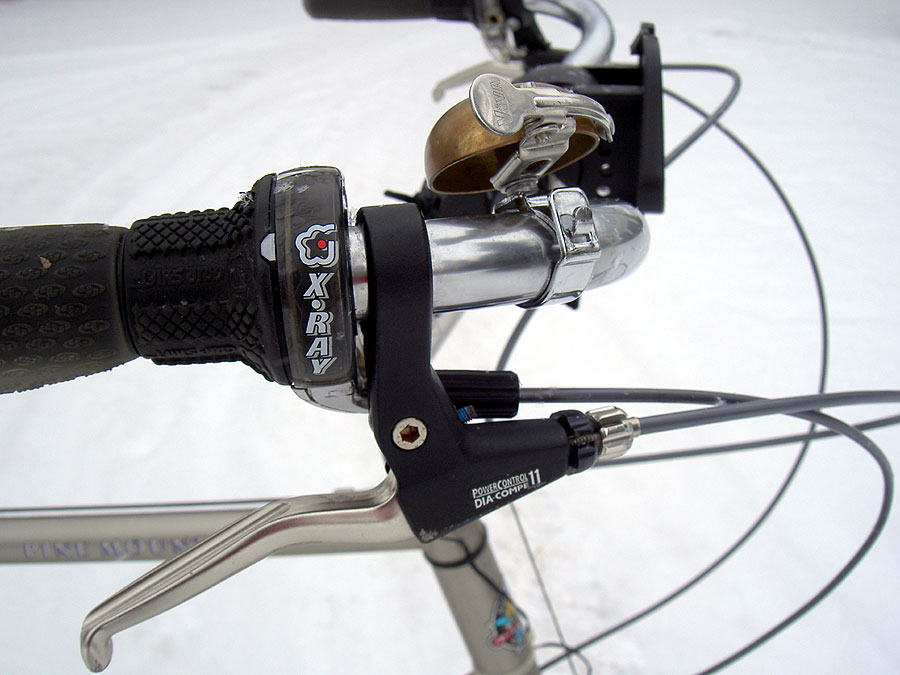
Saturday was the day to mount the tires. I started with the bike, which I brought into the house Friday night to warm it and the tools up. I have a nice big garage, but it's no fun to work out there at 16F with all the cold tools, etc. I took off the 26 X 1.75 Trek Kevlar Inverts I normally ride on the Marin and put on the Nokians. I had other repairs to do as well; on Halloween I'd suffered my first SPD crash, not getting unclicked from the pedal and toppling over, and this had broken my Twist-Grip shifter. It still worked, with an occasional slip, but was uncomfortable against my hand and having a broken shifter housing was not going to be good long-term. I'd bought a replacement one (labelled "X-Ray"!) over at The Bicycle Chain and installed that as well. This took me a while as I don't deal with these very often and had to ponder how it went together and how the cable routing worked. Here's the X-Ray shifter on the Marin:

X Ray shifter on Marin

All done, I took the Marin out and rode it around in the driveway and yard. I don't know if the Nokians grip that much better or if they just give you unwarranted confidence but I rode without difficulty on our snowy driveway.

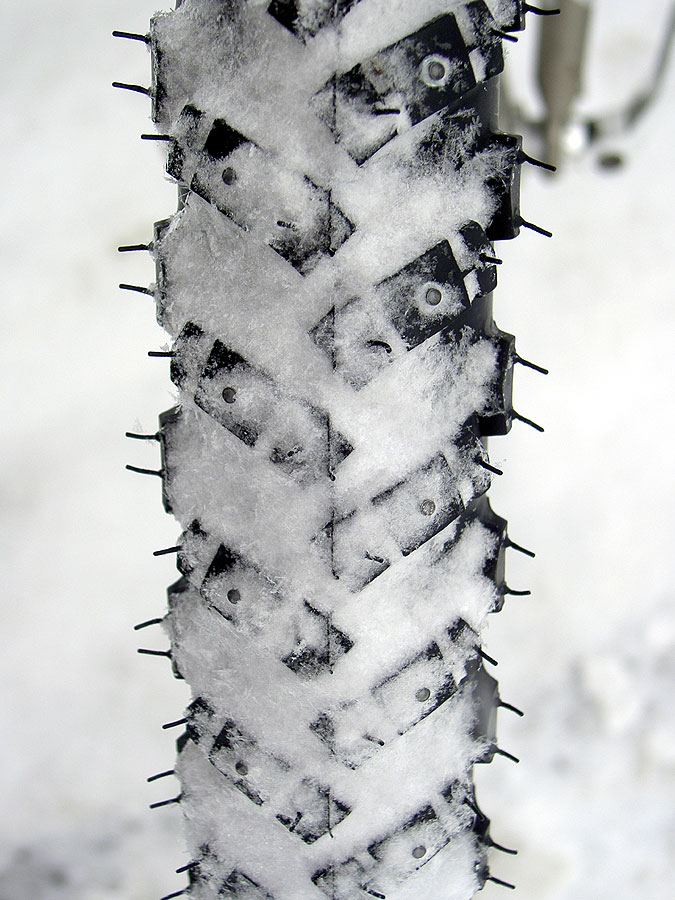
Nokian Mount and Ground 160  26 X 1.9
This is the tire after a bit of riding. You can tell it's brand new from all the little rubber things sticking up off the tire. You can see the studs in the tire either side of the centerline.

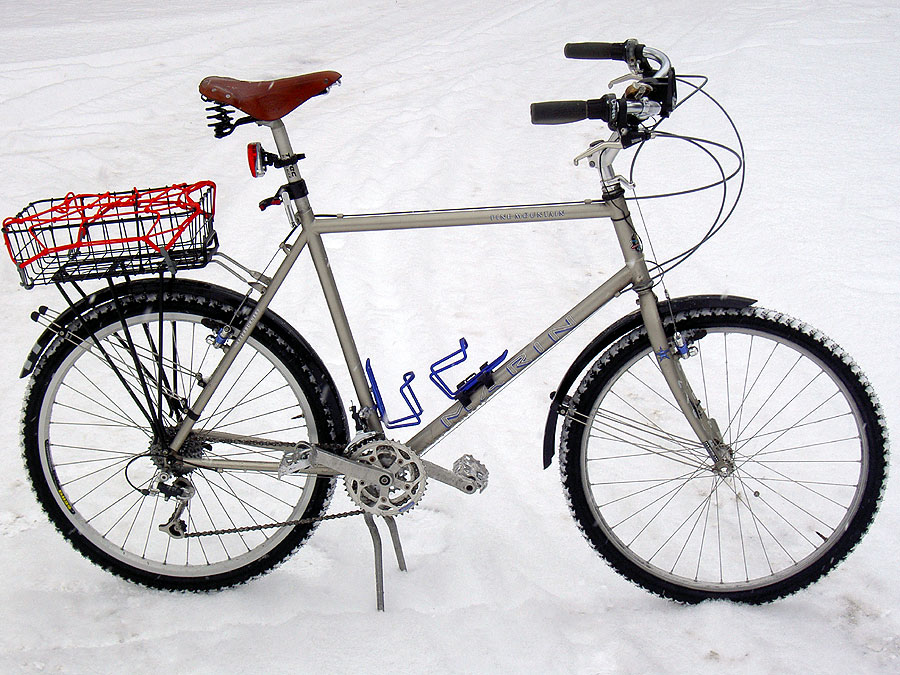
Marin Pine Mountain with Nokians mounted
Here's the Marin. One reason I hadn't done more than teeter up and down a mile during the cold months has been a reluctance to expose my main bike to the winter salt on our streets. This is still true; I don't expect to ride the Atlantis, acquired last spring and now my main bike, this winter, but the Marin I am now willing to try. It's a beefy mountain frame, is well-suited to plowing into surprise potholes and whatnot and, while hardly a junker, is my secondary bike, relegated to pumpkin duty and local runs to the grocery store. I'm not as worried about operating this bike in the harsh conditions of a Minnesota winter.

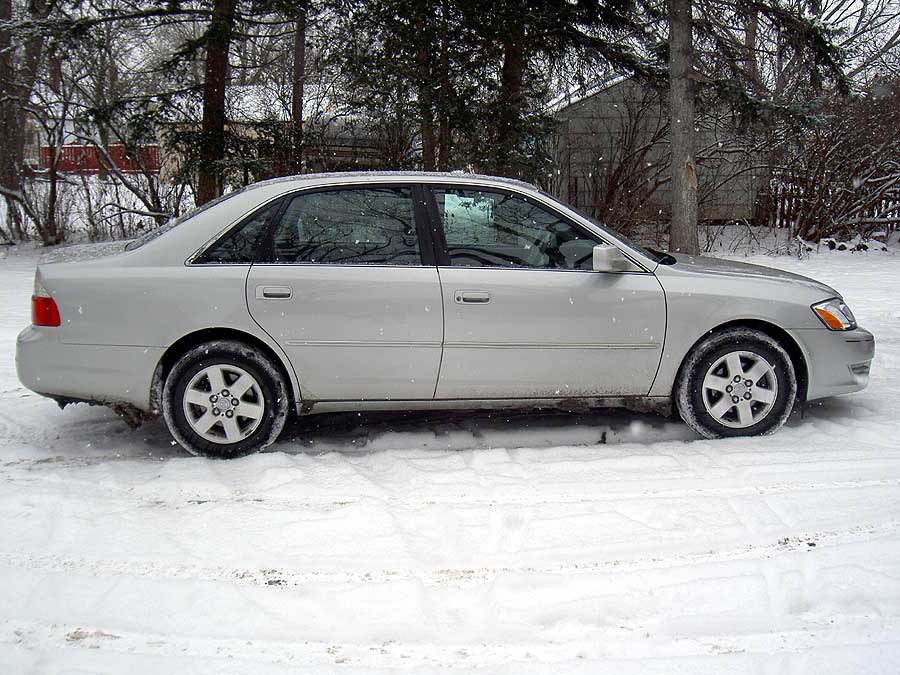
There was other work to do, too. Our main car is a Toyota Avalon, two years old now. We don't buy new cars very often and thought a long time before getting this. There were those who suggested we get an SUV for the safety of four-wheel drive. We wanted lots of leg room, particularly in the back seat, and fell for the Avalon the first time we test-drove a used one. I thought about the 4WD thing; we don't do off-roading, and the times we need extra traction the issue is typically one of tire grip rather than road clearance or needing all-wheel drive. Also, you look at the death rates for occupants of large sedans versus sports utility vehicles and the sedans come out much better. While it is true that in a crash between a Suburban and our Avalon, the Avalon is likely to come out worse, overall, the death rates in Suburbans (to pick one vehicle) are much higher. A lot of this has to do with large SUVs rolling over, an uncommon crash in a low-slung sedan, much more frequent and disproportionately deadly in higher and heavier SUVs. The sedans stop shorter, turn and accelerate more quickly, have better visibility, sit lower and, in a car the Avalon's size (3,400 lbs), still offer a lot of structural protection.

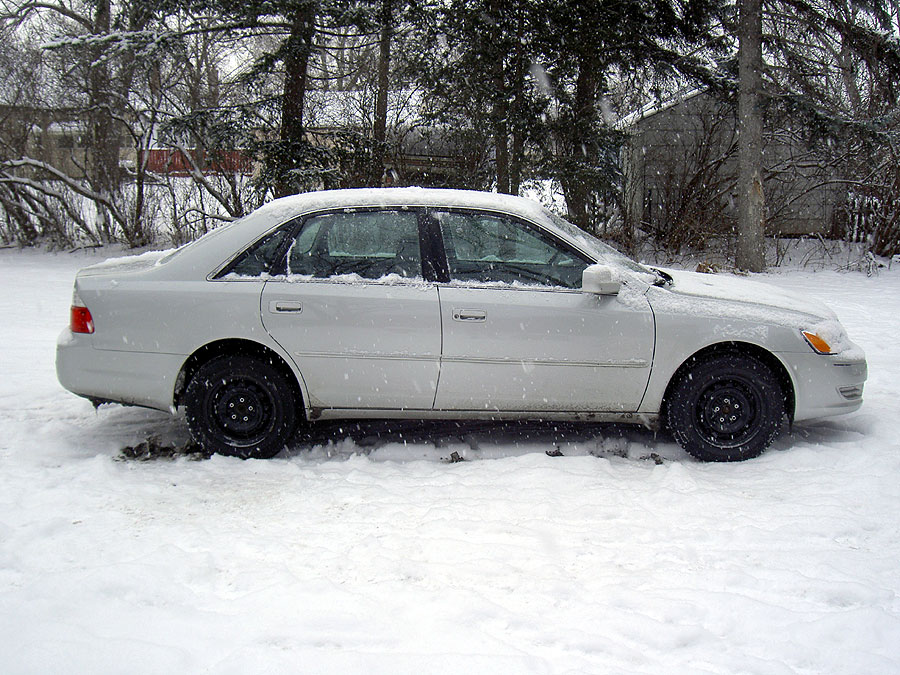
In thinking about our snowy and icy roads, I decided that a good compromise would be to get the Avalon, roomy, powerful and comfortable, and get a set of snow tires. I ordered up a set of Bridgestone Blizzaks from The Tire Rack and, being a cheapskate, got them on the painted black steel rims rather than the expensive alloy ones. These look pretty hideous.

Here's the Avalon, freshly returned from Schoonover Body Works after its third visit in two years. This car has proved irresistable to others, who keep running into us.
Avalon with regular wheels

At the same time I bought the Blizzaks, I went to Sears and got a hydraulic jack so I could do a NASCAR-like tire changes rather than use the car's own jack. So, having re-shod the Marin, I went out and got out the hydraulic jack to hoist the Avalon.

It wouldn't work.

I pumped and pumped and pumped and it would raise about three inches and stop. I retreated to the garage, rummaged around to find the instructions for it and sat out in 15 degree comfort reading about my jack. It sounded like I was going to need more hydraulic jack oil, though where the old stuff was I have no idea. There was no puddle on the shelf where I store it.

On the other hand, I could ride the Marin! I got the bike out, suited up, and rode out through the snow of the backyard and off down the snow-covered streets. The Nokians seemed to grip well. I wasn't exactly leaning through the curves threatening to drag my pedals, but neither was I teetering along perfectly vertical, afraid to lean at all. I plowed through the light snow, through heavier bits where it had been plowed, and on clear pavement. I haven't ridden knobby tires in years. They look enormous even though they're much smaller than the original knobbies that came on the bike. I rode down to the local Checker Automotive store and bought myself a bottle of hydraulic oil. Then I saddled up and rode back, partly on a busy road cleared to the pavement, partly on the snowy side streets. The snow tires worked great.

I filled the jack and sure enough, it jacked fine, then spent a busy and un-NASCAR-like 40 minutes putting on the snow tires. Here's the Avalon with the snows on it. It looks like a law-enforcement model.
Avalon with snow tires on

There, now the fleet is ready. We'll drive around in the Avalon with our superior grip and anti-lock brakes waiting to get clobbered from behind by out-of-control drivers. I can do the same on my bike!

This should be a fun winter!

Saturday, December 03, 2005

Keep Ridin', Patriot

I like this ad. It's especially appropriate on a day like today, with a steady fall of puffy snowflakes. Click on this image and you get taken to an ad agency site where a Miller ad gets played; make sure your speakers are on. Not for those with dial-up!

Keepin' It Cold, Patriot


Clink clink! That's one way to keep the brewskis cold! I saw this link on a blog called Commute-A-Blog. The guy is from near Boston so I think Commute-a is his pronounciation of what we Midwesterners call Commuterrr. You know, to a bicycle, we are nothing but fuel cells, and Miller High Life is as good a raw material as any to make the bike go! Speaking of which, I'm getting thirsty...

Wednesday, November 30, 2005

Iowa Bicycle Map

I had a busy couple of weeks up through the Thanksgiving weekend. I flew to Boise, Idaho, the weekend before Thanksgiving to give a deposition in a legal matter, returned, then we all drove down to Iowa to my sister's for Thanksgiving. She lives in an old (1850s) farmhouse in a valley a few miles upstream from the Mississippi River. I won't go into detail on the weekend, it had virtually nothing to do with bicycles (other than admiring a Schwinn World Sport 10-speed my brother-in-law got for $17 in nice shape but with a profoundly uncomfortable seat).

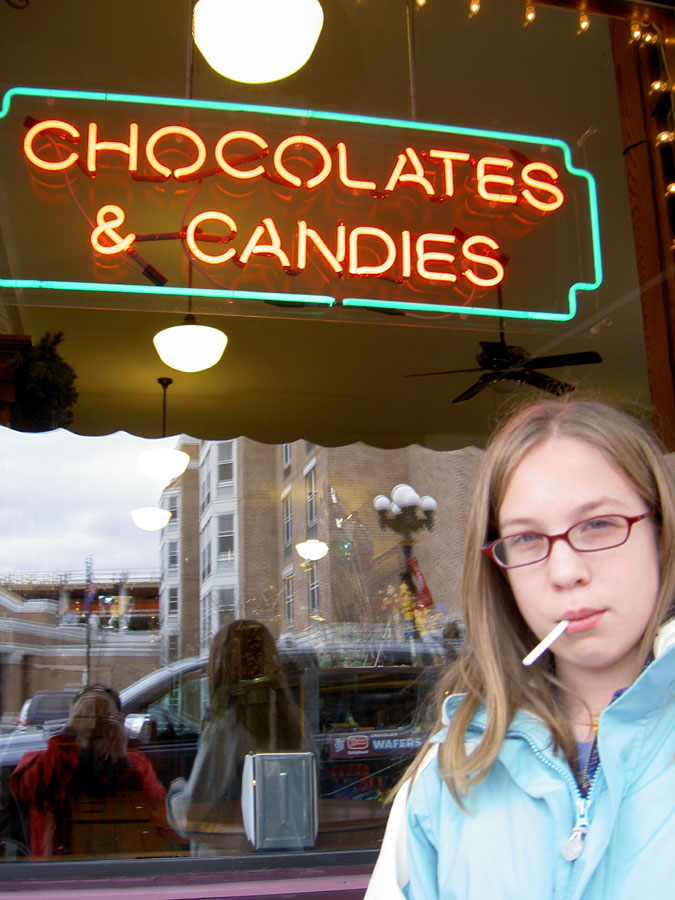
As much as I love cycling, as much as I love the freedom and joy I get when out riding, I also like driving. Driving to Iowa is a beautiful run, down the Mississippi along Highway 61, crossing at Lacrosse, then down Wisconsin 35. We usually stop in Lacrosse. There's a coffee and candy shop on Pearl Street where they sell candy cigarettes. I believe these are illegal in Minnesota, so we stock up.
Geneva with Candy Cigarette, er, stick
Here's Geneva looking tough putting on her Lacrosse-bowling-league-after-work-at-the-brewery face. I noticed that the candy cigarettes have become more politically correct; unlike last year, they are called Candy Sticks, not cigarettes, and no longer have a red end like a glowing cig. We always get here after Halloween, which is too bad, these would be great to give out on Halloween.

I like the fallowness of the land, I like the starkness of the light, the sense of foreboding of winter. I like Thanksgiving, largely free of religious or commercial overtones, just family and friends together thankful for our many blessings. I won't go on about it.

However, at one point, as we were about to set out somewhere in my sister's car, I noticed a 2005 Iowa Transportation Map for Bicyclists published by the Iowa Department of Transportation. I looked at it and asked if I could keep it.

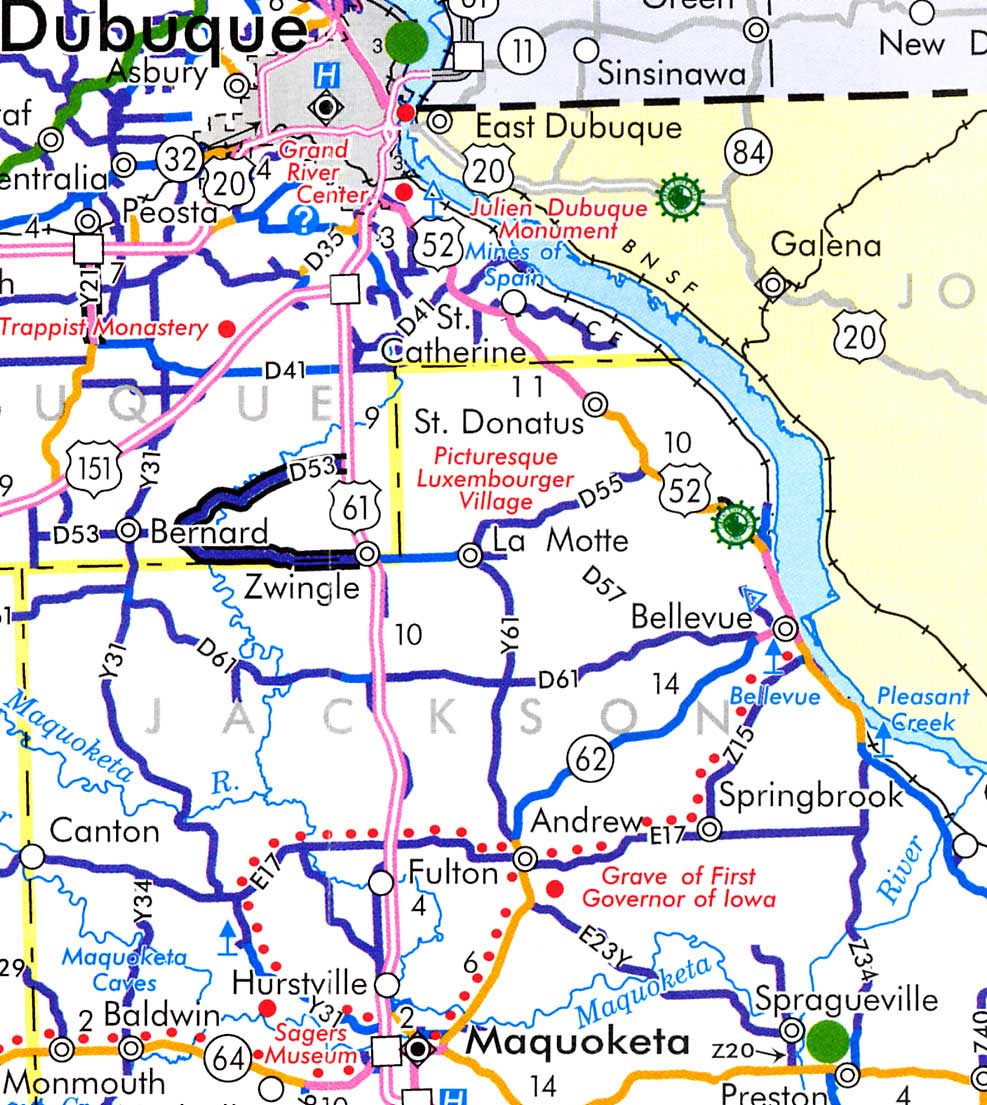
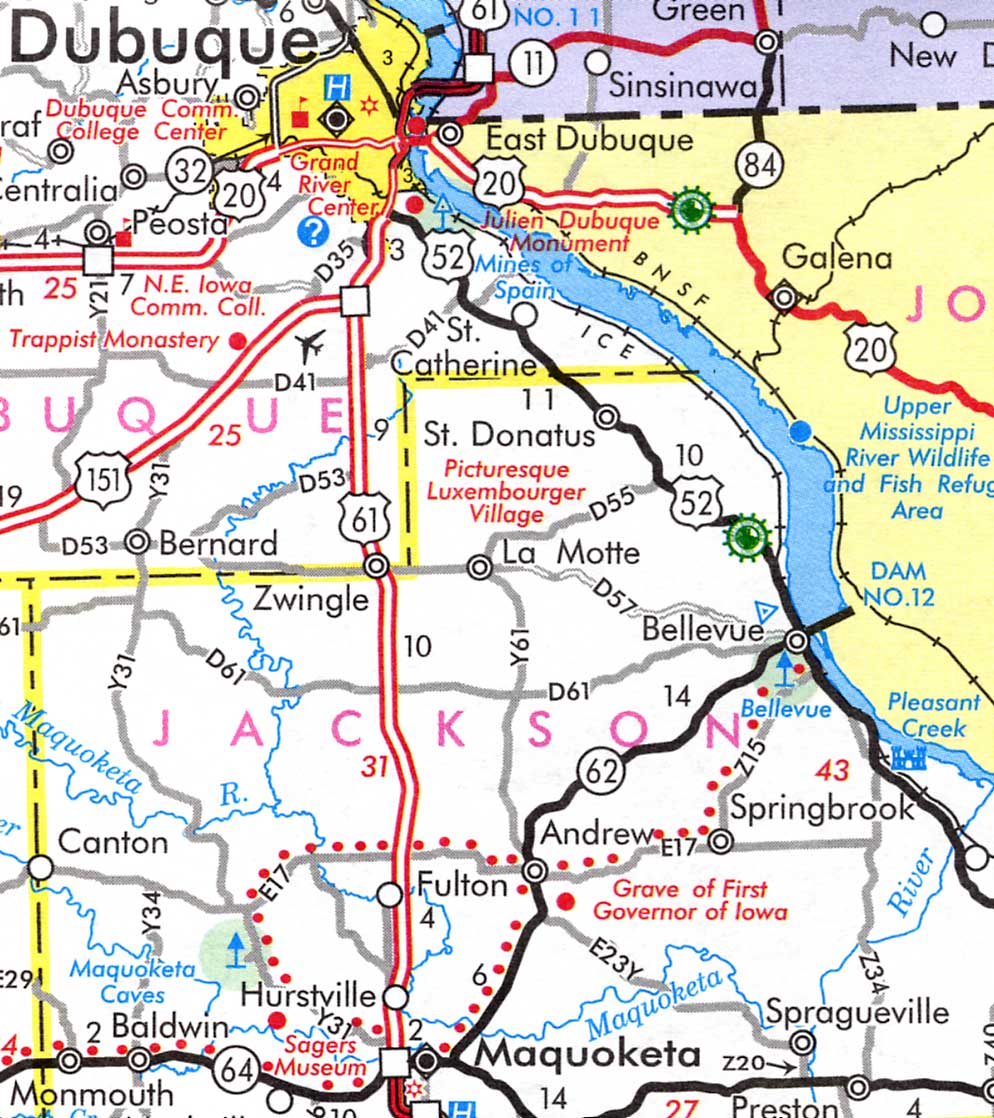
This map is pretty cool. It is in essence a duplicate of the regular Iowa Department of Transportation Transportation Map but with the roads marked differently. Rather than color the roads strictly by their legal designations (Interstate, U.S. Highway, State Highway, County Road), the color is by the Annual Average Daily Traffic (AADT). The most interesting roads are the purple ones, with AADT of 0-700 vehicles. This encompasses most of the excellent and extensive County Road network that criss-crosses the state. In addition, the AADT color is black-banded when the road has a minimum 4-foot paved shoulder or bicycle lane. Green dots indicate bike trails under five miles in length; numbered green dots indicate trails over five miles in length, with additional information on the back of the map. Also on the back of the map are the usual city maps showing bike trails in the cities, some rules of the road, suggested trail etiquette and the clever ad, Bike Helmets: Don't hit the road without one.

I scanned in a bit of the detail around where my sister lives from both the regular 2005 Iowa Transportation Map and the 2005 Iowa Transportation Map for Bicyclists. They show the differences pretty clearly.

  • I noticed right away that the County Road my sister lives along is different on each map. It's between the towns of Bellevue, more or less the center of this scan, and La Motte to the west. On the regular highway map, County D57 is shown as a white-centered grey road, a gravel County road; on the Bicyclist's Map, the D57 designation is there, but the road isn't shown. This is appropriate, as the gravel road wouldn't be tons of fun to ride on.

  • Continuing on west of La Motte to Zwingle and to Bernard, you can see that the road has the four-foot paved shoulders or bicycle lane and thus is shown in the purple (for the 0-700 vehicles a day) with the black borders (for the bike trail).

  • Other things are also more varigated. The State Highway 62 from Maquoketa through Andrew to Bellevue is a single black line on the Highway map; on the Bicyclists map, it shows an AADT of 1,501 to 3,000 from Maquoketa to Andrew and then 701 to 1,500 from Andrew to Bellevue. That gives you some useful information about the expected traffic flows.

  • What the map doesn't show is elevation changes. I know, I know, you can hold the cracks about the boring flat terrain, try riding across this state and you will find out how wrong you are. That road from Maquoketa to Andrew and Bellevue is very hilly (it's coming off the plain down to the Mississippi Valley) and you'd better be ready for some long grinds and wild descents. In general, in Iowa, if the map shows a twisty road, it's hilly (or running along a river, but you can tell that) and if it's straight, like the roads in north-central Iowa, it's flat or just gently rolling. You can infer this with experience, but it's not shown directly on the map.


The Transportation Map for Bicyclists version:
Iowa DOT Bicycle Map
The regular Transportation Map version:
Iowa DOT Highway Map
The Real Version:
Jackson County D57
The photo is of my sister's farm. Jackson County D57 is crossing the photo, and is hard gravel like the road I'm on. You could ride it, I guess, but gravel roads aren't always very pleasant depending how deep and fresh the gravel is. The Map for Bicyclists is wise to leave it off as a good route.

It's cool that Iowa has done this. I pretty much grew up there so have a soft spot for Iowa and Iowans who are generally overlooked and underestimated. I certainly see that here; one of my theories of populations is that every state makes fun of the state south of it. Who knows what they do in Louisiana? For all the cool cycling culture and cutting-edge attitude in the Twin Cities, Iowa has done this nifty map, hosts the cross-state RAGBRAI ride each year and has a terrific network of county roads that make it a marvelous place to ride. If your two-wheel travels take you that direction, I'd recommend picking up one of these maps. You can order them from the DOT Iowa Bikes site. Have fun!

Monday, November 28, 2005

Bikes in Slate

There are a couple of articles in Slate talking about Practical Cycling. In one, Outside magazine writer Bill Gifford writes about riding a bike in everyday life in The Bicycle Diaries. In another article, a guy named Andy Bowers, an editor for Slate, writes Nobody Rides in L.A. about riding in Los Angeles and what a vastly different experience it is than driving. Here's a short excerpt:

One day, I found myself biking down an empty little access road next to the notorious 405 freeway during the evening commute. The freeway, as usual, was paralyzed, and I noticed I was actually moving faster than the cars. That's when the revelation hit: Over the past few months, I had discovered a different Los Angeles.

There's nothing there that's news to people who read this blog, but it is pretty prominent positioning for articles of this nature.

Of course, some of their immediate bite may be muffled by the price of gasoline drifting back down through $2.00 a gallon. With cheaper gas and the onset of cold weather in many parts of the country, it's an easy time to relapse from cycling.

Tuesday, November 08, 2005

Sneak Preview of Phase III

I rode to church Sunday. I'm sure nothing could be more fascinating to you than me relating all the times I ride to church. This being All Saints Day, it was a Festival Sunday, and the usual 9:00 Stodgy Service/11:00 Lame Service schedule was changed to 9:00 Quiet Service/11:00 Festival Service. The good news here was that choir didn't need to be there until 10:15 to warm up versus the usual 8:30. With all this extra time there would be plenty of time to ride.

I left shortly after 9:00 riding the Atlantis. I build out this frame in June and am only now getting close to 1,000 miles on it. To many cyclists around here, 1,000 miles on a bike is as nothing, you do that by late May. For me, it's as many miles as I've ridden in a season in years. (Actually, I have probably 300 more on the Marin, but it's hard to tell, the computer battery died and my USB drive that I tracked mileage on got wiped out so I lost track). I want to get the bike over 1,000 miles for the season and don't anticipate riding the Atlantis much once the weather turns cold and the streets get salty.

It was 36F when I left, and foggy. I've been riding in these conditions in a wool t shirt, a Wooly Warm long-sleeved jersey and an REI DayGlo yellow cycling jacket. I wear a SmartWool skullcap (extremely thin wool, but it helps a lot as I have no hair) under my Bell Metro on which I have not yet installed the Cold Weather Kit with the extremely hilarious-looking basset hound ear covers. I wear some wool pants I got from Marshall Fields and some Pearl Izumi gloves that are not insulated but which work fine for this type of temperature range.

Having decided the streets work better than trails at night, I wanted to try my street route in daylight before riding it at night the first time. I made a quick stop at the local Caribou Coffee to get a Mocha in my excellent Jong Won JSB500 stainless steel thermal water bottle, then set off. I did my usual Como/Raymond/Pelham/Lake Street Bridge route but rather than taking the West River Road bicycle path I rode a couple of blocks down Lake Street and took 46th Avenue southbound. This is marked as a good bike street on the Twin Cities Bike Map. I rode this down to 42nd Street, then headed west across I-35W to Bryant Avenue, then a few blocks south to church. I arrived in 1 hour 3 minutes by my stopwatch including the stop at Caribou. This is a full 10 minutes faster than my usual time when I use the bike paths. It's 12.5 miles even. I like this; it cuts more than a mile from the path-utilizing route and, if less scenic in the daylight, will be shorter and better in the evening.

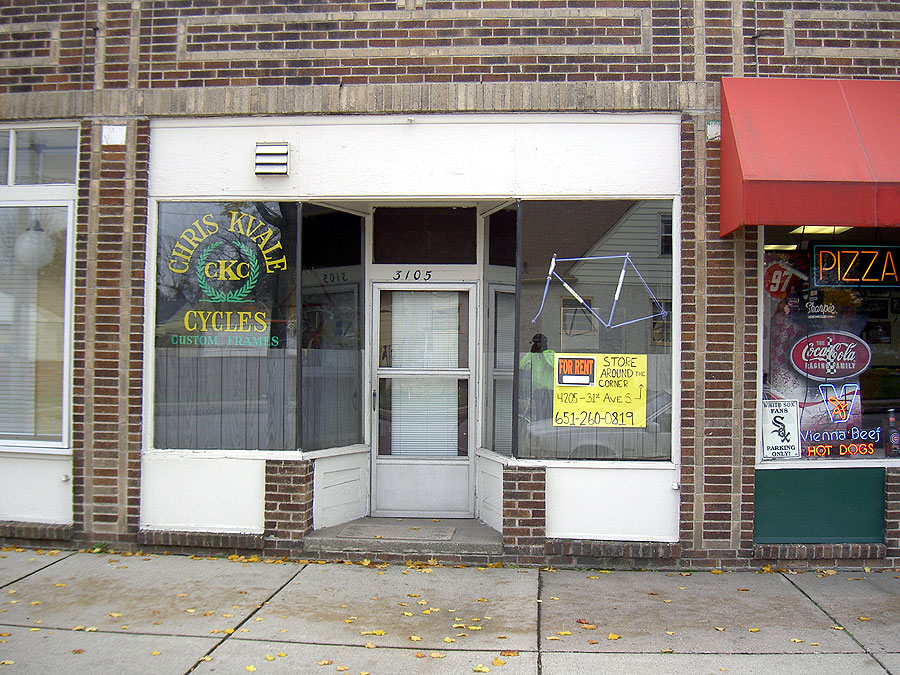
Church over, I saddled up and headed out. I originally thought just to zoom back home, but instead began to get distracted by things on the way home as I looked around. The first was a bicycle framemaker I've never heard of and whose shop I have never seen. This is on 42nd Street just west of Hiawatha.
Chris Kvale Custom Frames
I've never heard of Chris Kvale Cycles before but then I'm not particulary in tune with the Twin Cities cycling scene. I went up and peered through the window. The blue frame hanging there looked very luscious with a beautiful paint job and some superb lug detail work. I think he paints these frames as well. Looking for the link on the web later, it sounds like he's highly regarded. It looks also like he's moving around the corner, the opposite side of the hot dog shop.

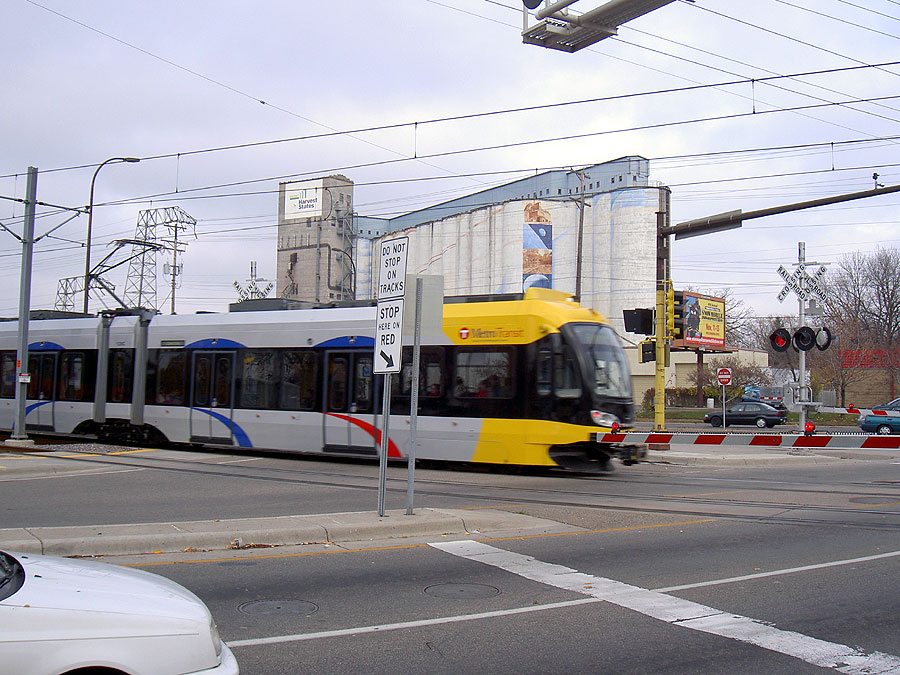
I rode on a bit. The light rail barriers came clanging down.
New Minnesota and Old Minnesota
New Minnesota and Old Minnesota. In the foreground, one of the Light Rail trains goes by while in the background, across Hiawatha, stands a grain elevator. Minneapolis was founded on grain milling and trading and a vestige of this business remains scattered along a rail spur on the east side of Hiawatha. This rail spur has some interesting ramifications for bicycles, too, as you shall see below.

I wasn't in a particular hurry to get home, where lay lots of leaf work to do, and instead meandered up along the streets behind Hiawatha taking some pictures. As with most photos on my blog and website, if you click on the image here you'll get a bigger version.

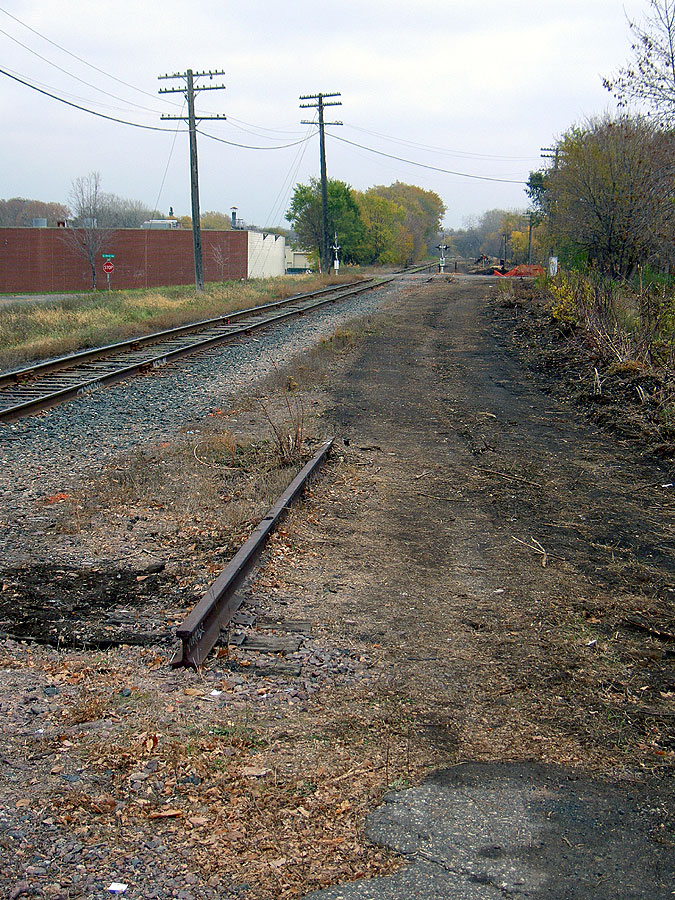
Railway north of 42nd Street at Hiawatha
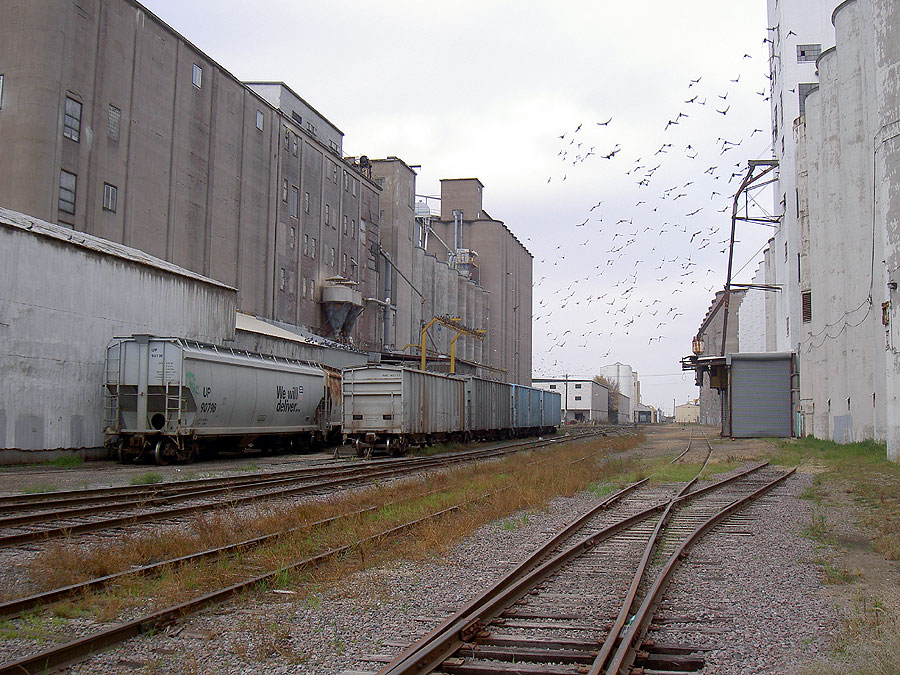
The rail spur along Hiawatha is limited to pretty slow speeds and just sort of peters out so that there is barely a remnant left by the time it gets to Minnehaha. Here, though, it is still active.
Elevators and Rail Cars
Here are some grain cars alongside one of the elevatores.
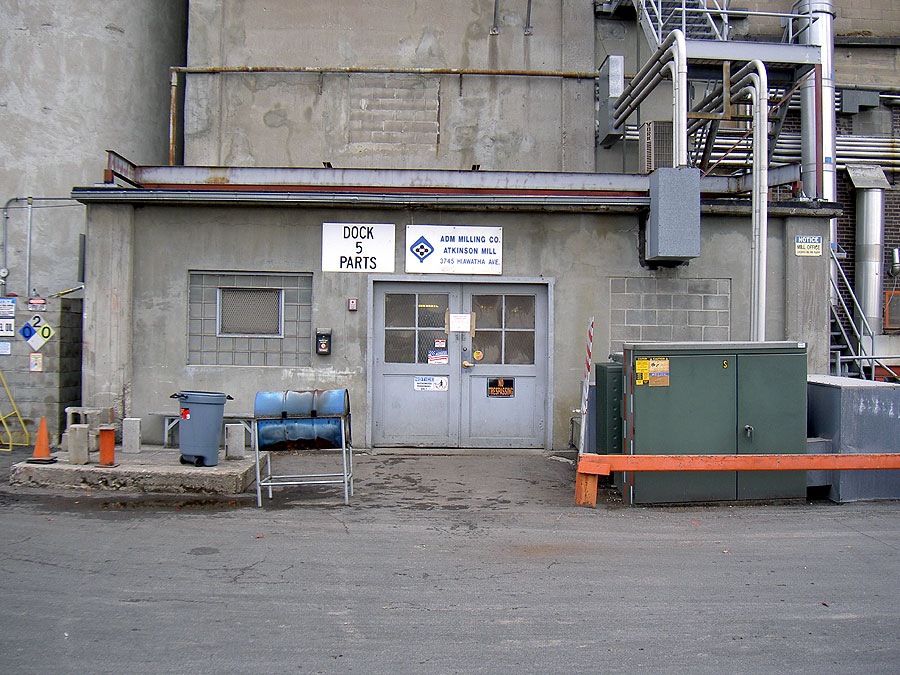
ADM Atkinson Mill yard office
For all the financial services businesses and high-tech stuff, this was the core business for Minneapolis for a long time.
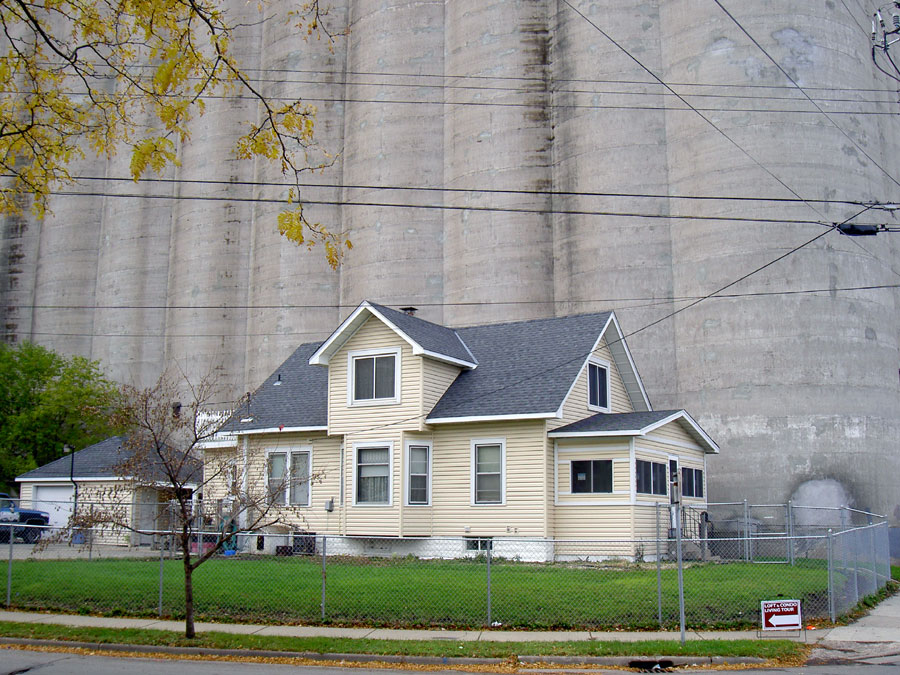
House by the Elevator
This house is right behind one of the elevators. I think if I stood between them I could spread out my arms and touch both.
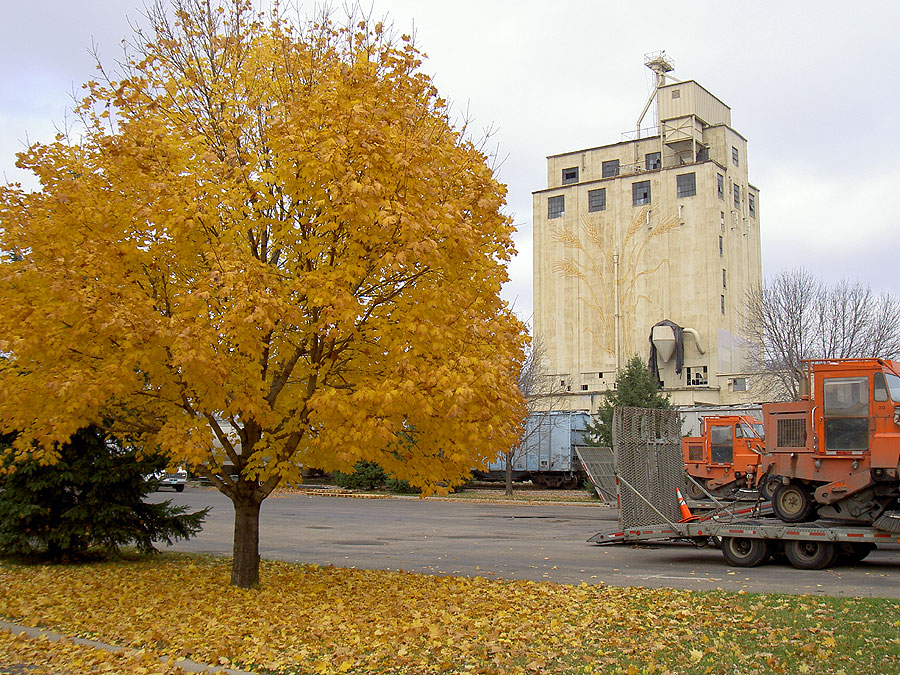
Elevator with wheat mural
I like the wheat mural on this elevator.

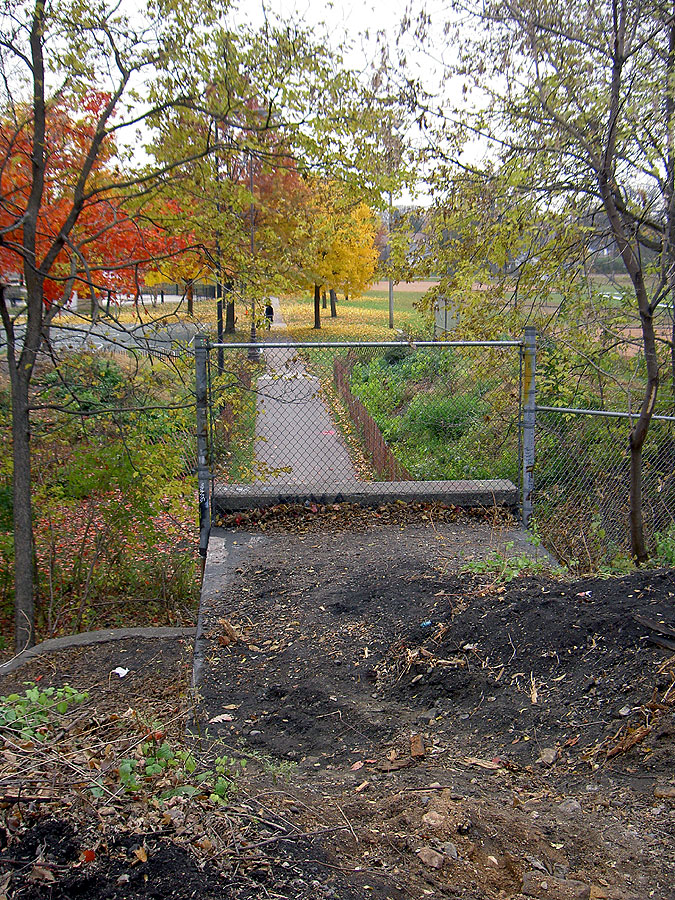
The train tracks that serve these elevators curve to the east just north of Lake Street and head over to the Mississippi River and Saint Paul. The same rail spur served the train tracks that ran along the Midtown Greenway Bike Trail. There is a plan to put a bike trail alongside the train tracks. I don't know if this means to actually cross the Mississippi or not, but you can see Phase III of the plan here.

I meandered over to Lake Street and then up to the train tracks. The road crossed on a level crossing.

Rail lines to the west
Looking west, you can see the tracks and some of the light industry.
Rail lines to the east
Looking east, I noticed that work seems to have started.
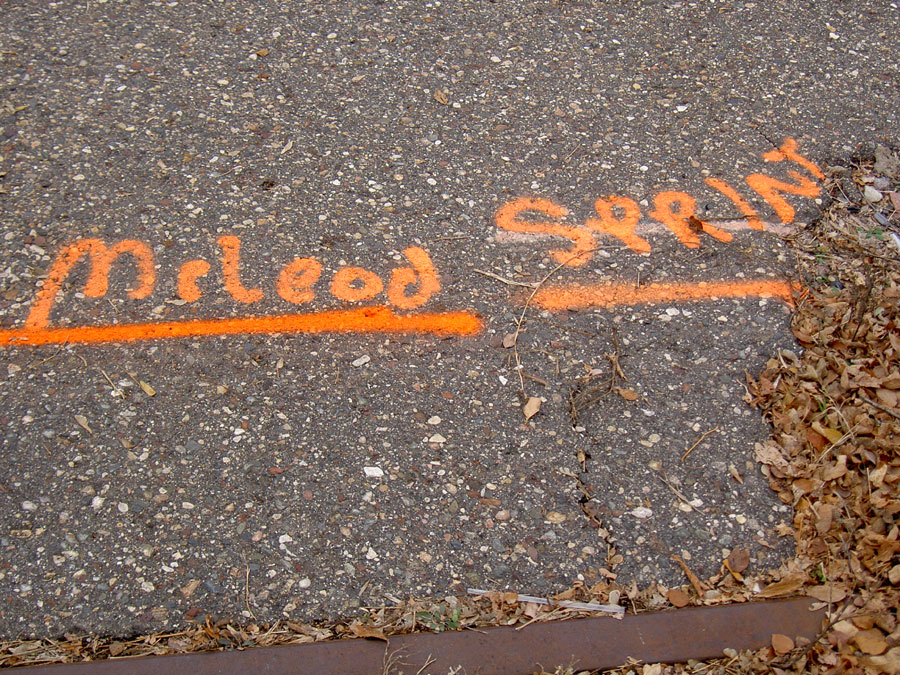
McLeod and Sprint
Things were marked up like there was work going on, McLeod and Sprint here. McLeod was once digging down in Eagan and put an auger through both the main and backup data cables for Northwest Airlines, shutting down Northwest's worldwide operations for a few hours. Running main and backup lines right next to each other may help explain why NW is in bankruptcy. The second set of tracks has mostly been pulled up. The dirt looked pretty hard-packed. The Atlantis is no mountain bike, but the 700C X 28 tires aren't delicate, either, and I decided to ride along and see what I could see.

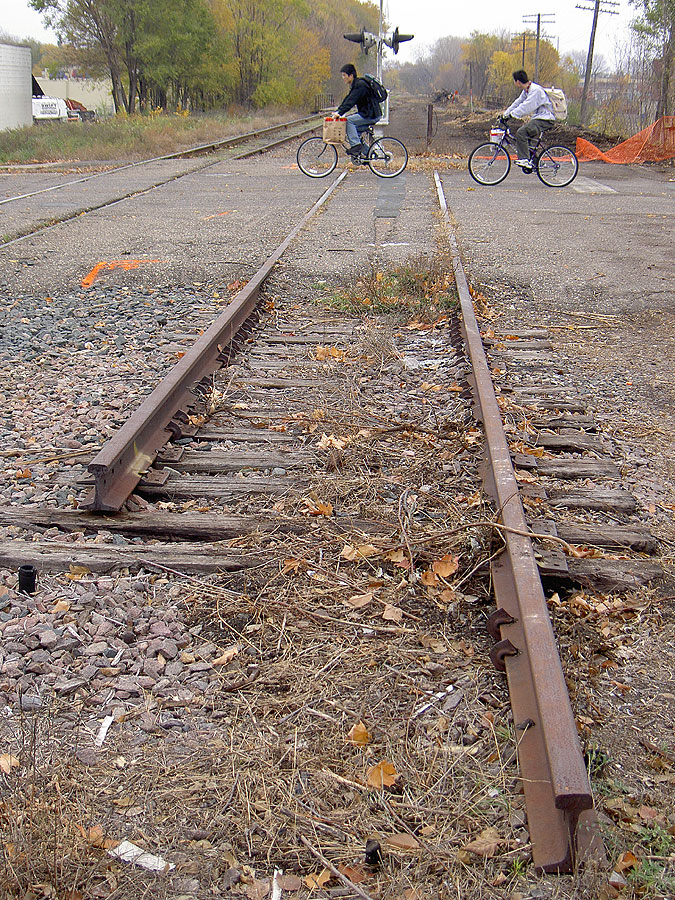
Cyclists cross railway tracks
I rode down alongside the tracks. They hadn't pulled up the parallel tracks at the level crossings. Here a couple of Practical Cyclists cross over; the front guy has a grocery bag on his handlebar.

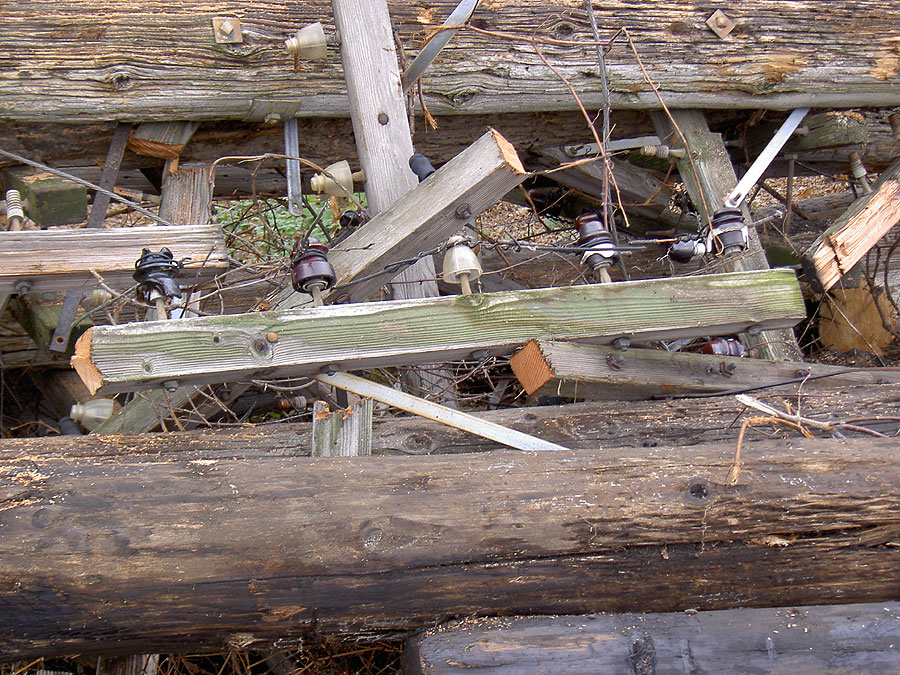
Pile of railway ties, utility poles, etc
There were heaps of debris. Some of it was trees, some of it telephone poles, some of it railroad ties.

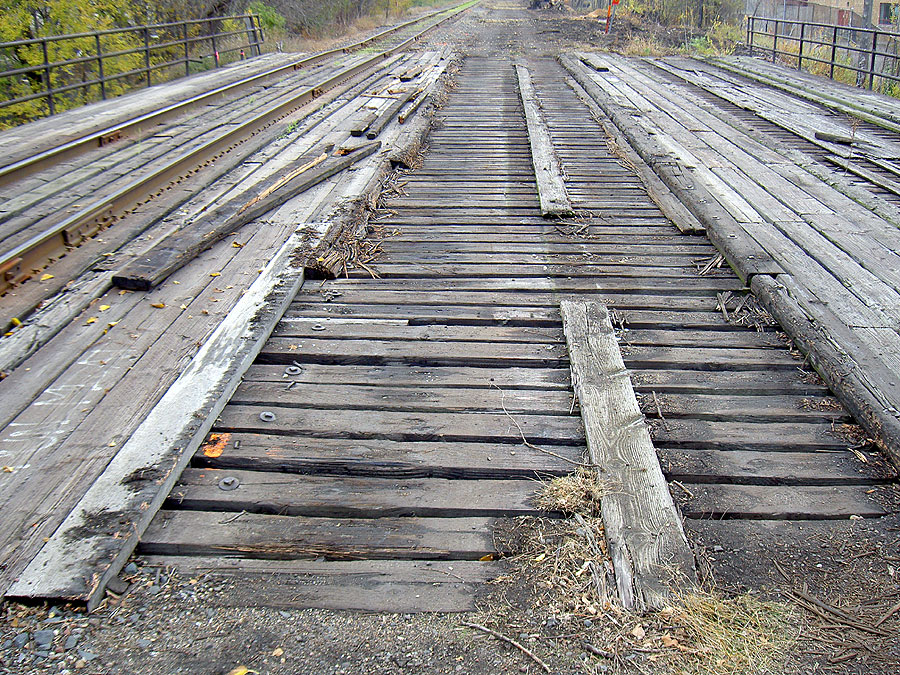
Bridge deck before any work
As the tracks move towards the river the land begins to fall away from the railroad tracks which are up on an embankment. Here a bridge crosses a road where a few blocks west they'd still been level crossings. No work has been done on this bridge, but I rode on across.

Graffiti number one
It's mostly light industry along the north side of the tracks. Some segments of the Minneapolis artistic community seem to have found this area already.
Graffiti number two
For all the artistic impression, they could sure use help with their handwriting.

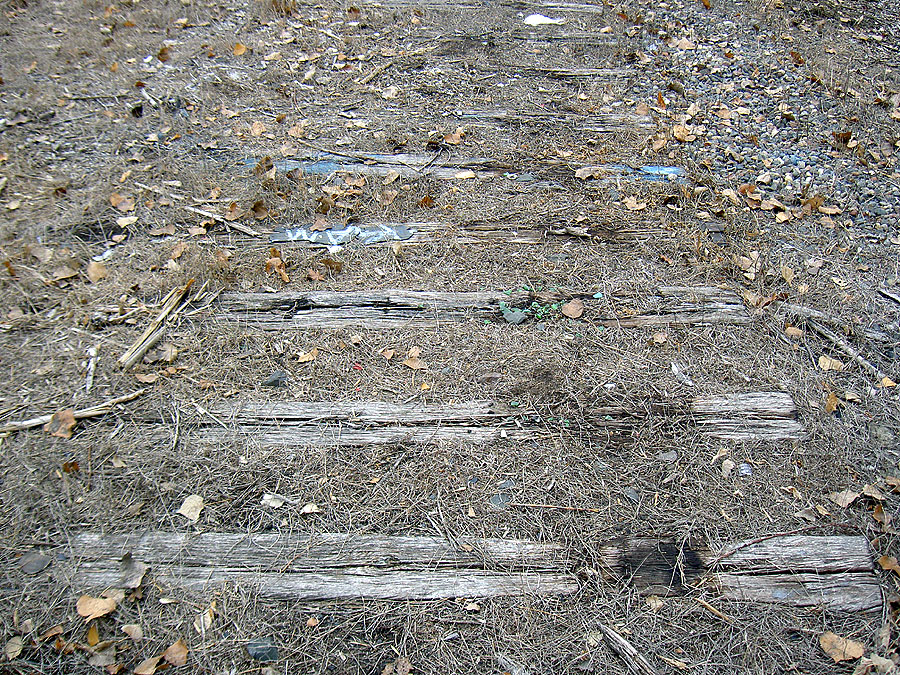
Railroad ties like an archeological skeleton
These factories had had rail service at some point, but now the ties in the ground emerged like they were old dinosaur bones.
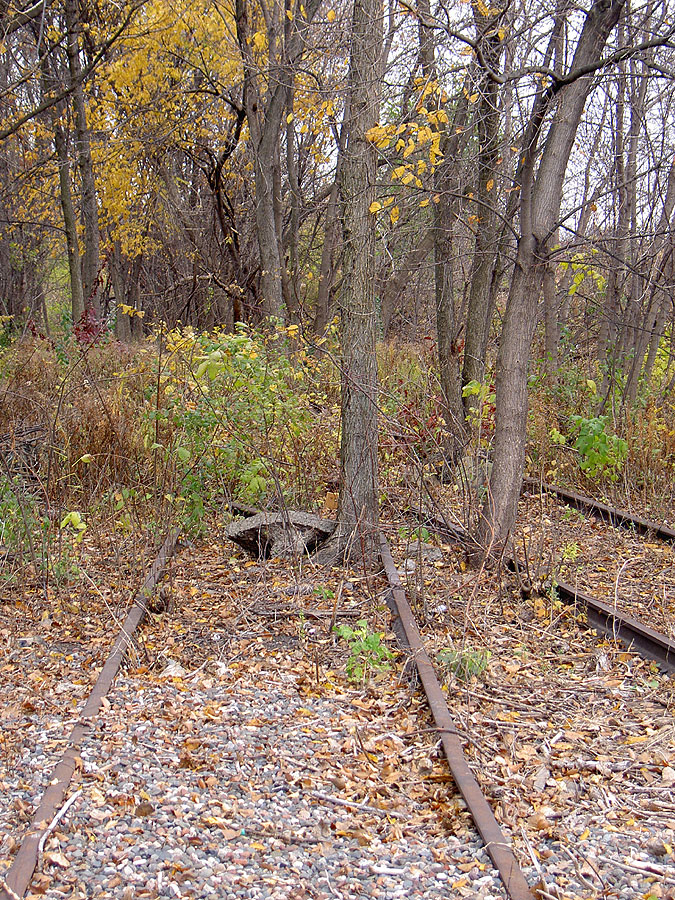
Trees growing in old train tracks
There are some remaining rails, but it's clear they haven't been used in a long time. I wonder when the last train ran on these tracks? 1960s? 1950s?
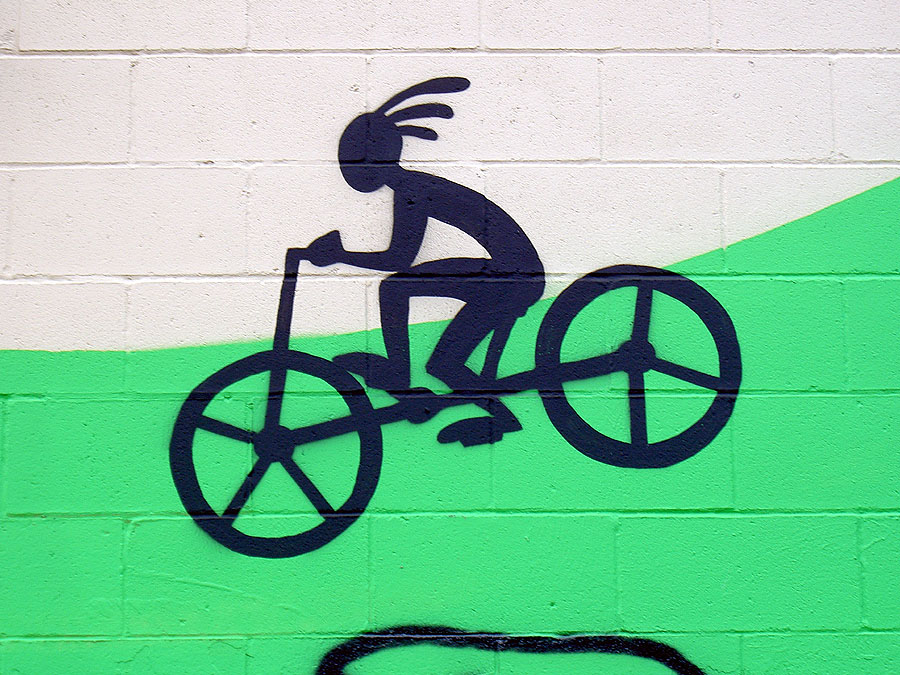
Anasazi bike mural
I think some of the graffiti is official. This Anasazi-style cyclist recurs along the factory walls several times, as does a similar runner motif.
Pedestrian Tunnel under tracks
At 38th Avenue there's a pedestrian tunnel under the tracks. The embankment for the rail line keeps getting higher above the surrounding ground and is quite an obstacle at this point.
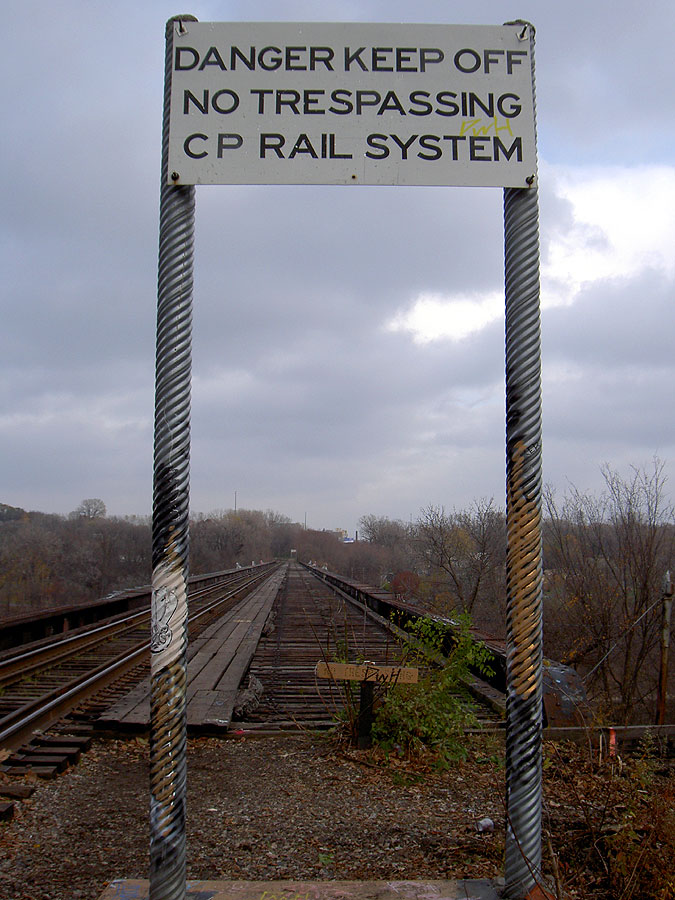
No Trespassing
You go by some houses and then come to the west end of the Mississippi River bridge. I don't know what the plans are here; it would be great if the trail carried on over the river, and the bridge is wide enough for a single rail track and a path. I read on one of the always-useful railfan sites that this is Bridge #22 and was for the former Chicago, Milwaukee, St. Paul and Pacific main line going west. It was called the Short Line Bridge and opened on December 4, 1880. The Milwaukee Road ran passenger trains across the bridge until May 1971 (when Amtrak started). Canadian Pacific and Minnesota Commercial still use the bridge to service the Southtown yard (the stuff along Hiawatha) although it is no longer on a through route and now has only one track.

Mississippi River from Minneapolis bridge threshold
You'd be a long way above the river!
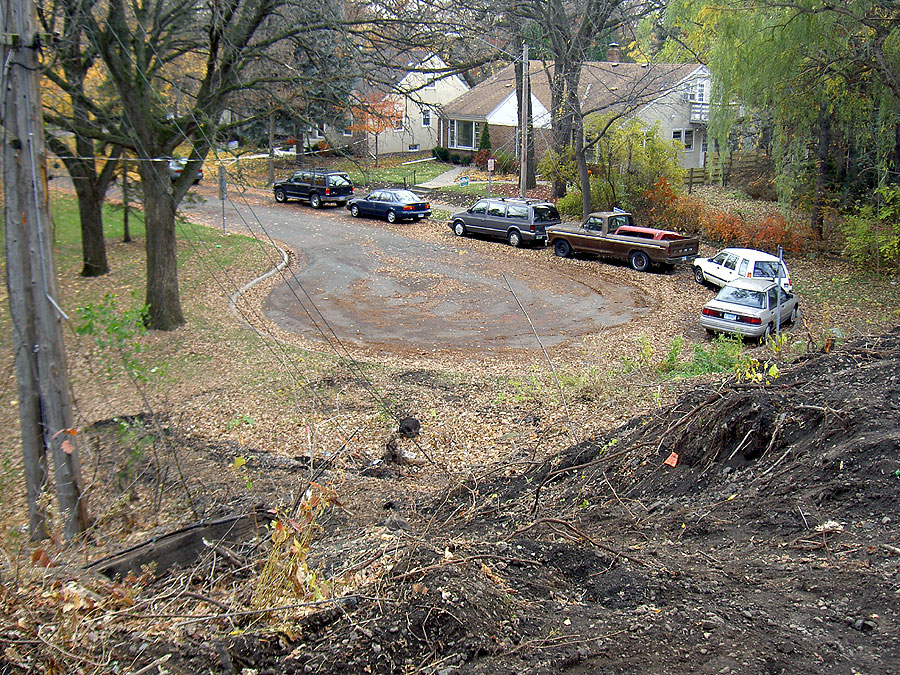
Road turnaround by bridge
I stumbled down the embankment to the West River Road.
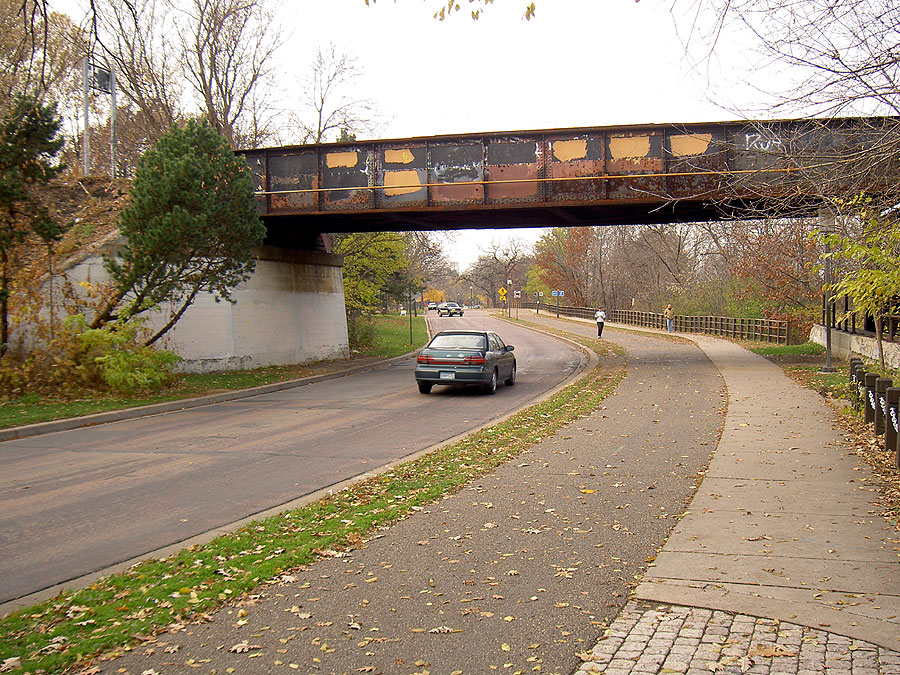
Bridge over West River Road in Minneapolis
This is the bridge over the West River Road before it heads across the river. I decided to go over to the Saint Paul side and see where this comes out. I set off down the bike path to the Lake Street Bridge, my usual river crossing, a few blocks south.
Yellow leaves in Minneapolis Tree
Most of the trees have lost their leaves, but a few are hanging on and haven't even completely turned yet!
Rail bridge from Lake/Marshall Bridge
This is the rail bridge from the Lake Street bridge. This is looking upriver.
Bridge above East River Road
I rode up the East River Road. The rail bridge is way up in the air here.
Atlantis by bridge support
Heavy Iron. This bridge is built! That's a major nut behind the handlebars.

A guy stopped, mistaking me for some other Atlantis rider, and we chatted for a few minutes. I meekly said I was closing in on 1,000 miles; he was getting close to 8,000 for the year, and had just toured in Nova Scotia. He was retired, he said, which gives him lots of time to ride. He noted that the front wheel of the Atlantis had a lot of spokes; it's 36 spokes but is radially-laced, which makes it look like a lot. Funny thing is, the back wheel is 32 spokes. He told me that should be the other way around. He asked if I were riding the same direction, which I thought was nice, but he was going south down the trail and I wanted to go east, so we parted ways.

I rode east up Saint Anthony Street which goes from the East River Road to Pelham, a street I've been using on my way to church. I've lived here more than 11 years and had never been on this street. It runs parallel to the tracks and rises quickly up the hill.
Tracks coming from bridge
These are the tracks coming from the bridge. There's room for a bike trail there!
Tracks to the east in St Paul
And then they go off to the east. I rode up to Pelham.

Graffiti on railway bridge over I-94
The Saint Paul artistic community hasn't been idle either.
Interstate 94 and the railway tracks
A pathway along the tracks would deal very gracefully with crossing the Interstate. This is where Highway 280 goes off to the north from Interstate 94.
Rail bridge over I-94
And off it goes.

At this point, teatime was drawing near and I gave up following the tracks and rode on home. Karla, who had been up at 5:30 getting Henry ready for an early Minnesota Boychoir appearance, was feeling fatigued and we had a couple of cuppas. Cycling was done for the day, and Henry and I went out and worked on leaves until dark.

Bikes make a great way to explore like this. You can get places that are tough or impossible in a car, everything is accessible, you can see lots, and there's no problem stopping to take some photos, unlike a car, where you've got to park the darn thing every time you want to take a snap.

The trail could be pretty cool. If the Greenway actually does extend from the current termination at Hiawatha and continue to the river and then over and into Saint Paul it would be an extraordinarily useful bicycle and pedestrian superhighway. (Actually, you can read about the construction progress here and there are plans to use the rail bridge). The Greenway already joins up very nicely at its western end with other bike paths; to have it connect across the river would be brilliant. I will have to make some inquiries about it.

In the meantime, the Atlantis got to 996 miles. One short ride and it'll be over 1,000 for the season.

Friday, November 04, 2005

Last Ride of the Velo-Pumpkin

I rode to church choir again. It was 64F outside Wednesday night and the ladies were meeting early, us men weren't due until 7:40, so I figured what the heck, the pumpkin on the back of the Marin isn't rotten yet, let's light 'er up and ride to church.

The Marin has big beefy 26" X 1.75" tires on it, all the better for pounding over unseen potholes and obstacles, plus the rear basket and pumpkin were already installed. I headed out right at 6:30.

The main difference between this week and last is the end of Daylight Savings Time. It was basically completely dark out as I left, though I wasn't quite as anonymous as I thought; I passed a couple walking a few blocks from home and they called out, where's the skeleton?, a result of my Adventures on Halloween.

I went west on Hoyt, through the Fairgrounds, illicitly down the last bit of Intercampus Transitway to Como, and along Raymond to Pelham. I like to think the flickering pumpkin looked good floating along in the darkened State Fair Grounds, for instance, but it's hard to tell when it's behind you.

I had a pumpkin malfunction on Pelham and had to stop and find the top and reset it and the bungee cord. I didn't see as many cyclists this time, but the lightless ones could pass by unseen pretty easily. I rode across the Lake Street bridge and down the West River Parkway bike trail. There didn't seem to be as many pedestrians out as last week, either, even though this week was warmer.

I did run into some cyclists along the Minnehaha bike path, all showing lights. Of course, in the dark, you can't really see the person, you just get dazzled by the headlight and then they flash by. I was using my Blackburn Quadrant front light. It throws just enough light to be useful in the really dark bits and is probably pretty visible to oncoming traffic.

I got behind another commuter for a while. He seemed annoyed that I was behind him. He'd speed way up and slow down while I plugged along behind. He wasn't so slow that I felt compelled to overtake him nor so fast that I wouldn't catch back up. He finally took off in a standing sprint and got a long way ahead of me and made a green light where I caught the red, and I didn't see him again. He had a helmet light on but it was pretty dim. He also had a taillight, but it was hidden by a bag strapped to his rack so that it wasn't visible until you were almost on top of him. Not like my pumpkin, with five LED blinkies all blazing away inside it. I think it's stupid not to show lights when riding at light.

I got to church right about 7:45. I've done the ride in 1:05 (on the Atlantis, in daylight) but 1:15 seems more realistic, allowing for lights, pumpkin malfunctions, etc. The one trouble is, choir-wise, my throat gets dried out and the tone of my voice isn't as good as it should be. We're just rehearsing, it's Sunday mornings that count, but I may need to come up with a good warming-up drink to help me when I ride there, not that that will happen much more this season.

Going home, I rode 46th and then 42nd Streets, then north mostly on 46th Avenue. I think the streets are actually better than the trails in the dark. At least cars all have lights, the street lighting is brighter, you don't have the picturesque meanderings along the creek which all of a sudden are dark, ill-lit turns concealing dog-walking pedestrians, oncoming lightless bikes, etc. If you do see other bikes (and I saw a couple of others), you aren't confined to a narrow pathway. I think in the dark, I prefer the streets.

Once home I took all five blinkies out of the pumpkin and removed it from my basket lest it rot in position. Garbage ain't 'til Tuesday. I don't know what people thought of it, whether it provided moments of confusion or annoyance or happy delight. Often you don't know how you affect others, and hope only that on the whole it's positive. I like the whimsy of the pumpkin taillight and will undoubtedly do it again next year.

Tuesday, November 01, 2005

Veloween

All Hallows Eve

Halloween this year gave a sudden lurching realization that my children are getting big. As a kid, I did the usual Halloween stuff, costumes and trick or treating (and, for my Des Moines years, the oddball Beggar's Night). Once I was through college and in an apartment and then in a house, I delighted in giving away full-sized candy bars rather than the snack size. Once we had children, I began to take them out for Halloween in a succession of cute costumes. Henry in particular would put forth unflagging effort in collecting free candy as we'd range far and wide through the neighborhood. Last year Geneva for the first time kept up with him through the whole evening and they each collected ten pounds of candy (we weigh it each year). Last year, while I strolled along, there was someone on a bicycle who rode by a few times in a strange costume with an enormous head that looked like it was made of paper mache. They didn't say anything, they just rode past and waved, up and down the streets of the neighbourhood.

This year, Henry still wanted to go trick or treating but Geneva didn't. She wanted to hand out candy and see all the cute kids in their costumes. I thought back to the guy on the bicycle and to a classic skeleton costume we'd made for Henry ten years ago and thought, that'd be fun. I could make a skeleton costume, ride my bike up and down the streets, put a pumpkin on the rear rack and give out candy!

So, I made a costume. The top is a cheap XXL black long-sleeve t-shirt from Target, the bottom a pair of old black Levi's. I cut out bones from fusion interfacing and ironed them onto the garments. I also bought white and black face paint to make my head look like a skull. Finally, I have a white helmet liner made for use in the summer to reflect sun and wick sweat; that would serve to keep my head warm. Some thin black gloves would keep my hands warm.

Karla had bought five pumpkins. I carved a couple, including one about the right size for the bicycle basket. This Wald basket is one we have lying around which I zip-tied to the rear rack of my Marin Pine Mountain Urban Assault Bike. I initially set up the pumpkin with an REI candle lantern, for a couple of decades my preferred source of light when camping.

Here's the pumpkin mounted and ready to go. This is my Marin Pine Mountain, not the Atlantis. This bike has fat 26" street tires on it, all the better for pounding over obstacles I can't see in the dark. The basket is zip-tied to the rear rack, the pumpkin wedged in place against the front of the basket, and a yellow bungee cord holds the pumpkin down and the lid on.
Marin Pine Mountain with pumkin

Here's a closer shot of the pumpkin.
Pumpkin in bicycle basket

The light to start with was from an REI candle lantern. I cut a couple of slots in the pumpking and the lid held the wire bail in place. I had high hopes for this arrangement.
Candle Lantern in pumkin   this didn't work too well

About 6:30 we set out, Henry wrapped in yards of muslin as a Mummy, me in my skeleton outfit with white skull-head and pumpkin.
Matt's Make Up
Hello, little girl, like some candy? This is my skull makeup at the end of the evening. My beard kept me from getting the whole jaw really white. Still, at a distance, the effect was good.

I soon ran into technical difficulties with the pumpkin. The candle kept going out. These candle lanterns work great even in pretty wet and windy conditions when camping, but something about the bike was giving the candle trouble. I wonder if it was sloshing wax from stops, starts, bumps and turns, something it doesn't have to deal with when camping. I'd stop and re-light the candle lantern but kept having to check over my shoulder to see if it was still lit.

After a while I rode home, took out the candle lantern and instead put in four LED blinkie taillights all set to steady on. This worked great. The light bounced and reflected around the interior of the pumpkin and gave a good strong orange-red glow out the carved face. (Later, when the evening was done, I tried putting all four lights on blink, and that was even better; they all blink at different rates, giving this flickering effect).

Thus equipped, I rode around. I startled a number of people. I think I startled a lot of drivers. Clad in black, I was unwilling to ride in front of people who had a Stop sign, worried they'd coast on through and hit me, so I'd so a right turn. The poor driver would be coming up to an intersection when suddenly this enormous skeleton on a bike would come looming around the corner. A couple of adults I talked to (during brief pumpkin maintenance stops, or when stopped to give children candy) said the effect was very startling. I would have liked to see what the pumpkin was like from a distance, since it would roll down the street, around corners, and probably looked pretty odd in dark areas since I was showing no rear lights at all.

Halloween's a great night to ride around. Part of the fun is how open and lit up people's houses are; you can see in, check out the neighborhood. It was fun when I'd walk with the children to note who was nice and who was grouchy, to see people come and go, who was cheap and who generous, even who was really stingy, like the year one guy gave out poems. I didn't shadow Henry this year, instead ranging far and wide through the Como neighborhood and even riding around the Como Lake. I was hoping I'd see the big-headed cyclist from last year and rode some of the same streets but there was no sign of that person. This was too bad, I'd like to have heard how they came up with the idea.

I got one treat; waiting at a corner, a guy came out who'd seen me ride by and said, you're working hard tonight, here's a treat and handed me a bottle of Bass Ale. Hot damn! Beer trick or treatin'! It was unopened and I kept it until the night was done.

Here's Henry and I at the end of major candy operations. The strips of reflective tape on my read fender sure work well in this photo! Henry's mummy costume was getting pretty ragged. At one point I'd ridden by him and a dog had come out of a house and was tugging on a loose piece of wrapping. Despite his costume malfunctions and attacks by vicious canines, he collected 12 pounds of candy, a really good outing.
Matt and Henry at Halloween 2005

My costume was inspired by one we did for Henry ten years ago. Here we are then.
Henry and Matt at Halloween 1995

Here I am with my bottle of Bass. Next year I think I'll do hand bones as well, so the arms don't just end at the gloves. In this picture, lit with the camera's flash, you don't get to appreciate the lurid red glow of the blinkies in the pumpkin.
Matt with Bass Ale

I had my first SPD crash. I'd felt pretty smug about going clipless this summer with my SPD pedals on the Atlantis and the Marin and never having the inevitable crash new SPDers are supposed to encounter. Since getting the Atlantis, my miles on the Marin have been pretty limited. The pedals on the Marin, some Nashbar-brand SPD on one side, platform on the other, have a lot tighter releases than the Ritcheys on the Atlantis. So, I come up to an intersection where there is some traffic confusion and slowed way down and then stopped and my foot wouldn't release and over I went. As I fell, I'm thinking, great, I haven't crashed in years, and here I go on one of the few times I'm not wearing a helmet. Crash! Predictably, as soon as I hit, my shoe released. I scraped my knee and banged my elbow but other than that my main injury was to my dignity. Fortunately, in skeleton costume nobody knows who I am! Crash? What crash?

Riding like this is not for the faint of heart. I usually try to be very visible and now I was riding around in black with no front lights on a night full of oblivious pedestrians and distracted drivers. On the other hand, I was generally meandering at a stately pace, not pushing to make time, and so could pay lots of attention to being cautious, avoiding drivers, etc. I'm thinking next year I might do it again but cruise around more of the city, not just up and down the streets of our area. It would be kind of fun to go up and down Summit, ride around Crocus Hill, maybe even pop down to Concord or Lake Street where the skeleton motif would fit right in with the Dia de los Muertos theme. Skeleton-costumed cyclists riding around with pumpkin taillights giving out full-sized candy bars to little children has to win us some goodwill, right? Plus, it's fun. It could be the start of a trend!