Yep, that's my boy, holding up the orange flag! I was a Volunteer Coordinator for the races this year and one of my main responsibilities was the course marshalls. Henry worked Wednesday and Friday nights and all day Saturday. The glory boys may be those sprinting to the finish line, but the volunteers make this all work. I had the privilege of working with dozens of these folks and the races went great. Henry was one of many who worked multiple shifts and days and I am legitimately proud of him. You can read the account of the racing stuff in Velonews; this photo is from Mankato's Stage 5. The photo is by Kurt Jambretz of Action Images, though I added the arrow!
Thursday, June 19, 2008
Henry in Velonews!
Yes, my son has made it to Velonews! The shot shows the tight group of men racing for the finish line at the end of the Mankato Road Race last Saturday. The arrow picks out Henry.

Yep, that's my boy, holding up the orange flag! I was a Volunteer Coordinator for the races this year and one of my main responsibilities was the course marshalls. Henry worked Wednesday and Friday nights and all day Saturday. The glory boys may be those sprinting to the finish line, but the volunteers make this all work. I had the privilege of working with dozens of these folks and the races went great. Henry was one of many who worked multiple shifts and days and I am legitimately proud of him. You can read the account of the racing stuff in Velonews; this photo is from Mankato's Stage 5. The photo is by Kurt Jambretz of Action Images, though I added the arrow!
Saturday, June 07, 2008
Sprocket Man
I was at Barley John's with some of the other nutters from the Three Speed Tour and there's often a show'n'tell. Many times these are old English bicycle parts of such rarity that I have no idea what they are, other times it's more recent but interesting stuff. I hardly ever have anything, at least since I last modelled my Rainlegs.
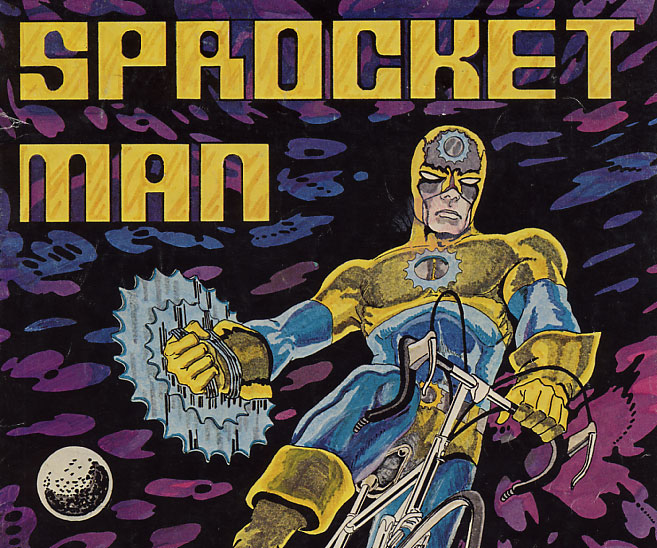
This time, though, Juston showed up with a comic book called "Sprocket Man". Here's some of the cover art:

This comic book isn't dated, but a close reading says it's probably 1973/74. Old bugger bike guys notice the high-flange front hubs, suicide brake levers, automobile styles, leg lights, lock styles and of course the fashions. This would also be in the midst of the 1970s Bike Boom.
Now, this isn't the weirdest bicycle safety material ever (the undisputed top place has to go to 1963's One Got Fat, sort of Planet of the Apes version of the League of American Bicyclists material and well worth watching) but it must rank right up there. In this comic book, Sprocket Man, complete in superhero outfit, dispenses advice on bicycle safety. Even more than One Got Fat, the material is well-thought out and remarkably relevant even 35 years later. The 1970s Bike Boom was a time when adults were riding bicycles in traffic in the U.S. for the first time in decades, and you'll notice the Right Hook, alternative left turn possibilities, ride with traffic, obey traffic signals, signal your turn, stay off the sidewalk, be courteous to pedestrians on the trails, use lights and reflectors, etc. I borrowed Juston's copy and scanned it in; you can read Sprocket Man here but be warned it runs 12 Meg (it started out at 62 Meg, so I've cut it down for you).
Comic books can be an effective communication tool, combining pictures and text (see the entry on Making Comics in Cool Tools) and Sprocket Man is actually pretty good once you get past the superhero thing. Now people draw on computer, and the pen-and-ink thing looks old, but it's still pretty cool.
Credits: Louis Saekow, Artist; John Troja and Julia Molander, Directors; developed by the Urban Bikeway Design Collaborative, a project of Urban Scientific and Educational Research, Inc., Washington, DC; this copy originally distributed by Pavlak's Pedal Palace, Mt. Clemens, Michigan, a Raleigh and Rampar Bicycles dealer. There is a Stanford Univeristy article from 2002 describing Sprocketman's origins. Finally, the CPSC has its own 24-page Sprocketman comic, apparently much the same material without the glossy cover which takes my PDF to 28 pages. Their copy is a smaller PDF but not as clear as mine; you gotta make choices in life.
This time, though, Juston showed up with a comic book called "Sprocket Man". Here's some of the cover art:
This comic book isn't dated, but a close reading says it's probably 1973/74. Old bugger bike guys notice the high-flange front hubs, suicide brake levers, automobile styles, leg lights, lock styles and of course the fashions. This would also be in the midst of the 1970s Bike Boom.
Now, this isn't the weirdest bicycle safety material ever (the undisputed top place has to go to 1963's One Got Fat, sort of Planet of the Apes version of the League of American Bicyclists material and well worth watching) but it must rank right up there. In this comic book, Sprocket Man, complete in superhero outfit, dispenses advice on bicycle safety. Even more than One Got Fat, the material is well-thought out and remarkably relevant even 35 years later. The 1970s Bike Boom was a time when adults were riding bicycles in traffic in the U.S. for the first time in decades, and you'll notice the Right Hook, alternative left turn possibilities, ride with traffic, obey traffic signals, signal your turn, stay off the sidewalk, be courteous to pedestrians on the trails, use lights and reflectors, etc. I borrowed Juston's copy and scanned it in; you can read Sprocket Man here but be warned it runs 12 Meg (it started out at 62 Meg, so I've cut it down for you).
Comic books can be an effective communication tool, combining pictures and text (see the entry on Making Comics in Cool Tools) and Sprocket Man is actually pretty good once you get past the superhero thing. Now people draw on computer, and the pen-and-ink thing looks old, but it's still pretty cool.
Credits: Louis Saekow, Artist; John Troja and Julia Molander, Directors; developed by the Urban Bikeway Design Collaborative, a project of Urban Scientific and Educational Research, Inc., Washington, DC; this copy originally distributed by Pavlak's Pedal Palace, Mt. Clemens, Michigan, a Raleigh and Rampar Bicycles dealer. There is a Stanford Univeristy article from 2002 describing Sprocketman's origins. Finally, the CPSC has its own 24-page Sprocketman comic, apparently much the same material without the glossy cover which takes my PDF to 28 pages. Their copy is a smaller PDF but not as clear as mine; you gotta make choices in life.
Wednesday, June 04, 2008
Volunteers Needed
I'm a volunteer coordinator for the Nature Valley Grand Prix/Great River Energy Bicycle Festival which is coming up next week and we're still looking for more volunteers. I thought I'd post the info and see if anyone bites.
There are races on five days, Wednesday June 11 to Sunday June 15:
Wednesday 6/11 (evening) – Downtown St. Paul Criterium
Thursday 6/12 (evening) – Cannon Falls Road Race
Friday 6/13 (morning) – St. Paul Riverfront Time Trial
Friday 6/13 (evening) – Minneapolis Downtown Criteirum
sure hope Friday the 13th isn't a Portent of Doom
Saturday 6/14 – Mankato Road Race
Sunday 6/15 – Stillwater Criterium
(and yes, it's Father's Day)
For each race, there is setup work to be done, course marshalling during the race itself, and then teardown afterwards. There are volunteer shifts for all of these work needs at each event and I'd like to ask you to consider signing up to work a shift or two.

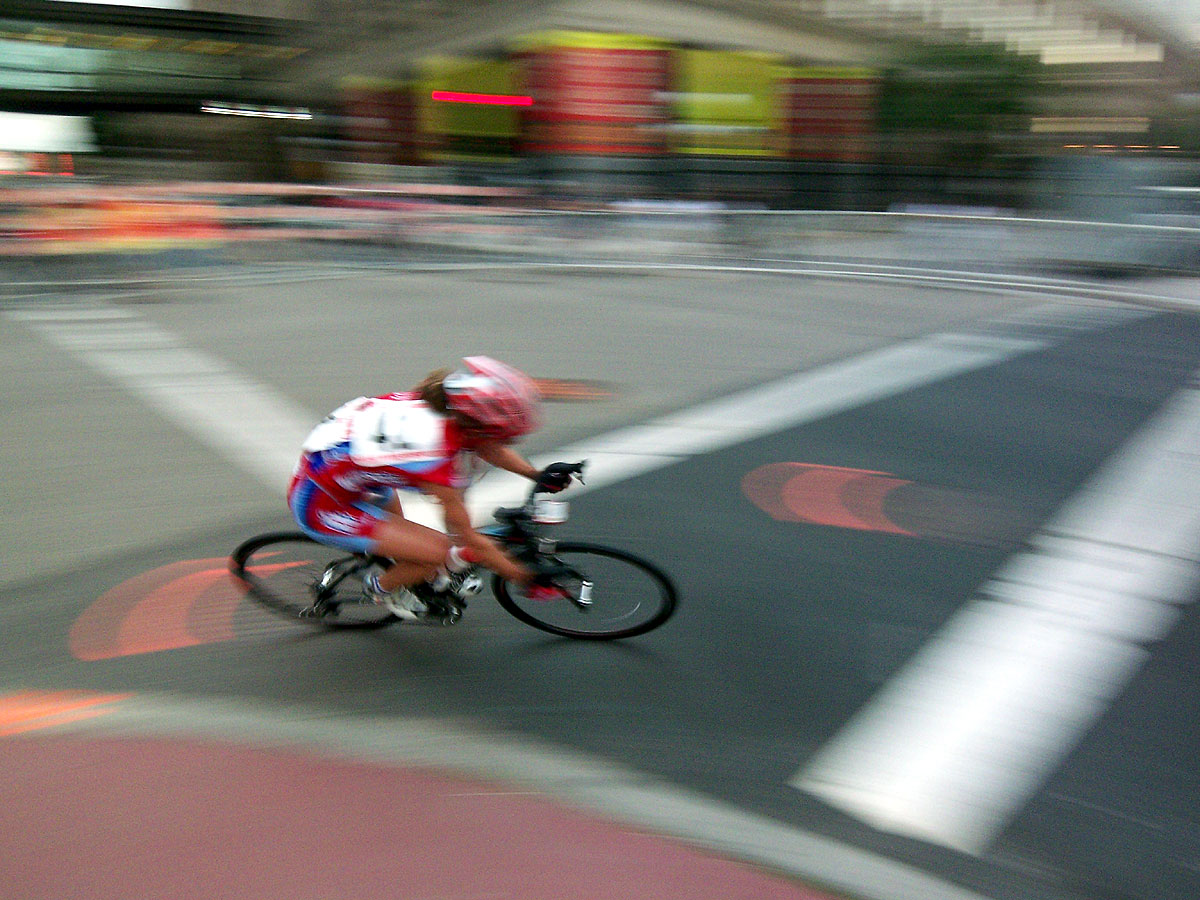
One of the women zooms past. The course marshalls are very close to the action.
Don't care much about bicycle racing? Yeah, me either. However, there is fun to be had working on events like this with friends and, in the end, the profits from the races go to Children's Hospital and Clinics of Minnesota. I've volunteered for several years but last December, now part of the organizing committee, was at the meeting where we presented one of those big printed checks to a doctor at the Clinics, who went on to discuss the palliative care for terminally ill children he works on. There were suppressed sniffles throughout the room. I hadn't worked these races for noble purposes, but felt privileged to be there for this presentation and an aspect of the races I hadn't considered.

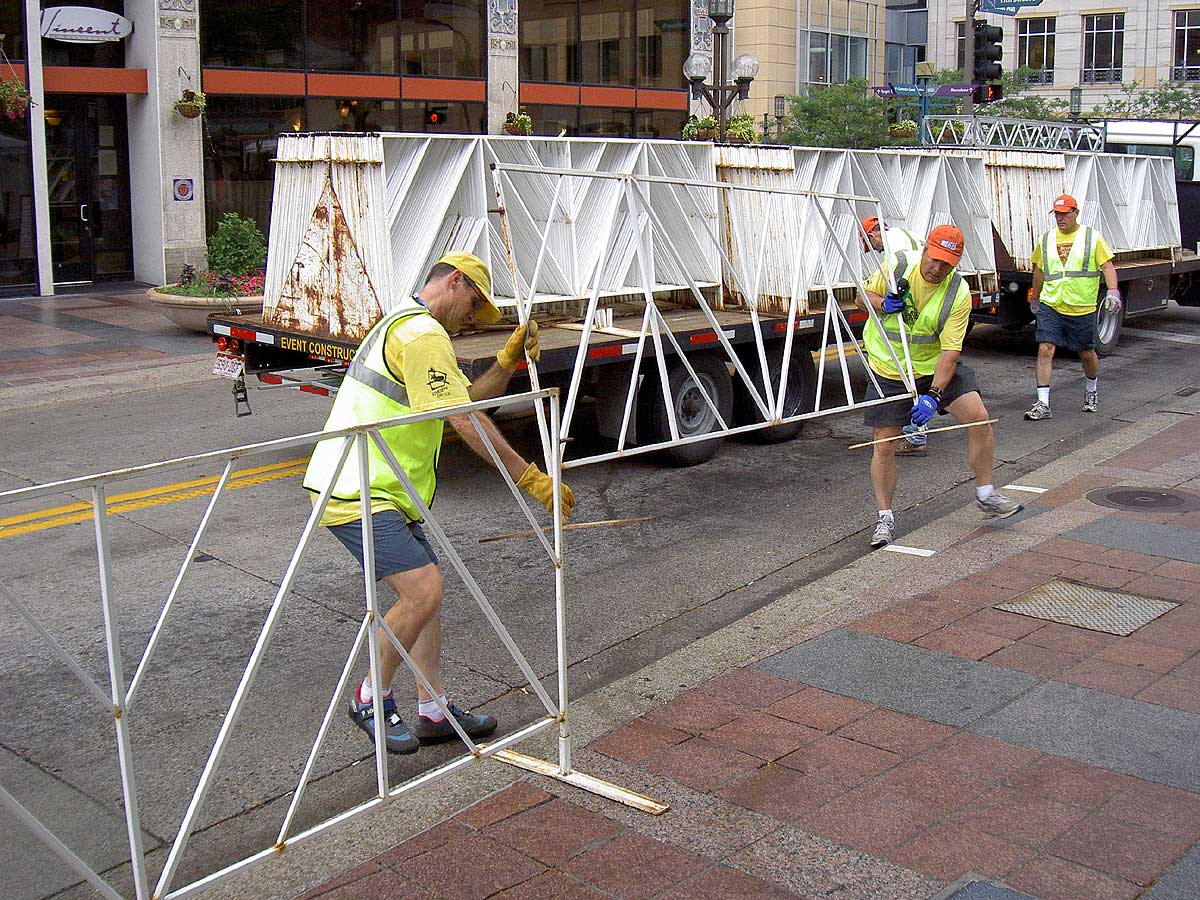
The setup work is important stuff and goes on even in the rain. We've torn down in roaring thunderstorms before. This is 2007 in Minneapolis.
Like to see what to expect as a volunteer? You can read about my experience last year, in 2006 (you have to scroll down) and even in 2005 (you have to scroll down here too).
Interested? You can sign up on the NVGP's website volunteer pages. If you don't want to work out on the races but wouldn't mind hosting a bike racer or two for a few nights, we have a Host Housing signup too, though it might be getting late for that.
Thanks for reading this, and I hope to see you at a race or two as a volunteer or spectator!
Thanks
Matt Cole
NVGP Volunteer Coordinator
Website: http://www.minnbikefest.com/
"Karla reminded me of something I'd said when she asked me about why Paul would do this, why would he ride up here to work like a dog for several days? She said I responded "Oh, Paul's always up for a bad time". On the face of it, working nights like Friday moving fencing in an unbelievable downpour doesn't sound like a great time, but it's a bonding experience. I wouldn't even say male bonding, because there were several women out there in the rain working away as well. And as they say, of those to whom much is given, much is expected. We are blessed with decades of fun on bicycles, good health, the flexibility to get the time off and the attitude that hard work shared with old friends can be enjoyable. It's also a great time of year to be outside doing stuff. You should consider joining in next year."
There are races on five days, Wednesday June 11 to Sunday June 15:
Wednesday 6/11 (evening) – Downtown St. Paul Criterium
Thursday 6/12 (evening) – Cannon Falls Road Race
Friday 6/13 (morning) – St. Paul Riverfront Time Trial
Friday 6/13 (evening) – Minneapolis Downtown Criteirum
sure hope Friday the 13th isn't a Portent of Doom
Saturday 6/14 – Mankato Road Race
Sunday 6/15 – Stillwater Criterium
(and yes, it's Father's Day)
For each race, there is setup work to be done, course marshalling during the race itself, and then teardown afterwards. There are volunteer shifts for all of these work needs at each event and I'd like to ask you to consider signing up to work a shift or two.
One of the women zooms past. The course marshalls are very close to the action.
Don't care much about bicycle racing? Yeah, me either. However, there is fun to be had working on events like this with friends and, in the end, the profits from the races go to Children's Hospital and Clinics of Minnesota. I've volunteered for several years but last December, now part of the organizing committee, was at the meeting where we presented one of those big printed checks to a doctor at the Clinics, who went on to discuss the palliative care for terminally ill children he works on. There were suppressed sniffles throughout the room. I hadn't worked these races for noble purposes, but felt privileged to be there for this presentation and an aspect of the races I hadn't considered.
The setup work is important stuff and goes on even in the rain. We've torn down in roaring thunderstorms before. This is 2007 in Minneapolis.
Like to see what to expect as a volunteer? You can read about my experience last year, in 2006 (you have to scroll down) and even in 2005 (you have to scroll down here too).
Interested? You can sign up on the NVGP's website volunteer pages. If you don't want to work out on the races but wouldn't mind hosting a bike racer or two for a few nights, we have a Host Housing signup too, though it might be getting late for that.
Thanks for reading this, and I hope to see you at a race or two as a volunteer or spectator!
Thanks
Matt Cole
NVGP Volunteer Coordinator
Website: http://www.minnbikefest.com/
From my 2006 write-up, referring to my old friend Paul who rode up here from Iowa to work on the races for multiple days:
"Karla reminded me of something I'd said when she asked me about why Paul would do this, why would he ride up here to work like a dog for several days? She said I responded "Oh, Paul's always up for a bad time". On the face of it, working nights like Friday moving fencing in an unbelievable downpour doesn't sound like a great time, but it's a bonding experience. I wouldn't even say male bonding, because there were several women out there in the rain working away as well. And as they say, of those to whom much is given, much is expected. We are blessed with decades of fun on bicycles, good health, the flexibility to get the time off and the attitude that hard work shared with old friends can be enjoyable. It's also a great time of year to be outside doing stuff. You should consider joining in next year."
Sunday, May 25, 2008
Bridgework on Sunday
As is often my custom, I took my bicycle to church Sunday to ride home after the early service, in which choir I sing, while my wife the Music Director stays on to play the late service. These are usually nice rides home without much in the way of time pressure and I can wander a bit.
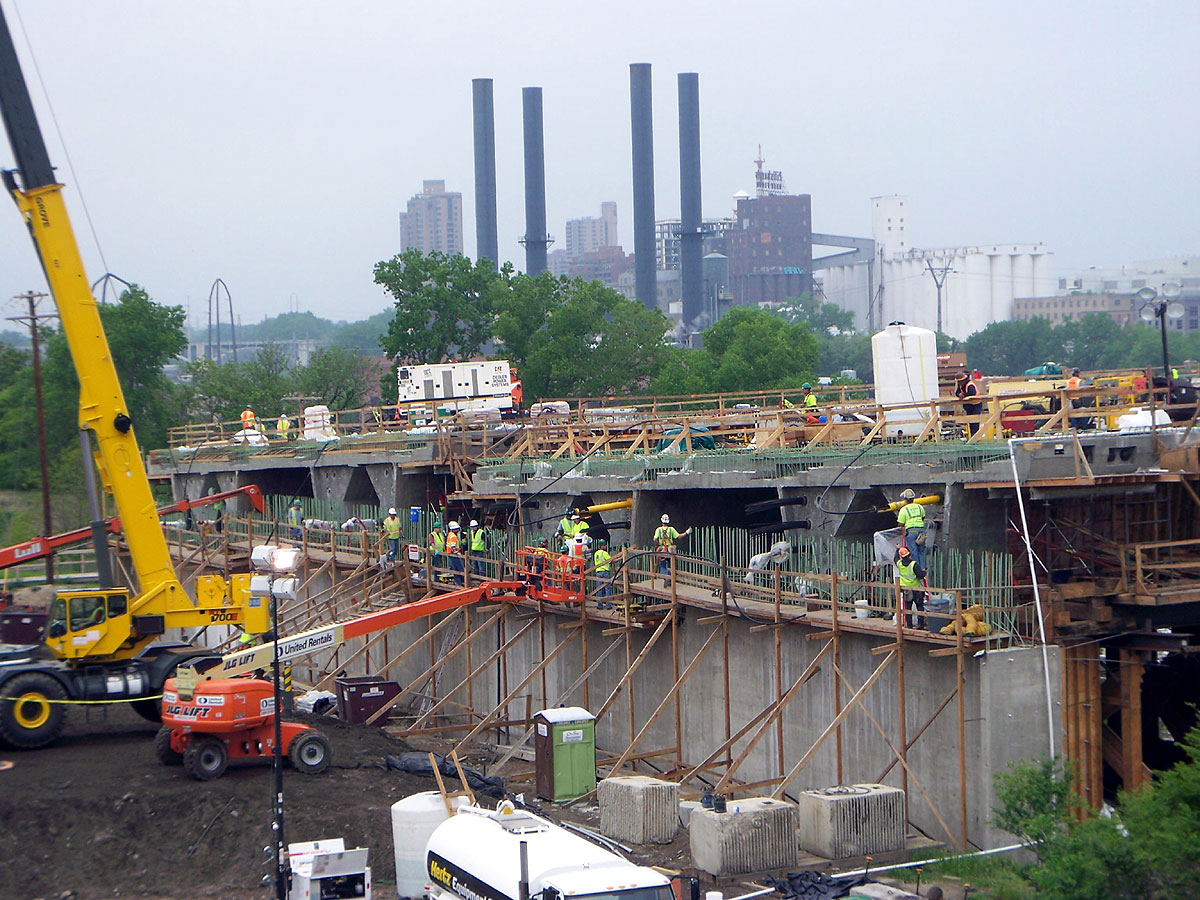
I'd seen that today the construction guys working on the I-35W bridge over the Mississippi were going to lift into place a couple of big concrete segments using some enormous crane on a barge. This sounds fun! So I rode past the West Bank of the University of Minnesota and onto the 10th Avenue Bridge immediately adjacent to the I-35W bridge construction site. This makes a marvelous viewpoint, by the way, and is fabulously accessible by bicycle. Here's what I saw.
Jeez, fellas, I hate to be critical or anything, but it looks to me like these aren't level. This is the land side of the approach to the southern bank of the bridge. This would be by the Holiday Inn, for the locals.
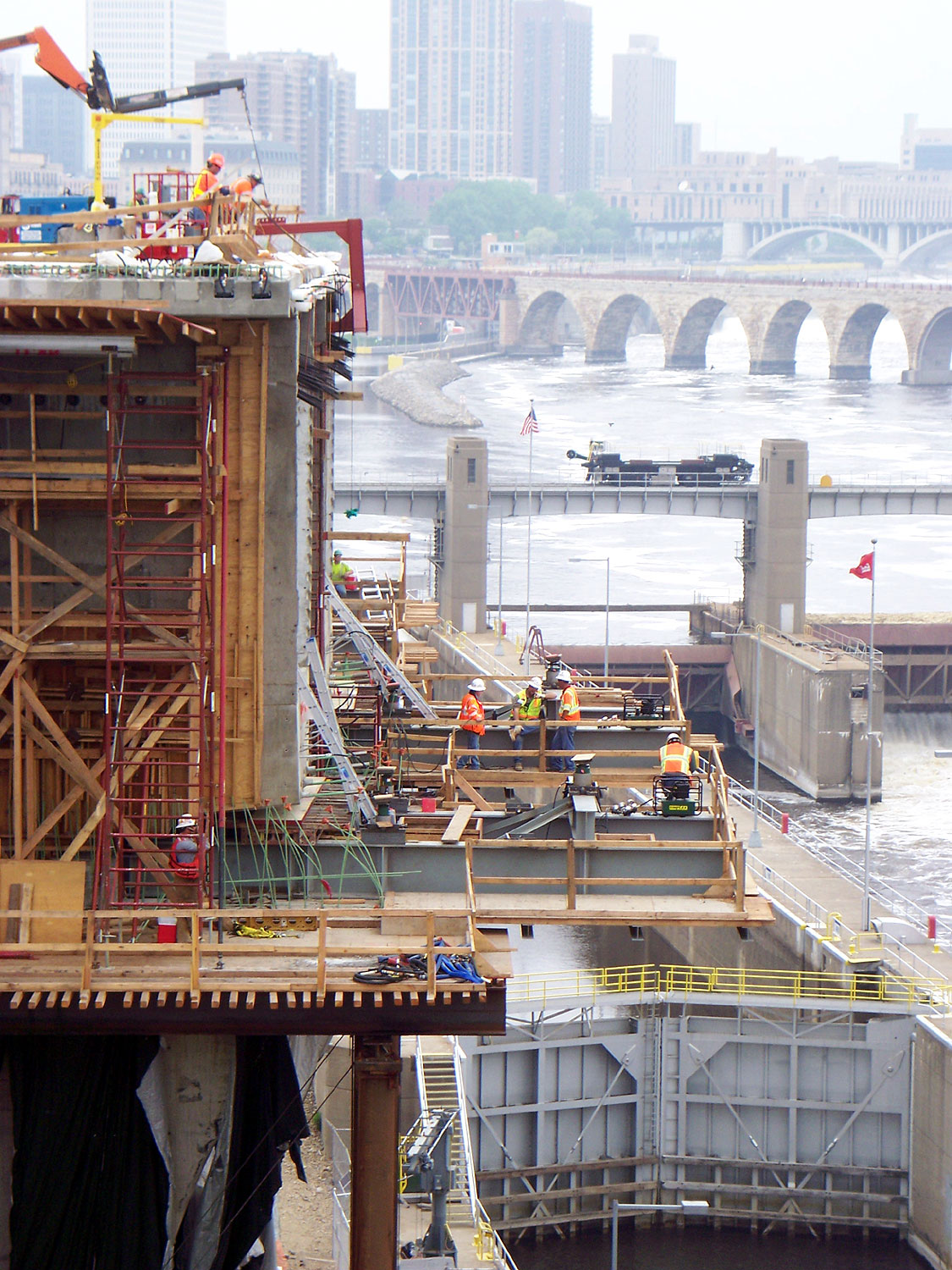
There were a bunch of workers here where the big concrete bridge deck segments were to be placed. I kind of wonder what individual workers do in a lift like this. A bunch were taking photographs. In the background you can see part of the Stone Arch Bridge, now used only for pedestrians and cyclists to get across the Mississippi. On the lower right you can see the downstream lock doors for the Upper Saint Anthony Lock.
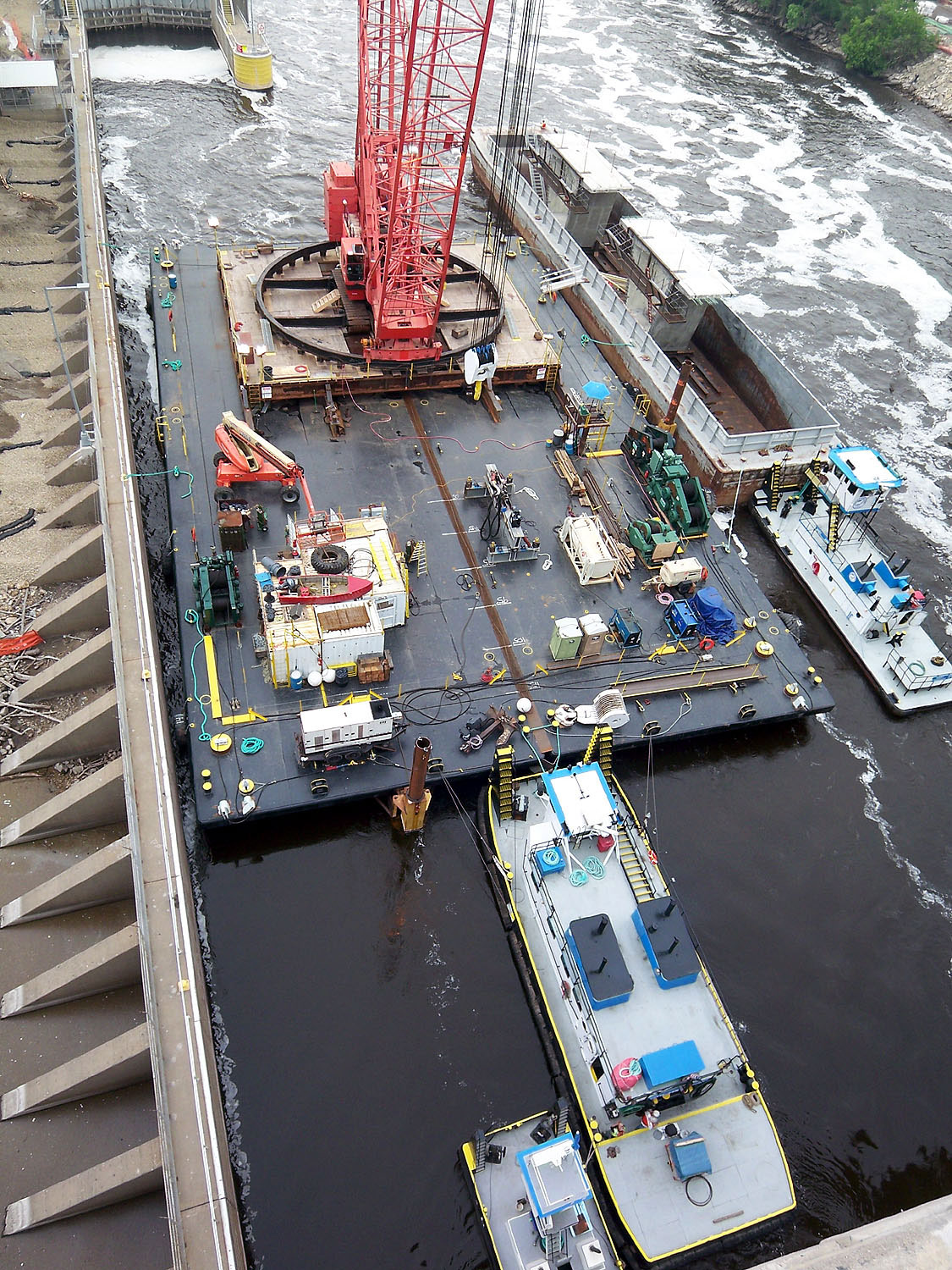
This is one major crane. It's two barges side by side and moored to the river bank against a pretty strong current. That's a towboat parked behind the two barges. Off to the right is another barge with the two bridge segments to be lifted with a towboat that had moved them into position. These things are cast in the Bohemian Flats area about half a mile downstream. This used to be a neighborhood full of (you guessed it) Bohemians but it was prone to flooding and they were moved out in the 1960s. It's normally open parkland now, but has proven darn handy in the event a major bridge falls down a few hundred yards upstream. They moved a lot of the steel beams there to figure out what had happened, and now are casting these concrete segments there. The little tiny tow nestled in at the bottom of the photo seems to be a water taxi...at one point, it chugged across the river with somebody, then came back. I suppose getting from one side to the other would be a real pain otherwise.
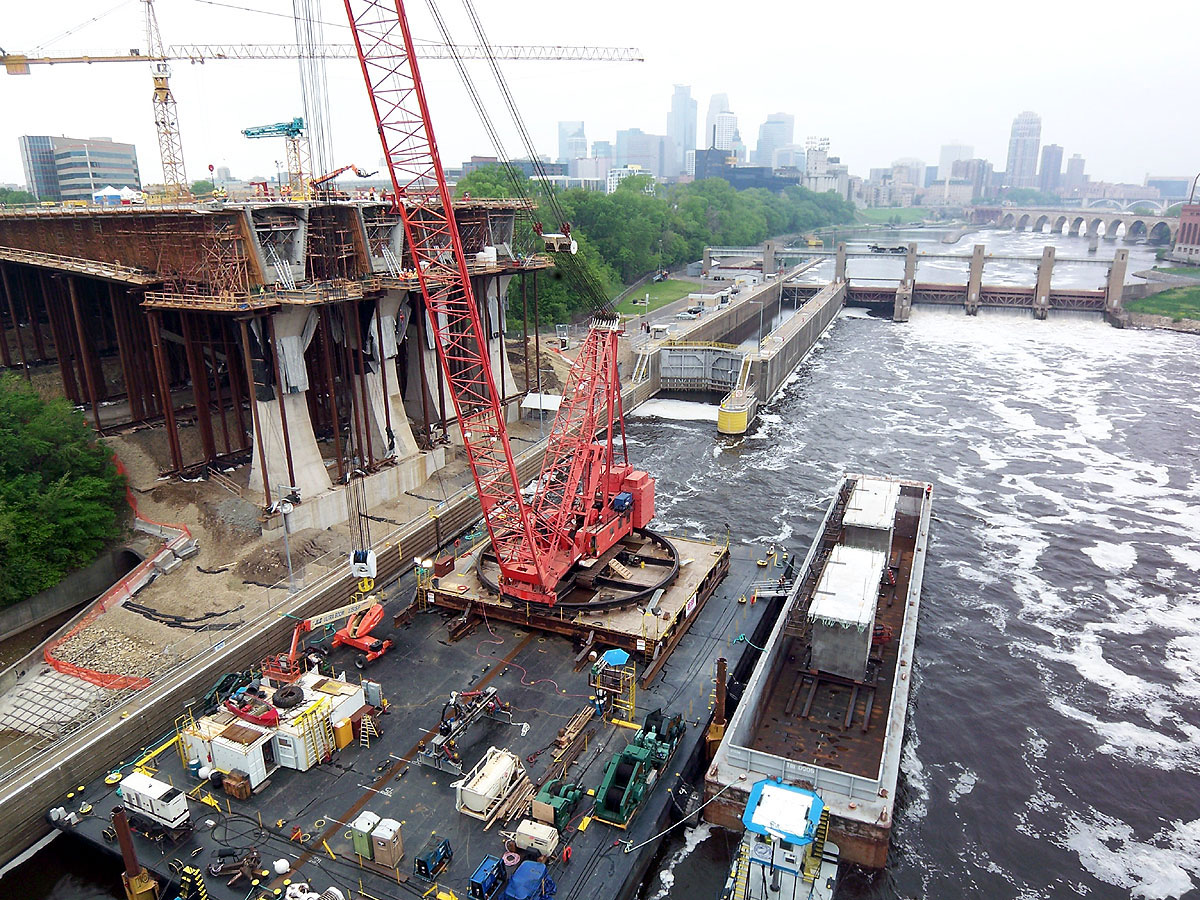
The overall lift scene. You can see downtown Minneapolis in the background and the Upper Saint Anthony Lock and Dam in the middle distance. The river has some real current to it at the moment.
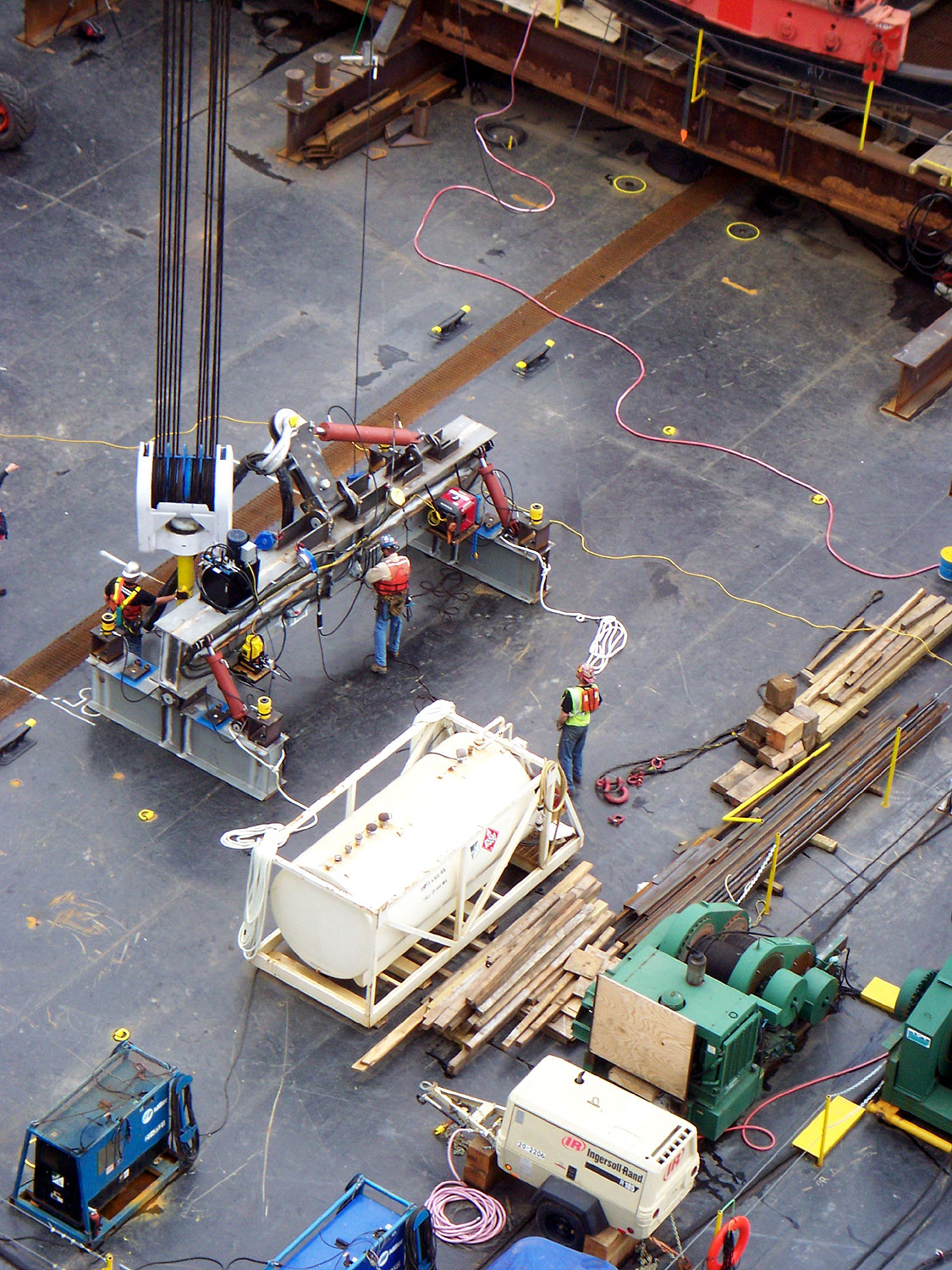
The crane was going to lift this thing, which the workers are fiddling with. Each bridge section had four long rods sticking out of it; near as I could tell, those would go through the four yellow holes in this puppy and be secured somehow, then lifted into position. The pulley on this crane has lots of mechanical advantage and they have to pull oodles of cable to get it move anywhere.
Unfortunately, there was lots of standing around activity going on and I had tickets to The Triangle Factory Fire Project ("a whimsical lighthearted romp!") at the Hillcrest Center Theatre at 2:00, so at 12:30, just as some actual activity was stirring on the deck, so I took my reluctant departure and rode on home and didn't see the actual lift.
The play was excellent, by the way, but today's performance was the final one. This was opening day for bridge segment lifting, and there are 120 sections to be done, so you still have plenty of time to see more.
I'd seen that today the construction guys working on the I-35W bridge over the Mississippi were going to lift into place a couple of big concrete segments using some enormous crane on a barge. This sounds fun! So I rode past the West Bank of the University of Minnesota and onto the 10th Avenue Bridge immediately adjacent to the I-35W bridge construction site. This makes a marvelous viewpoint, by the way, and is fabulously accessible by bicycle. Here's what I saw.
Jeez, fellas, I hate to be critical or anything, but it looks to me like these aren't level. This is the land side of the approach to the southern bank of the bridge. This would be by the Holiday Inn, for the locals.
There were a bunch of workers here where the big concrete bridge deck segments were to be placed. I kind of wonder what individual workers do in a lift like this. A bunch were taking photographs. In the background you can see part of the Stone Arch Bridge, now used only for pedestrians and cyclists to get across the Mississippi. On the lower right you can see the downstream lock doors for the Upper Saint Anthony Lock.
This is one major crane. It's two barges side by side and moored to the river bank against a pretty strong current. That's a towboat parked behind the two barges. Off to the right is another barge with the two bridge segments to be lifted with a towboat that had moved them into position. These things are cast in the Bohemian Flats area about half a mile downstream. This used to be a neighborhood full of (you guessed it) Bohemians but it was prone to flooding and they were moved out in the 1960s. It's normally open parkland now, but has proven darn handy in the event a major bridge falls down a few hundred yards upstream. They moved a lot of the steel beams there to figure out what had happened, and now are casting these concrete segments there. The little tiny tow nestled in at the bottom of the photo seems to be a water taxi...at one point, it chugged across the river with somebody, then came back. I suppose getting from one side to the other would be a real pain otherwise.
The overall lift scene. You can see downtown Minneapolis in the background and the Upper Saint Anthony Lock and Dam in the middle distance. The river has some real current to it at the moment.
The crane was going to lift this thing, which the workers are fiddling with. Each bridge section had four long rods sticking out of it; near as I could tell, those would go through the four yellow holes in this puppy and be secured somehow, then lifted into position. The pulley on this crane has lots of mechanical advantage and they have to pull oodles of cable to get it move anywhere.
Unfortunately, there was lots of standing around activity going on and I had tickets to The Triangle Factory Fire Project ("a whimsical lighthearted romp!") at the Hillcrest Center Theatre at 2:00, so at 12:30, just as some actual activity was stirring on the deck, so I took my reluctant departure and rode on home and didn't see the actual lift.
The play was excellent, by the way, but today's performance was the final one. This was opening day for bridge segment lifting, and there are 120 sections to be done, so you still have plenty of time to see more.
Saturday, May 24, 2008
OK, I'll Tutor You on How To Commute
My class on Bicycle Commuting was a bit of a bust. The young lady from the TMO was there and was apologetic from the beginning because the neighbourhood newsletter advertising a whole series of classes, seminars and rides (of which mine was the first) hadn't gone out yet. I noted in the last entry that it could be anything from three to 175 people. I was too optimistic. They'd been touting the class at Bike to Work Day and other events, but in the end, one woman showed up.
I ran through my spiel anyway. It was more responsive to audience input than it might have been with a larger group. On the off-chance it was a hit, I'd done thirty copies of my Bicycle Commuting handout and brought along a stack of the Trek One World Two Wheels (great name!) brochures. There were plenty of spares!
Despite the thin audience, it reaffirmed several points I made in the handout; both women were confused by derailleur gearing (they knew how to shift, but not about how to think about it or the amount of overlap and duplcation derailleur drivetrains have); the TMO woman does intermodal transport, taking her bike on the bus to work, then riding home, due to lack of shower facilities at her place of employment. I mentioned this as an alternative. She also said that the bike racks on the buses are getting more use, and she has had a bus come along with both slots taken even though she's early in the route; I mentioned that as well.
We went on for about an hour and a half when I detected fatigue setting in and wrapped things up. I packed everything back up, my 29 spare brochures (actually, I left one for the church, who I had credited on the back cover) and laptop, on which I had a pile of relevant photos in a Powerpoint show. It was beautiful outside, maybe 60. I had changed upon arrival to dress trousers, shirt and tie to make the point that it could be done, and decided to ride home all dressed up, just changing to cycling shoes.
Despite the lame attendance, running through the presentation in some semblance of order was worthwhile. The deadline helped, as well, as it made me write my handout. I consider this a beta version, but if you want to read it, it's called Bicycle Commuting: Making a Simple Thing Sound All Complicated and runs 20 pages. After Thursday's experience with my rapt audience of two, I'm tempted to make it longer, filling out the Gears and adding to How To Ride in Traffic in which, at the moment, I don't mention the Door Zone, for instance. If you read it and have comments, I'd like to hear 'em. My e-mail address is printed on the back cover (and the next version won't be quite so time-specific but will still make many references to the Twin Cities).
Anyway, I was riding home and going up Victoria saw a bicycle ahead of me which I easily overtook. It was a lady pulling her daughter on an Adams Trail-a-Bike. Her daughter was ringing her bell, so I rung mine back at her as I went by. I stopped at University at a red light and she caught up. She asked if I was riding home from work (still in tie, remember). Nope, I said, I actually just taught a class on Bicycle Commuting. Really, she asked, we're on our way home from church at the cathedral. We're trying to use the bike more. She was proud of her bicycle, a stylish new Trek. The light changed, we exchanged farewells and rode across University. Then it occured to me; I've got a couple of dozen spare handouts with me, why not offer her one?, so I pulled over and rummaged around in my pannier as she came up and stopped.
I asked if she'd like a Commuting handout. Sure! I gave her one and said I'd appreciate any comments she might have. She thought riding more sounded like a good idea, and thought maybe Commuting seminars are something they could sponsor at church. That probably wouldn't be a bad idea. We again exchanged goodbyes and rode on.
I wonder if this is finally Our Moment. My Trail-a-bike lady mentioned gas prices; my single outside attendee talked about her Suburban and gas prices and her commute. Is gas finally costing enough to make people begin to reconsider transportation options? I've seen false starts before, with the first oil embargo along with the 1970s Bike Boom, with the 1979/80 Iran embargo and high prices then. Cars got smaller, the speed limit dropped to 55, but then oil prices dropped dramatically in the mid-1980s and those efforts faded. The speed limit crept back up; our national fleet mileage peaked in 1986, the year oil dropped from around $30 a barrel to around $10; the young adult baby boomers who had driven the Bike Boom and cycle touring in the 1970s settled into middle age in motor vehicles. With oil so cheap it was hard not to partake of the cheap energy situation. This time, though, it doesn't seem like oil and gas will get cheap again. Is this the inflection point when some more permanent shift in transportation takes place? It feels like it, and hope to be able to help those wanting to incorporate cycling into the mix.
I ran through my spiel anyway. It was more responsive to audience input than it might have been with a larger group. On the off-chance it was a hit, I'd done thirty copies of my Bicycle Commuting handout and brought along a stack of the Trek One World Two Wheels (great name!) brochures. There were plenty of spares!
Despite the thin audience, it reaffirmed several points I made in the handout; both women were confused by derailleur gearing (they knew how to shift, but not about how to think about it or the amount of overlap and duplcation derailleur drivetrains have); the TMO woman does intermodal transport, taking her bike on the bus to work, then riding home, due to lack of shower facilities at her place of employment. I mentioned this as an alternative. She also said that the bike racks on the buses are getting more use, and she has had a bus come along with both slots taken even though she's early in the route; I mentioned that as well.
We went on for about an hour and a half when I detected fatigue setting in and wrapped things up. I packed everything back up, my 29 spare brochures (actually, I left one for the church, who I had credited on the back cover) and laptop, on which I had a pile of relevant photos in a Powerpoint show. It was beautiful outside, maybe 60. I had changed upon arrival to dress trousers, shirt and tie to make the point that it could be done, and decided to ride home all dressed up, just changing to cycling shoes.
Despite the lame attendance, running through the presentation in some semblance of order was worthwhile. The deadline helped, as well, as it made me write my handout. I consider this a beta version, but if you want to read it, it's called Bicycle Commuting: Making a Simple Thing Sound All Complicated and runs 20 pages. After Thursday's experience with my rapt audience of two, I'm tempted to make it longer, filling out the Gears and adding to How To Ride in Traffic in which, at the moment, I don't mention the Door Zone, for instance. If you read it and have comments, I'd like to hear 'em. My e-mail address is printed on the back cover (and the next version won't be quite so time-specific but will still make many references to the Twin Cities).
Anyway, I was riding home and going up Victoria saw a bicycle ahead of me which I easily overtook. It was a lady pulling her daughter on an Adams Trail-a-Bike. Her daughter was ringing her bell, so I rung mine back at her as I went by. I stopped at University at a red light and she caught up. She asked if I was riding home from work (still in tie, remember). Nope, I said, I actually just taught a class on Bicycle Commuting. Really, she asked, we're on our way home from church at the cathedral. We're trying to use the bike more. She was proud of her bicycle, a stylish new Trek. The light changed, we exchanged farewells and rode across University. Then it occured to me; I've got a couple of dozen spare handouts with me, why not offer her one?, so I pulled over and rummaged around in my pannier as she came up and stopped.
I asked if she'd like a Commuting handout. Sure! I gave her one and said I'd appreciate any comments she might have. She thought riding more sounded like a good idea, and thought maybe Commuting seminars are something they could sponsor at church. That probably wouldn't be a bad idea. We again exchanged goodbyes and rode on.
I wonder if this is finally Our Moment. My Trail-a-bike lady mentioned gas prices; my single outside attendee talked about her Suburban and gas prices and her commute. Is gas finally costing enough to make people begin to reconsider transportation options? I've seen false starts before, with the first oil embargo along with the 1970s Bike Boom, with the 1979/80 Iran embargo and high prices then. Cars got smaller, the speed limit dropped to 55, but then oil prices dropped dramatically in the mid-1980s and those efforts faded. The speed limit crept back up; our national fleet mileage peaked in 1986, the year oil dropped from around $30 a barrel to around $10; the young adult baby boomers who had driven the Bike Boom and cycle touring in the 1970s settled into middle age in motor vehicles. With oil so cheap it was hard not to partake of the cheap energy situation. This time, though, it doesn't seem like oil and gas will get cheap again. Is this the inflection point when some more permanent shift in transportation takes place? It feels like it, and hope to be able to help those wanting to incorporate cycling into the mix.
Monday, May 19, 2008
Teach You To Commute I Will
I'm teaching a class on Commuting by Bicycle on Thursday. This is being done on behalf of the Midway TMO (actually, it merged with the Saint Paul TMO and became Smart Trips). It was to be publicized in a mailing but the mailing hasn't gone out yet. I guess they've been flogging it at some events, but there's no signup required so there's no idea how many people will show. Fifteen, they guess, I'm printing 25 copies of my handout, and this is one of those events that could end up with 3 people or 175.
In the event you feel the need for advice from a dilettante commuter such as myself, it will be Thursday May 22 from 6:00PM to 8:00PM at Dayton Avenue Presbyterian Church at 217 Mackubin Street in Saint Paul. Maybe only two civilians will show up and we can impress them with the beauty and efficiency of bicycle commuting by having a bitter and recrimination-filled argument about clipless pedals.
I did commute today, what a hero, Me commuting isn't that notable except today I went to Home Depot after work. We're in the midst of a slowly-evolving kitchen renovation and this was the day to talk Cabinets. This isn't all that fascinating, either, but I rode the new bike trail that parallels Saint Anthony Boulevard. This was a disused train line, and in fact where the trail starts off Walnut just south of County C, there is a sign saying that this right of way is reserved for commuter rail use. The implication; the bike path is temporary, and don't whine you cyclists when we take it back. For the moment, and at the rate those projects move, for many years to come, it makes an excellent alternative to ridng on Saint Anthony Boulevard itself, which is four-lane divided and likely to be regarded as almost Interstate-like by motorists.
To get to the trail, I rode down Cleveland and took County C west. County C west of Cleveland pretty much blows. East of Cleveland there's a superb bike path south of the road AND a four- or five-foot shoulder for those who disdain sidepaths. West of Cleveland there's hardly any shoulder beyond the two travel lanes each way and it's concrete with lots of cracks and potholes indifferently filled in with asphalt. At least there's plenty of truck traffic and impatient motorists. Since it's outside of Saint Paul, it's not under the purview of the Saint Paul Bicycle Advisory Board and I don't know of any plans for the lousy bit of County C, but if they rebuild it to the standards of the road east of Cleveland it would be an excellent route towards downtown.
Although this isn't exactly unexplored territory for me (although I hadn't been on the trail, which opened last fall), I did consult my excellent Twin Cities Bike Map, 9th edition (that's the brand new edition, just out). Little Transport Press has become Bike Everywhere which I think is just a new name. I really like this map and am constantly surprised by the number of cyclists who don't have it. I'll be urging it on those who attend my Commuting Class because I have found it very trustworthy over the years. The price went up to $11.95 from $9.95 but it's printed on some kind of waxy paper that is supposedly water resistant, which is good because my older ones have gotten pretty worn being carried around. You should get one of these maps.
I did like this bit from the new edition:

The I-35W bridge over the Mississippi is missing on the map. He'll have to put it back in, of course, but it won't affect cyclists other than to reopen the bike path on the east bank.
Speaking of bridges, I got an email noting that in the flurry of self-congratulatory bill passing at the last minute by our government (our Governor Tim Pawlenty seemed more agreeable than usual, perhaps hoping that next year he'll be Vice President) was a couple of million bucks to remove and rebuild the Cedar Avenue Bridge over the Minnesota River in Bloomington. This will be for cyclists and pedestrians only and is a useful connector across the river. Doug will have to update the map again; right now, his says "Bridge Out" at that spot. He also still shows the Lowry Avenue bridge open; it had a pier move 11 inches and our suddenly bridge-sensitive government closed it down (the same happened to a bridge in Saint Cloud, and the Hastings Highway 61 bridge is down to 1 lane due to buckling gusset plates...sheesh, you have one Interstate Bridge drop off the map and all of a sudden people give a damn about our crumbling infrastructure). It's getting hard for a cartographer to keep up with the bridge status in this state.
In the event you feel the need for advice from a dilettante commuter such as myself, it will be Thursday May 22 from 6:00PM to 8:00PM at Dayton Avenue Presbyterian Church at 217 Mackubin Street in Saint Paul. Maybe only two civilians will show up and we can impress them with the beauty and efficiency of bicycle commuting by having a bitter and recrimination-filled argument about clipless pedals.
I did commute today, what a hero, Me commuting isn't that notable except today I went to Home Depot after work. We're in the midst of a slowly-evolving kitchen renovation and this was the day to talk Cabinets. This isn't all that fascinating, either, but I rode the new bike trail that parallels Saint Anthony Boulevard. This was a disused train line, and in fact where the trail starts off Walnut just south of County C, there is a sign saying that this right of way is reserved for commuter rail use. The implication; the bike path is temporary, and don't whine you cyclists when we take it back. For the moment, and at the rate those projects move, for many years to come, it makes an excellent alternative to ridng on Saint Anthony Boulevard itself, which is four-lane divided and likely to be regarded as almost Interstate-like by motorists.
To get to the trail, I rode down Cleveland and took County C west. County C west of Cleveland pretty much blows. East of Cleveland there's a superb bike path south of the road AND a four- or five-foot shoulder for those who disdain sidepaths. West of Cleveland there's hardly any shoulder beyond the two travel lanes each way and it's concrete with lots of cracks and potholes indifferently filled in with asphalt. At least there's plenty of truck traffic and impatient motorists. Since it's outside of Saint Paul, it's not under the purview of the Saint Paul Bicycle Advisory Board and I don't know of any plans for the lousy bit of County C, but if they rebuild it to the standards of the road east of Cleveland it would be an excellent route towards downtown.
Although this isn't exactly unexplored territory for me (although I hadn't been on the trail, which opened last fall), I did consult my excellent Twin Cities Bike Map, 9th edition (that's the brand new edition, just out). Little Transport Press has become Bike Everywhere which I think is just a new name. I really like this map and am constantly surprised by the number of cyclists who don't have it. I'll be urging it on those who attend my Commuting Class because I have found it very trustworthy over the years. The price went up to $11.95 from $9.95 but it's printed on some kind of waxy paper that is supposedly water resistant, which is good because my older ones have gotten pretty worn being carried around. You should get one of these maps.
I did like this bit from the new edition:
The I-35W bridge over the Mississippi is missing on the map. He'll have to put it back in, of course, but it won't affect cyclists other than to reopen the bike path on the east bank.
Speaking of bridges, I got an email noting that in the flurry of self-congratulatory bill passing at the last minute by our government (our Governor Tim Pawlenty seemed more agreeable than usual, perhaps hoping that next year he'll be Vice President) was a couple of million bucks to remove and rebuild the Cedar Avenue Bridge over the Minnesota River in Bloomington. This will be for cyclists and pedestrians only and is a useful connector across the river. Doug will have to update the map again; right now, his says "Bridge Out" at that spot. He also still shows the Lowry Avenue bridge open; it had a pier move 11 inches and our suddenly bridge-sensitive government closed it down (the same happened to a bridge in Saint Cloud, and the Hastings Highway 61 bridge is down to 1 lane due to buckling gusset plates...sheesh, you have one Interstate Bridge drop off the map and all of a sudden people give a damn about our crumbling infrastructure). It's getting hard for a cartographer to keep up with the bridge status in this state.
The Three Speed Tour
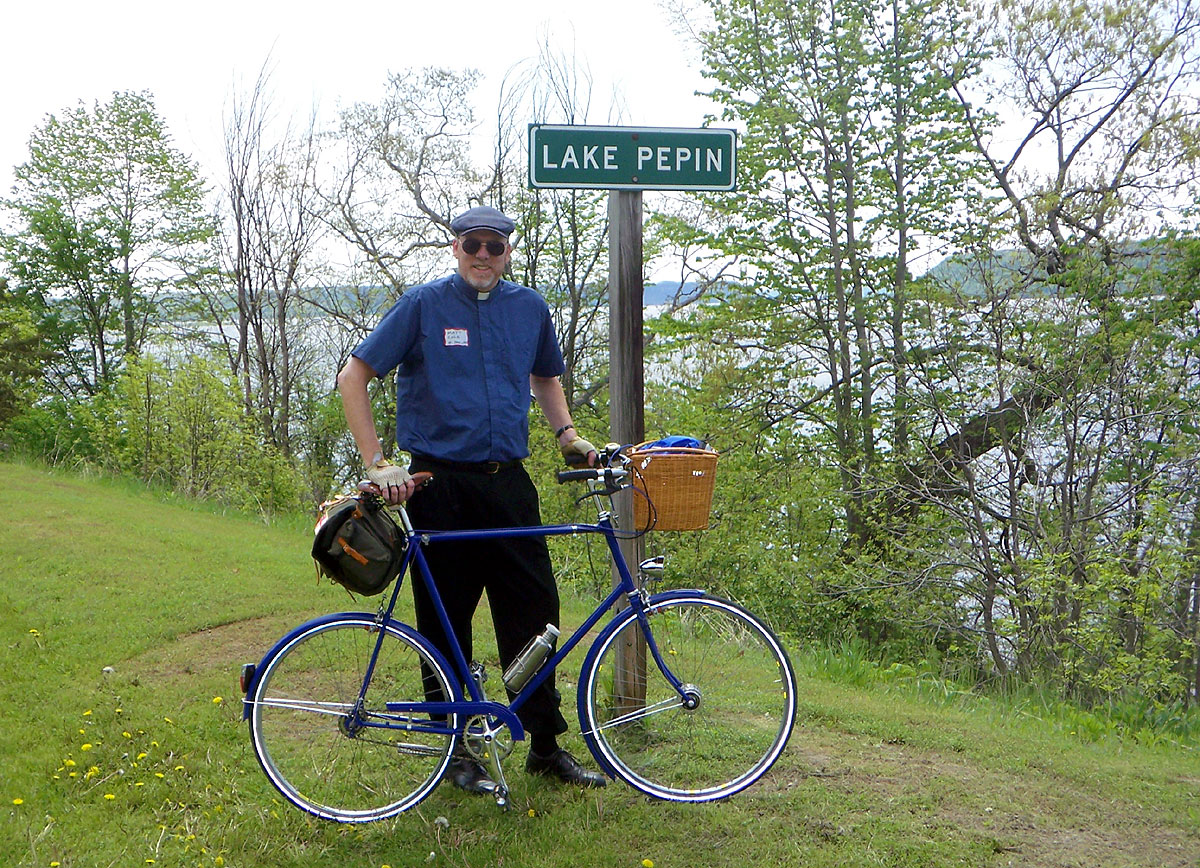
The 2008 episode of the Lake Pepin Three Speed Tour was this past weekend. As always, Jon and Noel organized a wonderful event. We gathered in Red Wing, rode to Wabasha Saturday with some tailwinds and a spot of rain to make in an official Three Speed Tour, had the usual bash at the Eagle's Nest Coffee Shop Saturday night, then gathered to ride back Sunday. It was cooler Sunday, sunny, but we had stiff headwinds. Fortunately, these were often screened along the river but the group that took the highlands route out of Wabasha suffered for their decision though I gather there were terrific views. There was a Brew Up in Lake City, the usual social gathering in Old Frontenac, the excitement of the Hill Avenue climb and descent for many of us, then the slog into Red Wing into the teeth of the wind and the post-ride gathering at the Staghead. This was of course all done on three-speed bicycles whilst dressed in proper ladies-and-gentlemen fashion. In my case, I again went as the Quicker Vicar, seen here at the Lake Pepin sign on the Wisconsin side.
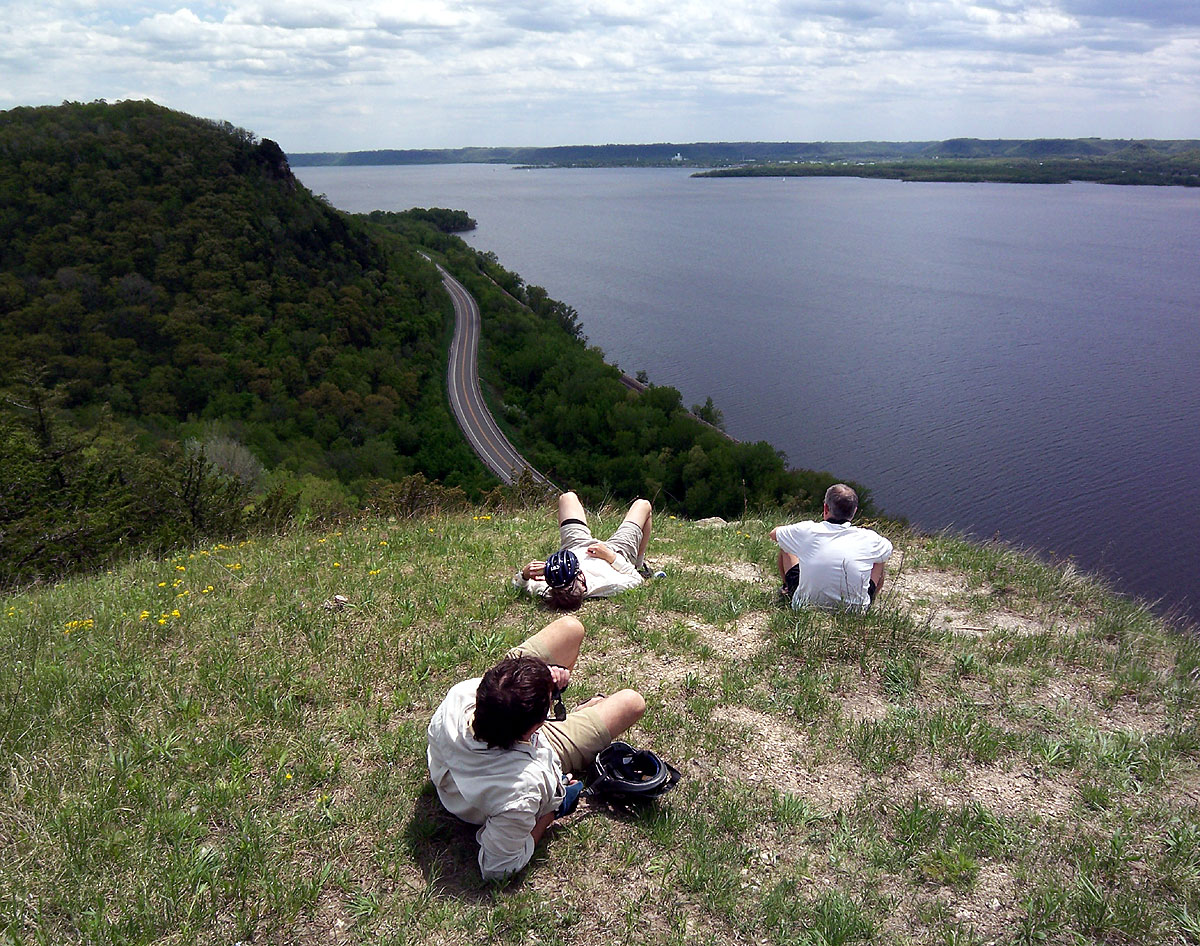
Last year I took the easy way out, sticking to Highway 35 south of Maiden Rock rather than taking the County AA/E climb to the top of the bluffs. This year, I climbed. Actually, I walked a bit of it, but it turns out that not much easier on the legs than riding. Once atop Maiden Rock, which had been ridden to by a tandem pulling a trailer and many riders including several young ladies in skirts and heels, we fell about to bask in the view and the sunlight.
That's Wisconsin Highway 35, the lowlands route, down below. The ride across the dandelion meadow is just about the only off-road riding I do all year. The reward is great, since two years ago I'd done the Death March selection for the loop and bypassed this outcrop by accident. It's worth going out to.
I'll write more, but it'll be a few days. Got a busy week coming up. To all who rode the Tour, thanks for a great event, it's terrific how our little bit of alternate reality for two days creates such a high and it's a priviledge to ride with you. It makes a great kickoff to the summer cycling season.
Last year I took the easy way out, sticking to Highway 35 south of Maiden Rock rather than taking the County AA/E climb to the top of the bluffs. This year, I climbed. Actually, I walked a bit of it, but it turns out that not much easier on the legs than riding. Once atop Maiden Rock, which had been ridden to by a tandem pulling a trailer and many riders including several young ladies in skirts and heels, we fell about to bask in the view and the sunlight.
That's Wisconsin Highway 35, the lowlands route, down below. The ride across the dandelion meadow is just about the only off-road riding I do all year. The reward is great, since two years ago I'd done the Death March selection for the loop and bypassed this outcrop by accident. It's worth going out to.
I'll write more, but it'll be a few days. Got a busy week coming up. To all who rode the Tour, thanks for a great event, it's terrific how our little bit of alternate reality for two days creates such a high and it's a priviledge to ride with you. It makes a great kickoff to the summer cycling season.
Wednesday, May 14, 2008
Gridlock
It's Bike to Work Day in Saint Paul. Convoys formed at various points around the city and rode downtown to food and prizes and speeches. I don't work downtown, though, and am hoarding vacation time for other purposes, so just rode to work by myself.
I stopped at the dry cleaners to drop off some trousers to get cleaned and pressed for my clerical duties at this weekend's Three Speed Tour. I rode down Hoyt and took Hamline north up to Larpenteur, where I got in the left turn lane. A motorcycle pulled up next to me in the straight-through lane. Crossing traffic stopped, southbound Hamline traffic got the advanced-left signal and began going, I got poised to start, and....cross traffic started up again.
Neither I nor the motorcycle were heavy enough to trigger the traffic light.
Now, there was a segment on Channel 5 IMissedIt News a week or two ago about cyclists' running red lights and stop signs. Now here we were, me and the motorcyclist, obeying the traffic semaphores as cars stacked up behind us. If we strictly followed the law, nobody would go anywhere, ever.
I checked to make sure no cars were filtering forward to right-on-red, and rode over to the pedestrian crosswalk button and pushed it, then rode back into my left turn lane. Half a minute went by and cross traffic stopped. This time the southbound traffic got the advanced left again, but our lights turned green and we got to go. I hope that the motorists stacked up behind us noted that traffic signals don't always work for cyclists and that sometimes we have to take a liberal interpretation of their meaning or nobody goes anywhere.
I saw a couple of other riders along the way. I rode up Hamline rather than my usual Lexington to work, so am not sure if these folks are regulars or not, but a couple looked well-equipped (panniers, attire) and waved as they went by. No speeches at work, no free food, no prizes, just another day riding past the gas stations with their $3.72 signs up. With those kinds of prices, and possibly worse to come (a story last night on the news noted that many older gas pumps don't go past $3.99 a gallon, a faint echo of the late 1970s or was it early 1980s when older pumps wouldn't go past 0.999 a gallon), there may be more of us on the road. Give them a wave when you see them.
I stopped at the dry cleaners to drop off some trousers to get cleaned and pressed for my clerical duties at this weekend's Three Speed Tour. I rode down Hoyt and took Hamline north up to Larpenteur, where I got in the left turn lane. A motorcycle pulled up next to me in the straight-through lane. Crossing traffic stopped, southbound Hamline traffic got the advanced-left signal and began going, I got poised to start, and....cross traffic started up again.
Neither I nor the motorcycle were heavy enough to trigger the traffic light.
Now, there was a segment on Channel 5 IMissedIt News a week or two ago about cyclists' running red lights and stop signs. Now here we were, me and the motorcyclist, obeying the traffic semaphores as cars stacked up behind us. If we strictly followed the law, nobody would go anywhere, ever.
I checked to make sure no cars were filtering forward to right-on-red, and rode over to the pedestrian crosswalk button and pushed it, then rode back into my left turn lane. Half a minute went by and cross traffic stopped. This time the southbound traffic got the advanced left again, but our lights turned green and we got to go. I hope that the motorists stacked up behind us noted that traffic signals don't always work for cyclists and that sometimes we have to take a liberal interpretation of their meaning or nobody goes anywhere.
I saw a couple of other riders along the way. I rode up Hamline rather than my usual Lexington to work, so am not sure if these folks are regulars or not, but a couple looked well-equipped (panniers, attire) and waved as they went by. No speeches at work, no free food, no prizes, just another day riding past the gas stations with their $3.72 signs up. With those kinds of prices, and possibly worse to come (a story last night on the news noted that many older gas pumps don't go past $3.99 a gallon, a faint echo of the late 1970s or was it early 1980s when older pumps wouldn't go past 0.999 a gallon), there may be more of us on the road. Give them a wave when you see them.
Tuesday, May 13, 2008
Bicycle Sales Up Worldwide
Forbes has an article (reabable here) about the booming sales of bicycles worldwide. Some snippets:
That's an interesting point about the poor past in the last bit I cite above. I have read that in bicycle-friendly Amsterdam, one of the challenges is getting immigrant communities, especially Muslim ones, to adopt bicycling. It's not part of the cultural background for many in these communities, and, in an echo of late 19th-century America, the freedom bicycles allow women is discomforting to the traditional social structure.
Another interesting bit that addresses a market hardly even breathing in the U.S.:
Now, 25-km an hour is only about 16 mph, but that's still a useful speed, faster than my usual cruising in-town, and gets rid of some of the sweatiness that inhibits many people from commuting. Maybe this will become a market in this country as well.
Rising petrol prices, growing awareness of environmental issues and the popularity of cycling as a recreation sport has fuelled a surge in demand for bicycles around the world...
Bicycle sales have over the past five years increased by 14.6 percent among European Union nations, which buy 70 percent of the world's bikes, according to Bike Europe. In the United States, sales have increased by almost 9 percent in the same time period...
Europeans increasingly pedal to work on bike-friendly streets planned by city governments that encourage cycling, while a growing pool of commuters in China use battery bikes and Americans ride mainly for sport or to work off calories...
Would-be riders in newly developed regions such as Taiwan still see bikes as a symbol of a poor past, while riders complain worldwide of inclement weather, unsafe traffic and rampant theft despite the best locks.
That's an interesting point about the poor past in the last bit I cite above. I have read that in bicycle-friendly Amsterdam, one of the challenges is getting immigrant communities, especially Muslim ones, to adopt bicycling. It's not part of the cultural background for many in these communities, and, in an echo of late 19th-century America, the freedom bicycles allow women is discomforting to the traditional social structure.
Another interesting bit that addresses a market hardly even breathing in the U.S.:
Giant also manufactures battery powered bikes which are popular in China where the company operates three factories. Battery-powered bikes are a big hit as China's economic boom puts money in the pockets of even the poorest factory workers who almost immediately upgrade their bikes.
Chinese consumers snapped up more than 20 million battery powered bikes in 2006. The bikes, powered by a 36 or 48 volt battery can travel at around 25-km an hour. They sell for around 3000 yuan ($430) a unit.
Now, 25-km an hour is only about 16 mph, but that's still a useful speed, faster than my usual cruising in-town, and gets rid of some of the sweatiness that inhibits many people from commuting. Maybe this will become a market in this country as well.
Tuesday, April 29, 2008
Pedalphile
A few weeks ago I was registering twocitiestwowheels.com as a domain name. I was thinking about registering pedalphile.com as well, but made the mistake of doing an inquiry in Network Solutions' site. It was available, but at $35 a year. At godaddy.com it was way cheaper to register a domain, so I registered Two Cities Two Wheels and tried to register Pedalphile, but it showed it held by Network Solutions. Darn them! I figured I'd get back to it once the hold was released and register it, but when I tried today someone else had already snagged it April 13. Oh well. It's a great name, and I hope they make use of it.
Oil has been on people's minds lately. The runup in oil prices has not been that big a surprise, or at least should not have been to sentient beings. With gas prices in the $3.40 a gallon range, there are now calls to drop the federal gasoline tax for the summer to help the American consumer. Senator Obama is against it, Senators Clinton and McCain are for it. I think it's a stupid idea. Gasoline has become more expensive, but it's going to stay that way and you might as well get used to it. In the meantime, the Federal budget deficit continues to increase (and will take a nice jump next week when the government sends us all money borrowed from the Chinese so that we can go out and blow it. I may take my children to dinner since they're the poor sods who'll be paying it back, with interest) which helps weaken the dollar which helps push up oil prices.
Although not normally someone I cite when I make a point, how about this quote:
It has been interesting to watch the airlines' reactions to the oil price increase. Prices are going up and some airlines have simply shut down operations. I think airlines are in a bad position and combining Northwest and Delta, as has been proposed, does not answer the question of how to get by on $120 a barrel oil. With the economic headwinds from contracting credit, reduced consumer confidence and increased commodity prices showing up in oil and food, there is going to be reduced demand for air travel, a situation exacerbated by the higher ticket prices airlines will have to charge. Almost the whole industry has gone through bankruptcy and they don't have the equity cushion to absorb a lot of losses from fuel prices.
I think airlines are going to have to find some new equilibrium, with much higher ticket prices and a much reduced flight schedule. I looked to see how many flights there are from here to Chicago O'Hare each day. Care to guess? My boss guessed 12. Wrongo. If you choose to fly on May 5th (I just picked a date), you can select from 32 flights to O'Hare on United, American or Northwest (you can find USAir or Continental flights, too, but they're just code-shares with these guys). There's two off at 6AM, two more at 7AM, and after the fifth flight of the day goes at 8:15 not an hour goes by without a flight until the gap between the American 7:35PM departure and Northwest's 9:15 and 10:16 flights, at which point we're done for the day, only to run it all again tomorrow.
One wonders, is there currently and will there in future be sufficient demand to support 32 flights a day between here and Chicago? (I'm ignoring flights to Midway airport, although when ATA collapsed a few weeks ago a lot of those went away). What if there's only really demand for 24 flights, or 17, or 10? There will be some painful price discovery and service adjustments as the competitors and customers grope through the scheduling and pricing scenarios trying to find this equilibrium.
Less acutely, regular people are going to have the same groping, expensive journey. Transit ridership in the Twin Cities is already way up this year; bicycle commuting will probably increase as well, helped along by the promise of finally getting some temperate weather. Does anyone doubt that carpooling will become more popular? My father used to carpool in the 1960s and 1970s, partly because we didn't have a second car until I was 16. If you live a long way from work, or work and home are areas not well-covered by transit, these adjustments are going to be hard.
I have to say I have enjoyed the cheap energy era. As much as I like bicycles, I also love airplanes, and first flew when it was so unusual that everyone dressed up and they published a passenger list, just like on a ship (OK, 1960, for the curious, by British Overseas Airways Corporation Douglas DC-6, Buffalo-Gander-Shannon-London service)(and no, I don't remember a thing, but I do still have the passenger list and I am exceptionally cute in the photos wearing my camel hair overcoat). I've enjoyed many a car trip just aimlessly sightseeing, and many of the advantages of cheap energy, from year-round fresh foods to cheap airline tickets, have enlivened my life. I think this era is drawing to a close, that we are getting higher energy prices from structural economic reasons rather than transient supply disruptions, and that adjustments are going to have to be made.
Bicycles are part of the answer. They can't do everything, of course, and they're pretty useless for nipping down to Chicago for the day, like I did last year on planes with a cheap advance-purchase ticket, but for many trips most of us take much of the time, they'll do fine. I guess it's our job to welcome new cyclists into the fold, show them the ropes, restore to them some sense of the joy and discovery that riding still holds. No matter how much you like bicycles, though, I'd probably hesitate to introduce yourself as a pedalphile!
Oil has been on people's minds lately. The runup in oil prices has not been that big a surprise, or at least should not have been to sentient beings. With gas prices in the $3.40 a gallon range, there are now calls to drop the federal gasoline tax for the summer to help the American consumer. Senator Obama is against it, Senators Clinton and McCain are for it. I think it's a stupid idea. Gasoline has become more expensive, but it's going to stay that way and you might as well get used to it. In the meantime, the Federal budget deficit continues to increase (and will take a nice jump next week when the government sends us all money borrowed from the Chinese so that we can go out and blow it. I may take my children to dinner since they're the poor sods who'll be paying it back, with interest) which helps weaken the dollar which helps push up oil prices.
Although not normally someone I cite when I make a point, how about this quote:
"Let us rid ourselves of the fiction that low oil prices are somehow good for the United States"That's Dick Cheney in October 1986 shortly after introducing legislation to increase the gas tax. He supported it in part because it would help reduce the federal deficit, something that seems to have become less of a priority for him in recent years.
It has been interesting to watch the airlines' reactions to the oil price increase. Prices are going up and some airlines have simply shut down operations. I think airlines are in a bad position and combining Northwest and Delta, as has been proposed, does not answer the question of how to get by on $120 a barrel oil. With the economic headwinds from contracting credit, reduced consumer confidence and increased commodity prices showing up in oil and food, there is going to be reduced demand for air travel, a situation exacerbated by the higher ticket prices airlines will have to charge. Almost the whole industry has gone through bankruptcy and they don't have the equity cushion to absorb a lot of losses from fuel prices.
I think airlines are going to have to find some new equilibrium, with much higher ticket prices and a much reduced flight schedule. I looked to see how many flights there are from here to Chicago O'Hare each day. Care to guess? My boss guessed 12. Wrongo. If you choose to fly on May 5th (I just picked a date), you can select from 32 flights to O'Hare on United, American or Northwest (you can find USAir or Continental flights, too, but they're just code-shares with these guys). There's two off at 6AM, two more at 7AM, and after the fifth flight of the day goes at 8:15 not an hour goes by without a flight until the gap between the American 7:35PM departure and Northwest's 9:15 and 10:16 flights, at which point we're done for the day, only to run it all again tomorrow.
One wonders, is there currently and will there in future be sufficient demand to support 32 flights a day between here and Chicago? (I'm ignoring flights to Midway airport, although when ATA collapsed a few weeks ago a lot of those went away). What if there's only really demand for 24 flights, or 17, or 10? There will be some painful price discovery and service adjustments as the competitors and customers grope through the scheduling and pricing scenarios trying to find this equilibrium.
Less acutely, regular people are going to have the same groping, expensive journey. Transit ridership in the Twin Cities is already way up this year; bicycle commuting will probably increase as well, helped along by the promise of finally getting some temperate weather. Does anyone doubt that carpooling will become more popular? My father used to carpool in the 1960s and 1970s, partly because we didn't have a second car until I was 16. If you live a long way from work, or work and home are areas not well-covered by transit, these adjustments are going to be hard.
I have to say I have enjoyed the cheap energy era. As much as I like bicycles, I also love airplanes, and first flew when it was so unusual that everyone dressed up and they published a passenger list, just like on a ship (OK, 1960, for the curious, by British Overseas Airways Corporation Douglas DC-6, Buffalo-Gander-Shannon-London service)(and no, I don't remember a thing, but I do still have the passenger list and I am exceptionally cute in the photos wearing my camel hair overcoat). I've enjoyed many a car trip just aimlessly sightseeing, and many of the advantages of cheap energy, from year-round fresh foods to cheap airline tickets, have enlivened my life. I think this era is drawing to a close, that we are getting higher energy prices from structural economic reasons rather than transient supply disruptions, and that adjustments are going to have to be made.
Bicycles are part of the answer. They can't do everything, of course, and they're pretty useless for nipping down to Chicago for the day, like I did last year on planes with a cheap advance-purchase ticket, but for many trips most of us take much of the time, they'll do fine. I guess it's our job to welcome new cyclists into the fold, show them the ropes, restore to them some sense of the joy and discovery that riding still holds. No matter how much you like bicycles, though, I'd probably hesitate to introduce yourself as a pedalphile!
Friday, April 25, 2008
This is a bit harsh
I think bicycle thieves are among the scum of the earth and don't get punished enough, but this is going a bit far: Two Jailed Over Boy's Pool Death.
Kid steals a bicycle, the owner and some friends throw him in a pool, prevent him from getting out, and he drowns. A crowd watched:
I'm not sure what the appropriate punishment is, but death sounds too harsh. These guys are all at pretty stupid ages, not unlike the 15-year-old who stole a car a couple of weeks ago in Minneapolis, drove 80mph down Lake Street running red lights and killed a woman going to church. I wouldn't be surprised if bike thefts rise this year, triggered by more people trying bicycle commuting and the resulting increase in opportunities for theft by the more feral elements of the population.
Kid steals a bicycle, the owner and some friends throw him in a pool, prevent him from getting out, and he drowns. A crowd watched:
She said about a dozen people watched Shane struggle in the water and did not try to rescue him.Ah yes, Jolly Olde England!
I'm not sure what the appropriate punishment is, but death sounds too harsh. These guys are all at pretty stupid ages, not unlike the 15-year-old who stole a car a couple of weeks ago in Minneapolis, drove 80mph down Lake Street running red lights and killed a woman going to church. I wouldn't be surprised if bike thefts rise this year, triggered by more people trying bicycle commuting and the resulting increase in opportunities for theft by the more feral elements of the population.
Thursday, March 27, 2008
Coincidence?
February 10, 2008: Matt sees Robin Williams at the North American Handmade Bicycle Show.
March 27, 2008: Robin Williams' wife of 19 years files for divorce
Hmmm, I wonder if the Visa statement showed up?
March 27, 2008: Robin Williams' wife of 19 years files for divorce
Hmmm, I wonder if the Visa statement showed up?
Stupidest Bike Lane?
Slate has a video purporting to show the stupidest bike lane in America, a 275-foot effort in Los Angeles. Take a look here to watch the video. He solicits suggestions for stupider bike lanes if you have any in mind.
Monday, February 04, 2008
Bummer
I was getting my jollies reading today's Bike SnobNYC and the comments and amidst the comments was the news that Sheldon Brown has died. I think most any interested cyclist has referred to Sheldon's extremely good site on cycling gear, technique and history. He was very engaged in the community and even commented on my blog a couple of times, which made me feel honored. I never met the guy, never talked to him personally, exchanged emails just a couple of times, but his loss leaves a hole in the cycling community. He'll be missed.
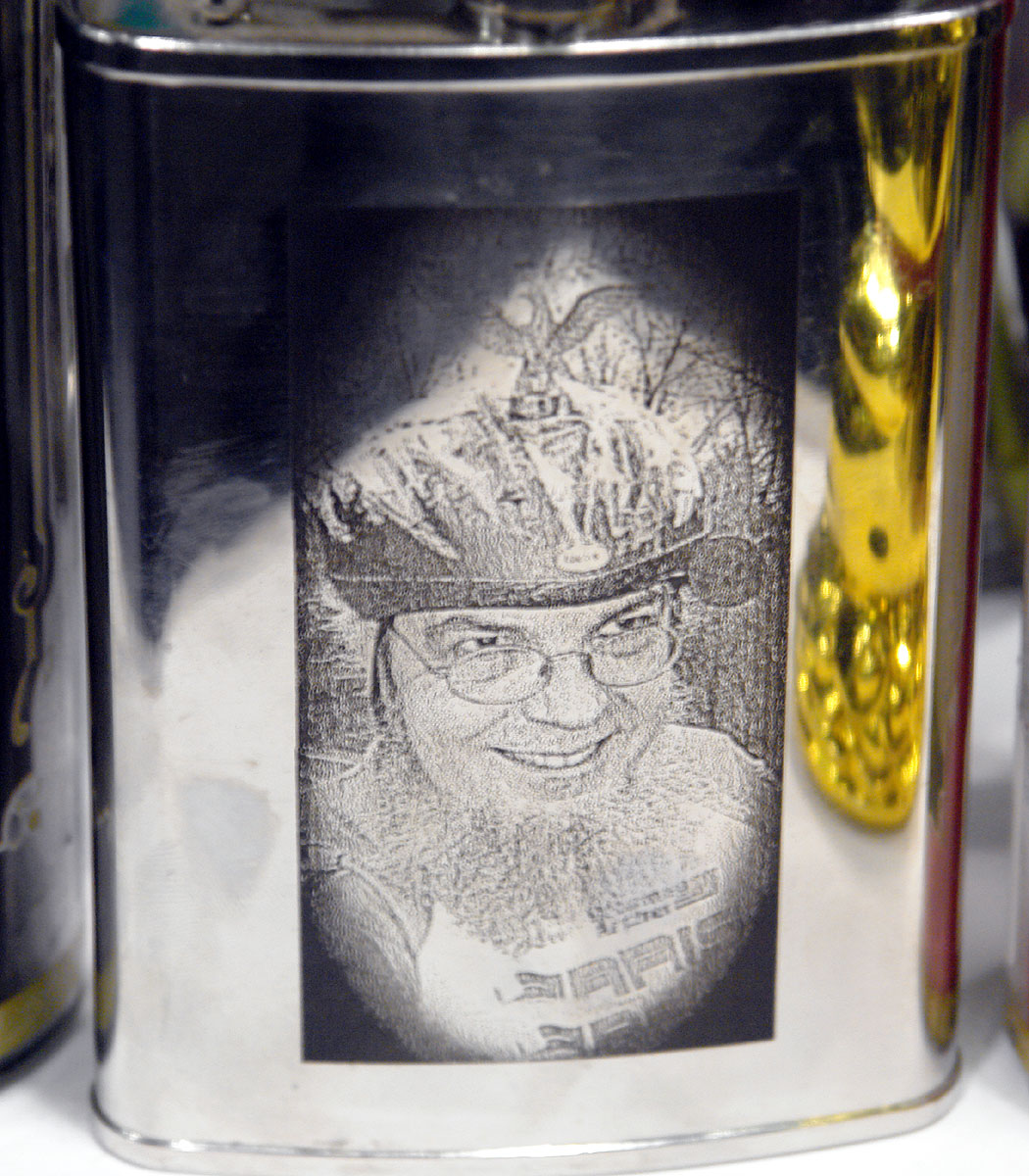
This is an image of Sheldon that Ahearne had engraved on one of their flasks as part of a tribute memorial to him at the North American Handmade Bicycle Show in Portland.
Friday, February 01, 2008
Peak Oil at the Legislature on Monday
Matthew Simmons of Simmons International will address the Minnesota legislature on Monday, February 4 at 1:00 p.m., Room 200 of the State Office Building. He will speak to a joint meeting of the Senate Committee on Energy, Utilities, Technology and Communications and House Energy Finance and Policy Division. His visit is sponsored by Representative Bill Hilty in an effort to move forward a resolution directing the state to plan to meet the challenges of peak oil. The meeting is open to the public and we are encouraged to attend and show legislators they are concerned about this issue.
I like Matt Simmons and have a link to his website over on the right. If you read the Peak Oil sites, you'll find all kinds of attitudes and opinion, some of which can give you the willies. Simmons, an investment banker with long experience specializing in the energy industry, brings a voice that I find informed and reality-based. Not to say that he's reassuring; he thinks the peak may have hit in mid-2005 and we're in the early stages of the production plateau/rising demand with the resulting increase in energy prices. Also, he has been warning about peak natural gas, which is alarming to me since my house is heated with gas.
Simmons has links to many presentations on his site. I particularly like the perspective from his Presentation to his Harvard Business School 40th Reunion (like I said, he's real mainstream)on the history of the energy industry these last four decades.
Anyway, this meeting is open to the public. There are many reasons to ride bicycles, among them their supreme efficiency. They are a simple answer to many complicated problems. If you want to hear about one of these complicated problems from an informed expert, this meeting would be a good one to attend. Having said that, I'm not sure I'll make it, having just been gone three days on a business trip (on which, in an apparent effort to speed up the Peak Oil phenomenon, I was "upgraded" to a Ford Expedition for no additional charge, what a bloated cow of a vehicle that is!) and next week I'm gone after Tuesday, so time is short at work, and I may not make it.
I like Matt Simmons and have a link to his website over on the right. If you read the Peak Oil sites, you'll find all kinds of attitudes and opinion, some of which can give you the willies. Simmons, an investment banker with long experience specializing in the energy industry, brings a voice that I find informed and reality-based. Not to say that he's reassuring; he thinks the peak may have hit in mid-2005 and we're in the early stages of the production plateau/rising demand with the resulting increase in energy prices. Also, he has been warning about peak natural gas, which is alarming to me since my house is heated with gas.
Simmons has links to many presentations on his site. I particularly like the perspective from his Presentation to his Harvard Business School 40th Reunion (like I said, he's real mainstream)on the history of the energy industry these last four decades.
Anyway, this meeting is open to the public. There are many reasons to ride bicycles, among them their supreme efficiency. They are a simple answer to many complicated problems. If you want to hear about one of these complicated problems from an informed expert, this meeting would be a good one to attend. Having said that, I'm not sure I'll make it, having just been gone three days on a business trip (on which, in an apparent effort to speed up the Peak Oil phenomenon, I was "upgraded" to a Ford Expedition for no additional charge, what a bloated cow of a vehicle that is!) and next week I'm gone after Tuesday, so time is short at work, and I may not make it.
Monday, January 21, 2008
Portland on Marketplace
I went down to the Iowa Bicycle Summit in Des Moines this past weekend. The Summit ran Friday and Saturday, so I drove down after work Thursday evening. On the way down, I was listening to NPR and on the Marketplace show and they had a segment called Portland's Support of Bikes Pays Off. It opens thus:
I'll be out sampling the Portland Bicycle Scene in a couple of weeks; I'm taking the Framebuilders Express out to Portland to go to the North American Handmade Bicycle Show. I'm sure Vanilla will be there and the list might be six years by the time the show's done. It's going to be like getting on the list for Green Bay Packers season tickets--you'll need to sign up your unborn offspring.
A couple of items of note from the Iowa Bicycle Summit: Trek is doing an advocacy effort and apparently liked my blog name a lot. They've called theirs One World Two Wheels and have some nice non-Trek-specific advocacy materials. One of the things they wanted to do, but Clif Bar beat them to the punch, is a site like Clif's excellent 2 Mile Challenge, which shows people what's within 2 miles of home, and thus easily rideable. From Trek's point of view, getting more people to ride means selling more bicycles, and addressing the Practical Cycling arena is a way to expand these markets. I'll write more about the Iowa Bicycle Summit tonight or tomorrow.
Imagine San Diego as one big peloton today. Thousands of cyclists are converging there for the Bicycle Leadership Conference. They'll be figuring out how to expand the bicycle market. One obvious answer: get more commuters to ride bikes to work. On that score, Portland, Oregon, is way out front of the pack. According to Bicycling Magazine, the city has the highest number of bike commuters in the country.Apparently there's an Oregon state statute that any story on bicycling in Portland starts with the Zoobombers, and this one conforms. They talks about other companies and even Vanilla Bicycles, which I think are just about the most succulent of the custom frames out there. Ten grand now, and a five-year waiting list. Anyway, it's nice to see bicycles getting a bit o' coverage on a show mostly concerned with larger markets.
I'll be out sampling the Portland Bicycle Scene in a couple of weeks; I'm taking the Framebuilders Express out to Portland to go to the North American Handmade Bicycle Show. I'm sure Vanilla will be there and the list might be six years by the time the show's done. It's going to be like getting on the list for Green Bay Packers season tickets--you'll need to sign up your unborn offspring.
A couple of items of note from the Iowa Bicycle Summit: Trek is doing an advocacy effort and apparently liked my blog name a lot. They've called theirs One World Two Wheels and have some nice non-Trek-specific advocacy materials. One of the things they wanted to do, but Clif Bar beat them to the punch, is a site like Clif's excellent 2 Mile Challenge, which shows people what's within 2 miles of home, and thus easily rideable. From Trek's point of view, getting more people to ride means selling more bicycles, and addressing the Practical Cycling arena is a way to expand these markets. I'll write more about the Iowa Bicycle Summit tonight or tomorrow.
Thursday, January 03, 2008
$100 A Barrel
Was it really less than three years ago that President Bush took a nice romantic hand-holding walk with Crown Prince Abdullah to urge him to keep oil below $50 a barrel?
Yeah, that worked well.
Yesterday, a single oil contract on the New York Mercantile Exchange traded at $100.00 a barrel, and ten more traded at $99.90. That's within spittin' distance of the inflation-adjusted highest price ever of $102.81 a barrel, reached in April 1980. The Journal does a wonderful interactive grahic of this, with the green shading being the inflation-adjusted price. You can see the Journal's graphic here. Maybe Mr. Bush should have let the Prince get to second base.
I think we're in for a tough year or four. Not only are house prices dropping (and the real shitstorm of mortgage problems in the most bubblicious states still lie ahead of us), but plenty of people are eyeball-deep in car payments, too. This article in the L.A. Times called "New Cars That Are Fully-Loaded--With Debt" looks at this problem. Motor vehicles are the most expensive piece of depreciating consumer crap that most of us buy, and more and more people are getting underwater on these loans.
Part of the reason I haven't been blogging as much recently is the usual December Christmas crush and partly because I have spent a lot of time reading on what has been termed the Subprime Crisis but really is a broader credit crisis underlaid by financial institution solvency issues. What can I say, my degree's in Economics, my background is finance, and I like this stuff. If you want to follow along on this, I highly recommend the Calculated Risk blog. Note that this has nothing whatsoever to do with bicycles. If you'd rather hit yourself with a hammer than read about mortgage backed securities servicing agreements, Calculated Risk may not be the spot for you.
Yeah, that worked well.
Yesterday, a single oil contract on the New York Mercantile Exchange traded at $100.00 a barrel, and ten more traded at $99.90. That's within spittin' distance of the inflation-adjusted highest price ever of $102.81 a barrel, reached in April 1980. The Journal does a wonderful interactive grahic of this, with the green shading being the inflation-adjusted price. You can see the Journal's graphic here. Maybe Mr. Bush should have let the Prince get to second base.
I think we're in for a tough year or four. Not only are house prices dropping (and the real shitstorm of mortgage problems in the most bubblicious states still lie ahead of us), but plenty of people are eyeball-deep in car payments, too. This article in the L.A. Times called "New Cars That Are Fully-Loaded--With Debt" looks at this problem. Motor vehicles are the most expensive piece of depreciating consumer crap that most of us buy, and more and more people are getting underwater on these loans.
Part of the reason I haven't been blogging as much recently is the usual December Christmas crush and partly because I have spent a lot of time reading on what has been termed the Subprime Crisis but really is a broader credit crisis underlaid by financial institution solvency issues. What can I say, my degree's in Economics, my background is finance, and I like this stuff. If you want to follow along on this, I highly recommend the Calculated Risk blog. Note that this has nothing whatsoever to do with bicycles. If you'd rather hit yourself with a hammer than read about mortgage backed securities servicing agreements, Calculated Risk may not be the spot for you.
Saturday, December 29, 2007
Cycling Congressman
No, I'm not dead. December is our busiest month and my lightest cycling month of the year. It's also a bit weak on blogging not that the world mourns. I did notice that this weekend's Wall Street Journal has an article about Earl Blumenauer, an Oregon congressman who bicycles everywhere. It's not a common choice among U.S. Representatives. Apparently, the Journal is going to be set free one day soon but for the moment I have printed the article into a PDF file and you can read it here.
Have a Happy New Year!
Sunday, November 04, 2007
Scofflaw
I haven't been blogging much in recent weeks, but thought this was notable. There will be a ribbon cutting for the new Midtown Greenway bridge over Hiawatha on Thursday November 8 from 4 to 6PM. I expect there'll be the usual huge ribbons, oversized scissors and speeches. It's a good moment for the Greenway Coalition and the politicians who supported and funded this. The bridge is really nice.
I can say this from personal experience, as on the way home from church this morning (Karla plays two services, I just sing in the first one and then ride my bicycle home, having taken it on the car to church) Henry and I rode up Bryant and onto the Midtown Greenway. There were signs up along the path about the Thursday grand opening. When we got to the end of the Greenway where it turns right onto the sidewalk to go across Hiawatha you could see the end of the bridge ramp approach with huge TRAIL CLOSED signs. However, there was some guy who'd overtaken us a couple of minutes before riding up there. It didn't look that closed. Signs are for motorists and other losers, let's go take a look. So, Henry and I rode between the two TRAIL CLOSED signs and up the west approach.
It looks really nice, all landscaped now with streetlights in place. It curves up to the big support pole that holds the whole bridge up. There are a couple of benches facing towards this pole, which seems a weird thing to sit and look at. Then, over Hiawatha, across the light rail tracks and swoop back down to the trail on the east side of the street. Other cyclists there were coming up the trail and dutifully queuing up to cross on the crosswalk. I thought about calling out to them and suggesting that they use the bridge, but figured I'd leave that up them, they'll know soon enough.
This is really nice. No more riding on the sidewalk, no more crossing on a crosswalk, just up and over all that traffic. We rode on eastwards to the end, where you can see how wonderful the Short Line bridge would be to cross the Mississippi and connect into Saint Paul, but had to get off and move over to the Lake/Marshall bridge.
Maybe you can't get across during the week if there's lots of construction guys around finishing up work, but on a late Sunday morning there was no problem, and a week from now it will be officially open.
I can say this from personal experience, as on the way home from church this morning (Karla plays two services, I just sing in the first one and then ride my bicycle home, having taken it on the car to church) Henry and I rode up Bryant and onto the Midtown Greenway. There were signs up along the path about the Thursday grand opening. When we got to the end of the Greenway where it turns right onto the sidewalk to go across Hiawatha you could see the end of the bridge ramp approach with huge TRAIL CLOSED signs. However, there was some guy who'd overtaken us a couple of minutes before riding up there. It didn't look that closed. Signs are for motorists and other losers, let's go take a look. So, Henry and I rode between the two TRAIL CLOSED signs and up the west approach.
It looks really nice, all landscaped now with streetlights in place. It curves up to the big support pole that holds the whole bridge up. There are a couple of benches facing towards this pole, which seems a weird thing to sit and look at. Then, over Hiawatha, across the light rail tracks and swoop back down to the trail on the east side of the street. Other cyclists there were coming up the trail and dutifully queuing up to cross on the crosswalk. I thought about calling out to them and suggesting that they use the bridge, but figured I'd leave that up them, they'll know soon enough.
This is really nice. No more riding on the sidewalk, no more crossing on a crosswalk, just up and over all that traffic. We rode on eastwards to the end, where you can see how wonderful the Short Line bridge would be to cross the Mississippi and connect into Saint Paul, but had to get off and move over to the Lake/Marshall bridge.
Maybe you can't get across during the week if there's lots of construction guys around finishing up work, but on a late Sunday morning there was no problem, and a week from now it will be officially open.
Sunday, September 30, 2007
The Education of a Cyclist
I was appointed to the Saint Paul Bicycle Advisory Board last February. A few months in, I can see the frustrations that others have experienced in this sort of capacity. The BAB is a Mayor-appointed committee with members from each of Saint Paul's seven Wards (I'm Ward 5) and a couple of at-large members. There are also representatives from Parks and Recreation, the Police and Public Works. We are to provide public input to the city on bicycle aspects of Saint Paul transportation. Part of the frustration comes from having no budget and no staff and all the power and influence that implies, so nearly all the work we do is volunteer out of our time (a city employee does keep minutes, a Parks and Rec guy works up the agendas). We meet every month and discuss things; how about a bike path on this street? Can we get the path along Shepherd Road repaved, it sucks? Most of these run into a welter of objections, no money, other projects, road widths, neighbour objections, other agencies have jurisdiction, so pipe-dreamy as to be out of the question, so on a month to month basis it's hard to feel like we're accomplishing much.
Others have felt this as well, have served on the BAB for a time then left in frustration or disgust to work other avenues. On the other hand, some things have got done. There are bike lanes painted on Como Ave. now, Share The Road signs have sprung up, there have been a couple of public meetings to solicit bicycle input and the recent heads of the BAB worked up the Bicycle portion of the Saint Paul Transportation plan. Perhaps it's the speed that things move that seems so slow, it's like walking off the end of one of those airport moving sidewalks where you suddenly slow down, like the Star Wars leap to light speed in reverse. You ask for something simple like a resurfacing of an existing bike path that is in bad enough shape that cyclists are returning to the adjacent highway and are met with all the problems, Scenic River Committee plans, DNR involvement, path not up to current design standards, DOT study of additional access points to road and how that will affect the path, some on county land, blah blah blah. All we really want is a six foot-wide path resurfaced, it'll be another 40% more expensive next year, but there's this flak cloud of objections. Perhaps someone sympathetic will get killed and that'll hasten things along, in the meantime the BAB seems like a long and tedious slog in a policital milieu in which I'm not used to operating.
Bike lanes or no bike lanes, I think more people are going to be riding in any case, led along by higher fuel costs and the rising popularity of city bikes, which have been big at last week's Interbike (Quality Bicycle Products just introduced their Civia line which, from the photos currently on the site, apparently include a generator hub but no lights, and I've long been a fan of the Breezer Uptown 8 where they had the guts to spec the Nexus Redband 8-speed Premium hub instead of the heavier Nexus 8 and do include lights along with the generator hub). If it's going to take until 2014 for the studies to be complete before we can commence the planning for the design criteria prior to the RFP to repave this stinking bicycle path then there must be something I can do in the meantime.
So I looked into the League of American Bicyclists League Certified Instructor (LCI) program. There are currently just three active LCIs in Minnesota and the profile of the LAB is so low you could slip it under the door. Not only that, it seems to have been through some turmoil. From what I gather, the LCI program arose from the Effective Cycling work of John Forrester. He's an opinionated guy and holds that cyclists fare best when they act and are treated as drivers of vehicles. Broadly speaking, I agree with this, but in the ways of so many cranky cyclists and the Roman Catholic Church, broadly agreeing isn't quite good enough, and there was some schism in the LAB. I haven't bothered to discern all the fault lines here, but there is a whole website called LAB Reform which goes on about Board actions, copies emails and quotes bylaws. I've been active in churches and charter schools in the past and recognize precisely the sort of self-righteous outrage in this site. When people start quoting bylaws then things have really fallen apart. (Not only have I seen this in churches and schools, but the bicycle-oriented Thunderhead Alliance just chopped their executive director as well, undoubtedly after the requisite internal bitterness) (but not before she got top credit on their new 2007 Benchmarking Report "Bicycling and Walking in the U.S." which I printed out but haven't had time to study yet). The League is apparently trying to restore rigour to the LCI program after a period of what some felt was too simple a qualification (this is hearsay, I don't personally know how the program changed).
The Iowa Bicycle Coalition led by Mark Wyatt wanted to increase bicycle education in Iowa and decided to train some LCIs. This meant having candidates do the Road 1 course, the basic LAB cycling course for adults, and then subsequently do the LCI training which is basically learning how to teach Road 1 and a couple of other classes for Commuters and Kids. I follow the IBC site and noticed the announcement of these classes so pestered Mark long enough and cited my Iowa connections enough that he let me in. Road 1 was in late August. The LCI course was September 21/22/23.
This was actually pretty good. The League's been around since 1880 (as the League of American Wheelmen with a really cool LAW logo rather than the gender-neutral League of American Bicyclists with LAB which sounds like a dopey dog). The LCI course has evolved out of the course they actually called Effective Cycling, which is now a registered trademark of John Forrester.
Some of the materials need updating:

Before riding, perform the ABC Quick Check. Here our rider sights down the chain line. Yep, looks good!

A fundamental skill is to be able to check traffic behind you while riding in a straight line. This also helps communicate with motorists. What do you think this rider is communicating?

Keep a firm grip on the handlebars! Yes, there were some women in the course as well.
[OK, OK, these aren't actually LAB materials. They're from the 1901 Fancy Cycling: Trick Riding for Amateurs by Isabel Marks. And you thought spinning the front wheel on your fixie was cool!]
They have been updating some of it and we were on the cutting edge. When we took the Road 1 course in August (14 or 15 of us versus the 11 in the LCI course) we were shown the old LAB movie. This was from probably 1988 or so and featured a smarmy actor I've never heard of ("Joe Blow, Hollywood star") and such a procession of old bicycles, cars and helmets that it was hard to pay attention to the message (Hey, look, a Pinto!) (I had one of those helmets!) (Jesus, remember those shoes?). The new movie instead has an actress presumably taking an older male friend on a bike ride. This poor actress is stuck with the thankless task of droning out all the Important Points in a way that no real humans ever speak to each other ("But Bob, you should wear a helmet whenever you ride and it should be level on your head with the straps properly positioned and snug around your chin" instead of what we'd really say, something like "Hey idiot, where's your helmet?"). This guy rides so little he has to clear a levee of flotsam out of the way to get his bike out but she wreaks her revenge by apparently taking him on some 80-mile multi-hour ride, whining all the way ("But Bob, you should signal your right turn by holding your left arm out bent up 90 degrees at the elbow although in some states it is now legal to signal by pointing right with the right arm so you should check your state laws and local ordinances"). Oh the whole, the new movie is a lot better than the old one but after a while I'd want to extend my left arm out, knock her over and make a run for it.
The LCI training ran 3-8 on Friday, 8-9 on Saturday (and I don't mean 1 hour) and 8-6 on Sunday. Some of it was classroom work, discussing learning styles and how to address them, various exercises. Much of Saturday morning was each of us doing a 10-minute presentation on an assigned topic. My buddy Paul from Cedar Rapids (who had independently arrived at the idea of doing this class) got the thankless task of explaining gearing and derailleur adjustments but my Atlantis saved the day due to the wondrous SKS/ESGE/Pletscher two-legged kickstand which, due to some quirk of geometry on that bike, clears the crank arms completely. Paul put the bike up on the table and demonstrated this stuff right in front of us, the huge bike towering over the class as he showed the derailleurs shifting and adjusted my cables out of whack ("This is what it sounds like when the derailleur is badly adjusted" he'd say, twiddling away at my barrel adjuster). Others had to do their units on lane positioning, safety statistics, brake adjustment and operation, helmet fit and changing a flat tire. Mine was clothing and accessories, which was funny because I hadn't really packed thoughtfully ahead of time so brought most everything cycling-related at the last minute. I showed off my Bell Metro helmet with its mirror, gloves, the always-impressive Rainlegs Assless Bike Chaps, SPD shoes, legendary Jong Won JSB-500 water bottle, Carradice Nelson Longflap with Nitto Quick Release, panniers, Ortlieb front bag, wool jerseys, etc. My presentation was a modest hit.
That afternoon we went out to work out the outdoor parking lot units. There are some basic skills the LAB teaches; a Quick Turn (especially useful when someone tries to Right Hook you and you use it to turn inside them, and taught as countersteering in the Motorcycle Safety Foundation classes), the Panic Stop (emphasizing the front brake and shifting your weight backwards to keep from going over the bars and helping the rear wheel to maintain traction) and the Rock Dodge (that quick wheel twitch you do to miss a rock without actually changing the overall direction of the bike). To experienced cyclists, these seem pretty straightforward, but to a lot of people, it's new ground. The Road 1 course has you set up these obstacles in a parking lot using tennis balls cut in two and running people through them. Here are some of the parking lot scenes from Saturday afternoon and Sunday morning.

Carl returns to the start of one of the exercises. It was getting late and we actually managed to talk a pizza shop into delivering $80 worth of pizza to a parking lot at the corner of Third and Locust.

Zac's a Transportation Planner, Angela is an ex-state-trooper, Legislative Ombudsman and Des Moines's Bike to Work Program Director.

These folding bikes can look a bit daft but Paul rode his 140 miles over from Cedar Rapids.

Sunday morning we did the parking lot exercises for the Kids classes. Here Donnie and Zac compete in the always-popular slow race. You don't do this in Road 1.

Lori and Tina line up for the Quick Turn exercise. Tina didn't learn to ride a bicycle until she was 30.

Dan Ring doing well slow-riding on his Bike Friday. Iowa Bicycle Coaltion head Mark Wyatt is in the background.

The long time frames in the Saint Paul BAB look horrendous when viewed at the start, but we left Des Moines in 1994 to take a job in Minneapolis and they were talking then about the renovation of the East Side of downtown to be done in the unimaginably distant 2008 or something, and, well, here we are, the East Village (as they call it) is hopping, they have way more bicycle parking than, say, the Saint Paul Farmers Market (a shining symbol of the BAB's power!) and publicly-provided dog poop bags! No shit!
We'd each do our presentation, whether inside or out in the parking lot, then John Rider, the instructor, would ask us what we thought went well and what didn't, and the other LCI students would critique the presentation. We were getting to know each other pretty well; several of the Iowans already know each other, and we'd all done Road 1 in a day in August and were now in the midst of three days of the LCI class. This exercise was actually pretty useful, and made us think about and rapidly improve the way we talked, where we stood, the instructions we gave. It was particularly fun Sunday morning when we were instructed to act like 7th graders and responded with a welter of "Donnie farted!" and bicycle insults. Wait--bicycle insults sounds like 30-year-olds.
The last thing Saturday night was the night gear test, where we all rode to a dark path by the river and rode up and down the trail one at a time both with and without headlights shining on us to see how our reflectors and lights looked. This was illuminating har har. Sunday afternoon we did the road test, where in two groups we went out and did a 7 mile ride, alternately leading the group through a variety of traffic obstacles. It was surprisingly hot and very windy out.
There was a debriefing with John. Carl went first; he lived closest by, but a friend's 23-year-old daughter had been killed in a car crash and visitation was at six. Paul and I went next, as we were driving the furthest (Paul came to Saint Paul overnight, then took his Bike Friday on Amtrak the next morning to Washington DC and Cape Cod to visit a couple of his sisters). I noted to John that the League and the LCI program seemed a bit in transition and that they should get their act together. I pointed out a number of nagging errors in the text and a couple of stupid and even hilarious typos. Fundamentally, the set program of instruction, the base skills, the overall message was really good, but it is quickly undermined by mistakes or inconsistencies in the materials. If you're going to hold yourself out as the authority on bicycle education, the materials have to be excellent and error-free and the message consistent. It looks like the League is working on this; the parking lot drills instruction handout was very well done and new within the past month, and the video of the woman whining at Bob was much better than the old "hey look at that" one from the 1980s. Paul did his debrief as well, and we headed back to Saint Paul, pulling in right at eleven.

The traditional class shot, by some passer-by on Mark Wyatt's camera. Left to right you can see John Rider, League of American Bicyclists Regional Trainer (from Madison) and our teacher; Angela Dalton, Des Moines Bike to Work Program Director; Daniel Ring from Muscatine who I don't think has any official capacity but who I believe has commuted since the 1960s; Lori Leporte, Past President of the Des Moines Cycle Club and on the Board of Directors of the Iowa Bicycle Coalition; my old chum Paul Salamon from Cedar Rapids, who has no official cycling capacity but has ridden for ages; Tina Mowbry of Altoona; Mark Wyatt of the Iowa Bicycle Coaltion, who organized this training and who I believe also runs the Iowa Bike Summit (next one in January 2008); Mike, a consulting engineer from Des Moines; Carl Voss, who among other things serves on the Des Moines Trails and Greenways (TAG) Advisory Committee; me, of the famous Saint Paul Bicycle Advisory Board (which has basically no web presence); Zac Bitting, Transportation Planner for the Des Moines Area Metropolitan Planning Organization; and Donnie Miller, who owns Donnie's Indoor Cycling Experience in Moline, Illinois, is the Safety and Education Director for the Quad Cities Bicycle Club and is the Coach and Vice President for the Double "I" Cycling Experience Racing Team. Part of the fun of the weekend was all the riding styles; Donnie was very much the racer, Zac a mountain biker and a couple of these folks are big recumbent riders but went conventional for this course.
So once the paperwork clears, we'll all be LCIs, and eligible to buy the cool Instructor jerseys. I'll be the fourth active one in Minnesota though I have no doubt there have been others over the years who have drifted away or lost interest or gotten pissed at or disgusted with the LAB or one thing or another. I'm not sure if it's a widespread phenomenon, but two of the participants mentioned that there were local LCIs in their areas already but that they were such unpleasant old coots that people didn't like to use them any more. Perhaps it's healthy to have some new LCIs coming in who are agnostic on the old battles. I think there is some prestige among LCIs in having low numbers and mine of course will be unfashionably lofty (though, I'm hoping due to last-name order that it'll be lower than my buddy Paul's!) but in at least a couple of cases it sounds like a bit of fresh and friendly blood is just what's needed. I'm not entirely sure what I'm going to do with my LCI; contact the other ones to start with, I guess, to see see if they have any Road 1 plans. I do see a lot of need for training. In fact, I came up with a slogan:
They say you never forget how to ride a bicycle.
Actually, a lot of people never really learn.
Suddenly more sensitized to it, I see idiocy and incompetence all around. Yesterday, Saturday, I was at a ribbon cutting for the Lilydale Regional Trail extension, it was Saint Paul Mayor Chris Coleman and U.S. Representative Betty McCollum and speeches and thanks all around and a green ribbon and a huge pair of scissors, the culmination of some political, planning and funding process that stretched back God only knows how far, and while we're there some guy rides up and asks to get through and he has his helmet on backwards. Then last night, coming home from a chamber concert at church just after 10, a cyclist cuts left from the right hand side of the road across the cars starting off as the light turns green and across the intersection and off to the left. One of the cars honks at him, as well it should, it was an idiotic move, and the cyclist flips him off as he rides lightless down Lyndale. I didn't correct the helmet doofus (he looked like maybe he meant it and would regale you with 10 minutes of theory why, or that he wouldn't take kindly to having such a public error pointed out) or chase down the lightless idiot left-turner, I could puff up my chest all I want and say I'm an LCI, but that and $3.31 will get you a latte at Caribou. I also doubt that either backwards helmet-man or lightless flipper offer would take a Road 1 course, but perhaps there are people out there who would like to learn how to operate in traffic and to whom we can transfer the knowledge and training needed to give it a try and get out there. In the end, the best argument we have for bike lanes, bike bridges and bike parking will be more bicycles, and, as I said waaaay back at the beginning, maybe this LCI thing will be a channel to work on the training part while in the BAB I nudge and wheedle on the facilities bits.
[Want to join the LAB? Besides this education stuff, they also lobby on behalf of bicyclists in Washington DC. If you join using this link I get credit for it! In what is sure to be a popular move among Local Bike Shops, every person who joins gets me a discount coupon for Performance; every three get me a chance to win a bicycle in a raffle. These prizes don't mean much to me; I've never ordered from Performance and the bicycle is undoubtedly not made in my size, but having a voice in Washington can't hurt. Give it some thought.]
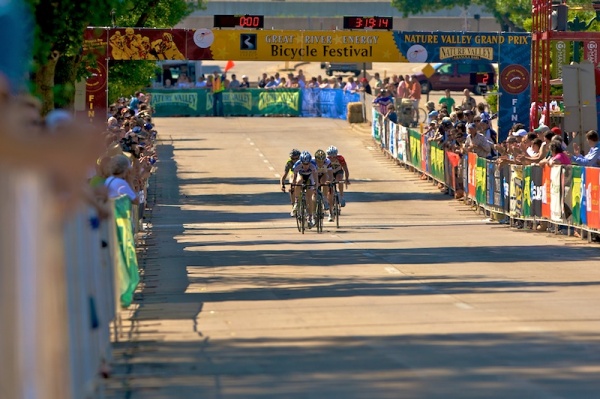
Others have felt this as well, have served on the BAB for a time then left in frustration or disgust to work other avenues. On the other hand, some things have got done. There are bike lanes painted on Como Ave. now, Share The Road signs have sprung up, there have been a couple of public meetings to solicit bicycle input and the recent heads of the BAB worked up the Bicycle portion of the Saint Paul Transportation plan. Perhaps it's the speed that things move that seems so slow, it's like walking off the end of one of those airport moving sidewalks where you suddenly slow down, like the Star Wars leap to light speed in reverse. You ask for something simple like a resurfacing of an existing bike path that is in bad enough shape that cyclists are returning to the adjacent highway and are met with all the problems, Scenic River Committee plans, DNR involvement, path not up to current design standards, DOT study of additional access points to road and how that will affect the path, some on county land, blah blah blah. All we really want is a six foot-wide path resurfaced, it'll be another 40% more expensive next year, but there's this flak cloud of objections. Perhaps someone sympathetic will get killed and that'll hasten things along, in the meantime the BAB seems like a long and tedious slog in a policital milieu in which I'm not used to operating.
Bike lanes or no bike lanes, I think more people are going to be riding in any case, led along by higher fuel costs and the rising popularity of city bikes, which have been big at last week's Interbike (Quality Bicycle Products just introduced their Civia line which, from the photos currently on the site, apparently include a generator hub but no lights, and I've long been a fan of the Breezer Uptown 8 where they had the guts to spec the Nexus Redband 8-speed Premium hub instead of the heavier Nexus 8 and do include lights along with the generator hub). If it's going to take until 2014 for the studies to be complete before we can commence the planning for the design criteria prior to the RFP to repave this stinking bicycle path then there must be something I can do in the meantime.
So I looked into the League of American Bicyclists League Certified Instructor (LCI) program. There are currently just three active LCIs in Minnesota and the profile of the LAB is so low you could slip it under the door. Not only that, it seems to have been through some turmoil. From what I gather, the LCI program arose from the Effective Cycling work of John Forrester. He's an opinionated guy and holds that cyclists fare best when they act and are treated as drivers of vehicles. Broadly speaking, I agree with this, but in the ways of so many cranky cyclists and the Roman Catholic Church, broadly agreeing isn't quite good enough, and there was some schism in the LAB. I haven't bothered to discern all the fault lines here, but there is a whole website called LAB Reform which goes on about Board actions, copies emails and quotes bylaws. I've been active in churches and charter schools in the past and recognize precisely the sort of self-righteous outrage in this site. When people start quoting bylaws then things have really fallen apart. (Not only have I seen this in churches and schools, but the bicycle-oriented Thunderhead Alliance just chopped their executive director as well, undoubtedly after the requisite internal bitterness) (but not before she got top credit on their new 2007 Benchmarking Report "Bicycling and Walking in the U.S." which I printed out but haven't had time to study yet). The League is apparently trying to restore rigour to the LCI program after a period of what some felt was too simple a qualification (this is hearsay, I don't personally know how the program changed).
The Iowa Bicycle Coalition led by Mark Wyatt wanted to increase bicycle education in Iowa and decided to train some LCIs. This meant having candidates do the Road 1 course, the basic LAB cycling course for adults, and then subsequently do the LCI training which is basically learning how to teach Road 1 and a couple of other classes for Commuters and Kids. I follow the IBC site and noticed the announcement of these classes so pestered Mark long enough and cited my Iowa connections enough that he let me in. Road 1 was in late August. The LCI course was September 21/22/23.
This was actually pretty good. The League's been around since 1880 (as the League of American Wheelmen with a really cool LAW logo rather than the gender-neutral League of American Bicyclists with LAB which sounds like a dopey dog). The LCI course has evolved out of the course they actually called Effective Cycling, which is now a registered trademark of John Forrester.
Some of the materials need updating:
Before riding, perform the ABC Quick Check. Here our rider sights down the chain line. Yep, looks good!
A fundamental skill is to be able to check traffic behind you while riding in a straight line. This also helps communicate with motorists. What do you think this rider is communicating?
Keep a firm grip on the handlebars! Yes, there were some women in the course as well.
[OK, OK, these aren't actually LAB materials. They're from the 1901 Fancy Cycling: Trick Riding for Amateurs by Isabel Marks. And you thought spinning the front wheel on your fixie was cool!]
They have been updating some of it and we were on the cutting edge. When we took the Road 1 course in August (14 or 15 of us versus the 11 in the LCI course) we were shown the old LAB movie. This was from probably 1988 or so and featured a smarmy actor I've never heard of ("Joe Blow, Hollywood star") and such a procession of old bicycles, cars and helmets that it was hard to pay attention to the message (Hey, look, a Pinto!) (I had one of those helmets!) (Jesus, remember those shoes?). The new movie instead has an actress presumably taking an older male friend on a bike ride. This poor actress is stuck with the thankless task of droning out all the Important Points in a way that no real humans ever speak to each other ("But Bob, you should wear a helmet whenever you ride and it should be level on your head with the straps properly positioned and snug around your chin" instead of what we'd really say, something like "Hey idiot, where's your helmet?"). This guy rides so little he has to clear a levee of flotsam out of the way to get his bike out but she wreaks her revenge by apparently taking him on some 80-mile multi-hour ride, whining all the way ("But Bob, you should signal your right turn by holding your left arm out bent up 90 degrees at the elbow although in some states it is now legal to signal by pointing right with the right arm so you should check your state laws and local ordinances"). Oh the whole, the new movie is a lot better than the old one but after a while I'd want to extend my left arm out, knock her over and make a run for it.
The LCI training ran 3-8 on Friday, 8-9 on Saturday (and I don't mean 1 hour) and 8-6 on Sunday. Some of it was classroom work, discussing learning styles and how to address them, various exercises. Much of Saturday morning was each of us doing a 10-minute presentation on an assigned topic. My buddy Paul from Cedar Rapids (who had independently arrived at the idea of doing this class) got the thankless task of explaining gearing and derailleur adjustments but my Atlantis saved the day due to the wondrous SKS/ESGE/Pletscher two-legged kickstand which, due to some quirk of geometry on that bike, clears the crank arms completely. Paul put the bike up on the table and demonstrated this stuff right in front of us, the huge bike towering over the class as he showed the derailleurs shifting and adjusted my cables out of whack ("This is what it sounds like when the derailleur is badly adjusted" he'd say, twiddling away at my barrel adjuster). Others had to do their units on lane positioning, safety statistics, brake adjustment and operation, helmet fit and changing a flat tire. Mine was clothing and accessories, which was funny because I hadn't really packed thoughtfully ahead of time so brought most everything cycling-related at the last minute. I showed off my Bell Metro helmet with its mirror, gloves, the always-impressive Rainlegs Assless Bike Chaps, SPD shoes, legendary Jong Won JSB-500 water bottle, Carradice Nelson Longflap with Nitto Quick Release, panniers, Ortlieb front bag, wool jerseys, etc. My presentation was a modest hit.
That afternoon we went out to work out the outdoor parking lot units. There are some basic skills the LAB teaches; a Quick Turn (especially useful when someone tries to Right Hook you and you use it to turn inside them, and taught as countersteering in the Motorcycle Safety Foundation classes), the Panic Stop (emphasizing the front brake and shifting your weight backwards to keep from going over the bars and helping the rear wheel to maintain traction) and the Rock Dodge (that quick wheel twitch you do to miss a rock without actually changing the overall direction of the bike). To experienced cyclists, these seem pretty straightforward, but to a lot of people, it's new ground. The Road 1 course has you set up these obstacles in a parking lot using tennis balls cut in two and running people through them. Here are some of the parking lot scenes from Saturday afternoon and Sunday morning.
Carl returns to the start of one of the exercises. It was getting late and we actually managed to talk a pizza shop into delivering $80 worth of pizza to a parking lot at the corner of Third and Locust.
Zac's a Transportation Planner, Angela is an ex-state-trooper, Legislative Ombudsman and Des Moines's Bike to Work Program Director.
These folding bikes can look a bit daft but Paul rode his 140 miles over from Cedar Rapids.
Sunday morning we did the parking lot exercises for the Kids classes. Here Donnie and Zac compete in the always-popular slow race. You don't do this in Road 1.
Lori and Tina line up for the Quick Turn exercise. Tina didn't learn to ride a bicycle until she was 30.
Dan Ring doing well slow-riding on his Bike Friday. Iowa Bicycle Coaltion head Mark Wyatt is in the background.
The long time frames in the Saint Paul BAB look horrendous when viewed at the start, but we left Des Moines in 1994 to take a job in Minneapolis and they were talking then about the renovation of the East Side of downtown to be done in the unimaginably distant 2008 or something, and, well, here we are, the East Village (as they call it) is hopping, they have way more bicycle parking than, say, the Saint Paul Farmers Market (a shining symbol of the BAB's power!) and publicly-provided dog poop bags! No shit!
We'd each do our presentation, whether inside or out in the parking lot, then John Rider, the instructor, would ask us what we thought went well and what didn't, and the other LCI students would critique the presentation. We were getting to know each other pretty well; several of the Iowans already know each other, and we'd all done Road 1 in a day in August and were now in the midst of three days of the LCI class. This exercise was actually pretty useful, and made us think about and rapidly improve the way we talked, where we stood, the instructions we gave. It was particularly fun Sunday morning when we were instructed to act like 7th graders and responded with a welter of "Donnie farted!" and bicycle insults. Wait--bicycle insults sounds like 30-year-olds.
The last thing Saturday night was the night gear test, where we all rode to a dark path by the river and rode up and down the trail one at a time both with and without headlights shining on us to see how our reflectors and lights looked. This was illuminating har har. Sunday afternoon we did the road test, where in two groups we went out and did a 7 mile ride, alternately leading the group through a variety of traffic obstacles. It was surprisingly hot and very windy out.
There was a debriefing with John. Carl went first; he lived closest by, but a friend's 23-year-old daughter had been killed in a car crash and visitation was at six. Paul and I went next, as we were driving the furthest (Paul came to Saint Paul overnight, then took his Bike Friday on Amtrak the next morning to Washington DC and Cape Cod to visit a couple of his sisters). I noted to John that the League and the LCI program seemed a bit in transition and that they should get their act together. I pointed out a number of nagging errors in the text and a couple of stupid and even hilarious typos. Fundamentally, the set program of instruction, the base skills, the overall message was really good, but it is quickly undermined by mistakes or inconsistencies in the materials. If you're going to hold yourself out as the authority on bicycle education, the materials have to be excellent and error-free and the message consistent. It looks like the League is working on this; the parking lot drills instruction handout was very well done and new within the past month, and the video of the woman whining at Bob was much better than the old "hey look at that" one from the 1980s. Paul did his debrief as well, and we headed back to Saint Paul, pulling in right at eleven.
The traditional class shot, by some passer-by on Mark Wyatt's camera. Left to right you can see John Rider, League of American Bicyclists Regional Trainer (from Madison) and our teacher; Angela Dalton, Des Moines Bike to Work Program Director; Daniel Ring from Muscatine who I don't think has any official capacity but who I believe has commuted since the 1960s; Lori Leporte, Past President of the Des Moines Cycle Club and on the Board of Directors of the Iowa Bicycle Coalition; my old chum Paul Salamon from Cedar Rapids, who has no official cycling capacity but has ridden for ages; Tina Mowbry of Altoona; Mark Wyatt of the Iowa Bicycle Coaltion, who organized this training and who I believe also runs the Iowa Bike Summit (next one in January 2008); Mike, a consulting engineer from Des Moines; Carl Voss, who among other things serves on the Des Moines Trails and Greenways (TAG) Advisory Committee; me, of the famous Saint Paul Bicycle Advisory Board (which has basically no web presence); Zac Bitting, Transportation Planner for the Des Moines Area Metropolitan Planning Organization; and Donnie Miller, who owns Donnie's Indoor Cycling Experience in Moline, Illinois, is the Safety and Education Director for the Quad Cities Bicycle Club and is the Coach and Vice President for the Double "I" Cycling Experience Racing Team. Part of the fun of the weekend was all the riding styles; Donnie was very much the racer, Zac a mountain biker and a couple of these folks are big recumbent riders but went conventional for this course.
So once the paperwork clears, we'll all be LCIs, and eligible to buy the cool Instructor jerseys. I'll be the fourth active one in Minnesota though I have no doubt there have been others over the years who have drifted away or lost interest or gotten pissed at or disgusted with the LAB or one thing or another. I'm not sure if it's a widespread phenomenon, but two of the participants mentioned that there were local LCIs in their areas already but that they were such unpleasant old coots that people didn't like to use them any more. Perhaps it's healthy to have some new LCIs coming in who are agnostic on the old battles. I think there is some prestige among LCIs in having low numbers and mine of course will be unfashionably lofty (though, I'm hoping due to last-name order that it'll be lower than my buddy Paul's!) but in at least a couple of cases it sounds like a bit of fresh and friendly blood is just what's needed. I'm not entirely sure what I'm going to do with my LCI; contact the other ones to start with, I guess, to see see if they have any Road 1 plans. I do see a lot of need for training. In fact, I came up with a slogan:
They say you never forget how to ride a bicycle.
Actually, a lot of people never really learn.
Suddenly more sensitized to it, I see idiocy and incompetence all around. Yesterday, Saturday, I was at a ribbon cutting for the Lilydale Regional Trail extension, it was Saint Paul Mayor Chris Coleman and U.S. Representative Betty McCollum and speeches and thanks all around and a green ribbon and a huge pair of scissors, the culmination of some political, planning and funding process that stretched back God only knows how far, and while we're there some guy rides up and asks to get through and he has his helmet on backwards. Then last night, coming home from a chamber concert at church just after 10, a cyclist cuts left from the right hand side of the road across the cars starting off as the light turns green and across the intersection and off to the left. One of the cars honks at him, as well it should, it was an idiotic move, and the cyclist flips him off as he rides lightless down Lyndale. I didn't correct the helmet doofus (he looked like maybe he meant it and would regale you with 10 minutes of theory why, or that he wouldn't take kindly to having such a public error pointed out) or chase down the lightless idiot left-turner, I could puff up my chest all I want and say I'm an LCI, but that and $3.31 will get you a latte at Caribou. I also doubt that either backwards helmet-man or lightless flipper offer would take a Road 1 course, but perhaps there are people out there who would like to learn how to operate in traffic and to whom we can transfer the knowledge and training needed to give it a try and get out there. In the end, the best argument we have for bike lanes, bike bridges and bike parking will be more bicycles, and, as I said waaaay back at the beginning, maybe this LCI thing will be a channel to work on the training part while in the BAB I nudge and wheedle on the facilities bits.
[Want to join the LAB? Besides this education stuff, they also lobby on behalf of bicyclists in Washington DC. If you join using this link I get credit for it! In what is sure to be a popular move among Local Bike Shops, every person who joins gets me a discount coupon for Performance; every three get me a chance to win a bicycle in a raffle. These prizes don't mean much to me; I've never ordered from Performance and the bicycle is undoubtedly not made in my size, but having a voice in Washington can't hurt. Give it some thought.]
Subscribe to:
Posts (Atom)